Star Trek: Discovery Season 4 – new trailer analysis

Spoiler Warning: There are spoilers ahead for Star Trek: Discovery Seasons 1-3 and the trailers for Season 4. Minor spoilers may also be present for other iterations of the Star Trek franchise.

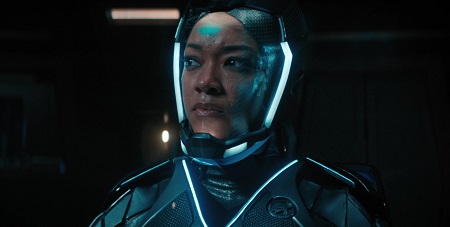
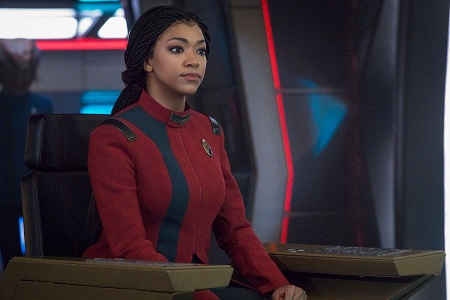
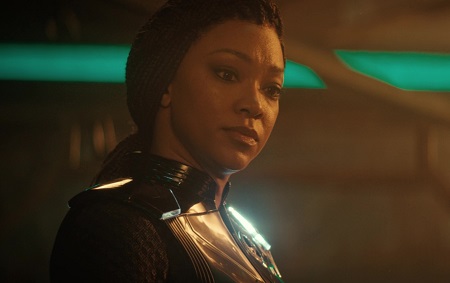
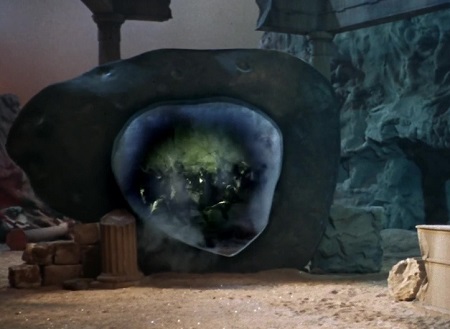
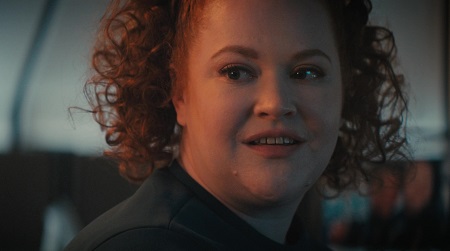
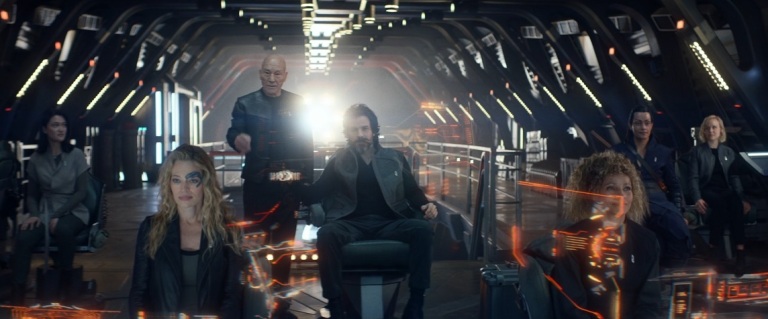
As many folks had predicted, 2021’s New York Comic-Con saw a brand-new trailer for Star Trek: Discovery’s impending fourth season make its debut! The trailer was certainly jam-packed with action and plenty of teases, and gave us a tantalising glimpse of the “gravitational anomaly” that seems to be at the core of the main storyline. Though there will almost certainly be smaller sub-plots and one-off stories like last season, the trailer mostly focused on Captain Burnham and the crew’s attempts to tackle the unknown anomaly.

First of all, none of the theories that I posited a few months ago about the nature of the gravitational anomaly now seem to be anywhere close to plausible! I had a feeling that this would be the case; that Discovery would once again create something wholly new rather than rely on a phenomenon we’d seen in a past iteration of the franchise.

Discovery is coming back in just over a month!

Captain Burnham was heard in the trailer telling her crew that the anomaly was unlike anything the galaxy had ever seen, and that once they “enter” it, they will be literally going “where no one has gone before.” I appreciated the callback to the line heard over the opening titles of The Original Series and The Next Generation – it’s a line which encapsulates Star Trek’s spirit of exploration with a side of adventure, and to me the use of that phrase represents Discovery staking its claim to be the successor of those exploration-focused shows.

Between what Burnham and Stamets had to say about the newness and unknown nature of the anomaly, we can seemingly rule out any connection to things like the Nexus, a graviton ellipse, and Tyken’s rift – as well as anything else we’ve seen before in Star Trek. That isn’t to say there categorically will not be any connection to other Star Trek stories, but that the anomaly itself will be something altogether new.

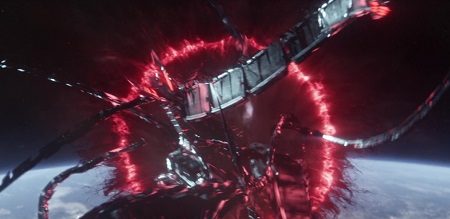
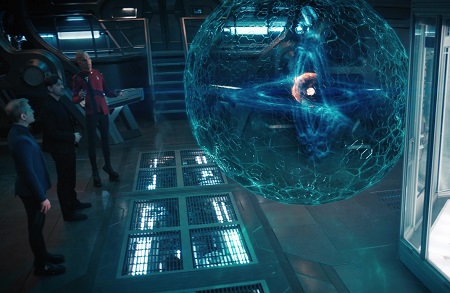
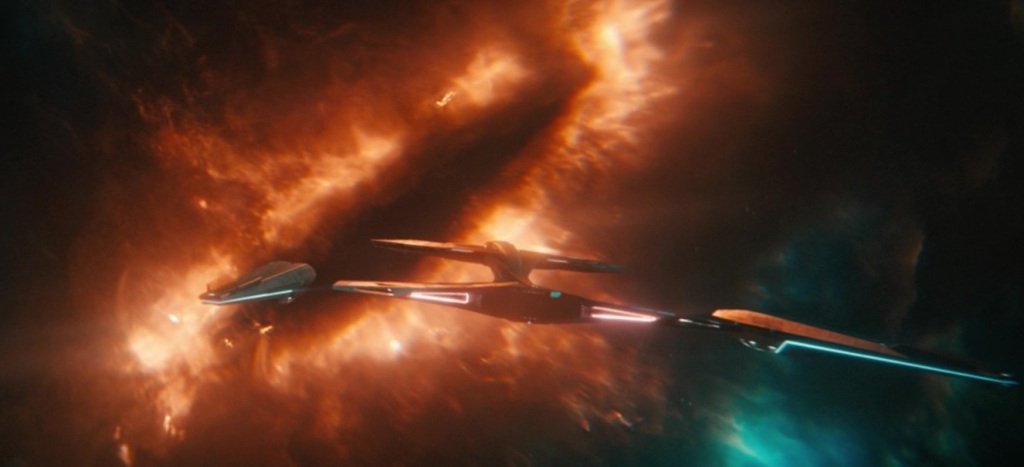
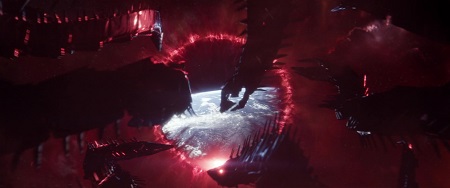
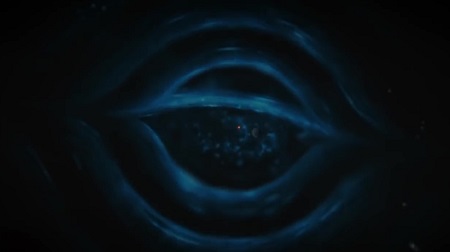
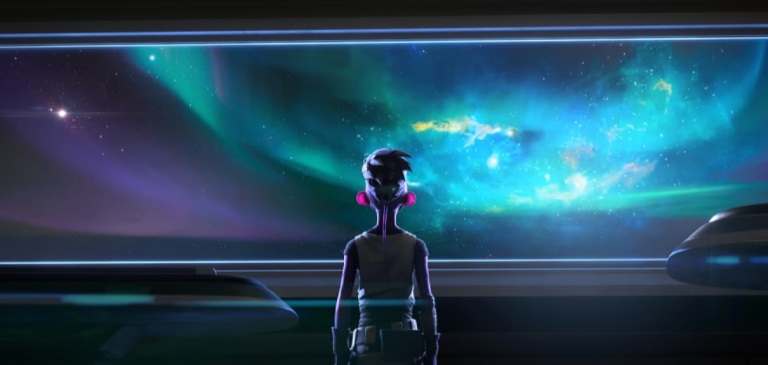
A beautiful CGI shot of the anomaly.

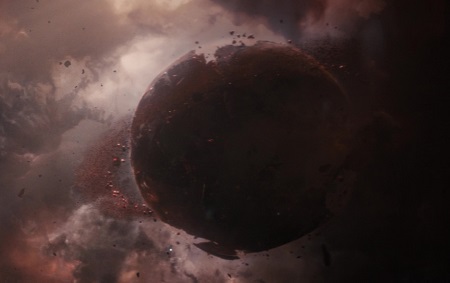
As mentioned, we got a couple of glimpses of what seems to be the anomaly itself. The first time we saw it it seemed to resemble a black hole within a black hole within a black hole… a kind of recursive black hole phenomenon. Discovery’s second season showed off a great recreation of a black hole (that was actually a Talosian illusion) and while the anomaly seen at the beginning of the trailer was different, especially in terms of colour, the design is comparable.

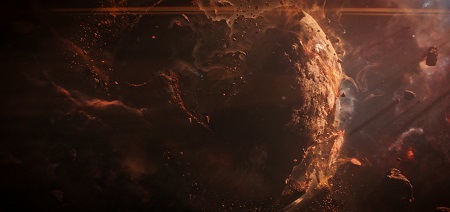
The second time we saw the anomaly in the trailer it looked very different, as though a “rip” or “tear” in the fabric of the universe, surrounded by glowing light but appearing as a dark smear. Unlike the black hole-inspired visual effect seen near the beginning of the trailer, this second look at the anomaly didn’t feature the same light-bending effect, nor was anything inside the anomaly visible.

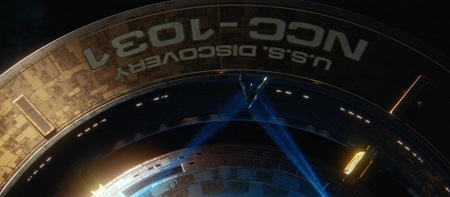
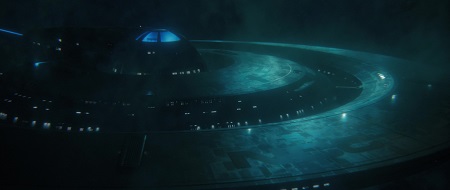
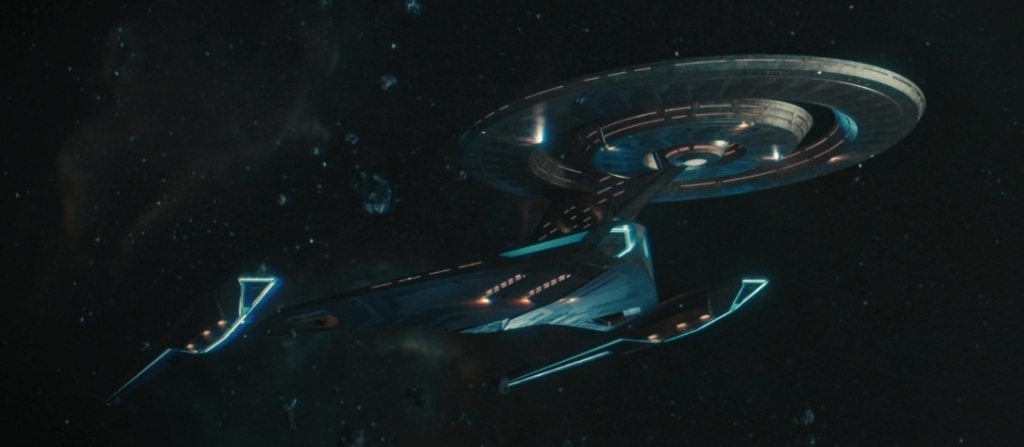
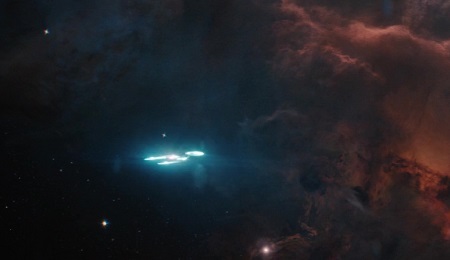
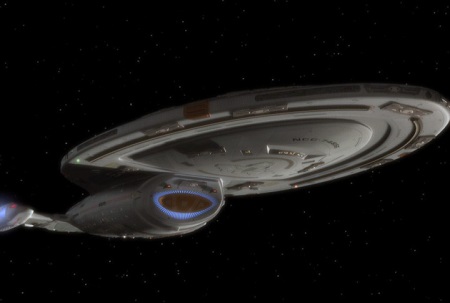
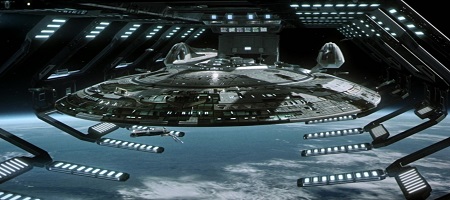
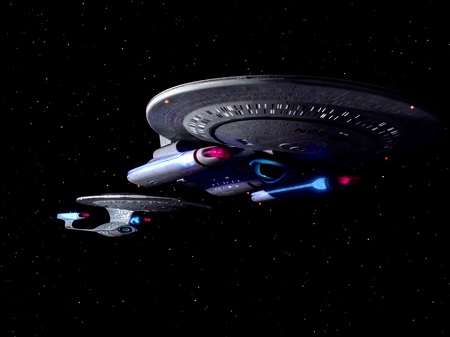
The USS Discovery approaches the anomaly.

Of the two depictions that seem to be of the anomaly – assuming that they are, in fact, both supposed to represent the phenomenon – the first black hole-esque look is, from purely an aesthetic standpoint, my favourite. It was more memorable and different, and the way the anomaly bent light around it seems more in line with its stated gravitational effects. The “dark smear” was fine – but it wasn’t particularly visually exciting, and could have represented any one of dozens of anomalies seen in past iterations of Star Trek.

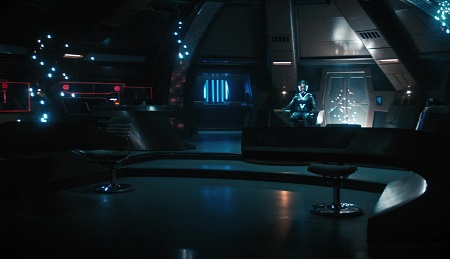
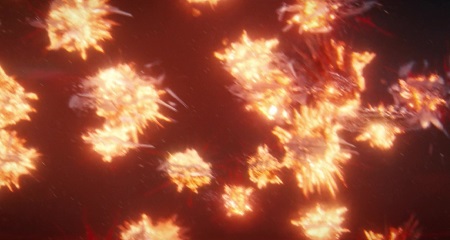
There were some short sequences that could be taking place on the other side of the anomaly, depending on how we view things. There seemed to be glimpses of characters fighting with swords, a large explosion, a forest that looked a lot like Su’Kal’s holographic world, and a child in a forest that could all be taking place after the USS Discovery enters the anomaly. We’ve seen parallel universes and different dimensions in Star Trek on a number of occasions, and I wonder if this anomaly could be the gateway to a different dimension once again.

Could this be on the “other side?”

But that’s enough story speculation for now! We won’t know more about the gravitational anomaly until the season kicks off in just over a month’s time, so let’s take a look at some of the other imagery from the trailer to see what else we can discover.

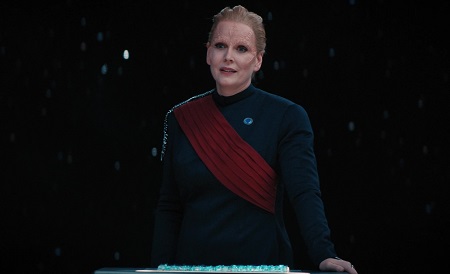
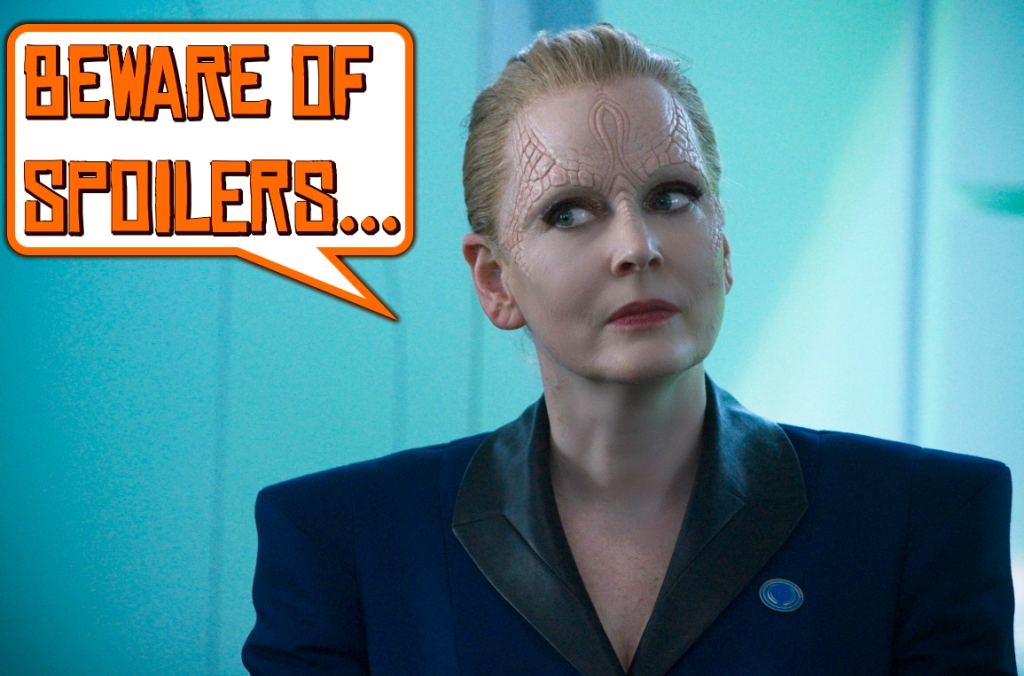
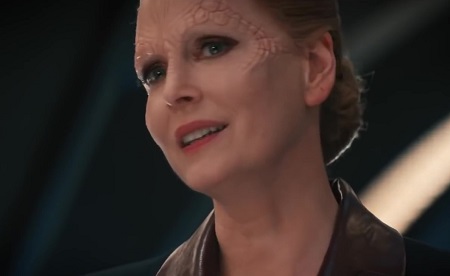
Firstly, it looks as though Ni’Var – the new name for Vulcan since the reunification of Romulans and Vulcans – will indeed rejoin the Federation. A brief scene showed the Federation president – a character identified during the Comic-Con panel as a part-Cardassian, part-Bajoran, part-human character named Rillak – presenting the leader of Ni’Var with a folded Federation flag. This was something teased during the epilogue of Season 3, with Saru’s diplomatic initiatives seeming to bear fruit.

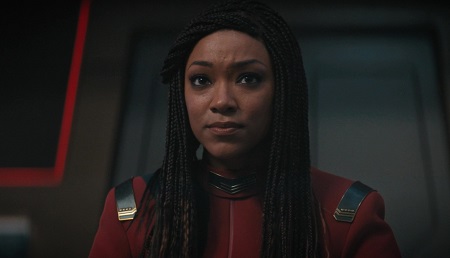
Captain Burnham looks on as the Federation President gives a flag to the leader of Ni’Var.

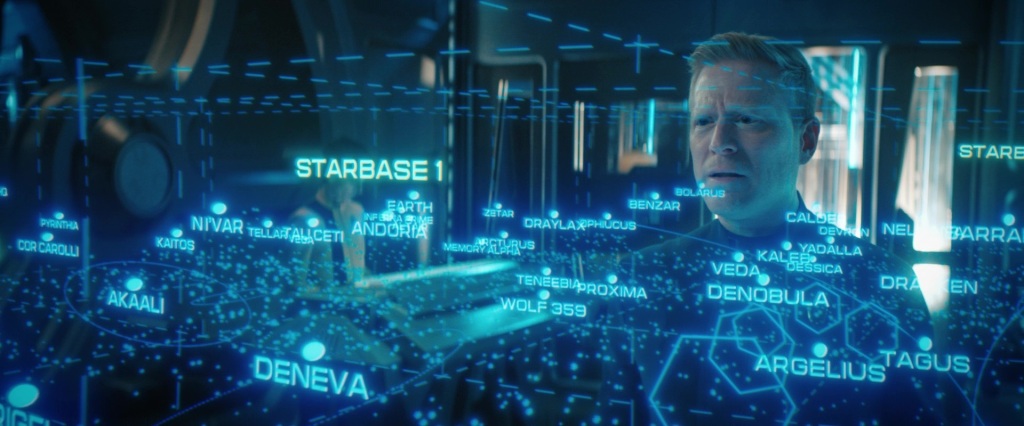
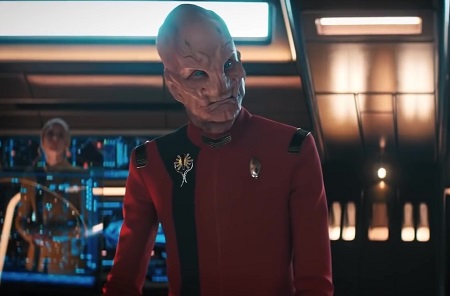
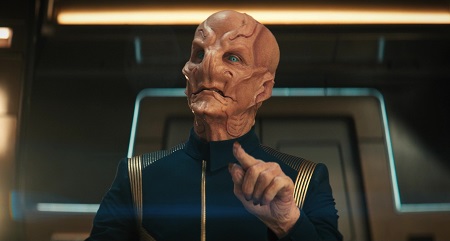
Speaking of Saru, after being unceremoniously shuffled out of the captain’s chair in that same epilogue sequence to make way for Michael Burnham, he was back in uniform in the new trailer. The first trailer only showed us a glimpse of Saru out of uniform, and there was confusion over the position he could have both aboard the ship and within the new story after taking a leave of absence and returning to Kaminar.

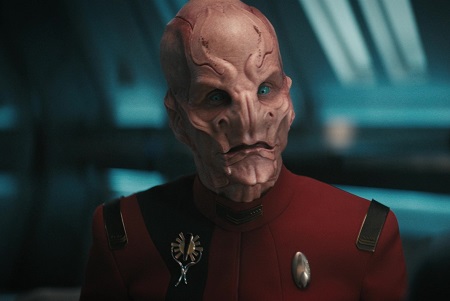
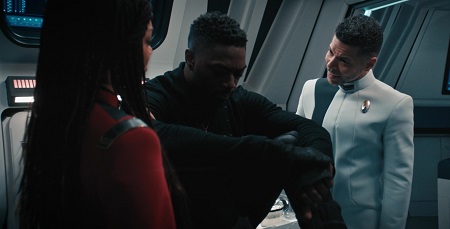
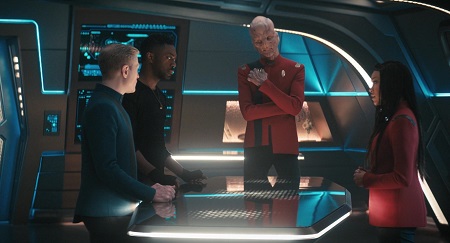
Saru’s role still isn’t clear – he seems to retain the rank of captain but hasn’t been restored to the captaincy of Discovery. He was also depicted wearing a different badge on his uniform alongside his combadge – I wonder if this might indicate a diplomatic role of some kind. Regardless, it’s great to see Saru back on the ship, and presumably he’ll be part of the crew. What role he will play in the ship’s command structure as an ex-captain is still not clear, though.

Saru is back in uniform – and is sporting a new badge!

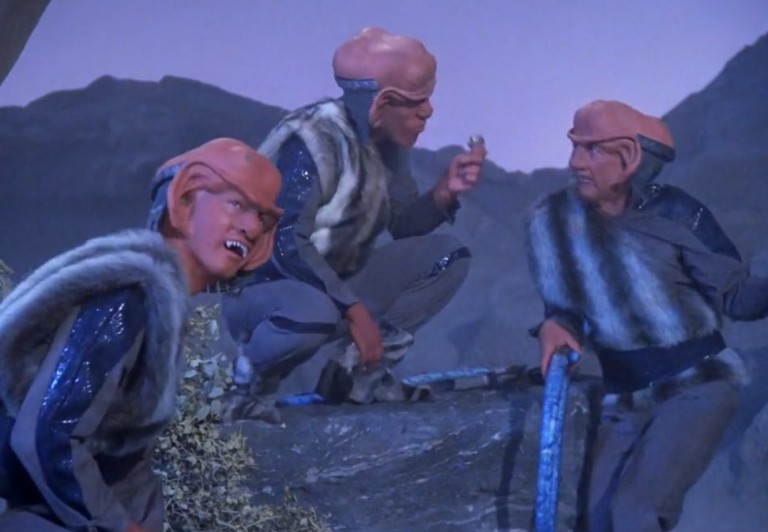
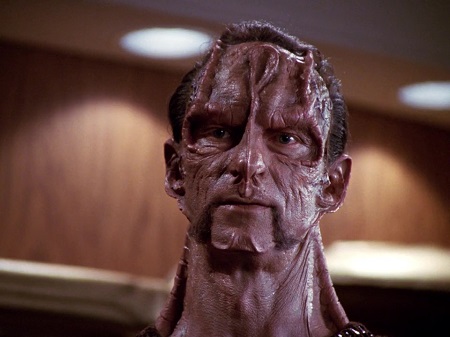
I couldn’t identify every single alien race seen in the trailer, but there were quite a few! At Federation HQ we saw an Orion woman not wearing a Starfleet uniform; she could be a representative of the Emerald Chain – or whatever remains of it. There seemed to be Tellarite crew members aboard Discovery, as at least one was present during an away mission. Also featured prominently at Federation HQ was a Ferengi Starfleet captain.

I liked the Ferengi design; it felt familiar enough to be obvious, while at the same time taking advantage of improvements in prosthetic makeup that have been made since the Ferengi debuted. There was more detail in this Ferengi’s face and ears than we ever saw in the likes of Quark and others. That isn’t to say the older makeup and prosthetics were bad, just that there have been advancements in the thirty-five years since the Ferengi were originally created! After Season 3 teased us with glimpses of Cardassians, Andorians, and Lurians who ultimately played no role in the story, I’m not getting my hopes up that this new Ferengi character will play a major part in the story of the season – but you never know!

The Ferengi captain.

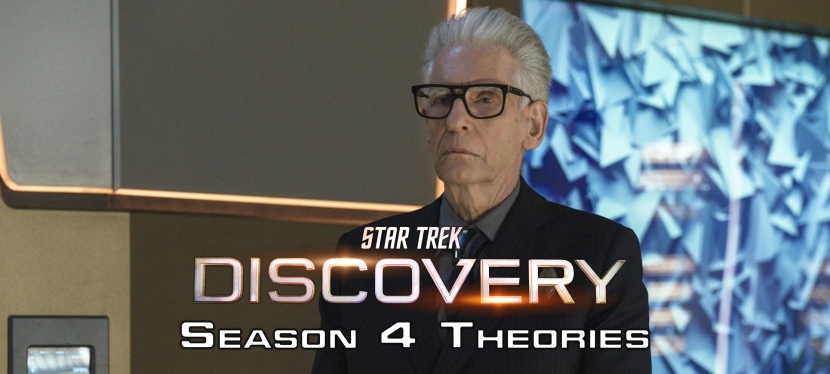
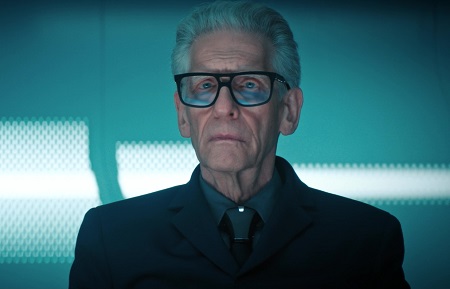
The existence of President Rillak seems to conclusively rule out the idea that the mysterious Kovich is in charge of the Federation. This had been a rumour or theory that some fans seemed to be quite attached to last time, but I was convinced for much of Season 3 that Kovich is in fact the head of Section 31 – or perhaps Starfleet security. We saw Kovich very briefly in the trailer, and previous statements from David Cronenberg – the famed director who plays the character – had already confirmed that he will be back in some capacity in Season 4.

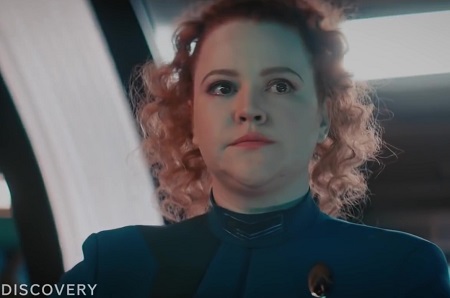
Tilly appears to have been promoted to lieutenant, at least based on the emblem she’s wearing on her collar in the trailer. Whether that will happen off-screen isn’t clear, but it would be kind of neat after her arc in Season 3 to see her rewarded with a promotion. Tilly was originally Burnham’s choice for first officer, but with Saru back perhaps he’ll fill that role? Either way, it seems that Tilly will be returning to the sciences division and not wearing the red uniform of the command division – something that was ham-fistedly digitally edited in the Season 3 finale!

Tilly is back in science division blue.

Dr Gabrielle Burnham and the Qowat Milat are making a return as well, as we saw them involved in a couple of different scenes during the trailer. It wasn’t clear whether the scenes we saw were all taken from the same episode or not, so the Qowat Milat could be in more than one episode. It was great that Discovery found a way to connect with events from Picard Season 1 in this way, and I wonder if we’ll get any other callbacks to the events of Discovery’s sister show. Due to the pandemic and its associated disruptions, Picard Season 2 won’t arrive until after Discovery Season 4 – though the original plan was surely for things to be the other way around!

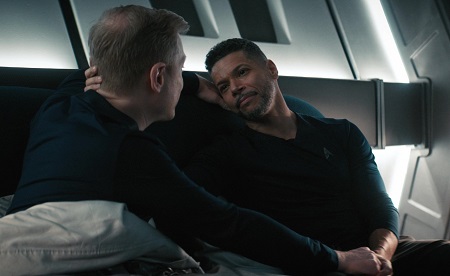
We got brief looks at Dr Culber, Adira, and Gray. Gray will supposedly be made visible this season after finally being seen by Dr Culber in the Season 3 finale. The short scenes featuring Adira and Gray in the trailer weren’t clear as to Gray’s visibility, and when Adira interacted with Tilly, Gray wasn’t present. But at the Comic-Con panel, Wilson Cruz teased that Gray will indeed become visible and that he may have a connection to the season’s main story in some way!

Adira in away mission gear.

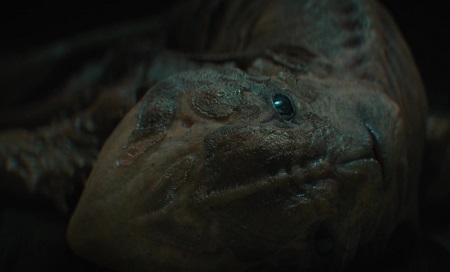
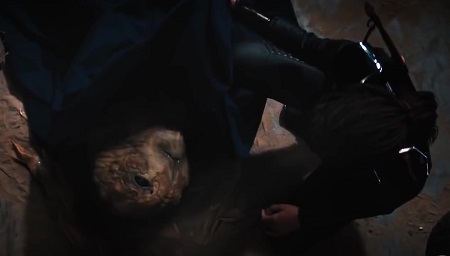
One of the most interesting shots from the teaser showed Michael Burnham pulling back a shroud over a reptilian-looking alien. This alien seems to be dead, but interestingly seemed to be noticeably larger than the humanoids we’re used to seeing in Star Trek. That could be a consequence of how this one scene was framed, but the idea of aliens – perhaps from inside the anomaly – being “more alien” in appearance is an interesting one in theory. I don’t believe we’ve seen this species before, though the dead alien’s reptilian-inspired look has superficial similarities to a few past Star Trek races.

Burnham with the dead alien.

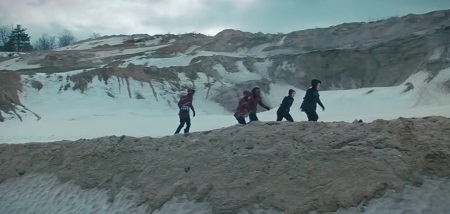
There was a shot on a snowy planet that I was also taken by. I wonder if this might be a return to the Guardian of Forever’s new homeworld – the one seen in the two-part Season 3 episode Terra Firma. That’s just a gut feeling and it could be somewhere else entirely, but it would be interesting if Discovery didn’t just abandon the Guardian of Forever. If the crew are on a quest to understand a completely alien and unknown phenomenon, the Guardian could be a good place to start. Maybe it has encountered the anomaly before, or at least is aware of it and knows something about it?

Is this scene taking place on the Guardian of Forever’s planet?

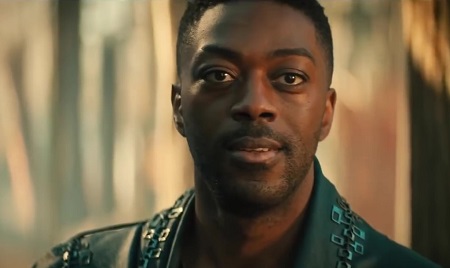
Book and Grudge were back – thank goodness! David Ajala was such a wonderful addition to the cast, providing the Starfleet crew of Discovery with an outsider’s perspective while serving as a guide of sorts to the 32nd Century. And Grudge is beautiful, of course! Book’s ship also made a return. We caught a glimpse of Book in the Spore Cube – his telepathy allows him to serve as Discovery’s navigator alongside Stamets. This could be an interesting source of conflict; how will Stamets feel about someone else muscling in on his job? But at the same time the ability of Book to navigate the mycelial network opens up the Spore Drive’s potential. With multiple navigators available – perhaps millions of potential navigators if any Kweijian or anyone who’s telepathic can take on the role – the Spore Drive could finally be rolled out to other Starfleet vessels.

Whether that will actually happen in Season 4 or not is still an open question, but I think finding a way for the Spore Drive to be more than just a gimmick to be used occasionally by Discovery is a good direction for the series to take. With the show now set in the far future of the 32nd Century, it wouldn’t tread on anyone’s toes in terms of canon – and it would be a great way for Starfleet to mitigate the dilithium shortage and future-proof their fleet. I might write this one up as a full theory, so watch this space!

I couldn’t resist including Grudge!

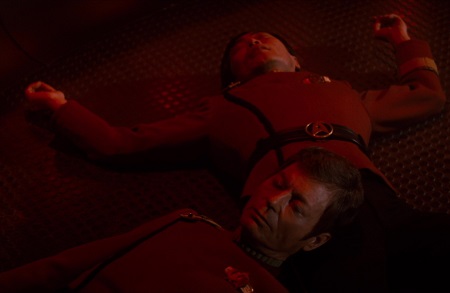
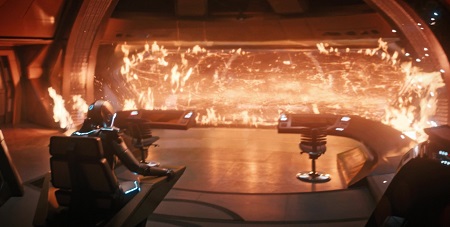
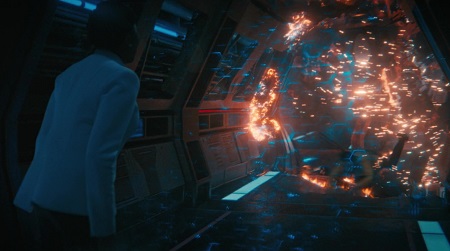
The visual effect of the crew lifted out of their seats by the anomaly’s gravitational effects is stunning. We’re not really used to seeing artificial gravity failures in Star Trek. Aside from The Undiscovered Country, I can’t really call to mind a time where the failure of a starship’s artificial gravity was a significant story element. Even when ships are badly battered and at the point of destruction, artificial gravity usually continues to function! If Discovery uses this effect sparingly I think it could be very impactful in Season 4.

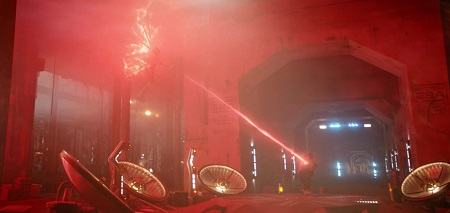
We saw several members of the cast – and a number of unidentified characters – involved in hand-to-hand violence. Some of this looked utterly barbaric, not at all the kind of thing we’d expect from Starfleet officers. At one point the Qowat Milat even seemed to be engaging a Starfleet officer. I wonder if this is all connected to the anomaly – perhaps things on the other side are more violent, like they are in the Mirror Universe, for example? Or perhaps the anomaly has different effects on people, driving some to become violent? Either way, there seemed to be a lot of that on show in the trailer, and some sort of explanation is required!

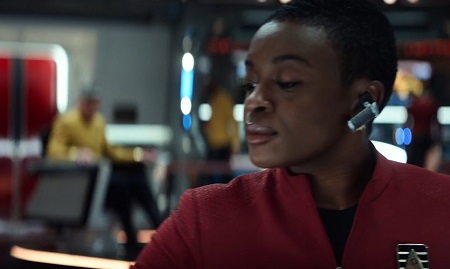
Captain Burnham looks on while Owosekun appears to be involved in a fight. This was just one of many examples of hand-to-hand violence seen in the trailer.

Though present, Admiral Vance didn’t have much to say in the trailer. I’m glad he’s coming back, though, as he was a great character in Season 3 as someone who embodied the values of Starfleet. We saw several scenes set at Federation HQ, which was of course Admiral Vance’s home base in Season 3. HQ seemed to look at least a little busier in the trailer than it had in Season 3; this could be a visual representation of the growth of the Federation as it begins to bring back wayward members and expand its fleet. The inclusion of President Rillak may mean Admiral Vance has less to do; both characters seem to occupy a similar role as superiors to Captain Burnham.

Speaking of Captain Burnham and President Rillak, a scene appeared to show Discovery’s captain receiving a stern telling-off from the Federation president. My suspicion is that this is something that happens early in the season prior to the discovery of the anomaly. That’s definitely just a gut feeling, but something about this conversation seemed to suggest the stakes weren’t quite so high. Perhaps Burnham did something in an early mission to earn the president’s ire, but the grave threat of the anomaly will force them to work together despite their differences of opinion and leadership styles.

President Rillak apparently doesn’t like Captain Burnham.

This sequence, out of everything we saw in the trailer, was my least-favourite. It felt like forced drama for the sake of forced drama, and the use of the word “bravery” when giving an officer a dressing-down was incredibly clumsy dialogue. It was a way to communicate to us as the audience that Burnham is brave and that she’s some kind of maverick who doesn’t always conform or do what authority figures tell her – but it just felt a little too forced. We know Burnham doesn’t always play by the rules having seen the way she operates over three seasons, and having a brand-new character dropped in to reinforce that point may not be the best use of the show’s time. I’ll reserve judgement until I’ve seen the full sequence in context, but in the trailer I didn’t like the way it came across.

So I think that’s all I have to say for now. Stay tuned because there are a couple of nascent theory ideas that I have based on the trailer, so it’s possible they could get the full write-up treatment in the days ahead. Discovery Season 4 is offering another “natural disaster” storyline after the Burn in Season 3, and that may not be to everyone’s taste. However, I confess to being genuinely curious to learn more about this anomaly. What is it? What danger does it really pose? Could it be a weapon rather than a natural occurrence? There are many, many questions running through my mind!

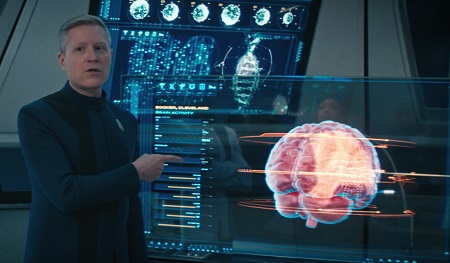
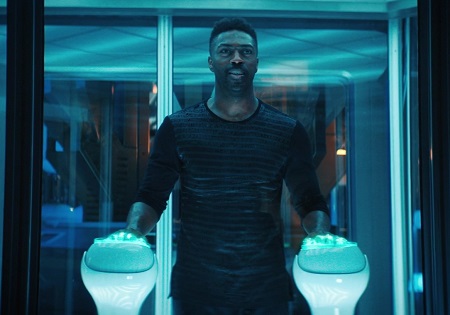
Cleveland Booker in the new trailer.

Whatever the ultimate cause of the anomaly, Season 4 looks like it’s on a good track. The trailer was action-packed and exciting, with ample interpersonal drama and an awful lot to unpack. I’ve tried to hit the main points here, but I’d encourage you to check out what other fans and publications have to say as they break down the trailer, as I’m sure there are points I missed or overlooked.

I’m really looking forward to Discovery Season 4 now, and with barely a month left there’s not long to wait. When the new season arrives I’ll be writing reviews of each episode and probably indulging in a spot of theory-crafting, just as I did during Season 3 last year. I hope you’ll stay tuned for that here on the website!

Star Trek: Discovery Season 4 will debut on Paramount+ in the United States on the 18th of November 2021, and on Netflix in the United Kingdom and elsewhere a day later. Star Trek: Discovery Seasons 1-3 are available to stream now. The Star Trek franchise – including Discovery and all other properties mentioned above – is the copyright of ViacomCBS. This article contains the thoughts and opinions of one person only and is not intended to cause any offence.

Star Trek: Lower Decks review – Season 2, Episode 9: wej Duj

Spoiler Warning: There are spoilers ahead for Star Trek: Lower Decks Seasons 1-2.

wej Duj – which is Klingon for “three ships” – was an exceptionally funny episode, and certainly one of the highlights of Season 2. What makes it stand out is that much of the humour came not from the main cast, nor even from secondary characters like the senior staff, but from guest-stars who gave us a glimpse at life on the lower decks of both Klingon and Vulcan ships.

Lower Decks promised us right from the beginning that we’d be looking at junior officers who get the worst assignments, so taking that concept and expanding it to show us the same kind of people on other vessels felt incredibly natural. It’s one of those ideas that just makes sense – and leaves you wondering why you didn’t think of it sooner!

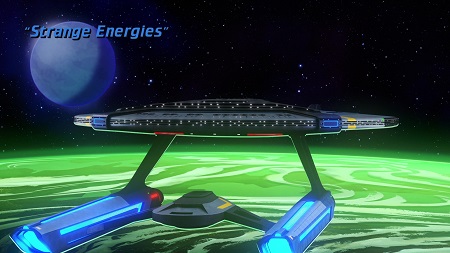
The title card – in Klingon!

The episode skipped the usual pre-titles sequence, so after the opening titles rolled we were straight into the action. The title of the episode was displayed in Klingon (or should that be Klingonese?), which was a very neat little touch. As an aside, wej Duj is the first Star Trek episode – out of more than eight hundred – to have a Klingon title!

The setup for the episode was interesting, and gave us a rare glimpse at a starship during a period of downtime. Most episodes naturally focus on adventures of one kind or another, yet when you think about it, at least some interstellar travel is going to be dull, waiting for the ship to arrive at its next destination. We’ve seen glimpses of that in episodes like Voyager’s Season 5 opener Night, but this was its first appearance in Lower Decks. As above, this concept feels like another natural fit for the series – showing us what some of the junior officers get up to while the ship is warping to its next destination.

Dr T’Ana and Tendi enjoying some downtime together.

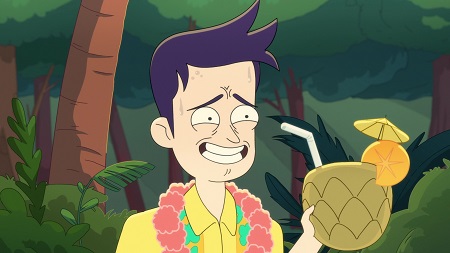
wej Duj used that premise as an excuse to shuffle the ensigns off-stage, and the story progressed without much significant involvement from Mariner, Rutherford, or Tendi. Boimler got a B-plot of sorts as he tried to buddy up to Commander Ransom. This sub-plot relied on a lot of sitcom-style “cringe” humour as Boimler pretended to be from Hawai’i to ingratiate himself with Ransom and a couple of other officers.

This kind of humour, popularised by shows like Friends, isn’t always to my taste. While Boimler’s story definitely had some funny moments, its reliance on a sitcom cliché premise made it the lesser part of the episode – at least in my opinion. The way it ended was definitely amusing in its irony, though, as it turned out that neither Ransom nor any of the others were in fact from Hawai’i either – all having made up the same lie at different times.

Though it wasn’t bad per se, Boimler’s sub-plot featured a style of humour that I generally don’t enjoy.

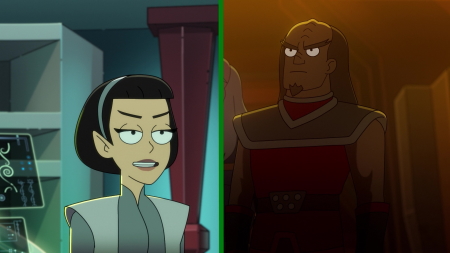
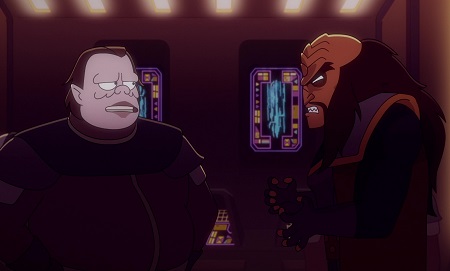
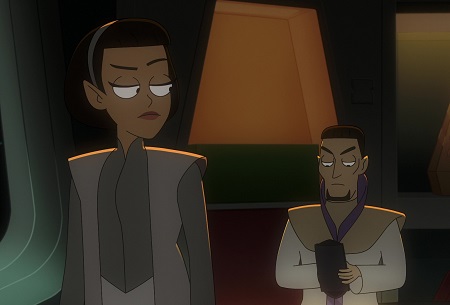
The main thrust of the episode focused on two guest-stars: junior Klingon officer Ma’ah, played by Jon Curry, and Vulcan lower decker T’Lyn, played by Gabrielle Ruiz. Pinning the bulk of an episode on two brand-new characters was a risk, but it was one that paid off and worked exceptionally well.

Both characters – and their supporting cast of fellow lower deckers and the senior officers aboard their respective ships – were exceptionally funny in completely different ways. The juxtaposition of two of Star Trek’s best-known races was at the core of what made this comedy work; seeing the aggressive, barbaric Klingons drinking bloodwine and engaging in fights to the death then immediately hopping over to the stoic Vulcans who showed no emotion was key to making the episode as funny as it was.

T’Lyn (left) and Ma’ah were the breakout characters from wej Duj.

wej Duj was also a very well-paced episode. In barely twenty minutes it had to bring together multiple story threads that began in very different ways and different places. It also had to balance three entirely disconnected segments and sets of characters, giving each enough screen time to allow for some development and for story beats to play out naturally. Not only did all of this work, with the pacing of each character’s story feeling just right, but wej Duj also connected the events every character experienced into the Pakled storyline that has been running since the end of Season 1!

I haven’t been afraid to criticise Lower Decks earlier in Season 2 when episodes felt overcrowded. Some potentially interesting storylines just didn’t get quite enough time to be fully-realised, and I stand by those criticisms. wej Duj was already an incredibly ambitious episode, considering everything it had to include, but seen in that light I think the fact that the writers, producers, and editors managed to pull it off is nothing short of remarkable.

There were a lot of different elements packed into a single episode this week, and the way they came together was brilliantly-executed!

It would’ve been easy to overlook one or more of the different stories considering the episode’s runtime and just how many characters and ships were in play. It really is a triumph of writing – and undoubtedly editing as well – that wej Duj worked as fantastically well as it did.

The Klingons were featured prominently in Star Trek Into Darkness as well as the first two seasons of Discovery, where some elements of their redesign proved to be controversial. Lower Decks returned the Klingons firmly to their familiar look – the one present from The Motion Picture right through to Enterprise. And as much as I enjoyed some of the Ancient Egyptian influence present in Discovery’s Klingon redesign, it felt absolutely wonderful to be back with the Klingons in their best-known aesthetic and to spend time aboard one of their ships again.

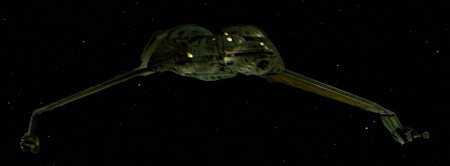
Commander Togg and other Klingon officers aboard the bridge of their Bird-of-Prey.

The aesthetic of the Klingon Bird-of-Prey on the inside was again very much in line with prior depictions. Everything from the lighting to the design used for Klingon computer monitors could’ve been lifted straight from Deep Space Nine or The Search for Spock – and I loved that the lower deckers were forced to sleep in hammocks that made the ensigns’ hallway look palatial in comparison!

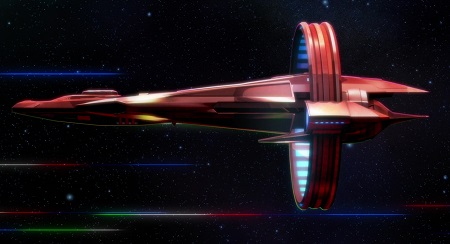
The Vulcan ship was clearly based on the design of ships seen in Enterprise. Though Starfleet is the Federation’s main military and exploratory force, throughout Star Trek the Vulcans have been depicted as maintaining their own fleet of ships alongside Starfleet, so I don’t think it’s in any way a canon problem to have a Vulcan cruiser like this in Lower Decks. The relative power of the Vulcan cruiser compared to the USS Cerritos, which was on full display in the climactic battle, was very reminiscent of the way Vulcan ships would constantly outclass and outmatch the NX-01 in Enterprise – a neat little understated callback to Star Trek’s first prequel.

T’Lyn’s Vulcan cruiser at warp.

With the Klingon commander in league with the Pakleds, T’Lyn and Ma’ah – and later the USS Cerritos – were all drawn to the same place. The Pakleds had detonated a bomb given to them by the Klingon commander in the hope of destabilising peace in the Alpha Quadrant and sparking a war, and while Ma’ah challenged his commander, T’Lyn and the USS Cerritos both detected the residual after-effects of the Pakleds’ weapon detonation.

This moment set up the storylines coming together, and it was based once again on the Pakleds’ stupidity, which was pretty funny. The way Commander Togg reacted to the Pakleds’ detonating the bomb he’d provided was one of the funniest moments in the whole episode! Captain Riker had speculated that someone had been manipulating the Pakleds to become so aggressive, and wej Duj gave us the answer – a rogue Klingon commander.

It turns out that a rogue Klingon commander has been arming the Pakleds and pushing them to attack the Federation.

As Discovery showed in its first couple of seasons, there’s plenty of life in the Klingons as villains. When stories get their warrior-barbarian culture right, the Klingons can feel very threatening indeed. I’d point to the Deep Space Nine Season 5 episode Nor the Battle to the Strong as just one example of that. But having seen the Klingons as allies throughout Deep Space Nine’s Dominion War in particular, and having had sympathetic characters like Worf, B’Elanna Torres, and General Martok, making the Klingon Empire as a whole an enemy once again wouldn’t be my first choice in Star Trek any more.

wej Duj found a clever way around this by giving us a character somewhat inspired by The Undiscovered Country’s General Chang. By making it clear that Togg was acting on his own, without the backing of the Klingon High Council or Chancellor – which should be Martok at this point in time, surely! – the story managed to be interesting and entertaining, but without dragging the Federation and Klingons into open conflict with one another. I think many Trekkies like the Klingons far better when they’re allies, with their aggressive nature turned on mutual enemies, than when they come into direct conflict with Starfleet – and I’m generally in that place too. While the Klingons can and do make entertaining villains, I enjoyed the way they were portrayed in The Next Generation and Deep Space Nine and would be loathe to see them as enemies once again.

The Klingons made a welcome return in a semi-adversarial capacity.

T’Lyn and her Vulcan colleagues also provided the episode with plenty of humour. The absolutely deadpan way that all of the Vulcans spoke to one another was hilarious, and the way they interpreted very politely-worded statements as emotional outbursts or insults was a very funny send-up of Vulcan culture from Lower Decks’ writers.

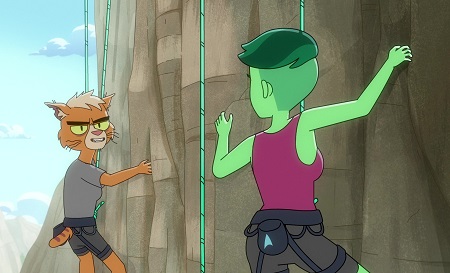
Though they featured prominently in the images shown off before the episode’s broadcast, wej Duj only contained brief scenes involving Tendi, Mariner, and Rutherford. I’d have liked to have seen a little more of the ensigns and their “bridge buddies” during their down time. Tendi’s rock-climbing outing with Dr T’Ana was a cute reference to The Final Frontier, which saw Kirk, Spock, and Dr McCoy enjoying shore leave at Yosemite national park. Rutherford’s pottery-making class with Shaxs actually contained a very sweet moment between the two, with Rutherford calling Shaxs “Papa Bear” when the latter became angry and upset by Boimler mentioning Bajor.

This moment between Rutherford and Shaxs was surprisingly touching.

Mariner didn’t appear to be enjoying her time with Captain Freeman at first, as the pair engaged in some mother-daughter bonding time on the holodeck and later in the captain’s ready room. But as they parted ways, both admitted that they had a good time together – another very sweet moment, and further evidence of the change in Mariner’s character and attitude that we’ve been tracking since midway through Season 1.

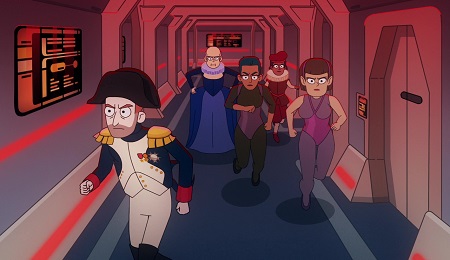
As the crew of the Cerritos scrambled to their posts from their leisure activities, the ship was awash with out-of-uniform officers. It was a pretty funny mix of characters in different outfits, and the sight gag of characters in everything from ball gowns to winter coats worked very well. It also showed that the crew are capable, despite serving on a “lowly” ship. These are still professional Starfleet officers, after all!

The crew of the USS Cerritos dropped what they were doing to rush to their posts!

Two questions remain now that wej Duj is over. Firstly: is the Pakled threat now over? Their reliance on Klingon weaponry has now been exposed, and with Commander Togg dead there isn’t anyone left to manipulate the Pakleds and push them closer to all-out war, so perhaps the threat is now largely at an end. I feel that the Pakleds have been very funny in Lower Decks as adversaries, but the way they’ve been presented has left them feeling like a one-trick – or one-joke – pony. Perhaps the “Pakleds are really dumb” joke has run its course, even though there was plenty of humour derived from that premise this week. Better to end it before it outstays its welcome, though!

Secondly, the end of the episode saw T’Lyn dismissed by her Vulcan commander and forcibly reassigned aboard a Starfleet vessel. Could she be making her way to the USS Cerritos, perhaps? T’Lyn provided ample humour in her own incredibly Vulcan way in wej Duj, and while there probably isn’t room for a fifth lower decker as a major character, bringing her in as a recurring character or in a different department could be an interesting way for the series to go as Season 3 beckons. It’s probably not going to happen… but you never know!

T’Lyn has been reassigned – could we see her aboard the Cerritos one day?

The worst thing about wej Duj is that now it’s over that means there’s only one episode left in Lower Decks Season 2! The ten-episode seasons that many modern television shows use are a double-edged sword in some ways. We get more shows, and the episodes that are made generally get a higher budget as a result. But it does mean that seasons seem to race by very quickly! I’m sure that Lower Decks has a suitably explosive finale planned for the end of the season, though.

wej Duj was a completely different kind of episode for Lower Decks. It saw guest-stars take centre-stage for the first time, and the episode was largely carried not by anyone aboard the USS Cerritos but by a pair of Klingons and some stoic, bickering Vulcans. Seeing the life of lower deckers on a couple of different ships was an absolutely outstanding premise, and wej Duj pulled it off with aplomb. The complicated story was expertly weaved together as it reached its climax, and appears to have exposed and perhaps resolved the lingering Pakled threat.

I had a lot of fun with wej Duj, and it will go down as one of the highlights of Season 2 without a doubt. It was funny almost from the first moment, with suitable moments of tension as the complex four-starship battle unfolded. It’s set a high bar for next week’s season finale!

Star Trek: Lower Decks Season 2 is available to stream now on Paramount+ in the United States, and on Amazon Prime Video in the UK and around the world. The Star Trek franchise – including Lower Decks and all other properties mentioned above – is the copyright of ViacomCBS. This article contains the thoughts and opinions of one person only and is not intended to cause any offence.

Star Trek Day roundup!

Spoiler Warning: There are spoilers ahead for the Star Trek franchise, including the following upcoming series: Strange New Worlds Season 1, Picard Season 2, Lower Decks Season 2, Discovery Season 4, and Prodigy Season 1.

Yesterday was Star Trek Day! And in case you missed it, ViacomCBS held a live event that was streamed online and via Paramount+ showcasing and celebrating all things Star Trek! We’ll break down the big news in a moment, but first I wanted to give you my thoughts on the event as a whole.

This was the first big in-person event that many of the folks involved had been able to attend since 2019, and there was talk of the pandemic and its enforced disruption on the various shows that have been in production over the last couple of years. There was also a lot of positivity from presenters and interviewees not only about Star Trek – which was to be expected, naturally – but also about being back together and simply being able to hold a major event of this nature. The positivity of hosts Wil Wheaton and Mica Burton was infectious, and the event was much better for the role the duo played in hosting the panels and introducing guests.

Mica Burton and Wil Wheaton were great hosts.

That isn’t to say that Star Trek Day was entirely without problems, though. To be blunt, the event dragged on a bit too long (it ran to over three hours) and several of the panels and interviews were the worse for being conducted live instead of the pre-recorded, edited, and curated segments and panels we’ve had to get used to in the coronavirus era. Several of the guests seemed unprepared for what should’ve been obvious questions, and there were too many awkward silences and pauses while people gathered their thoughts and responded to the hosts. Such is the nature of live broadcasting – and it sounds rather misanthropic to criticise it!

During what I assume was an intermission on the main stage we were treated(!) to a separate pair of presenters on the red carpet reading out twitter messages and posts from the audience. This was perhaps the segment that dragged the most; one of the presenters even admitted to not being a regular Star Trek viewer (she hadn’t seen Discovery at all) so unfortunately this part of the show was less interesting as the pair were a little less knowledgeable about the franchise. If it had been made clear that this section of the broadcast was going to last as long as it did I might’ve taken a break as well!

This segment in the middle of the broadcast dragged on a bit.

Overall, though, despite running a bit too long and the ending feeling a little rushed (something we’ll talk about later), Star Trek Day was a success. It didn’t only look forward to upcoming projects like Strange New Worlds and Picard Season 2, but it looked back at every past Star Trek series, inviting members of the casts of those shows to talk about what made them – and the franchise – so great.

As a true celebration of all things Star Trek, the broadcast has to be considered a success. And although a pre-recorded event could’ve been edited and streamlined to cut to the more interesting parts and to give interviewees a chance to gather their thoughts, it was nice to see many of the folks we know and love from Star Trek back together and able to spend time in person with one another. Hosts Wil Wheaton and Mica Burton did a great job at making us as the audience feel included, as if we were there at Star Trek Day right along with them. For those few hours – even through awkward moments and segments that seemed to run a little too long – it felt like being a member of the Star Trek family. As someone with few friends, I appreciated that immensely. For those few hours last night – and yes, even though Star Trek Day didn’t start until 1:30am UK time I did stay up to watch it – I felt like I, too, was an honorary member of the Star Trek family, and that’s a feeling I would never have been able to get anywhere else.

Star Trek Day was a successful celebration of all things Trek!

Now then! Let’s talk about the various panels, trailers, and interviews. Over the coming days I’ll be taking a closer look at some of the announcements and trailers in more detail (as well as perhaps crafting a few of my patented and often-wrong theories), but for now I want to try to include an overview of everything that was included in Star Trek Day.

We’ll come to the biggest announcements and trailers at the end, but first I wanted to talk for a moment about the music. Star Trek Day had a live orchestra on its main stage, and we were treated to live renditions of Star Trek theme music past and present – as well as a medley that kicked off the event. I was listening to Star Trek Day on my headphones, and the music sounded beautiful. Composer Jeff Ruso (who composed the theme music to Discovery and Picard) picked up the conductor’s baton, and the medley he arranged was really an outstanding celebration of all things Star Trek.

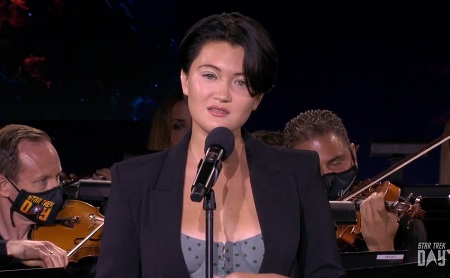
Star Trek Day both began and ended with music, as Isa Briones (Star Trek: Picard’s Soji) sang her rendition of Irving Berlin’s 1926 song Blue Skies to close out the broadcast.

Isa Briones’ rendition of Blue Skies brought proceedings to a fitting end.

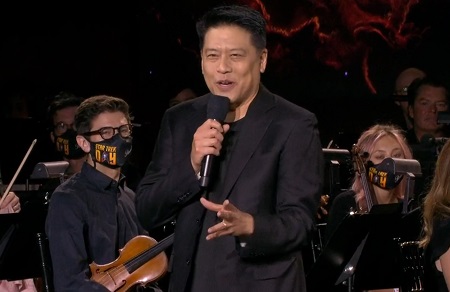
There were five “legacy moments” spread throughout Star Trek Day, and these celebrations of past Star Trek series were genuinely moving. Actors George Takei, LeVar Burton, Cirroc Lofton, Garrett Wang, and Anthony Montgomery spoke about their respective series with enthusiasm and emotion. Cirroc Lofton paid tribute to his on-screen dad Avery Brooks, talking about how Deep Space Nine showed a single dad balancing his work and family commitments. He also spoke about Deep Space Nine’s legacy as the first Star Trek show to step away from a starship and take a different look at the Star Trek galaxy.

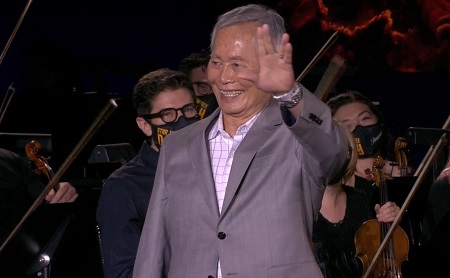
The themes of diversity and inclusion were omnipresent in these legacy moments, and all five actors spoke about how Star Trek and Gene Roddenberry have promoted diversity since the very beginning. George Takei spoke about Gene Roddenberry’s vision for Star Trek, how sci-fi had previously been something often seen as just for kids, and how putting a very diverse cast of characters together was groundbreaking in the 1960s. It’s always amazing to hear George Takei speak, and even fifty-five years later he still has a grace and eloquence when speaking on these topics. As someone who has himself been at the forefront of campaigning for diversity and equality, he does so with a gravitas that few can match.

George Takei’s speech was outstanding.

Garrett Wang spoke about how Voyager could be a “refuge” for fans; a place to go where everyone could feel included and like they were part of the family. The way the show combined two crews was, I would argue, one of its weaker elements, but Wang looked at it through a different lens, and I can see the point about how Voyager put those folks in a difficult situation and brought them together to work in common cause. He also spoke in very flattering terms about Captain Janeway and Kate Mulgrew – who is returning to Star Trek very soon.

Anthony Montgomery was incredibly positive about Enterprise, and how the series embodied the pioneering spirit of exploration. I loved his line about how Enterprise, although it was a prequel recorded later than many other shows, laid the groundwork and filled in much of Star Trek’s previously unvisited stories and unexplained lore. Above all, he said, Enterprise was a “fun” show – and it’s hard to disagree! The orchestra concluded this speech with Archer’s Theme – the music heard over the end credits for Enterprise – which is a beautiful piece of music. If I were to remaster Enterprise I’d drop Faith of the Heart (which is a nice enough song, don’t get me wrong) and replace it on the opening titles with Archer’s Theme. The orchestra played it perfectly.

Anthony Montgomery spoke with passion and good humour about Enterprise.

LeVar Burton talked about The Next Generation, and how Star Trek was reinvigorated for a new era. The Next Generation was the first spin-off, and it came at a time when spin-offs didn’t really exist in the sci-fi or drama spaces, so it was an unknown and a risk. Burton also spoke about The Next Generation’s sense of family, and how Star Trek can be a unifying force in the world.

Far from being mere padding, the five legacy moments saw stars of Star Trek’s past pay tribute to the franchise and the shows they were part of. There were consistent themes running through all five speeches, particularly the theme of inclusion. Star Trek has always been a franchise that strives to include people who are “different” – people like myself. For many fans, that’s one of the things that makes Star Trek so great. To see some of the biggest stars acknowledge and celebrate that aspect of Star Trek was wonderful, emotional, and rather cathartic.

Cirroc Lofton paid tribute to Deep Space Nine and his on-screen dad Avery Brooks.

Each of the five actors spoke with love, positivity, and enthusiasm for the franchise that made them household names. Anthony Montgomery’s incredibly positive attitude in particular shone through – he was beaming the whole time and seemed genuinely thrilled to have been invited to speak and to celebrate Enterprise.

If Star Trek Day aimed to celebrate all things Star Trek, then the legacy moments went a long way to making that ambition a reality on the night. The speeches were pitch-perfect, as were the orchestral renditions of all five Star Trek themes, and I had an unexpectedly good time with these moments. I wasn’t sure what to expect from the programme listed on the website; I didn’t really have any expectations of what the legacy moments would include. They surprised me by being one of the most enjoyable, down-to-earth parts of a hugely entertaining evening.

Garrett Wang represented Voyager in the show’s legacy moment segment.

Let’s talk about news and announcements. That’s what you’re here for, right?! That was certainly what I was most interested in and excited for when I sat down to watch the Star Trek Day broadcast – though, as mentioned, I was taken aback by some of the other elements present that I wouldn’t have expected!

First, a non-announcement! Wil Wheaton interviewed the head of production on Star Trek, Alex Kurtzman, early on in the evening. Kurtzman didn’t have anything to say about the Section 31 series, nor about the upcoming Star Trek film due for release in 2023. However, he mentioned something that I found really interesting: a Starfleet Academy series or project. This isn’t anything close to an official announcement, of course, and he and Wil Wheaton talked about it in abstract terms. But a Starfleet Academy series has been something Star Trek has considered in the past; Gene Roddenberry was quite keen on a Starfleet Academy spin-off prior to developing The Next Generation. Watch this space, because it’s at least possible that a project centred around Starfleet Academy will get off the ground under Kurtzman’s leadership.

Alex Kurtzman seemed to tease that a Starfleet Academy project may be coming sometime soon!

There were no brand-new shows or films formally announced at Star Trek Day. While I wasn’t necessarily expecting such an announcement, and Kurtzman’s earlier statement that no new show will be worked on until the current crop have run their course would seem to exclude it, there are multiple pitches and projects that have been rumoured or talked about over the last few years. The Section 31 series was absent again, as mentioned, and that’s more bad news for a series that feels like it isn’t going to happen. There were also no mentions of the likes of Ceti Alpha V, Captain Proton, or Captain Worf – just some of the heavily-speculated or rumoured pitches believed to be floating around over at ViacomCBS.

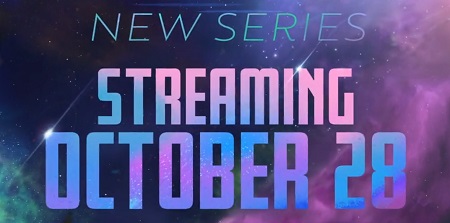
We did get release dates or release windows for several upcoming seasons, though! After Lower Decks Season 2 draws to a close in mid-October there’ll be a couple of weeks with no Star Trek, but then Prodigy will be available (in the United States at least) from the 28th of October. Shortly thereafter, Discovery Season 4 will kick off – it will premiere on the 18th of November in the United States and on the 19th internationally. Finally, Picard Season 2 is scheduled to arrive on our screens in February next year – presumably shortly after the season finale of Discovery.

Prodigy is coming soon… if you live in the USA, anyway.

All of this is great news! There was no release date for Strange New Worlds, but I think we can assume it will follow within a few weeks at most of Picard Season 2, which would put it perhaps in May or June 2022 at the very latest. But there will be a whole lot of Star Trek on our screens this autumn and winter, well into the first half of next year. Wil Wheaton said it best: with so many new Star Trek projects in production, we’re living through a new golden age of Star Trek right now!

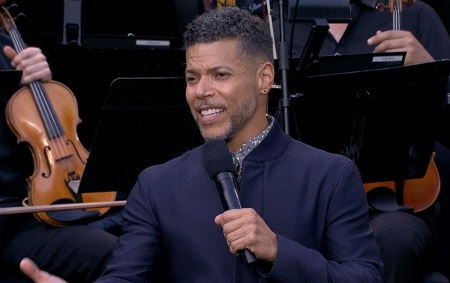
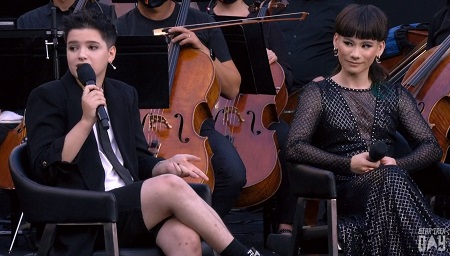
I was a little surprised when the Discovery panel ended without revealing a new trailer or teaser for Season 4. Michelle Paradise, Wilson Cruz, Blu del Barrio, and Ian Alexander talked about how the show is fostering a sense of family in the 32nd Century – and that we will see Gray get a “corporeal” body in Season 4 somehow, which is great! But I have to say I’d been expecting a new trailer; the show is only a couple of months away after all. Perhaps we’ll get that nearer to the time. There wasn’t any mention of Season 5 either, but it’s possible that announcement will come as the marketing campaign for Season 4 ramps up.

Wilson Cruz speaking during the Discovery panel.

Wilson Cruz seems like such a positive person in every interview I’ve ever seen him participate in, and he brought a lot of positive energy to the stage in Star Trek Day as well. There was talk of the Stamets-Culber relationship being revisited in Season 4, which is great – Stamets and Culber really form the emotional core of the show. He also spoke about how Dr Culber is embracing new roles in Season 4 – the role of counsellor to others aboard the ship as well as a parental role for Adira and Gray.

Gray’s storyline has the potential to be one of the most powerful in Discovery as the show moves into its fourth season. Being trans or gender-nonconforming can make one feel invisible – something I can speak to myself – and this is literally shown on screen by Gray’s invisibility. The powerful story of discovering how to be seen, and to do so with the help, encouragement, and support of one’s closest friends and family has the potential to be an exceptionally powerful story, one which I can already feel resonating with me. Blu del Barrio and Ian Alexander spoke very positively about their on- and off-screen relationships, and they seem like they work exceptionally well together as a duo. I can’t wait to see what Season 4 will bring for them both.

Blu del Barrio and Ian Alexander play Adira and Gray respectively. I’m greatly looking forward to their stories in Season 4.

I’ve already got a Prodigy theory! The show’s co-creators talked about how Prodigy Season 1 begins with the kids on a never-before-seen planet described as being “far removed and mysterious.” It sounds like we aren’t seeing a planet that the USS Voyager visited in the Delta Quadrant – something backed up by scenes seemingly set on that world in the trailer – and the USS Protostar appears to have crashed “inside” the planet. Did it crash during the final leg of Voyager’s journey home through the Borg transwarp network? Or perhaps during one of Voyager’s other flights – the space catapult from The Voyager Conspiracy or Kes’ telepathic launch in The Gift, for example. More to come on this, so stay tuned!

So we got a release date for Prodigy in the United States, but as I’ve said on a couple of occasions now it seems as though Prodigy isn’t going to be broadcast anywhere that doesn’t already have Paramount+. Considering that the series is a collaborative project between Star Trek and Nickelodeon (itself a ViacomCBS subsidiary), it should surely have been possible to secure an international broadcast on the Nickelodeon channel – a satellite/cable channel here in the UK and in many other countries. It’s a disappointment that, once again, ViacomCBS does not care about its international fans. It’s not as egregious a failing as it was with Lower Decks, because as a kids’ show Prodigy’s primary audience won’t really notice the delay. But for Trekkies around the world, to see Prodigy teased then find out we have no way to watch it is disappointing, and there’s no way around that.

The USS Protostar in flight.

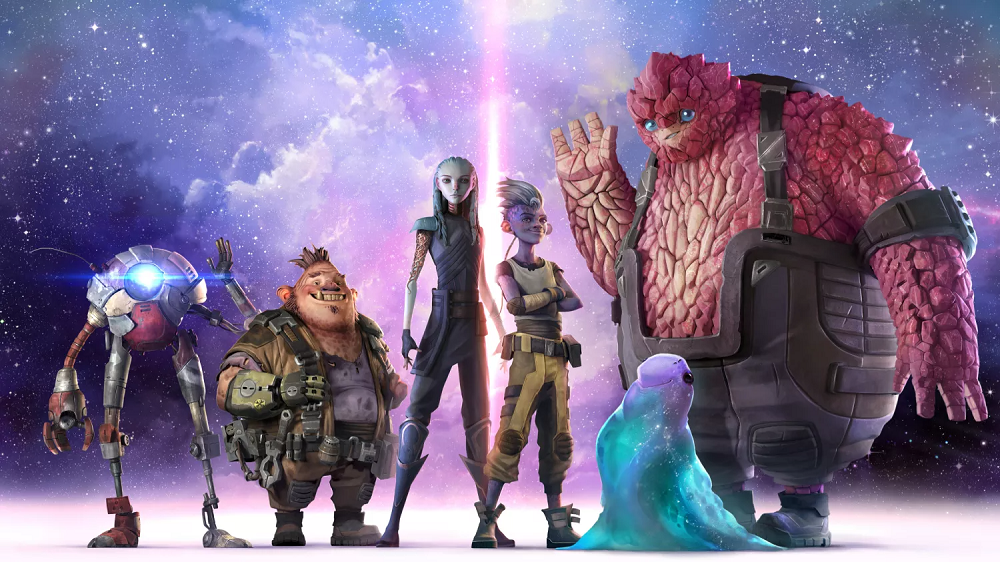
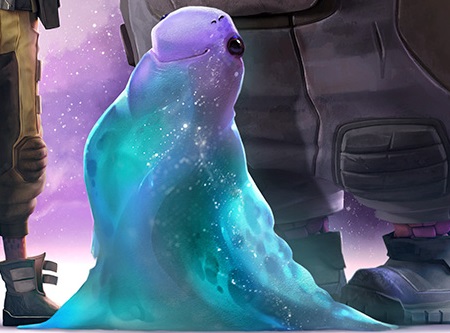
Despite that, the Prodigy panel was interesting. Dee Bradley Baker, who voices Murf – the cute blob-alien – seems like he’s a real Trekkie and spoke about the franchise with passion. It was so much fun to see him perform Murf’s voice live, as well! Brett Gray, who will take on the role of young leader Dal, seemed overjoyed to have joined a franchise – and a family – with such a legacy, and I liked the way he spoke about how the young crew of the USS Protostar will grow as the season progresses.

The show’s co-creators – brothers Dan and Kevin Hageman – spoke about how Prodigy won’t be a series that talks down to children, but rather aims to be a series with plenty to offer for adults as well. The best kids’ shows manage this – and the Hagemans have received critical acclaim and awards for their work on Trollhunters and Ninjago, so there’s a lot of room for optimism. They both seemed to have a good grasp of the legacy and role Star Trek plays and has played for young people, and I think the show is in safe hands.

Dee Bradley Baker gave us a tease of Murf’s voice!

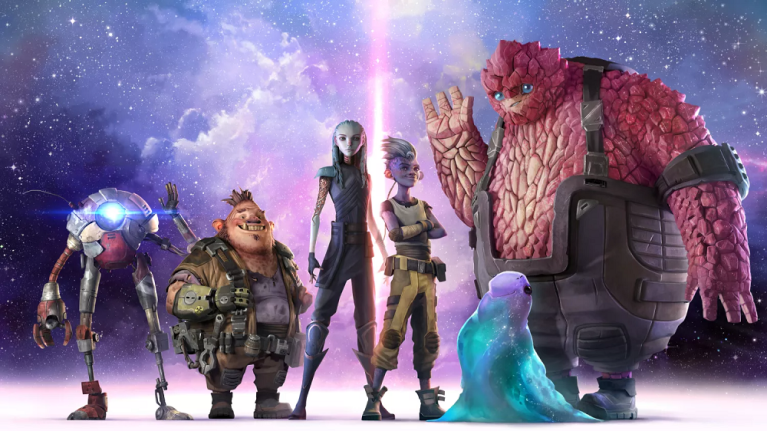
The Prodigy trailer was action-packed and exciting! We got a glimpse of the villainous character played by John Noble – and heard his distinctive voice – as well as got a much closer look at the USS Protostar than we had before. Perhaps the most exciting moment, though, was seeing the Janeway hologram for the first time! Janeway’s role in the show seems like it will be that of a mentor; the kids will make their own calls and decisions, but Janeway will be on hand to offer advice – at least that’s my take at this stage.

There were some funny moments in the trailer, too, which will surely produce a lot of giggles from Prodigy’s young audience. “Just hit all the buttons” until the phasers fire was a great laugh line, and the ship losing artificial gravity was likewise hilarious. There was also a crash-landing that reminded me very much of a scene in the Voyager episode Timeless. I’m really looking forward to Prodigy and to spending time with the young crew of the USS Protostar.

The crew of Prodigy on the bridge of the USS Protostar.

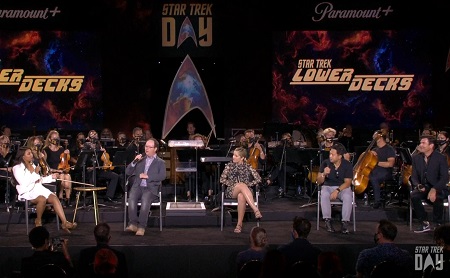
The Lower Decks panel was perhaps the funniest of the night. It was also the one where the interviewees felt the most comfortable and did their best at participating and answering questions; there were none of the awkward silences or long pauses that made me cringe during other panels. Noël Wells, Eugene Cordero, and creator Mike McMahan initially took to the stage before being joined in truly spectacular fashion by Ransom voice actor Jerry O’Connell. The cast members clearly get on very well together, and this came across as the four talked with host Mica Burton about the first four episodes of the season as well as what’s to come in the remaining six episodes.

Wells and Cordero talked about how they see their characters of Tendi and Rutherford becoming friends and bonding over “nerd” things – geeking out together over things like new tricorders, engineering, or how best to do their work was a hallmark for both in Season 1. I’m not so sure how I feel about Mike McMahan saying that the rest of the season plans to go “even bigger” with some of its stories. Lower Decks can be overly ambitious, at times, with the number of characters and story threads it tries to cram into a twenty- or twenty-five-minute episode, and this can be to the detriment of some or all of the stories it wants to tell.

Mike McMahan, Noël Wells, Eugene Cordero, and Jerry O’Connell participated in the Lower Decks panel.

However, McMahan spoke about the episode Crisis Point from Season 1 as a kind of baseline for how big and bold the show wants to go in the second half of Season 2. That episode was one of the best, not just for its wacky over-the-top action, but for its quieter character moments. If the rest of Season 2 keeps in mind the successful elements from episodes like Crisis Point, then I think we’re in for a good time!

The mid-season trailer was interesting! Here are just some of the things I spotted: the Pakleds are returning, Rutherford seems to get a “Wrath of Khan-inspired” moment in a radiation chamber, Tendi was transformed into a monster that seemed reminiscent of those in Genesis from Season 7 of The Next Generation, Boimler and Mariner are involved in a shuttle crash, Mariner rejoins Captain Freeman on the bridge, there was a scene in which Boimler easily defeated some Borg that I assume must be a dream or holodeck programme, a Crystalline Entity was seen, the creepy bartender with the New England accent was back, and Boimler and Mariner shared a joke about the utility of phaser rifles. I’m sure there was more – but those were the key things I spotted! The rest of Season 2 will hopefully continue to hit the highs of the past few weeks – and there’s another episode coming out very soon here in the UK that I can’t wait to watch!

Rutherford’s “Wrath of Khan moment” from the mid-season trailer.

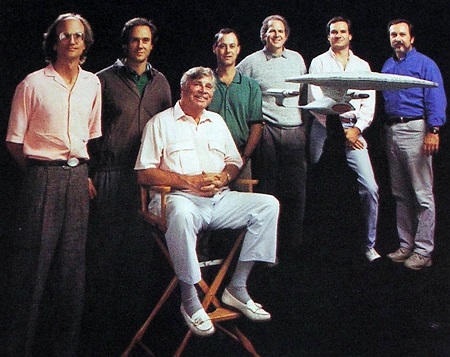
It was very sweet for Star Trek Day to take time to discuss Gene Roddenberry’s legacy, coming in the centenary year of his birth. His son Rod, and former Star Trek stars LeVar Burton, George Takei, and Gates McFadden joined Wil Wheaton to talk about Gene Roddenberry, and this was one of the most touching moments in the entire event. There were some laughs as George Takei told us about his first meeting with Gene Roddenberry and how he came to land the role of Sulu – including how both he and Gene mispronounced each others’ names! Gates McFadden seemed to have been talked into joining the cast of The Next Generation by Roddenberry, having initially wanted to return to the stage and join a play. Rod Roddenberry’s reminiscence of the design process for the Enterprise-D was hilarious – apparently his mother thought the ship looked like “a pregnant duck!”

LeVar Burton, who had been a Star Trek fan prior to joining The Next Generation, spoke about how he was overwhelmed at first when meeting “the Great Bird of the Galaxy,” and how a small role on a made-for-television film introduced him to producer Bob Justman, who later arranged for him to meet with Gene Roddenberry during pre-production on The Next Generation. All of these anecdotes went a long way to humanising Gene Roddenberry the man – we can often get lost in the legacy and philosophy he left behind, and how Star Trek and the world he created has influenced and impacted us, but this was a rare opportunity to hear small, personal stories about the man himself. I greatly appreciated that.

LeVar Burton spoke about working with Gene Roddenberry before giving a speech about The Next Generation.

George Takei got one of the biggest applause lines of the evening when he spoke about the importance of Star Trek’s fans, in particular Bjo Trimble, on popularising The Original Series and getting a nationwide fan community started. Decades before the internet came along to make fandoms and fan communities a part of many peoples’ lives, Star Trek was already developing its very own devoted fan community thanks to people like Bjo Trimble, and for George Takei to take time to acknowledge the role fans have played in Star Trek’s ongoing success was wonderful to hear.

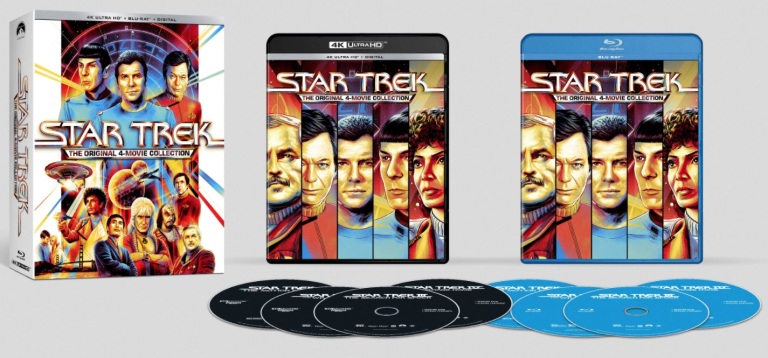
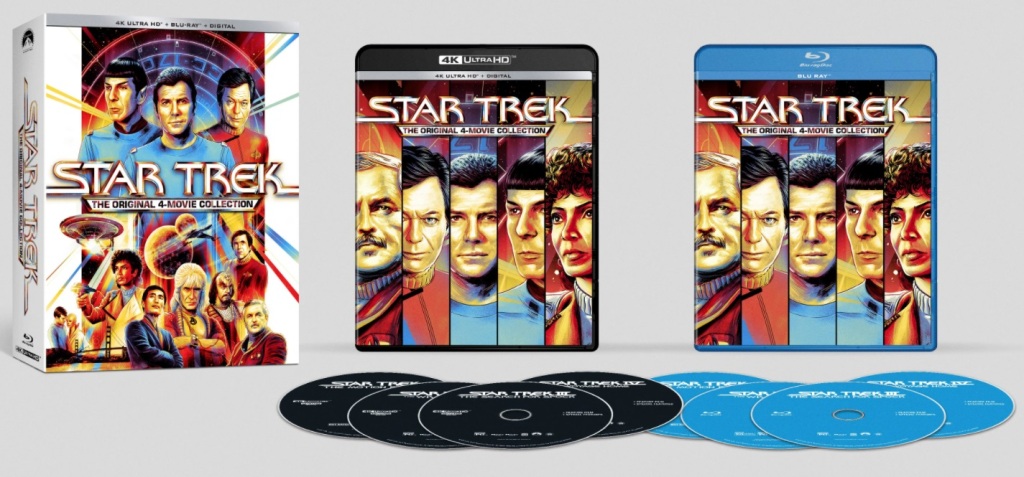
As I’ve said before, The Motion Picture was the culmination of this fan-led journey for Star Trek, but the film also laid the groundwork for much of what we’d come to know as Star Trek in the eighties and nineties. Many sets and design elements were in continuous use in some form from The Motion Picture’s premiere in 1979 right the way through to the cancellation of Enterprise in 2005, and much of the aesthetic and feel of Star Trek is owed to what The Motion Picture pioneered. George Takei acknowledged that, and that was a pretty cool moment. The Motion Picture is one of my favourite Star Trek films, and a 4K remaster was briefly shown off as well – the 4K blu-ray set of the first four Star Trek films is out now, so Star Trek Day took a moment to plug it!

There was a brief glimpse of the remastered version of The Motion Picture from this new box set.

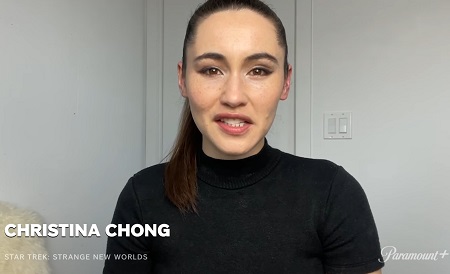
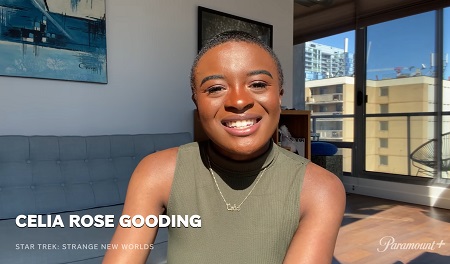
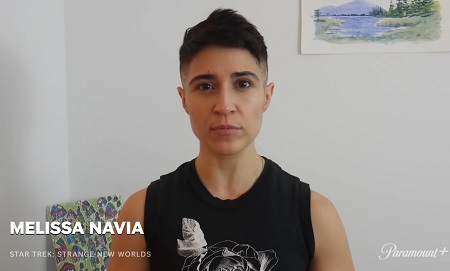
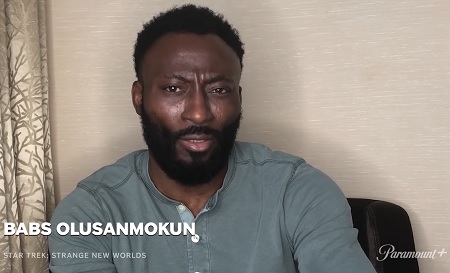
The panel that seemed to get the most online attention was, I felt, one of the worst and most cringeworthy to watch! The Strange New Worlds panel was followed up by a pre-recorded video that introduced new members of its main cast, who joined Anson Mount, Ethan Peck, and Rebecca Romijn. Among the newly-revealed characters were an Aenar (an Andorian race introduced in Enterprise) a possible descendant or relation of iconic villain Khan, and three characters from The Original Series who are returning to Star Trek: Dr M’Benga, who appeared in a couple of episodes, Nurse Chapel, and the one who got the most attention: Cadet Nyota Uhura!

Uhura blew up online after the announcement, and it’s fair to say that I was not expecting this! There was scope, I felt, for Strange New Worlds to bring back classic characters, but the choices they made seem to be pitch-perfect. I’m especially excited to see more from Dr M’Benga – he was a minor character who feels ripe for a deeper look. The same could also be said of Captain Pike and Number One!

Uhura’s return pretty much broke the internet!

As I predicted a few months ago, the uniforms for Strange New Worlds have been slightly redesigned from their Discovery style. I was never wild about the asymmetrical collars; they worked okay on Discovery’s all-blue uniforms but looked perhaps a little clumsy on the recoloured uniforms worn by Pike and the Enterprise crew. So to see the teaser show off a redesigned style that keeps the bold primary colours but ditches the Discovery style was pretty great! As with any new uniform I think we need time to see them in action and get used to them, but there’s already a lot to like. In addition to the V-neck style worn by Pike and Spock, we saw a white medical variant worn by Nurse Chapel, another medical variant with a broad crew collar worn by Dr M’Benga, and a zipper style worn by Number One. Starfleet uniforms – like any aesthetic or design element – are of course subject to personal taste, but from what we’ve seen so far I like the Strange New Worlds uniforms.

The Strange New Worlds live panel was not the best, though. Anson Mount, who is usually so full of life and happy to talk about all things Trek, sat in silence for large parts of it, deferring to the rest of the panel to answer questions. He may have been trying to avoid jumping in too fast or dominating proceedings, but it led to several very awkward silences that weren’t fun to watch. I got the sense that perhaps he wasn’t feeling well.

Anson Mount was not on his best form for the Strange New Worlds panel, unfortunately.

The producers – Akiva Goldsman, who has previously worked on Picard, and Henry Alonso Myers – gave us a few tidbits of information about the series. I was very pleased to hear so much positive talk about returning Star Trek to a more episodic format. Goldsman, who had been instrumental in crafting Picard’s serialised story during Season 1, seems quite happy to return to episodic television. There are a lot of advantages in a show like Strange New Worlds – i.e. one about exploration – to using a more episodic format. Episodic television can still see wonderful character growth – I’d point to Ensign Mariner in Lower Decks as a recent Star Trek example – so it was great to see how positively the cast and crew talked about that aspect of Strange New Worlds.

The producers and cast seemed very keen to embrace the legacy of The Original Series in more ways than one. Without looking to overwrite anything, they want to bring their own take on classic characters, and I think that’s great. Spock benefitted greatly from the expanded look we got at him in Discovery’s second season, and there’s no reason to think characters like Nurse Chapel or Cadet Uhura won’t likewise get significant character development that plays into the characters we know and love from their roles in The Original Series.

Jess Bush will be taking on the role of Nurse Christine Chapel in Strange New Worlds.

In terms of aesthetic, Strange New Worlds is trying to walk a line between embracing the 1960s style of The Original Series and also updating the show to a more modern look. There was talk about the design of sets, in particular Captain Pike’s quarters, and how the designers had been keen to return to the 1960s for inspiration. Likewise hair and nail styles were mentioned by Rebecca Romijn for Number One – a ’60s-inspired, “retro” look seems to be on the cards for the character, but not to such an extent that it becomes distracting. Walking that line is a challenge – but one I’m glad to see the show tackling!

We didn’t get a full trailer for Strange New Worlds, and the character introductions were cut in such a way as to minimise what we could see of the USS Enterprise. However, we did get a decent look at the transporter room set, which looks really cool, and when we met Dr M’Benga we got a glimpse of what I assume to be sickbay – and it looks like the colour scheme from The Original Series is still present in some form. We also got to see the logo and typeface for Strange New Worlds.

The Strange New Worlds logo.

So an underwhelming panel in some respects led to one of the biggest reveals of the night! Uhura, Chapel, and Dr M’Benga make welcome returns to Star Trek, that’s for sure. And there’s a particular genius to choosing these three characters in particular: they’re all ripe for more development and exploration. Uhura was a mainstay on The Original Series, but compared with the likes of Kirk and Spock there’s still plenty of room to explore her characterisation, background, and learn more about who she is in a way that will inform the original character and portrayal. Likewise for Nurse Chapel and Dr M’Benga – in many ways these two characters are near-blank slates for the new writers and producers to mould into their own creations.

I’m more excited today for Strange New Worlds than I was 24 hours ago, and that’s really saying something! I loved how Mount and the producers spoke about how his portrayal of Pike and Pike’s leadership style led them to redesign parts of his quarters so he could accommodate more of his crew around the table. Cooking was a big part of Captain Sisko’s character in Deep Space Nine, and I picked up at least a hint of that in some of the things said about Pike.

Dr M’Benga, despite being a returning character, offers a lot of scope for further development by a new team of writers.

The panel also discussed how the USS Enterprise is a “star of the show” in many respects, and how episodic storytelling will allow the series to return to Star Trek’s roots in terms of producing entertaining stories with morals. As I’ve said before, Star Trek has always used its sci-fi lens to shine a light on real-world issues, and to learn that Strange New Worlds is embracing that is fantastic news.

Spock’s characterisation was mentioned by Ethan Peck and the producers, and there was talk of how we’d see different facets of his personality. The Cage was mentioned as showing us “smiley Spock,” and I liked how the producers have a keen knowledge of how Spock and other Vulcans perceive and experience emotions – Spock is an emotional person, even if he suppresses those emotions much of the time. An exploration of that aspect of his character – informed by his experiences in Discovery Season 2, perhaps – will be truly interesting to see play out.

Captain Pike and the crew of Strange New Worlds will be on our screens in 2022.

Finally we come to Star Trek: Picard. This was the final event of the evening, and unfortunately the way it was teed up felt incredibly rushed. Jeri Ryan – who will reprise her role as Seven of Nine in Season 2 – raced onto the stage to introduce the new trailer, and it just seemed very obvious that the people running the event were acutely aware of time constraints and wanted to get it over with as quickly as possible. There was no Picard panel, no appearance from Sir Patrick Stewart (even by video-link or in a pre-recorded message), and though the trailer was very interesting the way Picard Season 2 was handled felt rushed right at the end of Star Trek Day – ironic, perhaps, considering the rushed way Season 1 also ended!

We’ll get to the trailer in a moment, but it was great to see that Picard Season 3 has been officially confirmed. We knew this was coming – Season 3 is already in production, and filming has already begun. But to get an official confirmation was good, and it drew a huge cheer from the audience. There’s clearly a big appetite for more Picard!

Picard is coming back for a third season!

Onward, then, to the trailer. This is one that I’ll have to return to for a more detailed breakdown in the days ahead, but for now here are my summarised thoughts.

A return to the 21st Century is not what I would have chosen. Time travel isn’t my favourite Star Trek storyline, and in particular time travel stories which return to the modern day can feel awfully dated very quickly. Look, for example, at Voyager’s two-parter Future’s End, or Star Trek IV as examples of that. Star Trek feels like the future – one of the reasons I love it so much – and when it comes back to the modern day I think it risks losing something significant. It’s possible that only a small part of the story will be set in the modern day, but even so I wasn’t exactly wild about this story element, unfortunately.

We knew from the earlier trailer that there has been some kind of change or damage to the timeline. It now seems as though Q may be more directly involved, as Picard blamed him for breaking the timeline. Whatever the change was, it seems to be centred in our own 21st Century (though it could be anywhere from 2020-2040, I guess) and resulted not in the creation of the Federation but a “totalitarian state” by the 24th Century. I don’t believe that this is the Mirror Universe that we’re familiar with, but rather a change to the Prime Timeline itself – perhaps caused by Q, but earlier comments seemed to suggest that Q wasn’t to blame, so watch this space.

A visit to the 21st Century would not have been my choice… but I will give it a chance!

In voiceover we heard Laris questioning Picard’s motivation for wanting to join Starfleet or leave Earth, something we’d seen him talk about in episodes like Family and again in Generations. She seemed to question whether he’s “running” from something in his past – could it be some darker impulse or perhaps a family secret that’s connected in some way to the creation of the totalitarian state? Could it be, as I suggested recenly, tied into World War III?

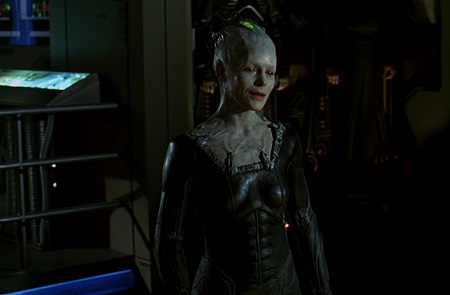
One of the things I was most curious about was the role of the Borg Queen, whose return had been signalled a few days ago via a casting announcement. It seems as though Picard has access to the incarcerated remains of a Borg Queen – somehow – and that she may be vital to allowing the crew of La Sirena to travel through time. Rather than the Borg themselves playing a role in the story, then, this may be a battle involving Picard and Seven – victims of assimilation – and a captured, damaged Borg Queen.

What role will the Borg Queen play? She appears to be a captive of some kind.

There’s a lot more to break down from the Picard trailer, and in the days ahead I’ll put together my thoughts in more detail – as well as perhaps fleshing out a theory or two. For now, I think what I want to say is that I have mixed feelings. The big drawback I can see is the modern-day setting for part of the show. I hope I’m proven wrong, but to me Star Trek has never been at its best with these kinds of stories, and I’m concerned that it’ll stray from being a Star Trek show into something… else.

On the other hand, there are many positives. The return of Laris, who seems to have an expanded role compared to where she was in Season 1. Q’s mysterious time-bending role, too. Is he the villain of the piece, or is his latest “trial” something that he believes will help Picard and humanity? What role will he play – ally, adversary, or something in between? The “totalitarian state” definitely channelled some elements of the Mirror Universe, but also seems to have put its own spin on this concept, taking it to different thematic places. I’d be curious to see what role the Picard of this timeline has in the government of the totalitarian state.

Something has broken the timeline – leaving Picard and his crew trapped in a “totalitarian” nightmare.

So that’s all I have to say for now. In the days ahead I’ll take a closer look at the Picard trailer, as well as talk about other things we learned at Star Trek Day.

Although it was a late night and a long broadcast, I had a good time with Star Trek Day overall. There were some moments that didn’t work well, some unprepared interviewees and some segments that dragged on too long, but on the whole it was a fun and incredibly positive celebration of Star Trek. I came to the broadcast hoping to see more from upcoming shows, but I was blown away just as much by the celebration of Star Trek’s past as I was by the look ahead.

The hosts, presenters, and most of the speakers and guests showed off their passion and love for Star Trek in a very positive way. There was a lot of talk about returning the franchise to its roots, celebrating the legacy of Gene Roddenberry and his original vision for Star Trek and what made it so appealing to people of all ages across multiple generations. As we look ahead to Star Trek’s future in 2021, 2022, and beyond, taking these moments to look back at what got Star Trek to where it is today was fantastic, and well worth taking the time to see. Above all, Star Trek Day shone with passion and positivity, and that’s just what the franchise needed as it marked its fifty-fifth birthday. Here’s to the next fifty-five years of Star Trek!

Star Trek Day was broadcast online and on Paramount+ on the 8th of September 2021 (9th of September 2021 in the UK). At time of writing the event can be re-watched on the official Star Trek website; panels and trailers are supposed to be available via Star Trek and Paramount+ official YouTube channels. Clips may also be available via official social media pages and channels. The Star Trek franchise – including all properties and series mentioned above – is the copyright of ViacomCBS. This article contains the thoughts and opinions of one person only and is not intended to cause any offence.

Star Trek Day 2021 predictions

Spoiler Warning: There are spoilers ahead for upcoming Star Trek productions, including: Star Trek: Picard, Star Trek: Discovery, Star Trek: Prodigy, and Star Trek: Strange New Worlds.

Just a short one today! Star Trek Day is coming up in a couple of days’ time, and we’re promised news and discussion of all things Trek straight from the horse’s mouth! Why is September the 8th designated as “Star Trek Day?” Good question, and here’s the answer: it was on that day in 1966 that The Man Trap premiered, kicking off Star Trek: The Original Series Season 1 and laying the groundwork for a franchise that’s still going strong today.

As an aside, last year I wrote a piece looking at the villainous creature at the heart of The Man Trap’s story, and you can find that article by clicking or tapping here. Worth a read at this time of year – if I do say so myself!

The Man Trap is where the franchise began – almost fifty-five years ago.

As much as Star Trek Day is an opportunity to look back at the franchise’s fifty-five years of history, this digital event hosted by Wil Wheaton and Mica Burton is also an excuse to look ahead to some of the Star Trek projects that are coming up over the next few months and years. There will undoubtedly be some news – and keep your fingers crossed because it’s even possible that we could get a big, unexpected announcement!

I’ve got a few ideas for what might be coming our way when Star Trek Day kicks off. Please keep in mind, as always, that I don’t have any “sources” nor any “insider information.” This is just a little educated guesswork – and a reminder, in case you’d forgotten, that Star Trek Day is imminent! All of the panels will be available to watch online on the official Star Trek website, so be sure to check in on the 8th to see what they have to say. Or just come back here a day or so later because I daresay I’ll summarise what I consider to be the most important points!

Let’s jump into the list!

Number 1: Official confirmation of Star Trek: Picard Season 3.

A third season is already being worked on!

This one is a bit of a cheat, as we’ve already heard from a number of reliable sources that Season 3 was in development alongside Season 2, and the two seasons are being filmed back-to-back. In fact, it seems as though some Season 3 scenes may have already been filmed – but that’s not confirmed at this stage.

What’s also unconfirmed, at least from ViacomCBS and Star Trek officially, is the existence of Season 3 at all. Though in the past we’ve seen the company wait until a season is almost being broadcast to confirm that the next one is in development, on this occasion it would make sense to announce Picard Season 3 way ahead of time. It’s already an open secret, so why not? It seems like a great way to drum up even more excitement!

Number 2: A trailer for Star Trek: Strange New Worlds.

Anson Mount recently appeared as Captain Pike in a series of trailers for Paramount+.

Since Strange New Worlds introduced us to five members of its main cast in mid-March, there really hasn’t been a lot of news about the series. We heard last month that production was drawing down on Season 1, only to later learn that some scenes outside of Toronto (where the show is based) were still being worked on. If it’s true that the season is finished, though, the time could be right for a trailer!

Along with Picard Season 2, Strange New Worlds has to be the series that I’m most curious about. Not only will it be fantastic to welcome back Anson Mount as Captain Pike, but the semi-episodic format that has been suggested feels like it could really be the best of both worlds – a return to Star Trek’s past without entirely stepping away from the modern feel of recent productions.

There is a Strange New Worlds panel that will be taking place during Star Trek Day, and a trailer would be a great way to wrap it up!

Number 3: A premiere date for Star Trek: Discovery Season 4.

The USS Discovery is ready to warp away to her next adventure!

At time of writing, all we know about Discovery’s impending fourth season is that it’s due before the end of the year. Maybe that’ll change and we’ll see the show fall back to early 2022, or maybe Discovery is still on track for a broadcast kicking off in mid-October after Lower Decks Season 2 has concluded. (That was what happened last year.)

Either way, I think Star Trek Day would be a great opportunity for ViacomCBS to drop the date of the new season’s premiere with a lot of attention on the franchise.

Number 4: A teaser trailer for Star Trek: Picard Season 2 featuring the Borg.

The Borg Queen is returning to Star Trek!

Soon we’re going to talk and theorise about the Borg in Picard Season 2. If you missed this, there’s been a casting announcement for the upcoming second season that caught me off-guard: the Borg Queen is returning! Not only that, but she may appear in as many as six of the season’s ten episodes, indicating that the Borg may play a significant role in the story.

It’s been more than eighteen years since the last Star Trek story featuring the Borg: Enterprise’s second-season episode Regeneration. After such a long time it’ll be fantastic to bring the faction back into play in a big way – assuming that’s even the plan! For all we know the Borg Queen may play an altogether different role in flashbacks or in an alternate timeline!

Regardless, following this casting announcement I’d think ViacomCBS would want to tease something about the Borg – without giving away too many potential spoilers.

Number 5: A second trailer for Star Trek: Discovery Season 4.

Captain Burnham in the first Discovery Season 4 teaser.

We got our first look at Season 4 of Discovery back in April, where a trailer showed Captain Burnham and the crew facing down a “gravitational anomaly” – whatever that could be! With the season coming up before the end of the year – all being well, that is – it would be a good time for a second trailer to get fans excited.

It can be hard to get the balance right when it comes to producing a trailer for a brand-new season, especially when a series has a mystery at its core like Discovery does. Show too little and it’ll be hard for fans and prospective viewers to get excited, but show too much and you risk spoiling major plotlines. Cutting the perfect trailer under such circumstances is a real skill!

Number 6: A release date for Star Trek: Prodigy.

Prodigy is coming soon… but how soon?

I’ve all but given up on Prodigy getting an international broadcast when it premieres this autumn – at least outside of countries and territories where Paramount+ already exists. Though the series has been co-developed alongside Nickelodeon, it seems as though ViacomCBS is intent on keeping the show exclusively on its streaming service, so it seems unlikely to arrive here in the UK until Paramount+ does some time next year.

For everyone who’s lucky enough to live somewhere with Paramount+ already, though, keep an eye out for a release date for Prodigy. Earlier in the year the series was officially announced for “Fall 2021” – and the beginning of September basically marks the start of autumn, as I recently noted! So we could see Prodigy literally any time from now until the end of November, and I think the Prodigy panel at Star Trek Day would be a great place to announce the specific date.

Number 7: A big, surprising announcement!

I’m always up for a surprise!

What could it be? Is the untitled Section 31 series finally on the verge of entering production? Has ViacomCBS backed down after years of being pestered by Michael Dorn and decided to greenlight a Captain Worf series after all? What about the live-action series that Alex Kurtzman had previously said was in development – could we finally learn more about that?

Though I don’t think we should get too excited about this one, there’s always the possibility for a surprise announcement of some kind. One thing we know for certain is that more Star Trek is in development – so it’s not impossible to think we could see something announced this week.

So that’s it!

All of the panels for 2021’s Star Trek Day!

Star Trek Day will be upon us before you know it, so stay tuned here on the website for coverage and analysis of any major announcements, as well as for a review/roundup of the event itself. I’m looking forward to Star Trek Day very much; it’ll be a great excuse to geek out for hours on end!

I hope this list of predictions has got you suitably excited for the main event!

Star Trek Day panels will be available to watch on Paramount+ and on the official Star Trek website on the 8th of September 2021. The Star Trek franchise – including all properties and titles mentioned above – is the copyright of ViacomCBS. This article contains the thoughts and opinions of one person only and is not intended to cause any offence.

Ten great Star Trek starship designs

Spoiler Warning: There are spoilers ahead for Star Trek: Picard Season 1, Star Trek: Deep Space Nine, and for other iterations of the Star Trek franchise.

The Star Trek franchise has an aesthetic all its own, and a big part of that is the way starships are designed. Many Trekkies have said over the years that a ship is like an extra member of the cast; a vital part of any Star Trek series or film. While there have been some visual misses, of course, for the most part Star Trek’s ships have been fantastic to look at.

Aesthetics are always going to be a matter of personal taste, and there are many factors at play in considering what makes for a “good-looking” starship. Because the ships and most of their technologies are wholly fictional, designers and artists have a fair amount of leeway when it comes to designing a new starship. Technobabble can always be employed to explain away inconsistencies – like how the USS Defiant’s warp nacelles work, for example.

The USS Defiant.

Over more than half a century, Star Trek has featured many different designs of starship. Many of these, even the newest ones, take inspiration from the original USS Enterprise, which was designed by Matt Jeffries (with some input from others, including Gene Roddenberry) for The Cage in 1964. The basic saucer section, drive section, plus two nacelles on pylons style has been present in most Federation ships – and, in some form, all of the “hero” ships – ever since.

On this list I’m going to pull out ten of my favourite designs of both Federation and non-Federation starships. The list is by no means exhaustive, and it may be a topic I revisit in future as I can already think of several more I could have easily included! As indicated, this whole thing is entirely subjective. So without further ado, let’s jump into the list – which is in no particular order.

Number 1: The Klingon Bird-of-Prey

A Bird-of-Prey seen in Star Trek V: The Final Frontier.

The Bird-of-Prey is absolutely iconic as a Klingon vessel, at least on par with the D-7 battlecruiser from The Original Series. The vessel debuted in Star Trek III: The Search for Spock, before going on to appear in four more films, all of the 24th Century shows, and even recently in Lower Decks. Few non-Starfleet ships are as iconic or recognisable, and even many non-fans would easily identify the design.

In cinema, the Bird-of-Prey has had starring roles in five films, making it one of the most well-known enemy or villainous ships. Iconic adversaries like General Chang and Dr Soran used Klingon Birds-of-Prey in their nefarious schemes. But as Klingon-Federation relations improved in The Next Generation, we began to see the iconic vessel as an ally; a workhorse of the Klingon fleet. By the time of the Dominion War in Deep Space Nine we were rooting for the Klingon-Federation alliance, and some of the ships most often seen on the front lines were these wonderful Klingon ships.

Based loosely on the earlier Romulan Bird-of-Prey, the winged design captures the warrior philosophy of the Klingons perfectly. The small ship is incredibly powerful, armed to the teeth with disruptor cannons and photon torpedoes. The way the wings change position for combat or while at warp is clever, too, and the green colour scheme makes the craft stand out when compared to Federation ships.

Number 2: The Excelsior Class

The USS Enterprise-B.

Another starship that would be a workhorse for decades, the Excelsior is a really neat, futuristic design. It manages to look smarter and newer than the Constitution class that it would eventually replace, yet at the same time is clearly manufactured by the same organisation. It retains the saucer, drive section, and nacelles on pylons of older Federation ships, but switches up the design too. The ship is flatter, with a shorter “neck,” and has nacelle pylons that are shorter and have a ninety-degree bend instead of coming out of the drive section on a diagonal.

The Excelsior class also debuted in Star Trek III: The Search for Spock – the film succeeded at introducing us to two of the most iconic designs in the franchise! Though we’ve never seen a show or film set entirely aboard an Excelsior class starship, Excelsiors have been featured in five films and all three of the 24th Century shows.

By the 24th Century the Excelsior class was still in use, and while it had taken a back seat to the likes of the Galaxy class and other newer ships, many Excelsior class vessels were still in service in a variety of roles. Some would even see action in the Dominion War, meaning that the Excelsior class was still being deployed almost a century after its inception. That must be one solid ship!

Number 3: The Runabout

A Runabout seen in The Next Generation.

I adore the Runabouts that debuted in Deep Space Nine. They remind me of camper vans (or RVs) in terms of size and design, incorporating most of the mod-cons a 24th Century Starfleet officer might expect – just in a much more compact vessel. If I could pick any starship for myself (and the cats) to have for cruising around the galaxy, I’d definitely pick a Runabout.

When Deep Space Nine was being developed, there was a sense that setting a series on a static space station might be too far removed from Star Trek’s past, and thus there was a need to give Commander Sisko and the crew something to keep them mobile. From an in-universe perspective, too, the station needed to have some way for the crew to leave in an emergency – or just to make routine visits to nearby planets. Hence the Runabout was born – larger than a shuttlecraft but smaller than any starship we’d seen before.

These cute mini-starships each have their own name and registration, but from what’s shown on screen they seem to be assigned to bases and starships as auxiliary craft rather than being fully-independent vessels in their own right. Despite that, Runabouts are depicted as highly capable, versatile vessels. Early exploration missions into the Gamma Quadrant often utilised Runabouts based at DS9, and the ships were more than capable of surveying planets and charting star systems.

Number 4: The Constitution Class (original configuration)

The USS Enterprise from The Original Series.

The original Constitution class has to make any Trekkie’s list of great starship designs, right? Though it may feel dated in some respects, this is the source from which basically all of the other designs on this list were created. Federation starships are pretty much all designed with the Constitution in mind – the saucer, drive section, and nacelles design is emblematic of Starfleet, and thus of Star Trek. Even non-Federation ships are designed to stand in opposition to the Constitution (and the ships derived from it) so it’s undeniably the most significant and important starship design in the franchise.

The original design was simple, mid-60s futurism at its finest. The saucer is a design that had been synonymous with spaceships for decades thanks to myths of UFOs and flying saucers, so the decision to incorporate that kind of design was genius. The ship’s engines with their glowing tips became inseparable from warp speed and faster-than-light travel. And of course the deflector dish was reminiscent of satellite dishes – a new technology at the time.

Most importantly, this is where Star Trek began. The Constitution class USS Enterprise kicked off the franchise and became one of the most iconic sights in all of science fiction. Even today it’s instantly recognisable, even to folks who don’t watch Star Trek or know anything about the franchise.

Number 5: The Constitution Class (refit configuration)

An iconic moment in The Motion Picture.

As much as I love the original Constitution class, I think I like the refit even more. The refit Constitution class is the subject of one of my favourite sequences in all of Star Trek – where Admiral Kirk and Scotty approach the newly-refitted Enterprise when it’s still in drydock in The Motion Picture. That sequence is so beautiful (and with an amazing musical score to boot), showing off the starship in all its glory.

If the original configuration of the Constitution class had design features emblematic of its 1960s space race origins, the refit is much more “up-to-date,” replacing the satellite dish-style deflector with a glowing light, toning down the grey colour, and generally adding more lights and more features that make it an icon of the ’80s. In fact, I’d argue that many ’80s and ’80s-inspired sci-fi ships can trace some part of their design back to the refit Constitution class.

At the same time, though, the refit doesn’t completely abandon what made the original starship so iconic. The saucer section, drive section, nacelles, and pylons are all still present. The domed bridge is still there at the top of the ship, and even though a lot as been changed, it’s still clear that this is supposed to be an updated design, not a wholly new one.

Number 6: The Galor Class Warship

A Galor class ship under fire from a Maquis fighter in the premiere of Star Trek: Voyager.

The Cardassians – and their Galor class warships – debuted in The Wounded, a fourth-season episode of The Next Generation which, in many ways, began to lay the groundwork for Deep Space Nine. And it was in the latter show that the Galor class would be seen most often; a vehicle for the villainous Cardassians.

Its design is, in some respects, a blend of Starfleet and non-Federation ships. The semi-circular “mini saucer” that juts out at the front, as well as the deflector array it sits atop, kind of resemble Starfleet designs, but the wings and elongated “tail” – as well as the yellow colour scheme – make it clear that this is definitely not a Federation starship!

The Galor class would be seen as the mainstay of the Cardassian fleet, serving in combat roles before and during the Dominion War. Some engagements during the Dominion War would see dozens – perhaps hundreds – of Galor class vessels deployed alongside their Dominion and Breen allies, and they could look incredibly intimidating en masse. Seeing Galor class ships open fire on the Breen and Dominion indicated that the Cardassians had switched sides during the war’s closing hours, and that sequence is absolutely outstanding; one of the best space battles in the entire franchise.

Number 7: The USS Pasteur

The USS Pasteur.

Unlike the ships mentioned above, the USS Pasteur was only seen in one episode – All Good Things, the season finale of The Next Generation. Despite its limited screen time, however, I like the design. Its spherical “saucer” section is distinctive, and gives it a look all its own. The spherical design was based on an unused concept Matt Jeffries had for the original USS Enterprise during early development on The Original Series, which is a cool little fact!

As I’ve said before, I really like the concept of a hospital ship in Star Trek. I’d be quite happy to see a “Star Trek-meets-ER” series one day, and such a series would surely make use of a ship like the USS Pasteur. Modern navies have hospital ships, so it stands to reason that Starfleet would too, and the USS Pasteur was our first up-close look at such a support vessel.

A Pasteur-type ship was seen in Season 1 of Lower Decks (albeit in a flashback) so the design isn’t dead. Perhaps one day we’ll see more of these ships and get to know a little more about them. Regardless, I love the design.

Number 8: The Borg Cube

A Borg cube in orbit of Earth.

Few adversaries in Star Trek are as genuinely frightening as the Borg – for reasons that I discussed in my essay on the faction. An intimidating villain needs an intimidating starship, and the Borg cube delivers. There’s something frighteningly mechanical about a plain cube. There are no engines, no obvious bridge or command centre… everything about the vessel from all sides looks the same.

The Borg’s hive mind sees them operate as one entity, and their ships are part of that. The “philosophy” of the Borg – for want of a better term – is perfectly expressed in the design of their most commonly-seen starship. Every part of the ship is the same, just as every Borg drone is the same.

When we first see a Borg cube in Q Who, the sheer scale of the ship is impressive, too. The Borg vessel dwarfs the Enterprise-D, and then its powerful weapons and tractor beam overcome the Galaxy class ship’s defences with ease. Even though we’ve seen Borg cubes defeated in subsequent stories, remembering that a single vessel was able to destroy 39 Federation ships and almost succeed at assimilating Earth reminds us that these ships are incredibly powerful. Even by the time of First Contact, defeating a single Borg cube was a tall order for Starfleet.

Number 9: La Sirena

La Sirena in The Impossible Box.

Captained by Chris Rios and chartered by Admiral Picard, La Sirena made its debut in Star Trek: Picard Season 1. Everything I said about the Runabout feeling like a fun-sized ship could also apply to La Sirena, but the visual style makes it distinctive. La Sirena is basically a Runabout mixed with a hot rod!

The red and white colour scheme suits the ship perfectly, and there are even echoes of Star Wars’ Millennium Falcon in La Sirena’s design and concept. It’s the perfect vessel for Picard; small enough to be run by a skeleton crew (plus holograms!) but large enough not to feel cramped. It’s definitely not Starfleet, but there are Federation design elements present throughout.

Star Trek hasn’t really had many opportunities to showcase civilian starships, so La Sirena represents a look at a completely different side of the Star Trek galaxy, one we haven’t seen before. Though the franchise keeps these things deliberately vague, there must be a great deal of interstellar traffic, including transporting passengers and cargo. People like Captain Rios – and also others like Kassidy Yates – show us a glimpse of that world.

Number 10: The Sovereign Class

The first shot of the Enterprise-E in First Contact.

Perhaps it’s because Nemesis was the furthest forward the Star Trek timeline had got for almost twenty years, but to me the Soverign class has always seemed like one of Star Trek’s most modern and futuristic starships. The design represents a complete overhaul from the previous Galaxy class, flattening the “neck” of the ship again so the elongated saucer is almost contiguous with the drive section.

It’s a shame that the Sovereign class Enterprise-E only had the opportunity to make three appearances, as I would have dearly liked to see more of it in action. In some ways it has more of a militarised feel than the Galaxy, especially in terms of its interior, and perhaps we can say that’s a response to Starfleet taking on board threats from the Borg and Dominion during the design process.

The most iconic Sovereign class moment for me is the Enterprise-E’s arrival at the Battle of Sector 001. Swooping in to take on the Borg cube when the Starfleet armada was falling apart – accompanied by another beautiful piece of music – is one of the best moments in First Contact!

So that’s it! Ten great Star Trek starship designs.

Star Trek: Discovery’s new take on the Constitution class.

There were many other ships I could’ve picked for this list, so stay tuned for “part two” in future! The Star Trek franchise has some great starships, and by keeping a relatively consistent aesthetic – generally speaking – has carved out a niche within sci-fi. Star Trek’s starships are almost always distinctive, and seldom feel like they could easily be part of some other film or franchise.

Everybody has their own favourites, though! There are some starships that we see often, either because they’re a “hero” ship or because they’re a frequently-used secondary design, and some of these have become iconic and emblematic of the whole Star Trek franchise. Other ships only make a handful of appearances, yet still manage to leave a lasting impression.

The Star Trek franchise – including all properties mentioned above – is the copyright of Paramount Global. This article contains the thoughts and opinions of one person only and is not intended to cause any offence.

Gene Roddenberry at 100

Today marks what would’ve been Gene Roddenberry’s 100th birthday, so it’s a good opportunity to pause and look back at the life and legacy of the man who created Star Trek – and changed science fiction forever.

Of course it’s true that we wouldn’t have Star Trek without Gene Roddenberry. But it’s very likely that Star Wars wouldn’t exist either, at least not in any form we’d recognise, and without either of those pioneers, countless other sci-fi and fantasy films and television shows would likely have never made it to the screen. Gene Roddenberry’s legacy extends far beyond the USS Enterprise, Captain Kirk, and the franchise he created that’s still going strong in its fifty-fifth year; he quite literally transformed science fiction and started the process of making it mainstream.

I never had the opportunity to meet Gene Roddenberry. In fact, by the time I settled in to regularly watch Star Trek: The Next Generation in the early 1990s, he’d already passed away. But his creation had a huge influence on my early life and adolescence, even though I only knew the man himself as merely one name among many in the end credits. Many people have spoken about the inspirational side of Star Trek, how the franchise depicts an idealistic future free from many of the problems and challenges our society has to deal with today. For me, that was – and remains – the appeal of Star Trek.

Gene Roddenberry (seated) with other members of the production and creative team behind The Next Generation.

Whole generations of people have grown up watching and loving Star Trek since Gene Roddenberry passed away. The fact that the franchise he created is still inspiring people to look to the stars – and to look to make changes for the better in the world today – a hundred years after he was born, and almost three decades since his death, is a phenomenal legacy for any one person to have. Untold numbers of people have been inspired by Star Trek to become scientists, doctors, engineers, astronauts, and even politicians, taking Gene Roddenberry’s philosophy and idealism for the future to every corner of our society. Star Trek may still be on the air, but Gene Roddenberry’s legacy has long since moved beyond the screen and into the real world.

As someone who never met Gene Roddenberry and only started watching Star Trek after he was already gone, I can’t comment on the man himself. I didn’t know him on a personal level, and I regret never having the opportunity to talk with him about the future and how our society and civilisation might evolve. But I can speak to how I perceive his legacy and how he affected the world, and though it might sound like a cliché, there are very few people who have had such a positive impact – both on my own life and in the wider world.

Gene Roddenberry with William Shatner, Leonard Nimoy, and DeForest Kelley on the set of The Motion Picture.

Star Trek was always double-layered for Gene Roddenberry. There was the cool sci-fi stuff; the spaceships, phasers, transporters, and the like. He brought those to life using the best available television technologies and special effects, some of which would be adopted by other productions and become mainstays of the sci-fi genre. But there was also social commentary and a desire to show audiences that the way the world is today isn’t the way it always has to be.

At a time when racial segregation was still ongoing in the United States, and when the battle for civil rights and racial equality was still being fought, Gene Roddenberry put black and white characters together on an equal footing. At a time when the United States and the Soviet Union were engaged in the Cold War, Gene Roddenberry put a Russian on the bridge of the Enterprise. And at a time when neurodivergent people were looked down on and mistreated, Gene Roddenberry created characters like Spock and Data, who present very differently to their peers but were nevertheless welcomed and accepted.

Gene Roddenberry created many wonderful and diverse characters.

Gene Roddenberry’s vision of Starfleet and the Federation was a space where everyone could feel welcome. Discrimination and hate didn’t exist in the 23rd or 24th Centuries as he saw it, and the way Star Trek depicted this vision of the future has been a force for good in the world.

On the practical side of things too, Gene Roddenberry’s legacy lives on. George Lucas has said on many occasions that Star Wars – arguably the biggest space-based entertainment property in the world – would not have come to exist without Star Trek and the trail it blazed. Countless other sci-fi and space-fantasy films, television shows, and even video games all owe a great deal to Gene Roddenberry and Star Trek. Though he didn’t invent the genre, Roddenberry expanded it in a big way. By creating one of the first connected fandoms, complete with meet-ups and conventions in which he and the show’s stars would happily participate, Roddenberry pioneered the concept of a fan community decades before the internet came along.

Jeffrey Hunter and Gene Roddenberry holding a model of the USS Enterprise during production of The Cage.

Later today, on what would’ve been Gene Roddenberry’s 100th birthday, a new episode of Star Trek will premiere. What would he have made of Lower Decks, the franchise’s first foray into comedy? Some folks who haven’t liked the direction that the franchise has taken in recent years might say he’d have disliked the concept, but actually Roddenberry had plans for a Star Trek comedy himself. Perhaps the most famous concept would’ve focused on Lwaxana Troi as a spin-off from The Next Generation, but he had many other ideas for Star Trek projects – including comedies – going all the way back to the 1970s.

A number of people involved in the production of Star Trek have noted how Gene Roddenberry was acutely aware of how audience expectations changed over time. One of the main reasons why his television project Star Trek: Phase II was reworked into The Motion Picture was because he’d seen the success of Star Wars in 1977 and how well audiences had responded to it. Though he may not have liked every single creative decision taken by the franchise over the years, he would at the very least understand that audiences have changed and that Star Trek has to change too. Whether he’d approve of every joke and character in Lower Decks or Discovery is thus a moot point; I think Gene Roddenberry would have understood and been supportive of the concept and of taking Star Trek to new places.

So that’s about all I have to say today, really. Though I never met him, Gene Roddenberry has had an ongoing influence on my life. As a Trekkie, I revel in the world that he created, the characters he brought to life, and the wonderfully optimistic vision of a future free from the kind of social ills that plague the world today. I believe, as he did, that the human race is capable of getting to that point. He encouraged all of us to reach for the stars – and to strive to build a better world. That legacy continues to this day – and I hope it will always be there.

The Star Trek franchise – including all properties mentioned above – is the copyright of ViacomCBS. Some behind-the-scenes photos courtesy of TrekCore. This article contains the thoughts and opinions of one person only and is not intended to cause any offence.

Star Trek: Lower Decks review – Season 2, Episode 1: Strange Energies

Spoiler Warning: There are spoilers ahead for Star Trek: Lower Decks Seasons 1-2,

Here we go again! After more than seven months with no new Star Trek, Lower Decks has returned to brighten our days once more!

Despite problems caused by the lack of an international broadcast limiting fans’ access to the show, the first season of Star Trek: Lower Decks was outstanding. The series broke new ground for the Star Trek franchise, being its first foray into the realm of animated comedy, yet at the same time felt familiar. Many of the jokes relied on references to past iterations of Star Trek, and as a whole Season 1 of Lower Decks felt like a love letter to the franchise and its fans.

Star Trek: Lower Decks has found an international home on Amazon Prime Video, and beginning with Season 2 fans all over the world are able to watch together, which is great news. I hadn’t realised until recently how much I’d missed my weekly appointment with Lower Decks, and it was wonderful to be able to step back into its fun take on Star Trek.

The episode’s title card.

Having been excited to see trailers and teasers for the new season earlier in the year, as Strange Energies approached I felt that the marketing department at ViacomCBS went overboard with showing us clips from the episode. I wanted to avoid the dreaded “Simpsons Movie phenomenon” – where a production gives away all of its good jokes and clever moments in marketing material ahead of time – so in the final few days leading up to the episode’s arrival I actually tuned out of all of these clips. I wanted to go into Strange Energies in as unspoiled a manner as possible.

The episode was solid, but perhaps not the best Lower Decks has had to offer. There were some clever jokes, fun references, and an A- and B-plot just like most of Season 1. The A-plot looked at the relationship between Mariner and Captain Freeman as they dealt with the titular strange energies that effected Commander Ransom. The B-plot focused on Tendi and Rutherford’s relationship in the wake of his memory loss at the end of Season 1.

Rutherford and Tendi got a secondary storyline in this episode.

Both of these storylines had some great elements and some that weren’t so good. When it came to Tendi’s desire to keep Rutherford as her friend, the whole thing just felt rushed. Within seconds of the two characters appearing on screen, Tendi had jumped down the rabbit hole of obscure technobabble medical conditions, and their story then raced through several sequences before coming to an obvious conclusion. The only time either character had a second to breathe was in the episode’s final moments.

Tendi has been a character that I felt failed to really find a niche in Season 1, despite Lower Decks putting her in several different situations. The one constant in her characterisation had been her friendship with Rutherford, so this storyline did have a solid foundation to build on. Perhaps if more time had been dedicated to it it could’ve worked better; such is the peril of making an animated series with episodes that barely reach the twenty-minute mark.

Rutherford and Tendi’s B-plot felt rushed.

As for Rutherford, though the memory loss was mentioned, it really served as little more than background for the unfolding story. I would’ve liked to have seen more of Rutherford coming to terms with his lost memories and re-forging the friendships he had in Season 1, not just with Tendi but also with Mariner, Boimler, and characters like Billups in Engineering. This story with Tendi worrying about the future of their friendship could still have worked in that context, but could’ve perhaps come in episode 2 or 3 of the season, after we’d seen a little more of Rutherford rebuilding after losing all of those memories. In that sense, one of the last big moments in the Season 1 finale felt like it was underused at the beginning of Season 2. There’s still scope for some Rutherford memory loss moments, I suppose, but they’ll come after this story has already effectively reset him to the way he was last year.

When the episode’s A-plot focused on the relationships between Mariner, Freeman, and Ransom I was concerned that we were going to see Mariner undo all of the growth and development that made her arc in Season 1 so powerful and interesting to watch. I was glad that it didn’t happen; the story built on that character arc and took the characters to different places without trying to undo what had come before.

Strange Energies devoted a lot of time to the relationship between Mariner and Captain Freeman.

It makes sense for characters as different as Freeman and Mariner to find it difficult to work together at times. And it makes sense for Ransom, as the ship’s first officer, to see Mariner’s newfound status and special treatment as an issue, so all of the building blocks that went into this side of the story worked as intended. Just as it took an extreme and unusual event in the Season 1 finale for Mariner and Freeman to overcome those differences and work together, it took another such event this time for them to realise that they didn’t enjoy their new dynamic as much as they pretended to. There’s almost a mirror feel to these characters’ stories in this episode and the Season 1 finale from that point of view; they form a duology.

Once a secret is revealed, though, there’s no way to cover it up again. And the show realised this; it isn’t possible to reset Mariner to the insubordinate angsty teenager that she was at the beginning of Season 1 because the nature of her relationship to Captain Freeman is now a known quantity, and we’ve already seen her growth in that regard. So Lower Decks charted a new path for Mariner, one which will hopefully allow her to do things on her own, keep some of her rebelliousness, but at the same time not completely regress or revert back to the way she was and undo that wonderful Season 1 character arc.

Mariner still gets to be a rebel, but hasn’t been “reset.” I think that balances things well!

Mariner undergoing a character regression was one of my fears for Season 2, and I’m glad that – so far, at least – Lower Decks has managed to avoid that temptation. A show can still be episodic if it has character arcs and genuine character growth, and what I’m hoping Season 2 will deliver, at least in regards to Mariner, is the best of both worlds from that point of view.

It was an interesting choice to begin Season 2 with an episode that essentially sidelined Boimler. He got a few seconds of screen time right at the very end, but that was all. After all of the speculation about a possible demotion or a return to the Cerritos, for it not to have happened in the first episode was a bold decision – one which worked well.

Boimler, Riker, and the bridge crew of the USS Titan.

Had Boimler been included in Strange Energies in any meaningful way (such as by returning to the Cerritos), realistically one of the other storylines would have had to be cut entirely in order to make his promotion-demotion story work. As it is there’s already a concern that undoing Boimler’s promotion so soon after granting it could be a problem, so keeping him out of the first episode and just teasing that things aren’t going well for him on the Titan was clever – it seems like it’s setting up a pathway for him to perhaps lose or voluntarily give up that role in a future episode.

Though I do have some theories that I posited before the season kicked off, I’m still not sure how Lower Decks will square that circle. Since we’ve been talking about Mariner and her Season 1 character arc, I want to repeat that I hope Mariner doesn’t intentionally sabotage Boimler’s new role and promotion. She seemed mad at him in the opening act of Strange Energies, but also said she couldn’t really blame him for leaving as the episode reached its conclusion. So there’s hope, from my perspective, that whatever reunites Boimler with the rest of the group won’t be all down to Mariner!

Boimler is clearly not settling in well aboard the Titan.

I’m curious to see if we’ll get a full Boimler episode next week – or at any point this season – showing him under Riker’s command aboard the Titan. If so, perhaps the conflict the Titan was engaged in with the Pakleds at the end of Strange Energies may have set that up. It was great to have Riker back, though, even just for a brief moment.

Ransom becoming a god-like entity was perhaps the weakest part of the episode, even though it served as the catalyst for a solid Mariner-Freeman storyline and managed to include some decent and clever jokes. Perhaps it felt too over-the-top, as if Lower Decks had turned the silliness up to 11 mere moments after the season debuted. Or perhaps there was just something about the way Ransom turned 180° from his usual laid-back self into a ship-eating monster that just felt forced or didn’t stick the landing.

I wasn’t wild about this part of the story.

Plus the whole “kicking him in the balls” ending was pretty silly and childish, even by Lower Decks’ standards. I usually enjoy even the lowest-brow humour that the show has to offer (the line “he’s got wood” was one of the funniest for me in all of Season 1, for example) but something about this being the ultimate resolution to Ransom’s newfound godhood just seemed… cheap? It was definitely exceptionally silly.

It was funny to see how casually Mariner, Dr T’Ana, and others treated what was happening to Ransom, as if these “strange energies” are something everyone in Starfleet has encountered or heard of at some point. And the callback to Where No Man Has Gone Before – Star Trek’s second pilot – was definitely appreciated, as was the way Dr T’Ana became convinced that squishing Ransom with a boulder was the only solution to the problem. Lower Decks has been packed full of these references and callbacks since it kicked off last year, and I was glad to see more of the same this time around.

The Gary Mitchell reference was neat.

The Cerritos is continuing its mission of second contact, and this week we met a new race – the Apergosians. Their design was okay, but nothing groundbreaking – though they really just served a role in the story instead of supposedly becoming a race we’re going to spend a lot of time with, so I guess that’s okay. Not every alien has to be unique and distinctive! Their leader, who was pretty much the only Apergosian to get a speaking role, was very picky and almost neurotic, and I wondered if Lower Decks was going to do some kind of story about autism or Asperger’s syndrome – perhaps the name of the alien race also contributed to that. As it happened the story went in another direction, which was probably for the best.

Dr T’Ana was great comic relief in Strange Energies, and she’s one of my favourite secondary characters on the show. The moment where Ransom used his new powers to turn her hypospray into an ice cream cone was already hilarious, but then the fact that she just shrugged and started eating it almost made me spit out my drink. I had to pause the episode and recover my composure! Her boulder obsession was also pretty funny; having become attached to the idea that this was the only way, she just went off in search of a boulder disregarding what Mariner and Freeman did. And seeing her driving a forklift was funny too.

Dr T’Ana, forklift driver!

So I think that’s about all I have to say about Strange Energies. It wasn’t the best Lower Decks has had to offer, dragged down a little by the Ransom storyline. Its B-plot also didn’t really accomplish very much and felt rushed. But there were some funny moments, good jokes, and satisfying interplay between two pairs of characters. The fact that Strange Energies has started to chart a path for Mariner that doesn’t revert her to her early Season 1 portrayal while still keeping her relationship with the captain and chain of command strained will hopefully lay the groundwork for more fun antics as the season rolls on.

A solid if unspectacular start to Season 2, then. All things considered I’m satisfied with that!

Star Trek: Lower Decks is available to stream now on Paramount+ in the United States and on Amazon Prime Video internationally. The Star Trek franchise – including Lower Decks and all other properties mentioned above – is the copyright of ViacomCBS. This article contains the thoughts and opinions of one person only and is not intended to cause any offence.

Great Star Trek villains: Dr Tolian Soran

Spoiler Warning: There are spoilers ahead for Star Trek: Generations. Minor spoilers may also be present for other iterations of the Star Trek franchise.

The Star Trek franchise has featured some absolutely terrific villains across its fifty-five year history. Characters like Khan, Gul Dukat, the Borg Queen, and many, many more have gone on to play significant roles in the franchise, cranking up the tension and drama while giving fans someone to truly despise. One of my all-time favourite Star Trek villains comes from what may – controversially – be my favourite Star Trek film: Dr Tolian Soran from Star Trek: Generations. It’s this character that I want to talk about today.

Although their motivations are very different, I feel that Dr Soran fills a similar role as an adversary for Captain Picard specifically as Khan did in The Wrath of Khan for Captain Kirk. Khan was motivated by vengeance and hatred for Kirk in particular, whereas Soran sees Picard as little more than a bump in the road on the way to completing a scheme he’s worked on for decades, so there are clear differences, yet in their two films the characters play similar adversarial roles for Star Trek’s first two captains.

Dr Soran in Star Trek: Generations.

One of Dr Soran’s lines has stuck with me ever since I first watched Generations in the cinema in 1995 (which is when the film was released here in the UK). The line is this: “Time is the fire in which we burn.” Delivered with menacing clarity by actor Malcolm McDowell, Soran’s view of time as an all-consuming fire is dark, yet beautifully poetic at the same time. Though Captain Picard would argue against this notion at the end of the film, the line, and the way it was delivered, is permanently etched in my memory. At times, it has been a motivating factor in my life, which may seem strange for a line delivered by a villain! As I said last November when I commemorated this website’s anniversary, the notion that time was catching up to me was one of the motivating factors I had in setting up my website and writing about Star Trek and other topics.

What I love most about the fire analogy is the way in which it describes the one-way flow of time. When an object is burned in a fire, an irreversible reaction takes place at the molecular level, and no matter how much we might regret burning something or wish we could undo a disastrous fire, doing so is impossible. The same is true of time – going back in time, changing the past or reliving a moment isn’t possible. (Except when Star Trek does time travel episodes, but that’s a different subject altogether!)

“Time is the fire in which we burn.”

Although Soran was an obsessive, desperate to get back to the Nexus, his philosophical side shines through at several key moments in the story, and the way this side of his character comes across elevates him. No longer a one-dimensional villain with a singular purpose, Soran is a thinker, someone who has an understanding of the world and his place in it. His interpretation of the world, or rather his reaction to it, may be extreme, but nevertheless the mere existence of this deep-thinking aspect of his character makes him feel a lot more significant and a lot more well-rounded. Soran has clearly considered the implications of what he’s doing, even if it means sacrificing millions of lives for his own benefit.

The attacks of September 11th, 2001 brought religiously-motivated terrorism to the fore in a way that was new for many people in the western world. Yet even before then, the idea of sacrificing one’s life in order to reach paradise, or heaven, had been a significant force. Soran’s quest to reach the Nexus at any cost can be seen through this lens; a dangerously obsessed man willing to do whatever it takes to reach his version of paradise.

The desperation etched on Soran’s face shows how obsessed he had become with returning to the Nexus.

At the same time, the Nexus storyline rebuffs the idea of religion in general, at least insofar as Soran is concerned. If Soran believed in an afterlife – a belief which is not uncommon even in Star Trek’s 24th Century – then his quest to re-enter the Nexus wouldn’t make sense. He could be comforted by the belief that the afterlife would be just as good, if not better than, what he experienced there. The fact that Soran is a scientist and he’s chasing an interstellar energy ribbon that is observable and definitely exists (within the confines of the story, of course) seems to pour cold water on the idea of Soran as a religious fundamentalist; his desire to reach the Nexus is based on his own experience of the phenomenon, and not simply on the nebulous concept of “faith.”

Star Trek’s history with religion is complicated. The Original Series once showed a “chapel” aboard the USS Enterprise, and in Deep Space Nine Kasidy Yates claimed her father was a minister, so human religion definitely still exists in the 24th Century and the franchise hasn’t tried to erase it. At the same time, however, Star Trek has often tried to offer alternative explanations for gods, miracles, and other religious experiences. The Final Frontier depicted the “god” at the centre of the galaxy as a beligerent alien. Q fills a similar role on occasion in The Next Generation. The Prophets in Deep Space Nine are noncorporeal aliens. And so on.

Star Trek has frequently looked at other explanations for things like the afterlife. (Pictured: Q in Tapestry).

So if the Nexus represents heaven or the afterlife for the sake of Soran’s story, it’s still a scientific and secular take on the concept. Soran isn’t like Sybok, a man on a mission with faith at its core. He’s a scientist, trying to solve a scientific puzzle. The fact that it has religious comparisons is neither here nor there for him; he sees the Nexus as his one shot at paradise.

Though we don’t see anything on screen of Soran’s life prior to his encounter with the Enterprise-B, given what happened to the El-Aurians and Generations’ focus on Picard’s family, there are the building blocks to see Soran through a semi-sympathetic lens if we’re so inclined. The Borg destroyed or assimilated the El-Aurian homeworld, and during the attack they killed Soran’s family, including his wife and children. When Picard visits the Nexus, he sees a version of the life he could have led, as did Kirk. What Soran sees in the Nexus – and what he wants so desperately to recapture – is his family. At a personal level we can understand and even empathise with that, even if it doesn’t come close to excusing his actions.

Soran immediately after being beamed aboard the Enterprise-B.

A villain that we as the audience can relate to is something the best stories manage to have, and a villain who isn’t simply evil for the sake of it also makes for a much more satisfying and fulfilling narrative. Soran ticks both of those boxes. We could even argue that Soran isn’t “evil” in the strict sense of the word; he’s merely uncaring and ambivalent to the lives of others due to his single-minded dedication to his quest.

For Trekkies, Soran is perhaps most significant and best-remembered for being the character who killed Captain Kirk. Star Trek’s first captain carried the torch for the franchise for more than two decades prior to the inception of The Next Generation, and while characters like Scotty, Spock, Dr McCoy and others all had their fans and their moments in the spotlight, Kirk was the most significant character from The Original Series. His death in Generations arguably marked the end of an era, and the definitive passing of the baton from one set of characters to another.

Soran is responsible for Kirk’s death – a seminal moment in the history of Star Trek.

Though we have since had a version of Captain Kirk back in the Kelvin timeline films, and Star Trek has of course returned to the 23rd Century with Discovery and Short Treks, the death of William Shatner’s Kirk is an incredibly significant moment in the history of the franchise. While it’s true that Star Trek had already moved beyond The Original Series by 1994 thanks to The Next Generation, Deep Space Nine, and the gentle yet clear ending to The Undiscovered Country, there was still a sense that any of the main characters could return – something epitomised by the return of Spock in Unification and Scotty in Relics. Captain Kirk did get the chance to make a triumphant return to the franchise – but doing so led to his death.

Kirk’s death is clearly a hugely emotional moment, especially for Trekkies who’d been with the franchise since the beginning. But his sacrifice stopped Soran and prevented the deaths of millions, as well as the deaths of the crew of the Enterprise-D. Even though the film doesn’t really acknowledge his death in this way, he died a hero.

Soran’s scheme brought Kirk and Picard together.

It was Soran’s scheme that killed Kirk, but it also brought Captains Kirk and Picard together. Between them they had to figure out a way to prevent Soran going through with his plan, and thus Soran became the unintentional catalyst for what has to be one of my favourite moments in all of Star Trek. Marvel films have shown that a good team-up story can be emotional and exceptionally fun, but putting together two of the most significant characters in the entire Star Trek franchise? It’s a moment that’s very hard to beat even more than 25 years later!

Without Soran, none of this would have come to pass. While we may lament Captain Kirk’s death, in a franchise that runs as long as Star Trek and where the in-universe timeline spans centuries, characters are eventually going to die. Maybe Captain Kirk would have preferred a quiet retirement, but as a satisfying story beat, making the ultimate sacrifice in order to save the lives of millions and a crew of Starfleet officers could not be more quintessentially Kirk.

Soran was a fantastic villain in Generations.

I find Dr Soran to be an absolutely fascinating character in his own right. But more than that, he’s responsible for perhaps the most ambitious crossover that the Star Trek franchise has yet attempted, and brought together Captains Kirk and Picard for an amazing adventure in a truly excellent film.

It’s hard to pick a fault with the way Soran was brought to screen, too. Malcolm McDowell put in an outstanding performance that was intense and riveting to watch. Even Soran’s lighter moments, such as his conversations with Geordi and the Duras Sisters, have a distinct edge to them. McDowell makes it clear with every syllable and every movement that Soran doesn’t care about any of them or their goals, and would hurt or kill them in a heartbeat if they got in his way. He comes across as a powerful, intimidating adversary thanks to this no-holds-barred approach.

So that’s about all I have to say, really! I find Dr Soran to be one of Star Trek’s most compelling villains.

Star Trek: Generations is available to stream on Paramount+ in the United States, and is also available on Blu-ray and DVD. The Star Trek franchise – including Generations and all other properties mentioned above – is the copyright of ViacomCBS. This article contains the thoughts and opinions of one person only and is not intended to cause any offence.

Star Trek news roundup!

I don’t really see my website as a news source for everything going on in the Star Trek galaxy! From time to time I have jumped in to comment on a big news story – the announcements of Strange New Worlds and Star Trek 2023, for example. But when small pieces of news crop up I’m usually content to let other sites and social media outlets pick them up; there’s not a lot to be gained by me repeating a one-line news item that’s already floating around the Star Trek fan community!

In the last few weeks, however, there have been several of these smaller news stories, so I decided to compile the ones I think are most interesting into a short list – just in case any of these managed to pass you by. We’ll be talking about upcoming Star Trek productions, so if you want to avoid any chance of spoilers, now’s your chance to jump ship!

We have some Star Trek news to dissect today.

This might be an occasional series that I run here on the website, but there are definitely better places to go if you want to get the latest Star Trek news right when it’s breaking!

So without further ado, let’s take a look at a selection of news items that have come up over the last few weeks.

Number 1: Strange New Worlds is practically finished with filming on Season 1.

Hit it!

We have Anson Mount to thank for this one! Mount – who plays Captain Pike in Discovery Season 2 and the upcoming Strange New Worlds – posted on social media that filming is underway on the Season 1 finale. Assuming that the season was filmed in order, and that there aren’t many re-shoots or secondary shoots still to come – this means that the filming stage of production is almost over.

There will be a lot of post-production work to do between now and the series premiere next year, and the fact we haven’t seen anything official yet – no still images, no teaser, no trailer – suggests to me that very little post-production work has been done yet. With Discovery Season 4 coming up before the end of this year, I think the post-production team must be prioritising that series. However, with filming almost over that means Strange New Worlds has completed a big part of its production! The show looks set to be on track for a broadcast in the first half of next year.

Number 2: Star Trek 2023 gains a director and writer – and it’s not who you might’ve been expecting!

My placeholder image for the new film.

Shortly before the announcement of Star Trek 2023 back in April, we got the news that Kalinda Vazquez – who had written the Short Treks episode Ask Not and the Discovery Season 3 episode Terra Firma, Part II, as well as having been a producer during Discovery’s third season – had been tapped by Paramount Pictures to write a brand-new Star Trek film. Barely a month later came the announcement of Star Trek 2023, and I’m sure I wasn’t the only person who put two and two together!

However, along with the announcement that Star Trek 2023 will be directed by WandaVision’s Matt Shakman, we also learned that the script has been written by Geneva Robertson-Dworet, who previously wrote Tomb Raider and Captain Marvel, along with Lindsey Beer, who doesn’t have many credits to her name thus far.

Does this mean that the Kalinda Vazquez project isn’t happening? Or is it now significantly less likely? Some outlets are staying positive, assuming that “no news is good news,” and that with no announcement that the Vazquez film isn’t happening that it must still be going ahead. Does that mean two Star Trek films are potentially in the works?

I guess we’ll have to wait and see.

Number 3: There was a very small teaser for Lower Decks Season 2.

Boimler and Mariner reunited!

To mark one month to go until Lower Decks Season 2 premieres, we got a new very short teaser that Star Trek put out on social media. Unlike the trailer which we got for First Contact Day in April, this second teaser was far shorter and only showed off one part of one scene.

However, there are two points of note. The first is that this is the first time we’ve seen Boimler and Mariner together since Boimler’s reassignment in the Season 1 finale. It was cute to see them back together, as they came to work quite well as a duo across the show’s first season. But perhaps the most significant point is that Boimler appears to be wearing an ensign’s rank on his uniform.

I have several theories regarding Boimler’s possible route back to the USS Cerritos, and you can check them out by clicking or tapping here. Though it does seem inevitable that Boimler will be back with the other ensigns, this is the first confirmation we’ve had that it will be through some kind of demotion – assuming that this isn’t a dream or a flashback or something!

Number 4: Whoopi Goldberg made an appearance on the official Roddenberry Facebook page.

Whoopi Goldberg on the Roddenberry Facebook page earlier this month.

Sir Patrick Stewart made headlines in 2020 when he invited Whoopi Goldberg to reprise her role of Guinan in Season 2 of Star Trek: Picard. But since that moment on The View – the daytime television show Goldberg co-hosts – there hasn’t been any mention of Guinan in Picard. Two teaser trailers have come and gone without her, too.

So it was interesting to see Whoopi Goldberg appear reading one of the “Roddenberry daily quotes” – a series that I believe is being run by the official Roddenberry Facebook page. At least this confirms she has some involvement with Star Trek!

Goldberg recently appeared in The Stand – a miniseries which premiered last December on CBS All Access. I have no reason to doubt that she would do Picard Season 2 if she could – but the lack of information about her return to the role of Guinan could mean the story of the season has moved in a different direction since Sir Patrick Stewart’s invitation.

Number 5: Star Trek 2023 is rumoured to bring back the Kelvin timeline.

Is the Kelvin timeline coming back?

The official announcement from Star Trek and Paramount did not confirm this, but some outlets have been picking up on a rumour that Star Trek 2023 is going to bring back Chris Pine and the rest of the Kelvin timeline cast. I’ve debated the pros and cons of a Kelvin sequel in the past, and with Star Trek’s return to the Prime Timeline I’m not convinced that another Kelvin project is the right way to go.

This is just a rumour, though, and there are myriad possibilities for Star Trek 2023 and what it could be. Star Trek Beyond did clearly tease a sequel back in 2016, and there have been several proposals in the last few years that never got off the ground. Is now the right moment to bring back the Kelvin timeline?

Number 6: 4K versions of The Motion Picture, The Wrath of Khan, The Search for Spock and The Voyage Home are in the works!

The films will also be available on standard Blu-ray.

A new 4K Blu-ray box set has been announced, and the first four films starring The Original Series’ cast are being remastered. Why not all six, including The Final Frontier and The Undiscovered Country? Because that’s ViacomCBS logic, I guess. Perhaps they plan to sell the final two later as a two-part set, and then make another six-film set, pushing collectors to buy more and more versions of these films!

Considering the significant investment ViacomCBS has made in its streaming platform, I’m surprised to see them putting together a 4K Blu-ray box set. I can count on one hand the number of folks I know with a 4K Blu-ray player, and with streaming continuing to grow as a significant force in home entertainment, there’s something decidedly antiquated about any optical media in 2021.

Hopefully the remastered versions of the films will make it to Paramount+ after their launch on 4K Blu-ray! And maybe this means ViacomCBS will be willing to take another look at some other Star Trek projects in dire need of a trip to the remastering suite?

Number 7: ViacomCBS corporate news.

The ViacomCBS logo.

As Trekkies we need to pay attention to the business side of Star Trek on occasion. There are two stories out of the corporate side of ViacomCBS that I think could be potentially important to Star Trek’s future, and both have come up in the last few weeks.

Julie McNamara had been the head of programming for CBS All Access during the development of Star Trek: Discovery, as well as briefly the head of programming for Paramount+ when the service was re-launched. She’d been involved with CBS for a number of years, and was a strong behind-the-scenes force in bringing Star Trek back to the small screen.

The departure of an executive who was seemingly pro-Star Trek should not be taken lightly, and the franchise has suffered in the past due to corporate leaders who weren’t on board with the kind of stories Star Trek aims to tell. Hopefully her replacement will be as keen on continuing Star Trek as she was, but I’m at least a little concerned about this change in leadership.

Paramount+ is the digital home of Star Trek in the United States.

Secondly, there’s a rumour flitting around the business world that ViacomCBS and Comcast are seeking a merger. Comcast owns – among many others – American network NBC, the SyFy channel, the Peacock streaming service, DreamWorks Animation, and Universal Pictures. Comcast is reportedly the third-largest media company on the planet.

Whether such a merger would survive government oversight is a legitimate question, but one better-suited to corporate lawyers! From my point of view as a Trekkie, the concern I have with this kind of merger is that Star Trek’s importance would be reduced. Paramount+ expanded the streaming lineup already, yet the Star Trek franchise remains a significant part of Paramount+’s new content. However, if Comcast and ViacomCBS were to merge, the new company would have access to hundreds of new brands, shows, and films. The Star Trek franchise would suddenly find itself in a position of being far less important, and that could have consequences for future productions.

I don’t believe either of these news stories are reason to hit the panic button. But as a Trekkie, I’m invested in Star Trek’s ongoing success. Star Trek continuing to be a successful franchise means its parent company – whoever that ultimately ends up being – will continue to invest in the brand and produce more films and shows.

Number 8: To The Journey – the Star Trek: Voyager documentary – has officially entered production.

Logo for To The Journey.

Following a successful crowdfunding campaign, To The Journey has entered production with filming kicking off in Los Angeles. What We Left Behind, the Deep Space Nine documentary produced by the same team in 2018, was truly interesting, and I have no doubt that To The Journey will be a riveting watch as well.

Production is going to be slow, according to director David Zappone, with filming expected to continue well into the new year. When To The Journey is ready, I plan to write a full review, so be sure to check back!

Number 9: Playmates is going to produce a new line of Star Trek toys!

The official announcement image.

I have a rather modest Star Trek collection, but some of my favourite pieces are toys from the ’90s by Playmates. The brand became synonymous with Star Trek for much of the decade, producing action figures, dolls, vehicles, playsets, and prop replicas, and the company recently announced that they’ll be stepping back into the Star Trek franchise.

The teaser image shown off along with the announcement looks like it includes action figures or dolls of the following characters: Data, Michael Burnham, Admiral Picard, Captain Pike, Saru, and Discovery-era Spock. That’s unlikely to be the extent of it, though!

The Playmates logo.

The Star Trek franchise has been very poor in recent years when it comes to merchandise. Not only has there been a lack of things like action figures and prop replicas, but some of the products that have been created under the Star Trek license are just plain weird. I mean, does anyone want a Star Trek faction flag made by a company that usually makes flags for sailing ships? Which moron came up with that idea?

Regardless, it’s great to see ViacomCBS signing a contract with a proper toy manufacturer. I have some amazing Playmates figures in my collection – including Dr Pulaski and Morn! Hopefully this is the first step to many more Star Trek collectibles hitting the market.

So that’s it!

This has been your (very unofficial) Star Trek news roundup! As mentioned above, I wouldn’t have necessarily written a full article about any of these, but the fact that several potentially interesting pieces of news came along in a relatively short span of time meant that I was quite happy to cobble them together into a nice list.

If this kind of situation occurs in future I may do the same thing. Otherwise, I hope you’ll stay tuned for much more Star Trek content to come! We’re less than a month away from the premiere of Lower Decks Season 2, and I’ll be aiming to review each new episode as they’re broadcast.

Until next time!

The Star Trek franchise – including all titles and properties mentioned above – is the copyright of ViacomCBS. This article contains the thoughts and opinions of one person only and is not intended to cause any offence.

Dr Pulaski – a character study

Spoiler Warning: There are spoilers ahead for Star Trek: The Next Generation. Minor spoilers may also be present for other iterations of the Star Trek franchise.

For reasons that still aren’t crystal clear over thirty years later, Gates McFadden was dropped after Season 1 of Star Trek: The Next Generation. Dr Crusher had been a mainstay of the show’s first season, going a long way to humanising the otherwise stoic Captain Picard, as well as bringing a family dynamic to the series. Her absence in Season 2 was an obstacle for the show to overcome, and to replace her, Gene Roddenberry and the creative team introduced a new character: Dr Katherine Pulaski.

I have to hold up my hands and admit to being a fan of Dr Pulaski. There are certainly elements to her characterisation that worked less well, and we’ll look at those in a moment, but on the whole I felt her inclusion in the series took The Next Generation to different places, places it wouldn’t have been able to reach without her. That’s my own bias coming into play as we delve into her character today.

The intention behind Dr Pulaski’s introduction was to shake up The Next Generation. Across the show’s first season there hadn’t been much interpersonal drama between the main characters – something that was a marked change from The Original Series. In Star Trek’s first incarnation, the “frenemy” relationship between Dr McCoy and Spock in particular was a source of both drama and humour, and it seems clear to me that The Next Generation lacked that in Season 1, and that Dr Pulaski was created to try to bring that element back to Star Trek.

When I think about Dr Crusher, with the possible exception of her role in the two-part episode Descent, I wouldn’t use the terms “strong” or “forceful” to describe her personality. She’s a reasonably quiet, slightly soft-spoken character, clearly very compassionate but also quite agreeable, especially when pressed by Captain Picard. To call her “bland” might be unkind, but she was never meant to be the standout character among the cast of The Next Generation.

Dr Pulaski is the polar opposite. She’s opinionated, outspoken, and occasionally brash. Though she does form firm friendships with other members of the senior staff, she’s much more of a standalone, individualist character. These are all traits that she inherited from The Original Series’ Dr McCoy, and we can see a very definite McCoy influence for practically her entire run on the series.

The role of a doctor in Star Trek is naturally a limited one, and that was especially true when the franchise was primarily interested in episodic storytelling. Dr Pulaski’s scenes are largely limited to Sickbay or dealing with medical-themed stories and events, and this naturally puts constraints on what she – and other doctors in the franchise too – can do. In episodes with a strong medical storyline, I’d argue that Dr Pulaski shines, and aspects of her personality that might otherwise come across as abrasive can instead feel determined and driven. In stories without much going on in Sickbay she’s naturally of less use to the writers, and it shows.

One of the main areas of criticism when Dr Pulaski came aboard was her relationship with Data. Designed to mimic the Spock-McCoy dynamic from The Original Series, some of Dr Pulaski’s early scenes and episodes with Data did not work as intended. She came across as patronising and looking down at Data – and that’s putting the most positive spin possible on it! At worst, Dr Pulaski was actively degrading and dehumanising in the way she spoke to and about Data, and that’s something that many fans found hard to take.

Though we’re more aware in 2021 of the need to be inclusive and attentive to the needs of neurodivergent people, non-binary folks, and other marginalised groups, even in 1988 many fans were uncomfortable at seeing Data dehumanised and talked about in the abstract. Fans had had a whole year to get to know Data, and just like we balked at Dr Bruce Maddox’s treatment of him in the episode The Measure of a Man, so too fans felt Dr Pulaski was treating Data unfairly. This is legitimate criticism, and soured many fans on Dr Pulaski almost from her first moment on the series.

Though I was perhaps a little unkind in my characterisation of Dr Crusher earlier, there were many fans of The Next Generation who liked the character and wanted her back. A letter-writing campaign began almost from the moment Season 2 premiered – supposedly with some involvement from Patrick Stewart – to convince the producers to bring back Gates McFadden and dump Dr Pulaski. Though I daresay this would’ve happened regardless of how well Dr Pulaski’s character had been received, the fact that those early episodes featured a conflict with Data that certainly went too far and crossed a line didn’t help her cause.

Despite all of that, by the time Season 2 was finding its feet, Dr Pulaski had become established as a regular member of the crew of the Enterprise-D, and had settled into her role in Sickbay about as well as she could. The fact that she was a strong and decisive personality may have been divisive among fans, but in my opinion she elevated the role of the ship’s medical officer, taking what had been a secondary position with Dr Crusher in Season 1 and transforming it into a more important role, especially in medical storylines. Even when Dr Crusher returned in Season 3, this aspect of the show continued to an extent; Dr Pulaski’s legacy on the show, despite the character being dropped with little fanfare, may be that Dr Crusher found more prominent storylines.

The comparisons with Dr Crusher are inescapable, and one other aspect that viewers felt was missing after Dr Crusher departed the series was a relationship with Picard. Dr Crusher and Picard had history as well as more than a little romantic tension, whereas Dr Pulaski didn’t have that connection with Picard – or with anyone else. Though there was a storyline in the episode The Icarus Factor involving a past relationship with Commander Riker’s father, this didn’t become a major aspect of her character, and she remained romantically un-attached for the rest of her tenure.

Though the episode Unnatural Selection is perhaps the story where she was given the most to do, where I felt we saw Dr Pulaski at her best was in episodes like Time Squared, where she tended to a second Captain Picard from several hours in the future, Up The Long Ladder, in which she takes part in a traditional Klingon ceremony with Worf, and though there are two sides to her relationship with Data on display in Peak Performance, the way she consoled him after his defeat at Strategema was sweet. In these moments we see different aspects of her character – her medical expertise, her embrace of different cultures, and through her evolving relationship with Data, her ability to overcome her own prejudice.

Perhaps the fact that Dr Pulaski had anti-android prejudice to begin with made her too unpopular with fans to be redeemable. Her occasionally blunt persona didn’t help her in that regard either. But had we met Dr Pulaski in Season 1 not Season 2, I think it’s possible for her evolving relationship with Data to have provided a deeply satisfying character arc.

The problem Dr Pulaski faced was that she joined a series that already had a full season – 25 episodes – under its belt. The characters had grown together and been through some major events in Season 1, particularly the death of their friend and colleague Tasha Yar. Yar’s own deep relationship with Data, which was jump-started by the events of The Naked Now, had gone a long way to humanising him across Season 1, and there was something charming in the “android who longs to be human” story. In Encounter At Farpoint, Riker called Data “Pinocchio,” and across Season 1 that’s how viewers came to know Data. Dropping in Dr Pulaski at the beginning of Season 2 and giving her a very prejudiced way of looking at this character we’d come to know and love was a bridge too far for many viewers, and although the relationship improved dramatically over the course of the season, her early interactions with Data remained a sore spot.

Dr Pulaski was present for all but two episodes of Season 2. However, most episodes didn’t have a major medical focus, and thus she was really a secondary character much of the time. Even so, I’d argue that she brought a lot to the show, and despite the introduction of her character not really succeeding in the way the creative team intended, Dr Pulaski certainly achieved her objective of shaking up the crew. Though she was never a villain, the introduction of Dr Pulaski showed that there can still be disagreements and interpersonal drama among Starfleet officers in the 24th Century, and that not everyone has to agree all the time. The Next Generation could, at times, fall into the trap of being too idealistic in its portrayal of characters in particular, and while there were adversaries and antagonists in Season 1 – including some from the Federation – Dr Pulaski was the first main character on the show to pull in a different direction. In that sense she arguably laid the groundwork for storylines we’d see from Season 4 onwards with characters like Ro Laren, and in particular the non-Starfleet crews we’d meet in Deep Space Nine and Voyager.

The fact that Dr Pulaski was never shy and didn’t pull her punches is something I found charming and appealing about her, particularly when compared to Dr Crusher’s Season 1 persona. She could be opinionated and even pushy at times, but she always did her best to help those in her care and didn’t bat an eyelid at the wacky situations the Enterprise-D would find itself in. Not only that, but she grew as a character across her single season on the show, particularly in terms of her relationship with Data and her understanding of different kinds of life. The Next Generation set out to seek out new life, and while Dr Pulaski’s old fashioned idea of what “life” is may have held her back at first, over time she came to recognise that Data was a valuable colleague and even a friend, even if she didn’t understand everything about him.

Had she been kept around and spent more time on the show, perhaps we would have seen those themes continue to play out. There was scope for her relationship with Worf to develop, not romantically necessarily but certainly putting them in more stories that would have allowed their friendship to grow and for both characters to learn more about the other’s culture. Her relationship with Kyle Riker could have been revisited, allowing for a more complex and nuanced relationship with William Riker on the Enterprise-D. And though she could never replace Dr Crusher in terms of having a close relationship with Captain Picard, the dynamic between the two – particularly the power play between a man who’s used to being the sole commanding officer of his ship and the doctor who’s the unquestioned master of Sickbay – would have been interesting to explore. There was scope for her to occasionally push back against Picard and other main characters, asserting herself more strongly than Dr Crusher usually would.

All of that and more would have been interesting to see, and while Dr Crusher had some great stories from Season 3 onwards, I’ve always felt at least a little sad that we didn’t get more from Dr Pulaski. At the very least it would have been nice to know how she came to depart the Enterprise-D and what her next role was going to be. Did she transfer to a different starship, return to Earth, retire? We don’t know, and I think it’s highly unlikely we will ever get any kind of solid confirmation of Dr Pulaski’s post-Season 2 life.

I found Dr Pulaski an interesting character and a welcome addition to The Next Generation, even though not every aspect of her characterisation succeeded or achieved its intended objectives. She remains an interesting character in Star Trek, particularly within the 24th Century, and I’ve always been fascinated by this single-season character. Season 2 of The Next Generation marked a change and uptick in the show’s quality – whence comes the expression “growing the beard,” a reference to Commander Riker’s facial hair! Though she wasn’t front-and-centre at every moment, Dr Pulaski played a significant role in the evolving series, helping it grow and become better than it had been in its first season. We can’t argue that the introduction of her character is somehow responsible for The Next Generation’s increasing success in that era, but we can’t dismiss it as mere coincidence either.

And perhaps that’s Dr Pulaski’s real legacy. She was a part of The Next Generation at a key moment – its powerful second season. Season 2 provided much more of a blueprint for the show’s future success – and for the successful development of Deep Space Nine and other parts of the franchise – than The Original Series-inspired first season had. Dr Pulaski, though originally intended to be a throwback to Star Trek’s first series, played a role in the franchise’s evolution as a character who wasn’t afraid to shake things up, stand up to her commander, and hold her ground. We can see elements of her personality in a number of Star Trek characters who came later, even continuing to the modern day.

Star Trek: The Next Generation is available to stream now on Paramount+ in the United States and on Netflix in the United Kingdom and elsewhere. The Star Trek franchise – including all characters and properties mentioned above – is the copyright of ViacomCBS. This article contains the thoughts and opinions of one person only and is not intended to cause any offence.

Five of my favourite Starfleet uniforms

Spoiler Warning: There are spoilers ahead for Star Trek: Discovery Seasons 1-3 and the teaser for Season 4, Star Trek: Lower Decks Season 1 and the teaser for Season 2, and Star Trek: Picard Season 1. Minor spoilers are also present for other iterations of the franchise.

This is going to be a controversial list! Practically every Trekkie I know has their own take on which Starfleet uniforms are the best – and why! Even if we can agree on some of our favourite episodes and films, the aesthetic of Star Trek has always been a world unto itself. Some of the best uniform designs may not feature in the best stories, and likewise some of the best individual episodes and films may not have their casts in the best uniforms, so the two aren’t necessarily connected – though a truly bad costume can, in some cases, detract from an otherwise-decent story.

There have been a wide variety of uniforms used across Star Trek’s 55-year history. Most designs incorporate at least some elements of the original – the costumes designed for The Original Series by William Ware Theiss in the mid-1960s. Gene Roddenberry’s brief for the uniforms was that they were to be “simple, utilitarian, and naval” in style, reflecting his vision of the future and of Starfleet. The very first uniforms, seen in The Cage, Charlie X, and a couple of other early Season 1 episodes, arguably best fit the “naval” aspect of the brief, with toned-down colours and a slightly thicker rolled collar. It was only partway through Season 1 that the typical uniform in its three bright primary colours was rolled out.

Captain Pike in The Cage, sporting the first ever Starfleet uniform.

Colour is a hugely important factor when discussing Starfleet uniforms. Since The Next Generation went off the air, most Star Trek projects have tried to move away from big bold blocks of colour, opting for smaller coloured patches or other ways to express differences in division and rank. Partly this is an attempt to make the uniforms look “modern,” but also I think there’s a feeling among at least some folks that the brightly-coloured shirts and tops of The Original Series in particular, but also The Next Generation, look rather childish or even camp, detracting from the serious messages present in many Star Trek stories.

That said, even the attempts to design sleeker, “cooler” Star Trek uniforms have almost universally resulted in garments that aren’t exactly serious by today’s standards! Recent attempts like the Discovery uniforms are still very sci-fi; hardly the kind of thing you’d see someone wear out on the street – unless they were on their way to a Star Trek convention. I guess what I’m trying to say is that trying to design a “cool Star Trek uniform” may simply be an impossible task!

The cast of Discovery Season 1 in their all-blue uniforms.

So I’m all in favour of embracing the campiness – at least to a degree. Once you get lost in Star Trek, things like uniform colours don’t take you out of it, or at least they don’t for me. I’m not really a fan of attempts to make uniforms that look too much like things that we already have in the real world. There obviously has to be a line between something plausible and something completely outlandish, but in sci-fi that line can be further away than some folks seem to think!

Several generations of Starfleet uniform have become truly iconic; instantly recognisable emblems of the franchise that hardly anyone with even a passing knowledge of popular culture could fail to identify. This has been helped by internet memes, with Captain Picard, Commander Riker, Captain Kirk, Captain Janeway, and even Voyager’s Doctor all re-entering popular culture years after their respective series went off the air.

Captain Picard’s facepalm is a popular meme – and reminds people about The Next Generation and the uniforms the crew wore.

We also need to give some of the new variants time. A uniform – or any aesthetic element of a series or film – doesn’t become an icon overnight, so the 32nd Century uniforms we saw in the Discovery Season 4 teaser, the uniforms in Picard Season 1, and whatever the Strange New Worlds crew end up wearing need time to grow on us! Some Trekkies have already taken to some of the new styles, which is great, but for a lot of folks it takes time to even get used to a whole new look – let alone learn to love it!

As I always say, this whole list is entirely subjective! If you hate all of these uniforms and love others, that’s 100% okay. As with practically every aspect of Star Trek, it’s a big galaxy and there’s room for fans with different tastes and preferences. Now that we’ve got that out of the way, let’s take a look at five of my favourite Starfleet uniforms!

Number 1: The Motion Picture – Admiral’s variant

Kirk wearing his admiral’s uniform – perhaps the only decent one in the whole film!

I can understand why fans were unimpressed with The Motion Picture uniforms on the whole. They represent an attempt – the first real attempt – for Star Trek to try something new and step away from the bold primary colours of The Original Series, but ended up being understated at best, bland and forgettable at worst. The dull colours, t-shirt design, and lack of any distinctive features all meant that these uniforms only ever saw one outing.

But there was an exception! Kirk’s uniform as an Admiral, which he wore for the first part of the film prior to taking command of the Enterprise, is undoubtedly one of my favourites. It’s understated, for sure, but I love the smooth lines between its grey and white sections, the high angled collar, and how the gold Starfleet insignia stands out without being too flashy or over-the-top.

A lot of the criticism of The Motion Picture’s uniforms is absolutely fair. But there’s something about Kirk’s variant that I absolutely adore. I’d suggest that it’s the most “uniform-looking” costume in the whole film, and with its shoulder epaulets and wrist braiding, it’s a unique blend of The Original Series and future, more military-inspired uniforms – some of which we’ll look at further down the list.

Number 2: The Next Generation – Season 3-7 variant

The cast of The Next Generation in Season 4.

I’m not calling today’s list my “all-time” top uniforms, but if I were putting Starfleet uniforms in a ranked list these uniforms would have to be near the top. Excluding variants like the acting ensign uniform Wesley Crusher wore, Troi’s “casual” outfits, and Picard’s jacket, the standard uniforms that were introduced beginning in Season 3 of The Next Generation hit all the right notes for me.

These uniforms have a high collar, which gives them a more “serious” feel than the previous crew-neck style. They retain the large blocks of colour across most of the top, yet the colours are ever so slightly toned down when compared to the bright colours of The Original Series, which I’d argue makes them appear a bit more serious and less camp. With the collars and pants being black, the coloured blocks on the top are striking and draw the most attention, and it’s easy to tell at a bare glance which officer represents which division.

It was a surprise when The Next Generation swapped the red and gold colours over – The Original Series had used gold for command and red for security/engineering. But there’s no denying it works well, and Picard and his crew honestly look fantastic in these uniforms.

Number 3: First Contact and Deep Space Nine Seasons 5-7

Data, Worf, Geordi, Riker, and Picard in Nemesis.

Though reportedly “uncomfortable” for some of the actors, I really like these uniforms. Until Star Trek: Picard premiered last January, they were also the most up-to-date uniforms in Star Trek’s internal timeline – at least if you exclude far future variants! These uniforms shrank the division colours down, retaining only a coloured undershirt poking up through the collar, with the rest being black and grey.

To me, this design says “new Star Trek” – even though the uniforms haven’t been new for almost 25 years! When the franchise was off the air, and even after it returned with prequels, these uniforms still represented the furthest forward Star Trek’s timeline had got, and I guess it’s for that reason I have more of an affinity to them. They’re modern-looking, swapping out big blocks of colour for greys and blacks that are more toned-down, and I guess the intention was to give them a more military style.

First Contact and Insurrection are two of my favourite films, and the latter seasons of Deep Space Nine – where these uniforms were also worn – saw the Dominion War story arc play out, which happens to be my favourite part of that series. I have very positive associations, then, between these uniforms and the narratives they were present in!

Number 4: The Wrath of Khan uniforms – a.k.a. the “monster maroon”

Kirk and Spock showing the “monster maroon” jacket in its open and closed positions in a publicity photo for The Undiscovered Country.

Speaking as we were of uniforms with a very military style, the uniforms which debuted in The Wrath of Khan were a total change from those present in The Motion Picture three years earlier. They incorporated elements of military dress uniforms, with a wide double-breasted jacket, high collar, epaulets, rank insignia, and a belt around the jacket.

In Star Trek’s internal timeline, these are the longest-serving uniforms (that we know of!) having been in service for around 75 years. I don’t personally think that they work well without the high collared undershirt, so my preference is for the Wrath of Khan variant, not those seen in The Next Generation. But the fact that they were in service for a long time is neat – and a way for The Next Generation to connect itself visually to the films of The Original Series era!

If The Original Series uniforms were campy and bright, these military-inspired ones were the complete opposite. Designed to be serious and focused while still retaining some colour, I think they look amazing. Having so many different elements could’ve made for a complicated look, but the simple use of one predominant colour helps settle things down.

Number 5: Star Trek: Picard – 2399 variant

Acting Captain Riker showing off the command variant of the 2399 uniforms.

Star Trek: Picard showed off two new uniform styles – one for flashback scenes and one for Starfleet in 2399. I would have preferred the flashback uniforms were replaced with the First Contact uniforms as they didn’t look great and were ultimately unnecessary, but the 2399 uniforms – which we saw Commodore Oh, Rizzo, and later Acting Captain Riker wear – were fantastic.

What I like most about these uniforms is that, after almost twenty years, colour was back in a big way! Enterprise had blue boiler suits, Discovery mostly showed off an all-blue look, and while neither of those uniforms are bad, I was keen to see something visually different – something more “Star Trek.” Picard delivered.

These uniforms are, in some respects, similar to the Voyager and early Deep Space Nine uniforms in that they’re mostly black with a coloured shoulder area and collar. But the lack of a prominent undershirt and the Starfleet delta detailing on the coloured sections makes them look far superior to those older uniforms! I hope we’ll get to see more characters wearing these uniforms going forward.

So that’s it! Five of my personal favourite Starfleet uniforms.

Boimler and Riker on the bridge of the USS Titan wearing First Contact-era uniforms.

Aesthetic, colour, and costume style are very much subject to personal taste, and I know there can be a range of opinions on all of these things. Despite that, with the exception of Kirk’s uniform from The Motion Picture, I think a lot of Trekkies would put at least one or two of these uniforms on their own lists of favourites!

There really aren’t many Starfleet uniforms that I passionately dislike. Most serve a purpose, and it’s usually at least understandable what the intention behind the design was. Enterprise’s boiler suits, for example, were clearly inspired by modern-day naval, submarine, and astronaut uniforms, and were designed to be a bridge between more typical Starfleet uniforms and 21st Century attire.

I didn’t put the Kelvin uniforms on the list this time. But they are pretty neat!

Voyager and Enterprise kept consistent uniforms during their entire runs, but every other Starfleet crew has had at least one change of uniform. Changing things up keeps the aesthetic of Star Trek interesting, and while I can understand why some folks lament changes of this nature, without radical departures from “normal” uniforms we wouldn’t have got to see some of the best and most visually interesting ones. I like that the Star Trek franchise is bold enough to continue to shake things up.

The teaser trailer for Discovery’s impending fourth season showed off another new uniform – a more colourful variant of the 32nd Century uniform that we saw worn by Admiral Vance and others. Though we really only had a few seconds of footage, I liked what I saw and I think these new ones have the potential to join a future list of this nature!

Regardless of what your favourites might be, and whether or not any of them made this list, I hope it was a bit of fun. I’ll never miss a chance to talk about Star Trek!

The Star Trek franchise – including all titles on the list above – is the copyright of ViacomCBS. All Star Trek shows and films mentioned above may be streamed on Paramount+ in the United States, and on Netflix or Amazon Prime Video in the United Kingdom. Availability may vary by region. This article contains the thoughts and opinions of one person only and is not intended to cause any offence.

Five ideas for Star Trek video games

Spoiler Warning: There are spoilers ahead for the Star Trek franchise, including minor spoilers for Star Trek: Discovery Season 3.

The Star Trek franchise has not been particularly well-served in the video game realm, especially in recent years. With the exception of Star Trek Online, which continues to receive updates, there hasn’t been a major release since 2017’s Bridge Crew. Both Online and Bridge Crew are somewhat niche titles, too, with the former being a massively multiplayer online game and the latter being a title designed with virtual reality in mind.

There have been a couple of new smaller games released this year, including free browser game Star Trek: Kobayashi Maru and Star Trek Legends for Apple Arcade, but considering the renewed popularity the franchise is currently enjoying, it feels as though there’s potential for ViacomCBS to do more with Star Trek as a video game franchise.

Star Trek: Kobayashi Maru is a free browser game. And it’s pretty good!

Star Trek Online was originally launched in 2010, and while the game is still being supported at time of writing, surely its lifespan is limited and it will eventually come to an end. The only other significant release really in the last decade has been the awful 2013 Star Trek action/adventure title, which was so badly-received that director JJ Abrams criticised it, fearing it actually harmed Star Trek Into Darkness when it was released that same year.

In this article I’m going to suggest five potential Star Trek video game ideas, and we’re going to consider different ways that the franchise could make a new attempt to score a hit in the gaming realm – something that hasn’t happened in a long time! Two of the biggest and most successful Star Trek video games that I can recall were 2000’s Star Trek: Voyager – Elite Force, which celebrated its twentieth anniversary last year, and the Star Trek: Armada duology of real-time strategy titles which were also released around the turn of the millennium.

As always, caveats apply! I’m not saying that these games will ever be made, and I don’t have any “insider information!” This is just a wishlist from a fan. Nothing more.

Number 1: Star Trek: First Contact

A Borg drone seen in First Contact.

I’ve already proposed a First Contact tie-in once before, but this time I want to hone in on one particular aspect of my suggestion from a few months ago. In short, First Contact – which is celebrating its 25th anniversary this year – would make for an excellent first-person shooter title with horror elements. Think Star Trek’s answer to Doom Eternal and you’re in the right sort of area!

Players would take on the role of a security officer aboard the Enterprise-E during the mission to Earth, and this character could be customisable which would be a nice touch. After arriving in the past, the player character would be one of the security officers tasked with holding the line and retaking the lower decks of the ship from the Borg as they attempt to assimilate the Enterprise-E and prevent first contact from taking place.

An Enterprise-E security officer firing his phaser rifle.

Though the main cast of the film would be present at points, the game wouldn’t necessarily have to follow the entire story directly. This would be a looser adaptation, with a focus on the battle for the lower decks of the Enterprise-E while Picard, Riker, and co. are busy with the main plot of the film. This would allow for maximum storytelling leeway, and I think a fun and engaging story could be written depicting the fight between Starfleet survivors and the Borg, which was something we saw parts of in the film but not the entire thing.

The first mission might take place during the Battle of Sector 001, and the player character could be present for significant moments like the holodeck scene with Picard and Lily, or even the spacewalk to prevent the Borg using the main deflector. In addition, the narrow hallways of the Enterprise-E, as well as jeffries tubes, catwalks, and even areas of the ship we haven’t seen like nacelle tubes would all make for dangerous and scary enclosed spaces to battle the Borg!

Number 2: Star Trek: Discovery

The USS Discovery.

As Discovery approaches its fourth season later this year, it’s not unfair to say the series has well and truly established itself in the franchise! As the series which brought Star Trek back to television after a twelve-year break, Discovery has been flying the flag for Star Trek for almost four years now. Some Discovery characters have been included in Star Trek Online, but it would be wonderful to see the series get its own video game adaptation.

Though there are many different ways a Discovery game could go, I feel like a third-person action/adventure title would be a great fit. Think Star Trek meets Uncharted or Jedi: Fallen Order and you’re on the right track! A game with a strong focus on story and with mysteries and puzzles to solve along the way would suit this game perfectly, and while it could be connected to either the Control story or the Burn, perhaps an altogether new and original storyline would work even better.

Michael Burnham would be the game’s protagonist.

Players would, of course, take on the role of Michael Burnham. However, at points in the game it would be possible to assemble away teams, picking up at least two other characters to join Burnham on her mission. Games like the Mass Effect series worked well with three-person squads, and adapting it to work here would be great.

The game could be set in either of Discovery’s time periods, but the 32nd Century naturally allows for the most storytelling options, as there’s nothing in canon to constrain it. The game could bring back familiar Star Trek races that haven’t been seen since past iterations of the franchise, and all of this could be done without treading on the toes of anything the series wants to do on television. Tying a game into an ongoing series makes a lot of sense, and while it isn’t something we see every television show try to do any more, it would still be a fun idea.

Number 3: Star Trek: Armada III

A sequel to this game would be fantastic!

I mentioned the Star Trek: Armada games earlier, and they were great fun to play around the turn of the millennium. The real-time strategy titles – of which there were two – played similarly to games like Age of Empires, and there were campaigns to get stuck into as well as random matches. Star Trek: Armada II in particular became a LAN party favourite for a couple of friends and I, and we played it regularly!

In addition to starships that could fight, part of Armada II involved base-building and resource collecting, with different kinds of ships and space stations required to research, build, and maintain the fighting ships. There were different factions to choose from as well, which is a must for this kind of title.

A screenshot of Star Trek: Armada II.

Armada III could pick up where the earlier games left off in the early 2000s, with a setting around the 2370s-80s. Or it could be set in the 23rd Century to connect with Strange New Worlds, with factions like the Klingons, Tholians, and Gorn. Alternatively, a 32nd Century setting would be an option, with the rump Federation and factions like the Emerald Chain and Ni’Var.

Regardless, I’d keep the real-time strategy gameplay more or less unchanged, with options for deathmatches and a single-player campaign. There are plenty of real-time strategy titles at the moment, with the genre going strong. There’s no reason why a new Armada title couldn’t be one of them!

Number 4: The Dominion War

A Jem’Hadar attack ship.

If Armada III would be a real-time strategy game, I imagine that the Dominion War could be adapted to make a wonderful grand strategy title. If you can imagine Star Trek mixed with the likes of the Total War series, you’re on the right page.

The Dominion War is perfect for this kind of grand strategy game, and players would have the choice of siding with either the Dominion and Cardassians or the Federation Alliance. The game would depict the entire war from beginning to end, starting with the loss of DS9 and concluding with the Battle of Cardassia… or the Dominion conquest of Earth!

Earth seen in Discovery Season 3. Think you could conquer it if you were in charge of Dominion forces?

Both factions would change as the game wore on, with the Romulans joining the Federation alliance midway, and the Breen throwing in with the Dominion about two-thirds of the way into the campaign. Perhaps, though, these events would not be set in stone, and failing to achieve certain objectives or keep key characters alive would mean the new allies don’t join.

The game would be similar to Total War titles in that there’d be an overall campaign map, but players would also be able to dive in and participate in individual battles. Pre-made battles or randomly created ones could be available to play in multiplayer as well, though the main campaign would be a single-player experience.

Number 5: An open world title

A map of the galaxy seen in Discovery Season 3.

Perhaps the expression “open galaxy” would be more appropriate! It would actually be tricky to create a true open world in a Star Trek game, unless the action was to take place entirely on a single planet. But in the vein of games like the Mass Effect series or Knights of the Old Republic, perhaps a role-playing/adventure game could be created with multiple planets to visit.

Players would have their own starship or runabout to command, along with a variety of potential recruits to join their crew, giving this game a “Mass Effect meets Star Trek” kind of feel. In addition to a main quest, which would see players tasked with defeating some kind of nefarious villain, there would be many smaller missions and side-quests allowing for plenty of opportunities for Star Trek fun.

A Mass Effect-style game in the Star Trek galaxy? Yes please!

I imagine the player character would be a Starfleet officer, given a “covert ops” assignment and sent on their way with minimal interference from Starfleet command, which would account for the large degree of player choice on offer. Though there would be a main story to follow, a big part of the fun of open world titles is exploring the map, discovering fun locations and side-missions, and getting lost in the world.

Star Trek has what I consider to be the best world-building of any franchise, so crafting a game that took advantage of the deep lore that the Star Trek galaxy offers should be something achievable. Giving players a practically blank slate to create a character and take them on their own Star Trek adventure sounds amazing, and I bet a game like this would win the franchise new fans.

So that’s it. Five ideas for future Star Trek video games.

Star Trek: Voyager – Elite Force (2000).

Star Trek video games, unlike comparable titles in the Star Wars franchise, have never really hit the mainstream in a big way. There have been some successes: Voyager – Elite Force had a moment in the year 2000 where it was popular with PC gamers, for example. But I don’t think it’s unfair to say that most Star Trek games have really only appealed to hardcore Trekkies. Finding a way to reach out beyond that is key to the success of any future title.

That doesn’t mean ViacomCBS should jump on some of the gaming industry’s fads or worst trends, but I think it does mean that, if they’re going to go to the expense of developing a video game, it should be one that has more than just niche appeal. I’ve mostly considered single-player games, because those are my personal favourites in most cases, but as Star Trek Online has shown, there is room for multiplayer experiences as well.

Star Trek is currently enjoying a renaissance, and if this continues it’s not implausible to think that future Trekkies might look back on the 2020s as a “golden age” of Star Trek in the same way fans of my generation look back on the ’90s! Video games aren’t essential to Star Trek’s success going forward, but the medium continues to grow and there’s a huge degree of crossover between Trekkies and gamers, so taking advantage of that and producing a high-quality, engaging game that’s fun and easy for new fans to get stuck into seems like a no-brainer to me. I’d dearly love to see a new Star Trek game some time soon – and I’ll be keeping my fingers crossed!

All video games mentioned above are the copyright of their respective studio, developer, publisher, etc. The Star Trek franchise – including all titles mentioned above – is the copyright of ViacomCBS. This article contains the thoughts and opinions of one person only and is not intended to cause any offence.

Worf and the spiral of clickbait

One potential news story that I opted not to cover here on the website was a recent social media post by Worf actor Michael Dorn. In a single Twitter post, Dorn wrote the following: “Just got the news, being summoned back into action. Starfleet calls. #ad”

Well, no sooner had that post hit Twitter than the Star Trek fan community began scrambling to “break” the news of Worf’s return to Star Trek. Websites, blogs, and YouTube shows all jumped on Dorn’s post, using headlines like: “Michael Dorn CONFIRMS Worf’s Return!” As the battle for clicks escalated, Trekkies online began speculating about what form Worf’s return could take, and this too began to grow and spiral out of control.

The Tweet that launched a thousand clickbait articles…

The Captain Worf series that he’s been trying to get off the ground for the better part of a decade seemed to be 100% confirmed, if you believed certain websites and channels. Others were convinced the Twitter post meant Worf would appear in Picard Season 2 or Discovery Season 4. And of course, many outlets reported their wild speculation with minimal caveats as though it were fact.

All of this hype came crashing down within 48 hours, however, when it became clear that Dorn’s Twitter post was nothing more than an advertisement for mobile game Star Trek Legends, an Apple Arcade exclusive title. Legends looks like so many other mobile games released in the last few years, and I have no desire to sign up to Apple Arcade at £5 per month just to play one mediocre-looking title. Even if it does have Worf!

Logo for Star Trek Legends.

Uninspired mobile games aside, I think this whole Michael Dorn saga is yet another example in a very long line of how we have to be incredibly careful how we use social media and how difficult it is to trust even supposedly “reputable” outlets. In this piece I’ll look at the issue as it relates to the Star Trek fan community in particular, but obviously these same broad points can apply to news, politics, and so on.

Michael Dorn’s post was designed to get attention. He may have written it himself, but it’s equally likely – in my opinion as someone who used to work in video games marketing – that it was written by the marketing team behind Star Trek Legends. But whoever wrote the actual words, the post was deliberately ambiguous and designed to get Trekkies talking, playing on fan hopes of the return of a major character who hasn’t been seen on screen since 2002.

Worf made his last canonical appearance in 2002’s Star Trek: Nemesis.

Marketers do this kind of thing all the time; it’s a nostalgia play. It isn’t the first time we’ve seen it in the Star Trek community, either. But because we’re in an age of 24/7 social media use, some of the biggest names in the online Star Trek fandom jumped on Dorn’s comment, seeing an easy way to get clicks – and thus money – for themselves.

Reading the Twitter post, and especially seeing the #ad hashtag, it should’ve been screamingly obvious that this was not connected to a new television show or film. And I have no doubt whatsoever that the social media managers, webmasters, and fan group leaders who began to write clickbaity articles and produce clickbait videos knew that for a fact. But they did so anyway. It was a topic of conversation – and an easy win. Who wouldn’t click on a video or article that screamed “Worf is coming back!” in big bold capital letters? For fans unaware of the original Twitter post, they jumped on such articles and videos hoping to learn that Worf was getting his own show or that he would appear in Picard – the natural implication of such a headline.

Worf having a role in Picard Season 2 was something some fans speculated about at length.

I’m lucky to have my own website, and that means I can cover the topics I want to at my own pace. I did see the Michael Dorn controversy unfold, but two things became apparent very quickly. First was that no one commenting online, no matter how large their website and following, actually knew anything substantial. And second, Dorn’s post had the #ad hashtag, which meant it was clearly connected to a product of some kind. Star Trek Legends turned out to be that product.

As a result, I chose not to cover a “story” that was a bag of nothing. I could easily have penned a short article about the prospects of a Captain Worf series and the potential for Worf to appear in Picard Season 2, Discovery Season 4, or Lower Decks Season 2. Maybe doing so would have driven traffic to the website. But it would’ve felt more than a little dishonest.

Worf in The Next Generation Season 7 episode Lower Decks.

Rumours swirl in the Star Trek fan community all the time – as indeed they do in every online community. But most of these “rumours” are clearly nonsense, based on unverified and often unspecified sources. The truth is that ViacomCBS and the creative team in charge of Star Trek generally do a good job at keeping a lid on leaks. Occasionally a story will leak ahead of an official announcement, but as we’ve seen with some big projects recently, including the new film scheduled for 2023, most of the time that is simply not the case. Yet many social media channels, fan groups, and websites insist on reporting rumour as if it were fact.

When I write speculatively here on the website, you’ll note that I always caveat what I’m saying by explaining that I have no “insider information” nor any “sources.” This is specifically to damp down any theory or speculation that I’m writing about and to clarify that it’s just guesswork on my part. Sometimes it’s educated guesswork, putting together things that seem obvious even if there’s yet to be official confirmation, but even then such a caveat is incredibly important.

Worf is a character in mobile game Star Trek Legends.

It’s easy for a website or social media group to fall into the trap of writing clickbait based on things like Michael Dorn’s Twitter post, but it doesn’t do anything for the Star Trek fan community. In some cases it can be actively harmful – building up hype and expectations that are obviously only going to lead to disappointment. Marketing folks need to be aware of this, as well. As much as Dorn’s post got people talking about Star Trek Legends, they deliberately set up Trekkies for disappointment by allowing Dorn to imply – albeit in a way that should’ve been easy for fans to see through – that Worf was coming back to Star Trek.

But the blame in this case doesn’t lie only with the marketing team at Star Trek Legends, who are, after all, doing their best to market a product. It lies with fan groups, websites, and social media channels who took that obvious piece of marketing and put their own spin on it, building up the hype of Worf’s possible return to Star Trek in order to drive clicks, views, and website traffic.

Worf in a teaser video for Star Trek Legends posted on Twitter.

This is what I mean by the “spiral” of clickbait: a slightly dishonest marketing post on social media appears. Fan websites and social media channels jump on it and take it out of context, in some cases completely disregarding or ignoring the possibility of it being marketing. As the hype bubble starts to build, more outlets and fans jump on the story, talking about it and driving more and more clicks and traffic. What began as a single post advertising a mobile game thus exploded to become a big story online, and it didn’t need to be. From the marketers’ point of view, it’s a rousing success! But for fans, at best it’s a mild disappointment.

It’s becoming increasingly difficult to find reliable, objective sources of information online, and it’s getting to a point where, unless something is confirmed unambiguously by an official outlet, I don’t trust it.

We all need to be careful what we read and watch, and try our best not to give in to clickbait!

Star Trek Legends is out now for iOS devices via Apple Arcade. The Star Trek franchise – including all titles mentioned above – is the copyright of ViacomCBS. This article contains the thoughts and opinions of one person only and is not intended to cause any offence.

Star Trek 2023: could it be the ULTIMATE crossover?

Spoiler Warning: There are spoilers ahead for Star Trek: Discovery Seasons 1-3, Star Trek: Picard Season 1, the Kelvin timeline films, teasers for Star Trek: Discovery Season 4 and Star Trek: Picard Season 2, and for other iterations of the Star Trek franchise.

A few days ago, Paramount Pictures announced that a new Star Trek film is in the early stages of production, with a planned release date of June 2023. Though no further information about the project was given, that didn’t stop me speculating! I’ve already put together a list of a few possible Star Trek 2023 concepts, but I wanted to give this one the full article treatment.

At a few points in Star Trek’s history we’ve seen crossovers between the different shows. Usually this takes the form of a character or two from one series appearing in another. For example, we’ve seen Commander Riker appear in Voyager, Dr Bashir in The Next Generation, and Worf in Deep Space Nine. In Star Trek’s cinematic canon, Janeway made a cameo in Nemesis, Prime Spock appeared in Star Trek and Star Trek Into Darkness, and most significantly, we got to see Captains Kirk and Picard work together in Generations.

Captain Kirk and Captain Picard in 1994’s Star Trek: Generations.

So the Star Trek franchise has a history of main character crossovers going all the way back to Encounter at Farpoint, the moment at which Star Trek debuted its second entry and replaced its original set of characters. In all of these crossovers, though, even the substantial ones that were more than mere cameos, we’ve only ever seen characters from two shows interact. What if Star Trek 2023 plans to offer more than that?

In short, here’s my theory – and if it doesn’t come to pass in 2023 we can consider it a proposal or pitch for the future! As a celebration of all things Star Trek, perhaps the new film will be the ultimate crossover, featuring a cast of characters from across the entire Star Trek franchise. How would this be achieved? Some kind of time travel story, naturally, perhaps involving the extradimensional activities of a faction like the Q.

John de Lancie has recently announced that he’ll be returning as Q in Picard Season 2!

How amazing would it be to see Captain Archer from Enterprise working alongside Riker and Janeway? Saru and Michael Burnham could team up with Geordi La Forge and Miles O’Brien. Soji and Picard meeting Kelvin Kirk. Pike and Spock fighting alongside Worf and Malcolm Reed. The potential for such a story is almost limitless.

Comic books – and the films they’ve inspired over the last decade or so – have routinely done crossovers and team-ups, and fans tend to agree that they’re amazing when done well. Star Trek, as I’ve already mentioned, has had limited crossovers before, but nothing quite on the scale I’m thinking Star Trek 2023 could bring.

This could be Star Trek’s answer to The Avengers.

There have been over 60 main characters in live-action Star Trek to date, including films and television shows, and obviously it wouldn’t be possible for Star Trek 2023 to have an ensemble cast that large! But a handful of characters from different shows representing different time periods and different parts of the franchise could absolutely come together; a perfect mixture of all things Star Trek and a true celebration of the franchise as it approaches its sixtieth anniversary.

With this many different Star Trek projects all in production simultaneously, it makes so much sense to have some kind of “Avengers assemble!” moment to bring them all together. Even if such a story were limited to bringing in characters from current shows instead of Star Trek’s back catalogue, I still think it would be well worth doing. A suitable story would need to be devised, and a villain or problem for the protagonists to overcome would need to be created, but those are the basic tenets of storytelling anyway and aren’t obstacles.

Captain Pike – soon to appear in Strange New Worlds.

I tend to say that time travel stories are not my favourites within Star Trek – or in sci-fi in general. But time travel can work, as we saw in films like Generations and episodes like All Good Things. All it would require is a simplified explanation, perhaps involving some outside power, and if the stakes were high – a threat to the entire galaxy, for example – it would make sense to bring in as many legendary characters as possible to help defeat it.

If you’re a regular reader you’ve probably heard me say on more than one occasion that the Star Trek franchise could – and should – be doing more to tie its different shows and projects together. At present, every extant Star Trek project exists in a different time period wholly separate from everything else. There have been limited prospects for significant crossovers as a result, and while Discovery Season 3 saw perhaps the biggest connection to the rest of the franchise so far, it can still feel that all of the different parts of the franchise are doing their own things independently of one another.

The Discovery Season 3 episode Unification III referenced events from The Next Generation and Picard.

While too many ties and connections can be offputting, especially for casual viewers, not enough references or crossovers means there’s no incentive for the audience to stick with Star Trek and jump into other parts of the franchise. It’s possible to watch Discovery as a standalone show and not even be aware of the existence of Picard, for example – and vice versa. More of these connections between different parts of the franchise could, if done right, encourage viewers of one series to hop over and try out others – and Star Trek 2023 could potentially be the biggest opportunity so far to do that.

Perhaps some looming threat in the 32nd Century forces Michael Burnham to call upon Starfleet’s finest from centuries past, and she travels back in time to pick up a number of officers, scientists, and soldiers to help her defeat whatever it is that’s coming. Or perhaps an outside power like Q forces his friend Picard to work with different people from different eras to tackle some existential crisis. There are a million-and-one ways for Star Trek to introduce the kind of time travel scenario needed to link up some of the franchise’s superstars for one amazing crossover event.

“Let’s fly… to the past!”

So who would I pick to join the crew? I think we have to start with the main shows in production (and one that could be in production by 2023). Admiral Picard, Michael Burnham, Captain Pike, and Section 31 leader Georgiou would head up the cast, and from there we could bring in perhaps one additional member of their respective crews for a more significant role – maybe with smaller roles or cameos on the cards for others. Then I’d dearly like to bring back at least a couple of other characters from Star Trek’s past – someone like Dr Bashir, perhaps, or Tom Paris.

The film would follow these characters as they worked to solve whatever problem they’re facing, with each of the principal characters making use of their unique perspective and skillset to help contribute to the project. There could be teething problems with the team as they get to know one another, but generally I’d stick to having them work well as a team, with emphasis on how people from different backgrounds and with different outlooks can all find ways to contribute. Then there’d have to be some kind of tense final battle or confrontation before everyone – or at least, the survivors – part ways and return to their respective eras.

The Section 31 series could be underway by 2023…

I guess now we’ve crossed over from the realm of reasonable speculation into fan fantasy! And I’m not the first person on the internet to propose an “ultimate crossover” of Star Trek crews; such talk has been around since before Generations in the mid-1990s! While I don’t know whether Star Trek 2023 will go down this road, I do think that a major crossover could and should happen at some point in the future. Not only would it serve a purpose and tie together previously-separate parts of the franchise, but I bet it would be an incredibly fun film for Trekkies – and non-Trekkies too!

So that’s it, really. This half-theory, half-fantasy is that Star Trek 2023 will be the “ultimate crossover” and bring together characters from across the franchise to tell a single, epic story. Even if this film doesn’t do it, I still hope this kind of crossover event will happen one day!

The currently-untitled film Star Trek 2023 is being produced by Paramount Pictures and ViacomCBS. Star Trek 2023 has a tentative release date of the 9th of June 2023. The Star Trek franchise – including all shows, films, characters, etc. mentioned above – is the copyright of ViacomCBS. This article contains the thoughts and opinions of one person only and is not intended to cause any offence.

Star Trek 2023: what could it be?

Spoiler Warning: There are spoilers ahead for the entire Star Trek franchise, including the most recent seasons of Discovery and Picard, as well as recently-revealed teasers for upcoming seasons and projects.

The announcement a couple of days ago that a brand-new Star Trek film is in the works was incredibly exciting! There hasn’t been a feature film in the franchise since 2016’s Star Trek Beyond, the third film in the Kelvin (or JJverse) series. Since The Motion Picture made its debut in 1979, the Star Trek franchise has been reasonably consistent in its cinematic output, with the longest gap between films to date coming between Nemesis’ release in 2002 and JJ Abrams’ 2009 Star Trek reboot. Aside from that seven-year gap, we’ve seen Star Trek films every three or four years on average, and there have been thirteen films released since 1979.

I’ve always considered Star Trek to primarily be a television franchise, and its return to the small screen in 2017 felt like a proper homecoming. As interesting as the Kelvin timeline films were, I was far happier to see Star Trek back on television. That’s not because the Kelvin films – or any other Star Trek films – were bad, it’s just that the television format seems to work particularly well and lend itself to the kinds of stories Star Trek does best.

Star Trek will soon be back in cinemas!

As I said when I wrote up a short piece about the film’s announcement, no information was provided by Paramount Pictures or ViacomCBS about the film other than its June 2023 release date. So it would be foolish to speculate, wouldn’t it?

Foolish, perhaps, but also a lot of fun! So this time we’re going to take a look at a handful of possible settings, scenarios, and ideas for Star Trek 2023 and what it might be all about. My usual caveat applies: I don’t have any “insider information,” nor am I suggesting any of these film ideas will turn out to be correct. This is pure guesswork and speculation on my part. That’s all.

With that out of the way, let’s jump into the list!

Number 1: A direct sequel to Star Trek Beyond.

The redesigned USS Enterprise in 2009’s Star Trek.

Attempts have been underway since before the release of Star Trek Beyond to get a fourth Kelvin timeline film off the ground. At one point, rumours swirled of a script that would have brought back Kirk’s father George – who had been played by Thor actor Chris Hemsworth in the opening scenes of 2009’s Star Trek. Pre-production on that project appeared to make headway, but – again, according to widely-reported rumours – the salaries of some of the principal cast members, including Kirk actor Chris Pine, were said to have derailed the project.

Beyond ended with a strong tease at a potential sequel. Kirk and his crew gazed out over the new USS Enterprise-A as construction on the vessel was completed, and there was a sense that the film was setting up a new story. After more than five years it hasn’t happened, and as I said when I considered the pros and cons of a return to the Kelvin timeline, Star Trek’s return to the Prime Universe and the expansion of the franchise to new shows and projects means that, at least in my opinion, the Kelvin timeline doesn’t really feel like a good fit right now.

The Kelvin crew in Star Trek Beyond.

In many ways, it would make more sense for any new feature film to at least have some connection or tie to the shows currently being produced, even if it isn’t a direct spin-off from any of them. The Kelvin timeline was a way to reboot Star Trek in 2009 after three decades of near-continuous production had burnt it out in the minds of many viewers. That doesn’t feel necessary right now. And going back to the Kelvin timeline after years in the Prime Universe risks overcomplicating things for a more casual audience.

So there are mixed feelings on this one! On the one hand, the story of the Kelvin timeline abruptly ends after Beyond, despite teases of a sequel. And the Kelvin timeline films were incredibly successful, bringing in huge audiences and plenty of money! But on the other hand, the reinvigorated Star Trek franchise has gone in a different direction since 2017, and I don’t see where a Beyond sequel fits any more.

Number 2: Captain Worf.

Worf in First Contact.

Michael Dorn, who played Worf in The Next Generation, Deep Space Nine, and four Star Trek films, has often talked about his desire to reprise the role. Since at least the early 2010s, Dorn has talked at every opportunity about his pitch to Paramount and ViacomCBS for a “Captain Worf” series, miniseries, or film. Perhaps, after years of pestering them, he finally got his wish?

At this stage we can’t rule it out! Knowing so little about the upcoming project means, in theory, that practically any Star Trek pitch that we know about could be in contention. Maybe the “Captain Worf” concept was one that the company liked, and a feature film was considered the best possible option for it. One advantage to it, at least in theory, would be that Michael Dorn is well-versed in both Star Trek and the project’s central character, meaning it would be less challenging to get started with when compared to a wholly new concept. Given that the film has just over two years to go from announcement to release, that could be a significant help!

Worf in Season 1 of The Next Generation.

However, I’ve never been sold on the “Captain Worf” idea, personally speaking. Worf is a fun character, but I see two distinct disadvantages if he were to be the central focus of a new story. Firstly, Worf is the character we’ve spent the most time with in all of Star Trek to date – he appeared in 270 episodes and four films across fifteen years. We’ve seen most aspects of his life unfold on screen already, including his role as a father, husband, friend, and Starfleet officer. Do we really need more Worf?

And secondly, Worf is a great secondary character, but the “Captain Worf” concept would put him centre-stage. That’s great for Michael Dorn, of course, but I’m not sure Worf is the most nuanced or interesting character to spend so much time with. Both Worf and Voyager’s B’Elanna Torres have explored the “Starfleet-versus-Klingon” concept on many occasions, which is perhaps Worf’s biggest point of internal conflict and the best reason to do a project like this. It could be interesting, and a chance to return to the 24th or early 25th Century would be great. But I’m not sold on this being the right way to do it.

Number 3: Ceti Alpha V.

My Ceti Alpha V mock-up.

A few weeks ago I looked at a pitch by The Wrath of Khan and The Undiscovered Country director Nicholas Meyer for a miniseries tentatively titled Star Trek: Ceti Alpha V. That project was planned as a three-part miniseries, but it could have been adapted into a feature film, I suppose!

This concept would focus on iconic villain Khan in the years between his exile by Kirk in Space Seed and his return in The Wrath of Khan. He and his followers were marooned on the titular planet Ceti Alpha V, and had to endure disaster following the explosion of nearby Ceti Alpha VI.

Khan in The Wrath of Khan.

As I wrote then, I’m not convinced that we need to see that part of the story! It wouldn’t really explain anything from The Wrath of Khan, as seeing Khan’s descent into madness for ourselves across several hours of television – or an entire film – isn’t necessary in any way to explain his actions or characterisation. Everything we needed to know about Khan is present in Space Seed and The Wrath of Khan.

As a feature film, though, a project like this has merit. It would pull on those nostalgic strings, connect to the franchise’s most well-regarded piece of cinema, and feature an iconic Star Trek character. From Paramount’s point of view, those advantages may make it worthwhile!

Number 4: Borg Invasion.

A Borg Cube over Earth in The Best of Both Worlds, Part 2.

If you’re a regular around here you might remember a Borg Invasion concept being one of my “unsolicited Star Trek pitches” last month! This is a concept that I’ve long felt would be fascinating, and while I envisioned it as a television series, it could perhaps be made to work as a film trilogy instead – potentially making Star Trek 2023 the first part of a short series of films.

But we’re getting ahead of ourselves! The Borg are one of the franchise’s most iconic villains, participating in one of Star Trek’s most highly-regarded episodes – The Best of Both Worlds – and best films – First Contact. The faction itself also hasn’t been seen on screen in any major way since 2003’s Enterprise Season 2 episode Regeneration, perhaps making them due for a comeback!

Borg drones in the Enterprise episode Regeneration – the last time we saw any “active” Borg on screen!

Discovery’s second season told a story which had the potential to be a Borg origin story, and Picard Season 1 also touched on the Borg, in particular Picard’s lingering trauma following his assimilation. But neither series brought back the Borg in a big way, despite the potential existing for either to do so. Could that be because ViacomCBS knew that Paramount Pictures (its subsidiary) was in the early stages of working on a new Borg film? Maybe!

The Borg are terrifying, and such a film would be action-packed and tense in equal measure. It’s been 25 years since Star Trek: First Contact took the Borg to the big screen for their only visit to the cinema so far, so I can’t help but wonder if they’re about to make a reappearance! Whether a Borg story would look to bring back any familiar characters or not is not clear – it wouldn’t have to, but as always in Star Trek, I’d be thrilled to see practically anyone connected to the franchise make a return.

Number 5: The Kelvin timeline version of The Next Generation.

The Season 1 cast of The Next Generation. Is a reboot on the cards?

2009’s Star Trek reboot presented an opportunity to go back to the drawing board and take another look at Kirk, Spock, Dr McCoy, and the rest of the crew of The Original Series. Ever since, (some) fans have been wondering what would happen to The Next Generation in the alternate reality – would the same crew have been assembled, or would its members even exist given the dramatic changes to the timeline?

Perhaps this is something we should explore in more detail another day, but I think that the existence of Chekov in the alternate reality, and the fact that he joined Starfleet, could be taken as evidence of the alternate reality not straying too far from the Prime Universe. Chekov was born after the incursion of Nero’s ship and the destruction of the USS Kelvin, so in theory we could argue that most people we met in past iterations of the franchise should have an alternate reality counterpart – just as they have a Mirror Universe counterpart too.

Did this moment in Discovery Season 3 hint at something to come?

Discovery Season 3 made a small reference to the Kelvin timeline – or at least, an ambiguous reference that felt like a Kelvin connection! In the episode Terra Firma, Part 1, the mysterious Kovich told Dr Culber of a “time soldier” who crossed over from the alternate reality to the Prime Universe. This soldier was wearing a uniform style seen in the first couple of seasons of The Next Generation, so it seems as though there was a comparable era of Starfleet in the alternate reality.

Could Discovery have been dropping a hint at this film? Possibly! Even if that’s just coincidence, it reinforced the existence of the Kelvin timeline – a fact that was known to Starfleet by the 32nd Century. Perhaps it was a subtle reminder to Trekkies that the alternate reality still exists, getting us ready for a new project? The Next Generation is very popular with fans, and rebooting it may seem like a solid idea for Paramount Pictures. Though I know some fans who detest the Kelvin films – or who refused to watch on principle – there’s no denying the reboot was a success, and rebooting The Next Generation could be as well.

Number 6: A Discovery film – if the show ends with Season 4 or Season 5.

Captain Burnham at the end of Season 3.

Speaking as we were of Discovery, its fourth season is due for release later this year. While there is no word yet on Season 5 – at least officially – it seems likely that the show will be renewed for a fifth season, which would presumably be broadcast in 2022. But what will happen next?

Both The Original Series and The Next Generation were followed up by films starring the casts of the shows, and perhaps something similar could be on the cards for Discovery, with Captain Burnham leading her crew onto the big screen. By 2023 we’ll have had at least one – probably two – more seasons of Discovery, so the crew will be almost as familiar to audiences as Kirk and his officers were when The Motion Picture was in production!

The USS Discovery.

If there is to be a fifth season of the show, that would mean production on Season 5 would likely be ongoing at the same time as this film, so maybe this is an indication that there won’t be a Season 5. With a number of other Star Trek television projects in various stages of development – including the untitled Section 31 series which is itself a spin-off from Discovery – perhaps the plan is to end the series after Season 4 and turn it into a feature film franchise instead, with television attention refocused onto other projects.

It would be a big change, but I can see at least one big advantage to a Discovery film: it would firmly establish the 32nd Century in the minds of audiences. I’ve felt for a while that Star Trek needs to try to condense its disparate timelines and time periods as much as possible, and the 32nd Century is by its very nature totally open-ended when it comes to storytelling potential. A Discovery film could be a “soft reboot,” relaunching Star Trek in the 32nd Century and setting the stage for new projects.

Number 7: A Deep Space Nine film – the return of Sisko.

Captain Sisko in Take Me Out To The Holosuite.

I was perhaps overly-critical of a “Captain Worf” idea in the entry above, but one character who I’ve been hoping to see return for over twenty years now is Captain Sisko. The ending of What You Leave Behind – the last episode of Deep Space Nine – more so than any other Star Trek finale left things open. Sisko entered the realm of the Bajoran Prophets, but promised to return in due course.

That return could happen at literally any point in the timeline; the Prophets don’t see time as linear. Sisko could thus appear in the Strange New Worlds, Picard, or Discovery eras – despite the fact that those shows take place centuries apart! But given the importance of his return to Star Trek, perhaps a Sisko feature film is on the cards.

Sisko in Move Along Home.

Sisko would be such a great point-of-view character. His absence from galactic affairs for decades or even centuries would allow the writers of the film to dump a lot of exposition onto the audience without it feeling like it came from nowhere. His return could both set up the plot of a new Star Trek story and provide the audience with a way in; introducing us to new characters, factions, technologies, and the state of the galaxy itself in whatever time period he finds himself.

Such a story could also return to Bajor, looking at whether the Bajorans ever joined the Federation, as well as the aftermath of the Dominion War. The Dominion War arc is one of my favourites in all of Star Trek, and a follow-up of some kind would be absolutely amazing to see. If Sisko returned during the Picard era, he could reunite with people like Major Kira or Dr Bashir, and a mini-reunion of some of the Deep Space Nine crew would be wonderful.

Number 8: A Nemesis sequel.

The Enterprise-E undergoing repairs at the end of Nemesis.

A direct sequel to Nemesis seems unlikely, especially with Picard Season 2 underway and planned for next year. But the official announcement of Star Trek 2023 mentioned a film set after Nemesis as one possibility. That seems incredibly interesting! Would it be set in the Picard era, perhaps with the crew of La Sirena in major roles?

The surviving crew of the Enterprise-D and Enterprise-E have largely gone their separate ways, at least as of Picard Season 1. Riker and Troi live in semi-retirement on the planet Nepenthe. Picard is off with the crew of La Sirena. Worf and Geordi were mentioned by name, but there’s no indication that either are still even in Starfleet at this point! Season 2 of Picard may answer these questions, as well as establish what became of Dr Crusher, and if so that could set the stage for a reunion on the big screen.

Acting Captain Riker in the Picard Season 1 finale.

As above with Discovery, Picard Season 2 is currently filming, meaning that production on Star Trek 2023 would have to wait if it wanted to include Picard himself. But there is another possibility: that a Nemesis sequel would focus on other characters. Perhaps it would look at Riker and Troi in more detail, especially if they returned to Starfleet following the events of Picard Season 1.

Star Trek 2023 may follow Riker’s time in command of the USS Zheng He, and perhaps he reunites with Worf, Dr Crusher, Geordi, or even Wesley! Or we could see the return of characters from Deep Space Nine and/or Voyager, such as Ezri Dax or Tuvok. With Captain Janeway coming back in Prodigy, anything’s possible right now!

Number 9: A Kelvin timeline crossover with either Strange New Worlds or Discovery.

Captain Kirk in Into Darkness.

One of the really enticing possibilities that came up when Strange New Worlds was announced was the possibility of some kind of Pike and Spock crossover story. I would be surprised in some ways to see Strange New Worlds – a highly-requested but completely untested – series hit the big screen, but a Kelvin timeline crossover could be a great way to do it.

Pike and Spock could team up with their alternate reality counterparts, perhaps looking to return to their own universe following some kind of crossover event. The two “young Spocks” would have to logically stand off – Kelvin Spock has already met Prime Spock but he can’t let young Prime Spock know that! It might be confusing, with two different versions of the characters, but it could be a lot of fun too.

Captain Saru in Discovery Season 3.

Alternatively the Kelvin cast could cross over with Discovery’s 32nd Century. Not only have we had the aforementioned reference to the Kelvin timeline during Discovery’s third season, but we know that crossing between the two universes also seems to mean crossing into a different time period. Perhaps someone in the Kelvin timeline accidentally opens a black hole, sending them to Discovery’s 32nd Century.

The reverse would be interesting too, and could draw on themes present in episodes of Voyager like The ’37s. If Captain Burnham and the crew of Discovery found themselves in an alternate 23rd Century, how many of them would struggle with the idea of remaining there, trying to rebuild their lives in a different universe, but perhaps a setting more familiar to them than the 32nd Century? That could be fascinating to explore – as would any crossover between two sets of crews!

Number 10: The Earth-Romulan War.

The NX-01 Enterprise encounters two Romulan ships in the Season 2 episode Minefield.

Picard Season 1 brought back the Romulans in a big way, and they also appeared in Discovery Season 3. The faction is clearly a big part of Star Trek right now, but one aspect of their history has never been explored – despite plans to do so in 2004-05. The unproduced fifth season of Enterprise would – allegedly – have included the Earth-Romulan war, one of humanity’s first major interstellar conflicts.

Fans have long wondered what this would have looked like – even as far back as the Earth-Romulan War’s first mention in The Original Series Season 1 episode Balance of Terror. We saw the first hints of Romulan aggression in Enterprise, as they attempted to disrupt the Earth-Vulcan alliance and start a Vulcan-Andorian War. Captain Archer managed to prevent that from happening, but as we know from Star Trek’s history, conflict with the Romulans broke out regardless.

A Romulan Bird-of-Prey as seen in Lower Decks.

This would be a great opportunity to bring back Captain Archer, T’Pol, or other major characters from Enterprise. It wouldn’t necessarily be an “Enterprise film,” but it could be a film that included at least some of the same characters. A single film might not be able to tell the story of the entire conflict, but it could certainly look at its most decisive battle – and with so little information having been shared on screen, it’s an almost-blank slate for any new writer or producer to play with.

The drawback, really, is that it would be hard to connect such a film to the ongoing Star Trek franchise, which has series set in the 23rd, 25th, and 32nd Centuries. Going back to a time shortly after Enterprise would isolate Star Trek 2023, and while it could be the springboard for more 22nd Century adventures to come, it could also end up feeling disconnected.

So that’s it. Ten possibilities for Star Trek 2023.

It’s quite likely that all of these suggestions are completely wrong; Paramount Pictures and ViacomCBS are just as likely, in my opinion, to want to take the cinematic franchise in a new direction with a new crew than they are to revisit something from Star Trek’s past. But that doesn’t mean it wasn’t a lot of fun putting this list together and considering the possibilities!

Star Trek 2023 probably won’t bring back these uniforms!

Star Trek 2023 is a truly exciting prospect. I desperately hope that it will come to streaming instead of the cinema – as you may know if you’re a regular reader, my poor health means I can’t get to the cinema in person any more. Probably it will be given a theatrical release, though, which will mean months of trying to avoid as many spoilers as possible for me! Time will tell.

For now, though, suffice to say I’m intrigued by the prospect of the first new Star Trek film since Beyond, and potentially the first film to feature a different cast of characters since 2009. Whether or not this is the previously-announced project written by Discovery and Short Treks producer Kalinda Vazquez is also not clear. We know basically nothing about this film right now except its planned release date! Hopefully we’ll learn more soon, so stay tuned. I’ll be sure to take a look at any casting information, behind-the-scenes details, or any other news that comes our way.

The currently-untitled Star Trek film is scheduled for release on the 9th of June 2023. This film is the copyright of Paramount Pictures and ViacomCBS, as is the entire Star Trek franchise. This article contains the thoughts and opinions of one person only and is not intended to cause any offence.

A Star Trek film is coming in 2023!

Spoiler Warning: There are minor spoilers ahead for the Star Trek franchise.

In case you missed the official announcement, a new Star Trek film has been officially greenlit by Paramount Pictures and given a release date: the 9th of June 2023! Better make a note in your calendar!

Unfortunately that’s literally all we know. Even the official Star Trek website didn’t have any more information, with whoever was tasked with writing up the announcement trying to pad out the piece… kind of like I’m doing now.

I would assume at this stage that this film is the project we recently learned was being written by Star Trek: Discovery and Short Treks producer Kalinda Vazquez, because that’s the only one we know of that’s actively in development. Other potential feature film projects – including a fourth Kelvin-timeline film, a Quentin Tarantino film, and a film by Noah Hawley that was described as “ready-to-go,” have all either been shelved or those involved have moved on to other things. But that doesn’t mean it’s necessarily the film written by Vazquez; it could be a previously-unknown film!

This could be another Kelvin film… but even StarTrek.com doesn’t know!

The post on the official Star Trek website mentioned the Kelvin timeline, but it also dropped a tantalising hint that it could be a new film in the Prime Universe set sometime after Nemesis. I’ve already looked at the pros and cons of a potential return to the Kelvin timeline, but there’s definitely scope to revisit the late 24th Century. Perhaps the new film will be set alongside – or even connected to – Star Trek: Picard.

There have been rumours about possible upcoming Star Trek projects for as long as there’s been a Star Trek fan community, and I’m at a stage now where I don’t believe any unless they’re officially announced or confirmed! There are just too many competing rumours out there to know for sure – and too many rumourmongers on the internet who like to spread nonsense. So while it may be fun to speculate – and I’m sure I will at some point soon – let’s not get ahead of ourselves when it comes to this new project. It’s very early days!

June 2023 is just over two years away, which is ample time to kick-start production of a feature film… at least, under normal circumstances! Hopefully the pandemic will not prove too disruptive, or too expensive, to this new project.

Maybe a post-Nemesis film is on the cards?

Personally I’d love to see this film come to Paramount+ (or whatever streaming platform they choose for UK distribution). As you know if you’re a regular here, my health precludes going to the cinema these days, sadly. But I expect, given that it appears to be a “proper” feature film and not a made-for-streaming affair, it will be given a theatrical release.

As and when more information is revealed, be sure to check back here on the website, as I’ll do my best to break down and take a closer look at whatever news we get!

So that’s it. That’s all we know at this stage.

New film. 9th of June 2023. Set a course and engage!

The currently-untitled Star Trek film is scheduled for release on the 9th of June 2023. This film is the copyright of Paramount Pictures and ViacomCBS, as is the entire Star Trek franchise. This article contains the thoughts and opinions of one person only and is not intended to cause any offence.

Star Trek: Picard – Six USS Stargazer theories

Spoiler Warning: There are spoilers ahead for Star Trek: Picard Season 1, the teaser for Season 2, and for the following: Star Trek: The Next Generation, Star Trek: Deep Space Nine, and Star Trek: Voyager.

Star Trek’s First Contact Day event a few days ago provided a lot of information and teases for upcoming projects in the franchise! Yesterday I took a look at one element from the Discovery Season 4 teaser, and today it’s Picard’s turn to go under the microscope! I wrote up my thoughts on the entire First Contact Day event, by the way, and if you missed that article you can find it by clicking or tapping here.

Both Discovery Season 4 and Lower Decks Season 2 are well into production – in fact, we now know that Lower Decks will be broadcast beginning on the 12th of August! Both shows were able to compile teaser trailers that incorporated a number of different scenes, probably from multiple episodes, and thus we had quite a lot to pick through for each! Picard Season 2, however, only entered production at the end of February, so naturally there wasn’t much to show.

There was a lot more to see from Discovery’s upcoming fourth season!

Instead what we saw was a stylised teaser, which I assume was deliberately filmed for First Contact Day. It seemed to include a shot of Château Picard – the Picard family vineyard – that was part of Season 1; a recycled shot to set up the rest of the teaser. The rest of the teaser comprised a shot of Picard’s study/office at the vineyard, with the camera lingering over a handful of items in the empty room.

The item most confusing to me at the moment is the book Paradise Lost! It’s an epic poem that I once had to read at school, written in the 1600s. And it’s all about Satan and God. Given what Picard is heard to say in voiceover about travelling through time and not knowing what might have been had different actions been taken, perhaps the meaning of Paradise Lost is less to do with the content of the poem than a literal reading of the title – something Picard did or didn’t do in the past changed the present, making things worse. That could be his “paradise lost.” This is frustrating!

How does Paradise Lost connect to the story of Season 2?

But Paradise Lost is not what we’re talking about today. In the teaser, Picard spoke of time as “the true final frontier,” and combined with the teaser focusing both on clocks and a backwards-running hourglass, time travel seems to be on the agenda! That’s before we get to Q, who is returning to tangle with Picard once more. Q is quite capable of time travel, as we’ve seen numerous times. Sir Patrick Stewart seemed to at least hint that Q isn’t responsible for whatever happens to Picard, but he’s clearly involved to some degree.

In addition to all of the time-related imagery, one thing from the trailer really leapt out at me: a model of the USS Stargazer. It’s the Stargazer that we’re going to talk about today, as the teaser seemed to at least hint at the possibility of revisiting this chapter of Picard’s life – something I predicted Season 2 might do a few weeks ago!

The USS Stargazer model as seen in the Season 2 teaser.

So let’s consider a few possibilities for how the USS Stargazer could be included in Season 2 of Picard. We’ve already heard the ship mentioned in Season 1; Dr Benayoun referenced Picard’s time aboard the ship in the episode Maps and Legends. Perhaps that was a hint at things to come in Season 2, and perhaps Dr Benayoun himself will make a return. We’ll have to wait and see what happens when the season airs next year!

My usual caveat applies: I have no “insider information.” I’m not claiming any of the things on this list will definitely happen in Season 2. This is just speculation and guesswork; a bit of fun and a chance to spend a bit more time talking and theorising about Star Trek. That’s all! So with that out of the way, let’s take a look at my six USS Stargazer theories.

Number 1: Picard’s “death” and a redux of The Next Generation Season 6 episode Tapestry.

Picard was given the option to make changes in his life in the episode Tapestry.

When I think of Q, Picard, and time travel, one of the first episodes that comes to mind is Tapestry. Given that Picard has faced death in Season 1, perhaps the stage is set for some kind of redux of this episode, or at least a story which uses a similar premise. In Tapestry, Picard was given a chance by Q to go back to his past and make changes in his life, choosing to use the wisdom of age to be more cautious and less impulsive. At first it seemed to save his life, but the changes made his life far worse and unliveable.

What wasn’t clear in Tapestry is whether Q and Picard were truly travelling through time or whether it was an elaborate illusion. I choose to think it was the former; Q had the power to do all of those things, after all! So maybe he will give Picard a chance to do so again.

Q in Tapestry.

At this stage we don’t know why Picard wants or needs to travel through time. It may be connected to the Zhat Vash, Coppelius, the super-synths from the season finale, or something else that happened last season. It may be connected to something from The Next Generation. Or it may simply be a new storyline written for the show as happened in Season 1. But if he did want to go back in time to change the past, perhaps he would enlist the help of Q, setting up a story similar to Tapestry.

If Picard were to go back in time to his Stargazer days, there are a lot of things he could potentially do differently, and thus a lot of different ways that the story could go. You’d think that, after what happened in Tapestry, Picard would have learned his lesson about changing the past. But if Q showed him a very different, far better future, perhaps he could be convinced to make such a change.

This might connect to the “paradise lost” concept that I touched on at the beginning. Perhaps Q is able to convince Picard that his best option, or the only option, to get a particular outcome in the future is to change the past?

Number 2: The Cardassian Border Wars.

Picard has had run-ins with the Cardassians before.

Though only mentioned briefly in The Next Generation, Picard was in command of the USS Stargazer during the Cardassian Border Wars. Not to be confused with Deep Space Nine’s Dominion War, this conflict took place in the mid-24th Century, prior to the events of The Next Generation. Picard made reference to one encounter in which a Cardassian ship fired on the Stargazer while the shields were down, causing him to have to flee!

One of the interesting things about choosing the Stargazer for part of Season 2’s setting as opposed to the Enterprise-D is that we know relatively little of Picard’s exploits while in command of the ship. Picard was in command of the Stargazer for around twenty years (from the 2330s to the 2350s) yet we only got brief hints at what he did in all that time. That makes it a relatively blank slate as far as the writers and producers of Season 2 are concerned.

A Cardassian Galor-class ship attacks the Enterprise-D in the episode The Wounded.

We do know, however, that Picard and the Stargazer saw action during the Cardassian Border Wars, and perhaps this could be a way for Star Trek to revisit the faction we got to know so well in Deep Space Nine. As one of the few known events during Picard’s time in command of that vessel, it’s at least possible that we’ll see it mentioned!

The Next Generation Season 4 episode The Wounded saw Picard work with the Cardassians, so it doesn’t seem as though he harbours any lingering feelings toward them; certainly not like the trauma he carries after his experiences with the Borg. So I don’t think that revisiting the Cardassian Border Wars would lead to the kind of powerful moment that we saw when Picard visited the Artifact in Season 1. But there could be something from those days that Picard has to confront, or perhaps he’s been hiding or repressing his feelings about the Cardassians since then?

The advantage to bringing the Cardassian Border Wars into play, at least from my point of view, would be that it would allow the series to revisit some of the events seen in Deep Space Nine and Voyager. Picard may not have much connection to those events, but other characters do. Seven of Nine, for example, served with and was once in a relationship with Chakotay, and his Maquis friends were killed by the Cardassians. Perhaps some kind of story related to Cardassia and the Cardassian Border Wars is on the cards.

Number 3: Assuming command in the 2330s.

Picard served in Starfleet for decades.

One of the things that Picard inadvertently changed during the events of Tapestry was that he never assumed command of the USS Stargazer. All we know of this event is that, following the death of the ship’s captain, Picard boldly assumed command. Doing so was a risk, one that the less cautious young Picard was willing and able to take. Following this event, he was appointed as the ship’s permanent commander and (presumably) promoted to the rank of captain.

The death of a ship’s captain is a significant moment, one that we haven’t seen often within Star Trek. Presumably the Stargazer’s captain was killed violently or during some kind of disaster or emergency; if he’d simply died of natural causes Picard’s tale of assuming command would be far less grand! So whatever happened, I think it’s fair to say it came at a difficult moment for the ship and crew.

Picard hallucinates the Stargazer crew in the episode The Battle.

This event may turn out to have some connection to Q or to something from Season 1 of the show. We could learn, for example, that the Zhat Vash or the super-synths were responsible for the attack on the Stargazer, and thus for Picard’s ascent to the captain’s chair. It may then be the Zhat Vash who want to go back in time to undo something, changing events so that Picard wouldn’t be in a position to help Soji and the Coppelius synths.

Maybe that’s a stretch and a reach, but the idea of undoing a mistake and trying to alter the future seems to be a theme of the season, according to the teaser. Picard himself was heard in voiceover saying that time never offers second chances – so perhaps the person or faction hoping to change the past is not Picard and his new crew, but some other nefarious faction. Picard and the crew of La Sirena may even be travelling back in time to preserve the timeline, not change it.

When it comes to factions we know of within Picard that could be interested in changing the past, the Zhat Vash have to be right up at the top. They’re fanatics, and after their recent defeat both at Coppelius and with the repeal of the ban on synthetic life they may try to travel back in time to exact their revenge. Going back to prevent Picard ever becoming a captain, changing his career and stopping him interfering in their plans, may be what they have in mind. One of the neat things about revisiting this era would potentially be a return of the red Starfleet uniforms!

Number 4: The Battle of Maxia.

The “Picard Manoeuvre” – Picard’s tactic at the Battle of Maxia.

At the opposite end of Picard’s time in command was the Battle of Maxia. At this battle, in which Picard faced a Ferengi ship, he devised the “Picard Manoeuvre” – a tactic that allowed his ship to appear to be in two places at once, and which was later taught at Starfleet Academy. In the aftermath of this battle, however, the Stargazer was lost. Presumed to have been destroyed, the ship was actually salvaged by the Ferengi.

The “Picard Manoeuvre” was referenced in Season 1, during the episode Et in Arcadia Ego, Part 2. As with the earlier reference to the USS Stargazer, perhaps this was setting up something that will become important in Season 2, or at least reminding us of its existence! These little crumbs could form a trail for us to follow, perhaps informing us of planned events in Season 2. Or I could be reading too much into individual lines, as I always seem to be!

Picard on the bridge of the Stargazer.

The Battle, the ninth episode of The Next Generation, explored the Battle of Maxia in more detail. It’s probably the one event involving the USS Stargazer that has been most closely examined on screen. That could mean it’s a good place for Season 2 to go, as it’s something we’re at least a little familiar with. Or it could mean that, as Picard has already confronted his actions at the battle and their consequences, there isn’t much left to explore.

In any case, it remains a possibility. Returning to the Battle of Maxia could see the return of the Ferengi in some capacity, though their involvement was not known at the time. As above, it could be a chance either for Picard to correct a mistake, or for someone nefarious to attempt to change the past – his past – by changing the outcome of the battle.

Number 5: The death of Jack Crusher.

Jack Crusher died while serving on the Stargazer.

Jack Crusher – husband to Beverly and father to Wesley – died while serving under Picard’s command aboard the USS Stargazer. It was at least implied that Picard bears a degree of responsibility for his death, or at least feels responsible for what happened. Perhaps that’s simply because of how he is as a commanding officer – but could there be more to it than that?

Of the main cast of The Next Generation, only Dr Crusher’s fate was left unconfirmed in Season 1. We saw Riker and Troi of course, and Data we know has died. Zhaban also confirmed that Geordi La Forge and Worf are still alive, so that only leaves Dr Crusher. In at least one future timeline, she and Picard had married – we saw no evidence for or against this idea in Season 1, so perhaps it could be explored in Season 2.

Jack Crusher in hologram form.

In the teaser, Picard spoke about how we often wish we’d acted differently during a crisis, and perhaps one thing he wishes he had been able to change was whatever led to Jack Crusher’s death. We could also learn that the Zhat Vash, super-synths, or some other faction or entity from Season 1 is involved in the events that led to him being killed, forming a kind of circular story going back to Picard’s past.

If Dr Crusher were to be involved in Season 2, she would undoubtedly have something to say about the possibility of revisiting the moment of Jack’s death! Maybe she would try to talk Picard out of it, saying that changing an event more than fifty years in the past would have huge ramifications for them both. Or maybe she’d be in favour of going back in time to prevent it from happening if his death set in motion a series of events that led to horrible consequences at the dawn of the 25th Century.

It’s also possible that Jack Crusher’s death may simply be the backdrop for the story – an event connected to something else in the series, but not something Picard hopes to undo.

Number 6: Anti-time and All Good Things…

Q and Picard in All Good Things…

In the finale of The Next Generation, Q set Picard a puzzle to solve that required him to think outside the box. In short, events in the future were – somehow – having a causal effect on events in the past. Figuring that out, and learning for the first time that time is not necessarily linear and moving only in one direction was what Picard learned.

As above with Tapestry, when I think of Q and time travel, I also think of All Good Things. The teaser made reference to “the trial,” and I believe even used a line spoken by Q in All Good Things as it drew to a close. Q told Picard in that episode that his and humanity’s trial in the eyes of the Q was ongoing, so perhaps the return of Q will mean revisiting some of these concepts.

Q in his “judge” guise in All Good Things…

Something that will be potentially interesting to explore are Q’s views on mortality. In the Voyager Season 2 episode Death Wish, Q helped a fellow member of the Q Continuum to die, but has never had to confront mortality himself. In many ways, Q seemed to regard Picard as something akin to a friend, and watching him age and confront death might be something that would interest and bemuse him.

In the panel that immediately followed the teaser, Sir Patrick Stewart appeared to refer to Q appearing in only a single episode, so perhaps his influence over the season won’t be as significant as we’re assuming. It was also implied that Q is not the cause of whatever the main event of the season is. However, if Picard needed to travel back in time for some reason – such as to prevent something catastrophic from happening in the present – he may voluntarily call upon Q. After all, how many other methods of time travel is Picard aware of?

All we can say for sure at this stage is that Q is involved somehow. But given the teaser’s focus on time travel, maybe his involvement will be in sending Picard and his new crew back in time, perhaps to the time he served aboard the Stargazer.

So that’s it. Six theories about Picard Season 2 and the USS Stargazer!

At this stage, with the second season perhaps as much as a year away from being broadcast, we have very little to go on. As mentioned, the teaser didn’t include a single character or completed scene or sequence, so I’m reading an awful lot into a few lines of voiceover and the imagery presented! We don’t even know for sure that the USS Stargazer will be included in any form, let alone visited through time travel!

The USS Stargazer being towed by the Enterprise-D.

Despite that, however, it’s great fun to speculate and theorise about what might be happening. The series is currently in production, with filming ongoing at time of writing, and while we’re unlikely to see another teaser or trailer any time soon, I’ll be keeping an eye out for any tiny tidbits of news that may come our way!

Discovery has shot forward into the 32nd Century; the far future. As such, it’s less easy for that show to bring back characters, themes, and storylines from Star Trek’s past – though that didn’t stop me making a few guesses about what may be going on in Season 4! But Picard is only set twenty years on from the events of the 24th Century Star Trek shows, and as such we could potentially see the inclusion of all manner of characters and other story elements – as indeed we saw happen in Season 1.

Regardless, I’m excited to see where Picard Season 2 takes the story next. The return of Q promises to be great fun, and while the season is a way off yet, I think it’s okay to make a few tentative guesses about what may be going on!

Star Trek: Picard Season 1 is available to stream now on Paramount+ in the United States and other regions where the platform is available. It may be streamed on Amazon Prime Video in the United Kingdom and other countries and territories. Star Trek: Picard Season 2 is scheduled to premiere on Paramount+ and/or Amazon Prime Video next year. The Star Trek franchise – including Picard and all other properties mentioned above – is the copyright of ViacomCBS. This article contains the thoughts and opinions of one person only and is not intended to cause any offence.

King of Kings (1961) – an Easter film with a Star Trek connection

I’m not a religious person, and thus Easter has never been an especially important time of year for me. As a kid, Easter meant two weeks off school and chocolate eggs. And as an adult, Easter means a long weekend… and chocolate eggs. That’s about all. But as someone who grew up in England and was frog-marched into church with other schoolkids – back in the days when every school was bound to the local church – I gained a passing familiarity with the holiday. Because I don’t enjoy hot weather, late spring and summer are my least-favourite times of year! Easter, as the event which signals the beginning of that time of year, has always felt at least a little unwelcome as a result, even if the abundance of chocolate serves as a suitable bribe.

But enough about my weather preferences! It’s Easter, and aside from chocolate, Easter means one thing: Jesus. Jesus of Nazareth was crucified, of this even non-Christians widely agree. Sometime between AD 30 and AD 40, Jesus was executed by Roman authorities in the province of Judea, and his resurrection three days later is what Christians celebrate at Easter. Jesus’ life and death have been depicted countless times in art and entertainment, and this time I thought it could be interesting to briefly look at a mid-century example: the 1961 film King of Kings.

The film’s opening title.

The title of this article promised you a Star Trek connection – since the Star Trek franchise is one of my biggest fandoms and a subject I write about often here on the website! The lead role in King of Kings is, naturally, the character of Jesus. In this case, Jesus is played by Jeffrey Hunter – better-known to Trekkies as Captain Christopher Pike, the original captain of the USS Enterprise.

Hunter’s life was tragically cut short, and he died aged only 42 following a fall that may have been caused by a stroke. Though he’s well-remembered today for his single Star Trek appearance – even more so since footage of him was incorporated into Season 2 of Star Trek: Discovery – he was a prolific actor in the 1950s and ’60s, appearing in films like Fourteen Hours alongside Grace Kelly, and The Searchers with John Wayne. He also appeared in a number of television roles, including in big ’60s shows like The FBI and Daniel Boone.

Jeffrey Hunter (1926-1969)
Photo Credit: jeffreyhunter.net

If you’re familiar with Star Trek’s early production history, you’ll recall that Hunter declined to reprise his role as Pike for the show’s second pilot, opting to focus on cinema instead. By the time The Menagerie was made – the two-part episode which reused most of the footage from the show’s first pilot – Hunter was unavailable, leading to the character of Pike being recast and creating the iconic disfigured, wheelchair-bound look.

But all of that is incidental! King of Kings was released in 1961, four years before Hunter would meet Gene Roddenberry and agree to work on Star Trek. The film received mediocre reviews, but was considered a box office success for film studio MGM. And having seen it for myself a few years ago, it was certainly an interesting experience!

Jeffrey Hunter as Jesus in King of Kings.

This was my first time seeing Jeffrey Hunter outside of The Cage – at least, that I’m aware of. Though he’s slightly younger and sports both Jesus’ typical long hair and beard he is recognisable in the role, and that was certainly something neat to see.

The film itself is typical mid-century fare. As I think I’ve explained on more than one occasion, the early 1960s is about as far back as I’m willing to go for most films and television shows, simply because the quality of practically every aspect of production declines more and more the further back in time a film or series was made. Early cinema holds an interest from an academic point of view – the way techniques were developed, how different genres came into being, how technologies were first pioneered, and so on – but I find that actual entertainment value, and my ability to get lost in a production really cannot survive the wooden sets – and wooden acting – of early cinema!

A Roman scene in King of Kings.

King of Kings falls into this trap at points, with some sets and backdrops being pretty obviously fake, and the general acting style being in line with other projects of its era. But it’s perfectly watchable despite those shortcomings.

The film aimed to be an “epic,” recreating the magic of earlier Biblical epic films like 1956’s The Ten Commandments, and of course Ben-Hur, which was released in 1959. Even the film’s poster imitates Ben-Hur’s visual style. I don’t know if I’m the right person to compare these films for you; all are roughly equal in terms of being watchable for me, with similar drawbacks that I find with films from this time period. What we can say, though, is that King of Kings is probably less well-remembered than the other two, with Ben-Hur in particular being widely considered a classic.

Hunter as Jesus of Nazareth at the film’s climax.

The story of Jesus’ life and death has been recreated in cinema on a number of occasions. The 1912 film From the Manger to the Cross is the earliest one I could find, and in the century since there have been countless others. One of the best-known in recent years is Mel Gibson’s epic The Passion of the Christ, which is a pretty gory and harrowing watch in parts – deliberately so. And who could forget Monty Python’s Life of Brian, a parody of the Bible story?

King of Kings fits somewhere in the middle, the kind of film I’d never choose to watch but for the combination of its Star Trek connection and the holiday we’re celebrating today. It’s a curiosity rather than something I could recommend for pure enjoyment, but if you’ve seen other, better-known depictions of the life and times of Jesus, King of Kings might’ve slipped under the radar. It’s worth a look if that’s the case!

Even for non-Christians, the basic message Jesus of Nazareth preached is worth listening to. Being kind and treating others with respect is something we can all aspire to, especially in today’s politically divided, pandemic-riddled world. King of Kings, like many Bible films, hammers that message home in what is, at times, a ham-fisted way. But the message itself is still worth paying attention to, and for one day a year, we can take a moment to appreciate that.

King of Kings is out now on DVD and Blu-ray, and may also be available to stream depending on location. King of Kings was directed by Nicholas Ray and may be the copyright of Metro-Goldwin-Mayer and/or MGM Holdings. This article contains the thoughts and opinions of one person only and is not intended to cause any offence.

Will we ever see the Suliban or Xindi return?

Spoiler Warning: There are spoilers ahead for Star Trek: Enterprise, Star Trek: Discovery, and for other iterations of the franchise.

Star Trek: Enterprise is the only series in the franchise to be set in the 22nd Century. As such, it exists semi-independently, with very few opportunities for characters, factions, themes, or storylines to cross over and appear in newer Star Trek projects. As a prequel, many of the characters and events that debuted in Enterprise were not mentioned or referenced in shows that supposedly took place years later – as those storylines had not yet been conceived.

Enterprise thus exists in a strange place in Star Trek’s broader canon. There was a brief mention of Captain Archer in both Season 1 of Discovery and the 2009 film Star Trek, but both were little more than blink-and-you’ll-miss-it affairs.

Captain Archer’s name was briefly seen on a monitor in the Discovery Season 1 episode Choose Your Pain.

I’ve written about this phenomenon before in relation to Star Wars, where I termed it the “prequel problem.” Introducing wholly new story elements in a prequel is a risky storytelling strategy, as not only might it adversely impact the original work (or franchise, in this case) but it could also cut off the prequel in terms of story, isolating it and making connections with the original work difficult.

While Enterprise managed to avoid most of the pitfalls that befell the Star Wars prequel trilogy, one area where I feel the “prequel problem” is noticeable is in terms of two of the main antagonist factions the show introduced: the Suliban and the Xindi.

A Suliban…
…and two of the five extant Xindi races.

Both factions played significant roles in Enterprise across its first three seasons in particular. The Xindi, it could be argued, became one of the key driving forces in the expansion of Starfleet, leading to early deep-space exploration and allowing Starfleet to hone many of the skills and technologies it would use in future missions of exploration and discovery.

The attack by the Xindi on Earth was also a significant moment, one which history should preserve for future generations of Starfleet officers and Federation citizens. While some of the events of the Temporal Cold War (or Temporal Wars, as Discovery called them) may have arguably been classified, the existence of the Suliban clearly was not, and both factions could – and almost certainly should – still be around in the 23rd, 24th, and 32nd Centuries.

The Xindi weapon-probe which attacked Earth.

Setting aside the obvious production-side reason that the Suliban and Xindi were created for Enterprise years after The Original Series and The Next Generation went off the air, in order to answer my question of whether we’ll ever see either return we need to consider possible reasons for their absence. In short, is there anything we could point to from an in-universe point of view to indicate why these major factions would have simply disappeared by the 23rd or 24th Centuries?

There are many factions and races seen in Star Trek that have only made a single appearance in the franchise so far, including many that could easily be revisited. The First Federation, encountered in The Original Series Season 1 episode The Corbomite Maneuver, are one example, as are the Sheliak, from The Next Generation Season 3 episode The Ensigns of Command. While we know the Milky Way galaxy is populated by a large number of alien races, some simply choose not to have much contact with the Federation.

The First Federation appeared once in The Original Series and have yet to return to Star Trek.

Location is an issue in this case, though. Enterprise depicted Earth’s first major mission of exploration, and the races encountered in the show – presumably including both the Xindi and Suliban – can’t have been located that far away (relatively speaking). The NX-01 Enterprise had a maximum speed of warp 5, limiting its possible range.

Star Trek has kept many locations and their distances from one another deliberately vague to allow for maximum storytelling leeway, and that’s probably no bad thing. I don’t want to get into the weeds on just this one point, but in short what I’m trying to say is that both the Suliban and Xindi are likely to be much closer to Earth than, for example, Bajor or Talos IV.

The planet Talos IV – a long way from Earth.

We’ve never seen it suggested that the Suliban ever joined the Federation in future, but the Xindi certainly had. Xindi were known to serve in Starfleet by the 26th Century – according to the time-travelling Crewman Daniels – and this further suggests that Federation-Xindi relations existed and grew over the years, even if they didn’t officially join up until centuries later.

In the aftermath of their conflicts with Earth, both of which were due to external manipulation by time travelling factions, it’s possible that both the Suliban and Xindi simply chose to cut off all contact, isolating themselves and maintaining no relationship with the Federation, and this is arguably the most likely in-universe explanation for the lack of appearances in the 23rd and 24th Centuries.

The Suliban Helix – their mid-22nd Century base.

However, it’s still possible that there were accidental encounters out in space, or that the Federation pursued a policy of attempting to reestablish contact and diplomatic relations behind the scenes, even if those attempts were rebuffed. Discovery’s Season 1 premiere gives us an interesting glimpse at how Starfleet handled the reappearance of a faction they had no contact with – let’s hope that second contact went better with the Suliban or Xindi than it did with the Klingons!

Bringing either the Suliban or Xindi into modern Star Trek would be a huge way to connect the ongoing franchise back to Enterprise in a way that hasn’t yet been attempted. I think it’s absolutely worth doing for that reason alone, and in a way, just as Discovery did with the Klingons, the two factions could be changed to fit the needs of a new story.

Degra, a member of the Xindi Council in the mid-22nd Century.

In fact, there’s arguably far greater scope to reimagine both the Suliban and Xindi than there ever was with the Klingons! The Klingons had been thoroughly established across fifty years of Star Trek before Discovery came along, and while the show managed some aesthetic changes (I genuinely loved the ancient Egyptian influence in parts of the Discovery redesign) it was constrained by both past and future depictions of the Klingon Empire. There are two huge reasons why the Suliban and Xindi don’t have similar constraints.

The first is that both the Suliban and Xindi were only seen in the 22nd Century. Depending on which series they were to reappear in, there’s been either a century, two-and-a-half centuries, or an entire millennium for their cultures to have changed, allowing the writers of modern Star Trek to adapt either faction to a far greater degree than the writers of Discovery Season 1 could with the Klingons.

The Klingon redesign was controversial when Discovery made its debut.

Secondly, this will be our first time seeing either faction free of the manipulation of time travelling villains. The changes made by interference in the timeline to both the Suliban and Xindi is impossible to overstate, and after finally freeing themselves from their time travelling benefactors, we simply don’t know what position either faction would be in.

Both of these reasons mean that, in my opinion at least, there’s a lot of potential in both the Suliban and Xindi if they did return. Since we know that the Xindi joined the Federation, perhaps Discovery Season 4 could bring back at least one Xindi character in the 32nd Century, establishing that the Xindi remained loyal even in the aftermath of the Burn.

Daniels explained to Captain Archer that the Xindi joined the Federation by the 26th Century.

The Suliban are more complicated, and could make for a return either as an antagonist or ally of the Federation, depending on which way the writers and producers wanted to take things. There’s no proof that the Suliban would simply become friendly toward the Federation and Earth, even after Silik’s death, and if they had withdrawn and cut off ties as I suggested above, they may have continued to have a burning hatred of Earth and the Federation.

Strange New Worlds could see the return of the Suliban, perhaps through the kind of deep space encounter that I mentioned. If such a story makes clear that it’s the first time anyone from the Federation has seen a Suliban in roughly 100 years, this would go some way to closing the hole their absence in the 23rd and 24th Centuries generated.

What might the Suliban be like a century or a millennium after we last met them?

I could see Pike trying hard to establish some kind of diplomatic ties with the Suliban, only to see his efforts fail and the Suliban attacking the Enterprise. A skirmish like this wouldn’t lead to a larger conflict necessarily, but it would again confirm that the Suliban remained isolated and unfriendly well into the 23rd Century.

Discovery, as mentioned above, could bring back the Xindi. While we certainly could see them on friendly terms with the Federation, we could also see either the Suliban or Xindi looking to exact revenge for the Burn – an event I’m sure at least someone blames the Federation for!

A Xindi-Aquatic.

Given that Enterprise is less well-remembered than the Star Trek shows of the 1990s, perhaps we won’t see a major tie-in any time soon. There have been a couple of name-drops as mentioned, with the Suliban being mentioned once in Lower Decks. But so far, no major connection has been made. While we can say that the setting of modern Star Trek shows precludes all but a few major character crossovers, I think the absence of major factions like the Suliban and Xindi is more obvious, and at the very least, establishing an in-universe reason for why they disappeared after the mid-22nd Century would be worth doing.

Both factions have interesting elements that could be explored. The Suliban – or at least, some individuals – had undergone extensive genetic engineering at the behest of someone from the future, and the impact of that genetic engineering on Suliban society could be explored. Did they, as their one reference in Lower Decks seemed to hint at, retain some of their abilities, like shape-shifting? If so, did those traits get passed down to future generations? What are the consequences of their involvement in the Temporal Wars and their fight with Earth?

Hardly anything from Enterprise has appeared in modern Star Trek… yet.

The Xindi are not a single species. They are, in fact, five different species that evolved together on one planet. A sixth species had been wiped out by the mid-22nd Century. In a way, the Xindi could be a microcosm of the Federation – different species working together. There’s potential for the Xindi to be an analogy for real-world problems of different races and groups working together, and thus the faction presents a way for Star Trek to do something it’s always done: use its sci-fi setting to look at real-world issues.

I would make the argument that there are good reasons to bring back either faction. Not only are they relatively blank slates – getting blanker the further into the future their reappearances end up being – but bringing them into a current Star Trek project would connect back to Enterprise, something which hasn’t been done since Star Trek returned to the small screen almost four years ago.

Discovery had opportunities in its first two seasons to make reference to either the Suliban or Xindi – or other factions or events from Enterprise – but failed to do so in any significant way. With Strange New Worlds (and possibly the Section 31 series) picking up the baton for the 23rd Century, it perhaps makes arguably the most sense to bring them back there. But I could also see it being possible for an appearance in Picard, Discovery, or even Lower Decks or Prodigy. In short, there are many ways either faction could come back.

Whether the Suliban or Xindi ever will come back, though… well, that’s up to the creative team in charge of Star Trek!

Star Trek: Enterprise Seasons 1-4 are available to stream now on Paramount+ in the United States and other territories where the service is available. Further international streaming is available via Netflix. The series is available on DVD and Blu-ray too. The Star Trek franchise – including Enterprise and all other properties mentioned above – is the copyright of ViacomCBS. This article contains the thoughts and opinions of one person only and is not intended to cause any offence.

Here’s why Shades of Gray is the best episode of Star Trek: The Next Generation

Spoiler Warning: There are spoilers ahead for Star Trek: The Next Generation.

It isn’t. This “article” is just a horrible April Fool’s Day joke.

Gotcha!

I need to write something convincing here so that I can use it as an excerpt on the homepage. Let’s see what we can come up with… By expertly blending these different scenes together, Shades of Gray compiles the very best of Star Trek: The Next Generation into a single package. There, that’ll do. What can I say? I used to work in video game marketing. I can spin and bullshit about any subject I choose!

While we’re here, though, it’s worth noting a couple of things about Shades of Gray if you have the time. And yes, I’m serious this time. Pinkie promise.

Riker was injured on an away mission… setting up a clip show.

Shades of Gray is the only clip show that Star Trek ever made. With the decline of clip shows in general, and modern Star Trek shows having shorter seasons that don’t need to be padded out to fit archaic broadcast television schedules, I doubt that we’ll ever see another one. That makes it utterly unique in the Star Trek franchise. “Unique,” though, does not mean “good.”

The only reason Shades of Gray was made, as I alluded to above, was to fulfil The Next Generation’s contract of producing twenty-two episodes in its second season. Problems earlier in the season caused shoots to run longer than planned, and several episodes ended up being more expensive to produce than expected – most notably Q Who, which introduced the Borg for the first time, but also Elementary, Dear Data. This left the show in a place where it was necessary to produce an episode as cheaply as possible. It was thus little more than a money-saving measure, as clip shows almost always were.

The final scene of the episode – and of the entire second season. They were lucky a third had already been commissioned!

The poor reception to Shades of Gray meant that no other attempts were made to make clip shows, and the creative team behind The Next Generation and other Star Trek shows of the ’90s were very keen to avoid them.

It’s the only episode of The Next Generation to feature all of the show’s main cast. In addition to the main cast of Season 2, Dr Crusher and Tasha Yar returned in clip form from Season 1. So it’s got that going for it… which is nice.

Finally, and this is the most bittersweet part for me, is that Shades of Gray marked the unceremonious end of Diana Muldaur’s role as Dr Pulaski.

Captain Picard and Dr Pulaski.

I’ve yet to meet another fan of The Next Generation who likes Dr Pulaski as much as I do. Where Dr Crusher was often – and I’m sorry to say this – rather bland and uninteresting, even in episodes which gave her a significant role, Dr Pulaski has much more personality and more character. She’s headstrong and opinionated, and while some of her opinions – such as her ideas about Data being less than human – did not win her any fans, I liked that about her.

I would say that the Data issue was only really present in a couple of places across the season, and certainly by the time the season really got going she and Data had developed much more of a rapport. But her initial conflict with Data was supposed to mimic Dr McCoy’s argumentative tone with Spock in The Original Series. Indeed Dr Pulaski was intended to be a Dr McCoy-type character, designed to shake up the dynamic in what was still a new series. I do like Dr Crusher, and she had some great episodes, particularly in Seasons 5 and 6. But I would have dearly loved to have seen more of Dr Pulaski.

Perhaps we should save that for a Dr Pulaski article somewhere down the line? Remind me if I forget!

I’m not going to waste any more of your time for this silly April Fool’s Day joke. I hope it was a bit of fun!

Star Trek: The Next Generation is available to stream now on Paramount+ in the United States and other regions where the service is available. The series may also be available internationally on Netflix, and is available to buy on DVD and Blu-ray. The Star Trek franchise – including The Next Generation and all other properties mentioned above – is the copyright of ViacomCBS. This article contains the thoughts and opinions of one person only and is not intended to cause any offence.

Five secondary characters from Star Trek’s past that I’d bring back

Spoiler Warning: There are spoilers ahead for Star Trek: Picard Season 1, Star Trek: Lower Decks Season 1, Star Trek: Discovery Seasons 1-3, and the casting of Star Trek: Prodigy. There are further spoilers for older iterations of the Star Trek franchise.

A few days ago I took you through a short list of five main characters from past iterations of Star Trek that I’d love to see come back. This time, in a similar vein we’re going to look at five secondary or recurring characters that likewise could make for interesting returns to the franchise. Though most Star Trek shows have primarily focused on a main cast of characters, every series to date has featured at least one or two recurring characters as well.

For this list, I’m counting characters who appeared on more than one occasion – not one-off guest stars. And as with my previous list on this topic, these are characters I’d like to see return to the franchise in a general sense, not characters I’m predicting will appear in any specific upcoming show or film.

As always, I have no “insider information!” This is purely for fun and a chance to highlight some of these characters, as well as speculate about what their futures (or pasts) might be like beyond what we saw of them in their original appearances.

Number 1: Shran

We don’t know for sure how long Andorians live, but it’s at least a possibility that Shran – who appeared in Enterprise as an antagonist and later ally to Captain Archer – could still be alive in the 23rd Century. If he is he’d be well over 100 years old, but that doesn’t necessarily count against characters in Star Trek!

Jeffrey Combs played Shran, and also played recurring characters Brunt and Weyoun on Deep Space Nine. As someone who has close ties to the franchise, it would be wonderful to bring him back. It was amazing to hear JG Hertzler’s voice in Lower Decks last year, and it would be amazing to welcome back Jeffrey Combs as well.

Shran offers the Star Trek franchise an opportunity to tie in Enterprise in a significant way. At the moment, Enterprise is very much an outlier in the Star Trek canon; cut off all on its own in the 22nd Century. Despite there being opportunities in the three films and two seasons of television set in the 23rd Century, only the briefest references to Enterprise have been made since it went off the air in 2005.

Strange New Worlds is the prime candidate for Shran to reappear, but if the untitled Section 31 series uses a 23rd Century setting, he could potentially appear there as well. Shran was depicted primarily as a soldier, but the passage of time could have softened that side of him, and I would love to see him occupy a less-aggressive role, perhaps as a Federation ambassador. However, if there were a story featuring the Andorians in a major way, we could certainly see him included there as well.

Number 2: Garak

We got to know Garak very well across the latter part of Deep Space Nine, and his backstory as a spy was given plenty of attention. What we don’t know, of course, is what came next – what happened to Garak after the Dominion War was over?

Sooner or later, I hope Star Trek takes us back to Bajor and Cardassia in a major way, looking at the aftermath of that conflict. I know that the Dominion War wasn’t wildly popular with everyone – some of my Trekkie friends regard it as the worst part of ’90s Star Trek! But it was a major event in the fictional history of the franchise, one which seriously impacted the Federation. Exploring its aftermath, and looking at how the Federation managed to rebuild, would be worth doing.

Garak was last seen on Cardassia Prime at the end of the Dominion War. With Damar dead and the Dominion withdrawing, it’s possible he would have been in some kind of leadership role, at least temporarily. His years living with the Federation on DS9 would have put him in a unique position to liaise between Cardassia and the Federation alliance.

However, I don’t think Garak would have necessarily stayed in a leadership position. As a former agent of the Obsidian Order he represents Cardassia’s past – an empire governed from the shadows. Having fought hard to overthrow their Dominion oppressors, the Cardassians may have wanted to look to civilian leadership. I doubt Garak would have been re-exiled or returned to DS9, but may have gone into quiet retirement instead.

Number 3: Morn

Morn was really just a background character in Deep Space Nine, but the fun alien design was unique and made him instantly recognisable. As a result he became a somewhat ironic fan favourite, and ultimately got his own episode in Season 6: Who Mourns for Morn? Though he never spoke a line in the series, Morn was a significant character at points, and during the Dominion War smuggled information to the Federation from the occupied station, allowing for the success of Operation Return.

In at least one future timeline, Morn took over Quark’s bar, so perhaps a story that revisited DS9 could see him in that role. If Quark’s is still around, perhaps Morn is simply seen there as a regular patron – he appeared to be semi-retired, after all. Even if a return to DS9 simply saw him in his familiar background role, that would be good enough!

Who Mourns for Morn already explained a lot of his backstory, so there really isn’t a lot of room to go into more detail in that regard. A story that brought back almost any of the Deep Space Nine cast could include Morn, though, perhaps as a trusted confidante. With Picard and the crew of La Sirena operating outside of Starfleet, if they found themselves in Bajoran space perhaps they’d need someone like Morn – he seems like the type who could be very helpful at flying under the radar!

Maybe this would completely ruin things, but I would dearly love to see Morn speak if he did return. Even a single line of dialogue would be more than enough! I’m sure some fans will scream and say “no! Leave Morn alone!” but I think it could be a really sweet moment if done well. If we did return to DS9, seeing Morn sitting on his usual barstool would feel like a homecoming of sorts – almost as though no time had passed.

Number 4: Naomi Wildman

Naomi Wildman made 19 appearances across Voyager, the majority of which came in Seasons 5 and 6. The show tried to explore the idea of her being the only child on a ship full of adults, but only really managed to land that kind of story once – in the episode Once Upon A Time. The introduction of Icheb and the other ex-Borg children potentially gave Naomi playmates, but we never truly saw much of this. And on at least one occasion, Naomi was not included in a story that focused on the Borg children – the episode The Haunting of Deck Twelve.

As a character who quite literally grew up in space, and aboard the lost USS Voyager no less, Naomi may have a rather unique perspective after growing up. How did she react to Voyager’s return to Earth – which would have happened when she was around six years old? In at least one future timeline she’d joined Starfleet, but whether she’d do so in the prime timeline is unknown.

Naomi had a close relationship with Seven of Nine, who is currently a recurring character in Picard. She was also close with Icheb, who we know was killed a few years prior to the events of Picard. Exploring her post-Voyager relationships with those two characters could prove very interesting. If Picard Season 2 – or any future seasons of the show – spend more time with Seven, we could be reintroduced to Naomi and learn what she’s been up to.

The death of Icheb, if explored in more detail, could also be an opportunity to bring her back. Did they remain in touch after returning to the Alpha Quadrant? Icheb joined Starfleet – did Naomi join too? If so, maybe they served together before Icheb’s untimely demise. Otherwise we could see Naomi return in any story featuring main cast members from Voyager. So perhaps an appearance in Prodigy – where Captain Janeway is set to return – is on the cards?

Number 5: Jack Crusher

Jack Crusher was the deceased husband of Dr Beverly Crusher and father to Wesley Crusher. He served on the USS Stargazer under Captain Picard’s command, and that’s about all we know. He was killed during an away mission, and it was at least implied that Picard bears a degree of responsibility for that, either through something he did or didn’t do.

As a deceased character, Jack Crusher could only come back via a flashback, time-travel story, or story set in the past. But where I think there’s scope to see more of him is in Star Trek: Picard, particularly if Beverly and/or Wesley Crusher return. We could learn the circumstances of his death, and it could be a very interesting story if Jack Crusher’s death were somehow connected to some event taking place in the current Picard era.

For example, Picard, Dr Crusher, and the crew of La Sirena may have to travel to the world where Jack was killed, only to learn that the beings responsible for his death were the super-synths, the Zhat Vash, or someone else that we met in the new series. There would be something cyclical about bringing back, even if just in flashback form, Jack Crusher.

In the future timeline shown in The Next Generation’s finale, Picard had married Dr Crusher. While there was no evidence for or against that outcome in Picard Season 1, any story that explores Picard and Dr Crusher’s post-Nemesis relationship could be made to include flashbacks to Jack. He was a significant character in both of their lives, and in addition, his legacy may have been a factor in Picard and Dr Crusher never taking their relationship beyond friendship in the prime timeline. A story that took them back to his death could be interesting for both of them.

So that’s it! Five recurring or secondary characters who I believe could be welcomed back to the Star Trek franchise in some form.

This was the second part of a two-part miniseries looking at the possibility for certain characters to reappear in the franchise. It’s unlikely to be the last time we talk about such things – with so many different Star Trek projects on the go, practically anyone from the past could come back in some capacity!

Aside from those who have been definitively killed off within the prime timeline, I would argue that basically any character could return. Not all of them would be suitable for the current crop of shows, but if the franchise continues its renaissance… who knows? Maybe we’ll finally get Star Trek: Morn after all!

The Star Trek franchise – including all series mentioned above – is available to stream now on Paramount+ in the United States and other territories where the service exists, and on Netflix in the United Kingdom and elsewhere. The Star Trek franchise – including all properties mentioned above – is the copyright of ViacomCBS. This article contains the thoughts and opinions of one person only and is not intended to cause any offence.

Unsolicited Star Trek pitches for shows that will never be made!

Spoiler Warning: There are minor spoilers ahead for Star Trek: Lower Decks Season 1, Star Trek: Discovery Season 3, and for other iterations of the Star Trek franchise.

In the early days of the website I put together a short list of ideas for future Star Trek projects. The list was, naturally, pure fantasy – I’m highly unlikely to ever be in the position of making a single episode of television, let alone working on Star Trek! But it was fun to write out some of these concepts and ideas that have been rolling around my head – in some cases for decades! So this time I’m going to update and expand upon that original list, and give you five of my Star Trek fantasies!

Wait, that sounds inappropriate.

There’s been a fair amount of talk over the last couple of years about potential Star Trek projects. Some have made it into production – like the “Captain Pike series,” a.k.a. Strange New Worlds! Others, like a sequel to Star Trek Beyond and a couple of other feature film projects appear to have been shelved. And some, like the Ceti Alpha V miniseries that I covered recently, are supposedly ready-to-go but languishing in development hell. This time it’s my turn to churn out some Star Trek ideas!

It’s my turn to put (metaphorical) pen to paper!

Though this is just a bit of fun – and a total fantasy, as there’s no way any of these projects will ever be made – I think there’s something valuable for any critic or commentator in thinking creatively. I spend a lot of time discussing Star Trek from the point of view of an independent critic, but many people have put in a ton of hard work to create the television shows, films, and games that I write about. Creative writing and criticism are very different tasks in many ways, and it’s no bad thing for a critic to try their hand, on occasion, at being creative.

Before we get started, two of my usual caveats apply. First, I have no “insider information.” I’m not claiming any of these projects are being secretly worked on over at ViacomCBS; this is pure fan-fiction. Second, these are projects that I feel would be fun in my subjective opinion. If you disagree and think they’d be awful, that’s fine. You’re entitled to your opinion!

With that out of the way, let’s get started!

Number 1: Colony World

The planet Terra Nova, as seen in Enterprise Season 1.

The original premise of Deep Space Nine was that it should be akin to a town in old Western stories – Commander Sisko as the “sheriff,” the Bajorans as “natives,” Quark’s Bar as the “saloon,” and so on. That concept can be seen at points early in the show’s run, but I’d argue that it had evaporated at least somewhat when the decision was made to make the Bajoran wormhole so important. The railroad came early to Star Trek’s frontier town!

Deep Space Nine largely moved away from being an isolated frontier station, and the huge amount of traffic that ran through the wormhole and the Bajoran system turned it into an important trading and diplomatic post. Thus we’ve never really seen what life is like out in the wilds, far away from the nearest Starbase. And that’s where my Colony World concept comes in.

Chief O’Brien greets Commander Sisko and Jake Sisko as they arrive on DS9 for the first time in Emissary.

This series wouldn’t be set on a starship or even a space station. It would be set on a remote colony, perhaps a brand-new one that’s just beginning to get established. There would be a small Starfleet outpost – perhaps a command officer and a couple of security personnel. The sheriff and his deputies, to use the analogy above! But the rest of the main cast would be Federation civilians, and there’d be scope in a series with a static setting to bring in a number of secondary recurring characters. Being set primarily in one location would potentially keep costs down, too, and without needing to spend a lot of money on expensive special effects the series might be inexpensive to make.

We could explore the motivations Federation citizens have to colonise the frontier. Why leave behind the paradise that is 24th Century Earth? Perhaps someone among the group has a past they’re looking to escape, and this could be a source of drama. And we could examine something Commander Sisko briefly confronted in the Deep Space Nine premiere – being assigned to an awful, unwanted posting. Because of the importance of DS9 and his role as the Emissary, Sisko only really had to deal with that for one episode, but we could see our Starfleet officers spending whole seasons coming to terms with being assigned to a post that they don’t want because of its remoteness.

A small Starfleet base seen in Insurrection.

Colony World presents an opportunity to look at the reasons for colonisation in a general sense. In the 21st Century, almost all of us live in established settlements; no one really goes anywhere new and just builds an entire town from scratch. So we could look at the environmental impact of doing so, both to be an historical parallel and to comment on future plans to colonise the moon and Mars. Taking an unspoilt wilderness and building on it, even with 24th Century technology, will contaminate the environment and change it; what does the Federation do to mitigate that?

Finally, the series could consider territorial disputes. Perhaps the planet targeted for colonisation is claimed by some other faction, or once had other occupants who left. There are so many contemporary parallels for land claims and arguments over territory that the series could touch on, and this could be a way for Star Trek to use its sci-fi lens to examine real-world issues.

Number 2: Borg Invasion

Multiple Borg Cubes seen in the Lower Decks title sequence.

On both occasions where the Borg attacked Earth they came in one single ship, and on both occasions they were defeated by Starfleet – albeit at great cost! But what would it be like if the Borg actually put real effort into assimilating the Federation? In The Next Generation Season 7 episode Parallels, we got a brief glimpse when a dimension-crossing Worf encounters a parallel universe Enterprise-D. The Federation put up a fight, but seem to have been overwhelmed.

The Borg have genuine horror series potential, and a Borg Invasion story could definitely cross over into the horror genre, playing on themes from zombie fiction like The Walking Dead. If you read my essay on the Borg a few months ago, you may remember that zombies are such a good analogy because in both cases, everyone the heroes lose can potentially be turned into another enemy to fight. That’s a terrifying concept, as is losing one’s sense of self-identity through assimilation; a fate worse than death.

Assimilation, as seen in the Voyager Season 5 episode Dark Frontier.

This wouldn’t make for a good film, it would really need to be a series. And not only that, but a limited series with a planned story from the beginning. If it were to run for, say, three seasons, Season 1 would start as normal with the Federation doing its thing, with a huge Borg attack in episodes 1-2. The remainder of Season 1 would see Federation losses mount, akin to Seasons 5-6 of Deep Space Nine when they had the Dominion War. Season 2 would look at attempts to recruit allies, perhaps restoring broken alliances with the Klingons or Romulans. Season 3 would see the development of some kind of Borg-killing weapon that would finally turn the tide, and the series finale would end in victory, driving the Borg from Earth.

The question of timeframe arises, especially with Discovery establishing the 32nd Century Federation and the Temporal War. Perhaps I’d put it in the 26th or 27th Centuries; far removed from established Star Trek in both directions.

The Enterprise-D in pursuit of a Borg Cube in The Best of Both Worlds.

Finally, and perhaps most controversially, this would be the Borg’s swansong; their final Star Trek appearance – at least for many, many years. A villain that is beaten too often becomes boring, and the Borg were certainly in danger of becoming stale toward the end of Voyager’s run. If the Star Trek franchise were to dedicate an entire series to the Borg Invasion, I would have it end with the Borg’s total and utter defeat, ending the faction permanently. It would be possible, of course, for future Star Trek projects to go back and do Borg-focused prequels, but for me this would be the end of the Borg – going out with a bang! Some factions, by their nature, are suited to one-off stories, and although the Borg are absolutely iconic within Star Trek, I don’t believe the franchise can keep doing Borg stories indefinitely. So this would be their end!

Aside from the obvious horror vibe, with elements from classic sci-fi horror films like Alien or The Terminator, there would be scope for such a series to tell dark and gritty war stories like we saw in episodes of Deep Space Nine such as The Siege of AR-558. Borg Invasion would be one of the darkest Star Trek shows ever put to screen. Whether that’s something you’re into will be a matter of personal taste, of course, but I think it could work exceptionally well.

Number 3: Hospital Ship

The medical ship USS Pasteur.

This is the concept that I’ve been kicking around for the longest time! I first started thinking about this idea in the mid-90s when The Next Generation and Deep Space Nine were still on the air. In short, this series would be “ER in space.” A hospital ship – something like the USS Pasteur from The Next Generation’s finale – would travel to places suffering from diseases and disasters to lend its expertise.

In my original (’90s) version of this idea, I thought it could be fun to bring back characters like Dr Pulaski and Dr Bashir; a crossover of some of my favourite medical officers from the 24th Century! That’s obviously not going to happen now, but the underlying concept remains valid. Not every episode would focus on some horrible plague or catastrophe, and there would be quieter stories in between to allow for character arcs and development.

My original version of this idea brought back Dr Pulaski.

Some of the ship’s activities would be routine, such as transporting medical equipment to a new colony, but other times they would be called upon to fight hard to cure a truly awful disease that had broken out on a starship or base, and seeing the medical crew race against time to save lives would be incredibly tense and dramatic – just like it is in other medical drama series.

The ship could also be sent to the aftermath of battles, triaging wounded officers and using its facilities to save as many lives as possible. If you can think of a concept done in a show like ER or even House, this series could put a sci-fi spin on it.

This series would be “ER in space.”

While most of the main cast would be medical staff – and I would probably put the chief medical officer as the main protagonist – there would also have to be other crewmen and officers on board; a captain, bridge crew, engineers, and so on, and some of these could be side characters or recurring characters. Perhaps in a true disaster situation some of them would be tasked with helping out in the hospital!

I loved ER when it was running in the ’90s and 2000s, and there are a number of other fun medical shows too. Star Trek could do justice to this concept, and without being constrained by real-world diseases and conditions that affect humans, there’s almost unlimited scope for creativity in the health issues suffered by both human and alien patients. As the world of entertainment begins to wrangle with the coronavirus pandemic, this series could be a way for Star Trek to use its sci-fi setting to take a look at one of the biggest events of recent years.

Number 4: The Federation Government

Jaresh-Inyo, Federation President in the mid-24th Century.

If the series above is “ER in space,” then this concept is akin to “The West Wing in space!” Except it’s not in space. It would be in Paris, or perhaps at some other location where the Federation Council is situated. Aside from the Deep Space Nine two-part story Homefront and Paradise Lost, we’ve never really spent any time with the leaders of the Federation. It’s implied that there’s a USA-like power structure, with a President as the executive branch, the Federation Council as some kind of deliberative or legislative body, and a federalist structure with semi-independent worlds under the Federation umbrella. But the specifics of how any of it works has been kept vague for all of Star Trek’s history.

This series would change that, and would explore how the Federation is governed. Exploration appears to be a priority for the Federation, at least in the 23rd and 24th Centuries, but beyond that we don’t know what objectives the Federation government may have. The Federation is usually presented as a post-scarcity society, one in which everyone’s survival needs are met and in which accumulation of wealth and possessions is not a concern. But someone still has to be in charge, ensuring that every Federation member world and every citizen can access things like replicators.

The Federation President in the late 23rd Century.

The Federation President is an elected role, and it’s assumed that members of its legislative body would be elected as well, but whether there are political parties, factions, etc. is not known, and the series could explore that. There are surely lots of people who would have the ambition of becoming President, and many more who would seek to use the position to change the Federation in some way.

Shows like The West Wing and even comedies like Yes, Minister looked not only at the politicians, but also at the civil servants who managed day-to-day government operations, and this series would look at those people as well. Who really holds power inside the Federation government, and are they all as altruistic as they seem?

This series would be Star Trek’s answer to shows like The West Wing.

In addition, we could look at diplomats and thus the Federation’s relationships with other factions. Deep Space Nine saw the building of relations with the Klingons, Romulans, and others, and if the series were set after the Dominion War it would also be interesting to see how relations progressed with both the Cardassians and the Dominion. The admission of a new Federation member – such as Bajor – could be a major storyline in the show as the characters make the necessary preparations.

Finally, the series might look at the relationship between Starfleet and the Federation government. We tend to see the command structure within Starfleet as absolute, because from the point of view of most Star Trek characters, the head of Starfleet has the final say! But in any democratic society, the military – which Starfleet partly is, at least – should not have total leeway to do whatever it chooses. The head of Starfleet must surely take their orders from the Federation government, and setting policies which impact Starfleet could be an ongoing theme in the show.

Number 5: Galactic Wildlife

Book and a trance worm in Star Trek: Discovery Season 3.

Styled as a pseudo-documentary, this series would hop from planet to planet looking at some of the wild animals that live in the Milky Way. Just like real documentaries that follow the lives of animals, we’d spend time following the lives and routines of some of the terrestrial, marine, and even spacefaring creatures that have been shown in Star Trek.

Every Star Trek series to date has looked at animals and non-sentient critters at some point, but rarely has an episode done so in any real depth. Thus, many of Star Trek’s animals are open to a closer look, and there’s plenty of room for creativity even within the confines of previously-established species.

Captain Kirk with tribbles. This must be one of the most iconic images in all of Star Trek!

While I’d want to keep the focus of this series on the animals themselves, there’s the potential to expand it a little, to spend some time with the narrator or even the science team who are following the animals. Again, though, I’d want to keep the documentary-style format going, so perhaps this would be done in the form of recorded logs.

Special effects and CGI continue to improve, so gone are the days when an “alien animal” would be a dog with a horn tied to its head! But the focus on the animals would mean the series would need a pretty high CGI budget, as it would need to look as convincing as possible. The 2019 remake of The Lion King pulled off photorealistic animation, though, so in theory I think it could be made to work – especially as technology continues to improve.

A very convincing alien, seen in The Original Series Season 1 episode The Enemy Within.

Among the creatures we could spend time with are famous ones like the tribbles or the Ceti Alpha V eel, as well as new creatures from recent shows like the gormagander (a.k.a. the “space whale”) or Book’s trance worms. Then there are critters like the Klingon targ, the Vulcan sehlat, the Cardassian vole, or even the gagh worms that Klingons eat.

Star Trek has shown or referenced a huge number of animals over the course of its 800+ stories, and it could be great fun to dive back into the franchise’s history, pull out a lesser-known species like the Regalian fleaspider, and take an in-depth look at the fictional critter. Maybe this, out of all the show ideas I’ve pitched today, is the most nerdy, niche concept of them all! But people like animal documentaries, and a series like this, which looks entirely at fictional creatures, has never been attempted as far as I’m aware. It would be wholly unique, not only within Star Trek but in the entire entertainment realm!

So that’s it. Five pitches for Star Trek shows… that will never be made!

This was a lot of fun to put together, and I have other Star Trek ideas that I’ve been kicking around that I might talk about on a future occasion. As I said at the beginning, this is pure fan-fantasy, and none of these projects will ever be produced – despite the fact that I think they’d be neat. There are many interesting ideas that fans have come up with over the years, some of which ultimately take the form of fan-fiction or even fan-made films. Trekkies are an incredibly creative bunch!

I hope you enjoyed this look at a few of my Star Trek ideas. Perhaps you like some of them as much as I do… or perhaps this list will exist as a reminder of why Alex Kurtzman, not Trekking with Dennis, is in charge of the franchise over at ViacomCBS!

The Star Trek franchise, including all series and films mentioned above, is the copyright of ViacomCBS. This article contains the thoughts and opinions of one person only and is not intended to cause any offence.

Star Trek: Strange New Worlds – Five new cast members join the series!

Spoiler Warning: There are spoilers ahead for Star Trek: Strange New Worlds. The video referenced in this article can be found below.

No sooner had I published my article making a few preliminary predictions (alright, guesses) for Strange New Worlds – my first piece on the upcoming series since July last year – than ViacomCBS dropped the biggest news so far about the latest Star Trek show! What an odd coincidence, eh?

The short video confirmed the rumour that the series has officially started production in Toronto, which is fantastic news. There had been speculation that filming had started, but there were also competing rumours that production hadn’t yet begun, so getting confirmation on that is great. It also firmly debunks the lie spread through some anti-Star Trek groups that the series (and other upcoming Star Trek productions) were cancelled or not going ahead!

In addition to the news that the series was officially in production, we also got to meet five new members of the Strange New Worlds cast. We’ll very briefly look at each in a moment, but first let’s assess the group as a whole.

Firstly, those of you who are good at maths will have worked out that the addition of five new cast members brings the total for Strange New Worlds’ main cast to eight. Discovery had seven during Season 3, and Picard also had seven during its first season, so eight characters is not completely out of the ballpark for a modern Star Trek production! In a series that will almost certainly run somewhere from 10-15 episodes, eight major characters is probably about the maximum number that Strange New Worlds could get away with, though.

Picard Season 1 dedicated several of its episodes and large portions of its runtime to its new characters, and while that was great and generally done very well, it meant that when we got to the season finale and rushed through a huge amount of story (leaving a number of things unresolved) some of that felt wasted. In short, what I’m trying to say is that today’s Star Trek shows have fewer episodes per season than they used to in decades past, and a shorter runtime naturally means you can fit in fewer stories – and arguably fewer major characters. Eight feels like a comfortable fit – but I would be wary of trying to cram in too many more!

Notable by her absence was Amrit Kaur, who played Cadet Sidhu in the 2019 Short Treks episode Ask Not. At the end of that short story, Cadet Sidhu was assigned to a role in engineering aboard the Enterprise, and while it was presented as a standalone story, by introducing a character in that manner, with Strange New Worlds clearly in mind at the time the episode was made, it felt like a deliberate move. Ever since the series was announced last year I felt relatively certain that Sidhu would be back, and while it’s possible she will be included in a future announcement, or reappear as a guest star, I admit I was a little surprised not to see her included here.

The cast members who we briefly met continue Star Trek’s longstanding tradition of diversity in its main characters. Babs Olusanmokun was born in Nigeria. Christina Chong is of mixed Chinese-English ancestry. Celia Rose Gooding is African-American. Melissa Navia is Colombian-American. And Jess Bush is Australian. Quite the mix!

The cast will have more women than men for the first time in the franchise’s history, which is certainly very interesting. On-screen representation continues to improve, and Star Trek has had a long and proud tradition of these big, diverse casts. Strange New Worlds continues that tradition, and the cast looks to be shaping up very well.

I’m afraid that I’m completely unfamiliar with all five of the new faces, though several of them have had roles in films and shows that I’ve heard of or seen parts of, so that’s good. The new cast members will have the opportunity to grow into their roles without bringing too much baggage with them, which is one benefit to bringing on board new faces.

We don’t yet know what roles any of the five will play. Surely we can expect to find at least one non-human in there, but which of them will take on that role and in what capacity is something we still don’t know. Every Star Trek series to date has introduced us to new alien races, as well as brought at least one new alien race into its main cast, and I see no reason why Strange New Worlds won’t do the same.

The final point of note is that, of the characters from The Cage, who were officers aboard the Enterprise under Pike’s command, none of them seem to fit with the new cast. Perhaps Yeoman Colt could be the character one of the new female leads is taking over, but none of the new cast fit with characters like José Tyler, Dr Boyce, or other officers present in that episode. I’ve said several times that I was sure Strange New Worlds was not simply going to recast everyone present in The Cage, and that the creative team would surely want to add in their own new characters, but it’s still worth noting that it doesn’t seem at this stage that any of those original characters are returning in a major way.

So that’s about all I have to say, really. By sheer coincidence this announcement came a few hours after I published my preliminary Season 1 predictions, which is kind of amusing! Hopefully we’ll learn soon what roles these folks are going to play. It looks like a fun group, and unless there’s some shocking announcement to come – like a returning cast member from a previous Star Trek series, or the inclusion of a Hollywood superstar – it feels like this announcement has rounded out the main cast. Eight major characters is more than enough for a series like this, though hopefully we’ll see a few secondary characters given screen time and development as well.

Strange New Worlds is off to a decent start, and I’m looking forward to the moment when I’ll be able to sit down and watch it! Stay tuned, because if we get any more information about the show, the characters, or anything else of note, I’ll be sure to take a look.

Hit it!

Star Trek: Strange New Worlds will be broadcast on Paramount+ in areas where the service is available. Further international distribution has not yet been announced. The Star Trek franchise – including Strange New Worlds – is the copyright of ViacomCBS. This article contains the thoughts and opinions of one person only and is not intended to cause any offence.


Here’s the full video:

A new Star Trek film is in the works

I’m a bit late to the party on this one, so you’ve probably already heard the news that a new Star Trek film is being worked on over at ViacomCBS/Paramount Pictures. It’s still interesting, though, so let’s take a moment to consider what it could be and what its inception may mean for the rest of the franchise.

Firstly, it now seems certain that the other Star Trek film projects that had been announced or discussed publicly are not happening. We should never say “never,” of course, and it’s not impossible that they may be revived in future, but for now it seems that the unified Star Trek team (working together since the 2019 merger that created ViacomCBS and reunited Star Trek’s film and television licenses) has decided to drop those projects and go in a different direction.

The new film is being created under the supervision of ViacomCBS.

The three films we knew about were: a fourth Kelvin-timeline film, a project that had been pitched by Quentin Tarantino, and a project by Fargo television series co-creator Noah Hawley that was supposedly ready-to-go. From what I can tell at this stage, none of these are happening now. To me, the continuation of the Kelvin timeline was perhaps the lesser of the three, but I was certainly interested to see what renowned director Quentin Tarantino would have brought to Star Trek, so the cancellation or shelving of his project is a little disappointing. Having been rejected once, I doubt Tarantino would be tempted to come back, especially if he’s moved on to other projects, and that’s a shame. Though we don’t have any confirmed details of his script or what the story would have entailed, I wonder if, as time goes by and we learn more about that project, it will come to be seen as a missed opportunity.

But enough about the Star Trek films we aren’t going to see! What about this new one?

All we know at this stage is that it’s being penned by Star Trek: Discovery writer Kalinda Vazquez. Vazquez wrote the Short Treks episode Ask Not, which brought back Anson Mount as Captain Pike, as well as introduced Cadet Sidhu – a character who may end up appearing in the upcoming series Strange New Worlds. She also wrote Terra Firma, Part II from Discovery’s third season, and served as a producer during that season as well.

Cadet Sidhu in Ask Not.

All in all, I think that’s a pretty good track record! Terra Firma as a whole was one of Star Trek’s best Mirror Universe stories – and that’s saying a lot, because the Mirror Universe is a setting I don’t generally enjoy. Ask Not was good fun too; a tense and dramatic short story that ended in a very uplifting way. Just based on those two stories – the sum total of Vazquez’s Star Trek output – the project would seem to be in good hands. Add into the mix that she’s worked on Fear the Walking Dead and it seems like the team over at ViacomCBS have made a solid pick. I’m already excited about the proposed film!

But not too excited yet. This is the fourth Star Trek film that has been publicly discussed in recent years, and as mentioned above, none of the other three were greenlit or entered production. So as interesting as this sounds, I think it’s best to try to keep the hype to a minimum and not get over-excited – at least not until filming has definitely begun.

Quentin Tarantino couldn’t get his Star Trek project off the ground. Will this new film succeed where his didn’t?
Photo Credit: Georges Biard, CC BY-SA 3.0 https://creativecommons.org/licenses/by-sa/3.0, via Wikimedia Commons

The film is said to be a new take on Star Trek, and I infer from that that we won’t be following an established crew. Despite Vazquez’s earlier work, this isn’t Star Trek: Discovery – The Movie! This concept – to bring in an entirely new crew for a feature film – is actually new to Star Trek. While the Kelvin films brought in a new cast that hadn’t previously been part of any Star Trek production, the characters they played were based on those from The Original Series. The other Star Trek feature films starred the casts of The Original Series and The Next Generation respectively, so starting entirely from scratch is a new model for a Star Trek film. It means attention must be paid to establishing who the characters are early in the story, as well as setting up where and when the action is taking place. It perhaps limits the main cast to a smaller number – three or four principal characters instead of a larger bridge crew – simply to allow us as the audience to get to know them better and follow their stories.

Starting afresh opens up the film to take almost any era, setting, and narrative that the creative team chooses. The Star Trek galaxy has at least 1,000 years of history to explore now that Discovery has firmly established itself in the 32nd Century, and there are whole areas of the galaxy that are unexplored. This means that there’s great potential for the new film to take a half-step away from familiar alien races and look at something new. That’s exciting, and I’m left at this stage with a sense that the project is very open in terms of what kind of story it could tell.

The galaxy is a big place!

It’s been suggested by some commentators that ViacomCBS would like to see a full theatrical release for this new film, but I couldn’t confirm that anywhere online; it seems to be opinion interjected by commentators. So I’d like to suggest for the record that this film could just as easily go straight to Paramount+. With ViacomCBS investing heavily in their new streaming service, as well as being keen to emphasise that it will be the new home for Star Trek going forward, it would make sense to bring new projects directly to their streaming service.

Disney+ has trialled the “premiere access” approach – asking subscribers to pay an additional fee to watch Mulan late last year and Raya and the Last Dragon this month. Time will tell how successful such an approach has been for Disney, but it’s something that Paramount+ could consider as well in lieu of a full release in cinemas. Obviously I have a bit of an agenda in this case – as you may recall if you’re a regular reader, my health makes it impossible for me to go to the cinema these days. But even though I’m biased, I still think we could see this project come to Paramount+ as an exclusive title!

So that’s really about all I have to say. The new film has potential, and I shall watch its progress with cautious interest. For me, while Star Trek has primarily been a television franchise, I’ve greatly enjoyed its feature films as well, so there’s definitely reason to be intrigued by the open-ended possibilities of a new project of this nature. Good luck to Kalinda Vazquez and the rest of the creative team!

The Star Trek franchise – including all projects mentioned above – is the copyright of ViacomCBS. This article contains the thoughts and opinions of one person only and is not intended to cause any offence.
Some Star Trek updates for 2021-22

Spoiler Warning: There are minor spoilers ahead for Star Trek: Discovery Season 3.

In addition to the first teaser image for Star Trek: Prodigy, a recent update from ViacomCBS (that was primarily directed at their investors) has given us a couple of interesting bits of news regarding both current and future Star Trek projects. Today I thought it would be worthwhile to take a look at what was said and try to figure out what may or may not be coming our way in 2021 and the first half of 2022.

The most significant piece of news was that ViacomCBS plans to have something from the Star Trek franchise on Paramount+ every quarter. Since it’s already almost March I think we can rule out anything in Q1 this year! But that still potentially leaves us with three Star Trek projects before the end of 2021.

The teaser image for Prodigy, in case you missed it!

I said just after New Year that I believed we’d see both Prodigy Season 1 and Lower Decks Season 2 this year, and those will almost certainly be two of the three. With Discovery Season 4 having been in production since November, I have to assume that will be the third series planned for this year – perhaps targeting a Q4 broadcast like Season 3 received in 2020. That’s ambitious in my opinion – post-production work on Discovery Season 3 took over nine months to complete – but if ViacomCBS and Paramount+ can manage it, it will be a fantastic achievement! And it will mean one extra Star Trek show in 2021 that I wasn’t expecting!

If that’s the plan, that would then open up Q1 and Q2 of 2022, and it seems certain that we’d get Picard Season 2 (which has just started filming) and Strange New Worlds Season 1 in the first half of next year – probably in that order. So this current quarter could be the longest we’ll have to go without any new Star Trek for quite some time!

Picard and his new crew are coming back soon.

What will happen after that is in question, and this is where the other interesting bit of news comes in: ViacomCBS has no plans to produce any other Star Trek shows until those currently in production have concluded.

This seems to mean that the Section 31 series, which originally had a premiere date suggested for this year, is going to be delayed yet further, and I interpret comments by some of its writers and producers to mean that the series going ahead at all is less certain now than ever. Strange New Worlds completely stole the Section 31 show’s thunder, both before and after it was announced, and as I said a while ago, I never really got the impression that there was much excitement for Section 31. Many Discovery fans were clamouring for a Pike series almost from the first episode of the show’s second season, but Georgiou and Section 31, while not badly received, were very much the lesser part of that story overall.

Anson Mount recently cropped up in his Starfleet uniform in the ad campaign for Paramount+.

Georgiou’s recent departure from Discovery has set the stage for Section 31 – but it also left things very open as to where (and when) she will end up. Perhaps behind the scenes what’s going on is some major retooling of the Section 31 show’s premise; it had been suggested by Alex Kurtzman and others fairly recently that the scripts were still being worked on, and this feels like another indication of changes to the upcoming series.

So this unfortunately raises the question of the Section 31 show’s ultimate fate. Is this the first step to it being cancelled… or “un-announced?” It feels like it could be, sadly. Despite not being as interested in Section 31 when it was announced, I’ve recently come around to the idea of this kind of spy thriller. If done well I think it could be something really fun and different within Star Trek, and with it having been announced I kind of want to see it come into being. Even if it only runs for a single season, or gets cut down to a miniseries or television movie I still think it could be worthwhile.

Michelle Yeoh is set to return as Mirror Georgiou in the Section 31 series some time soon.

The longer-term futures of other Star Trek projects are less clear. No future seasons of any in-production shows were announced – though it seems likely, according to the rumour mill, that we’ll see Discovery Season 5, and Picard Season 3 was said to be there for the taking if Sir Patrick Stewart wanted it. Beyond the halfway point of 2022, though, Star Trek’s future gets a little harder to predict. We could see Lower Decks Season 3, Prodigy Season 2, or perhaps a new set of Short Treks mini-episodes.

What is clear, though, is that Section 31, the potential Ceti Alpha V miniseries that I covered a few weeks ago, and the still-unannounced live-action series that is in pre-production won’t be coming imminently.

ViacomCBS has “plans” for expanding Star Trek beyond the projects that we know about, though, and there was talk of ideas and concepts being worked on behind the scenes. Paramount+ is being established with a view to a widespread international rollout, which will begin next month with the USA, Canada, and Australia, before heading to Scandinavia and Latin America later in the year. Hopefully it’ll come to the UK soon!

Paramount+ launches next week.

Other recently-announced projects for Paramount+ include a Halo television series, a prequel to Western drama Yellowstone, a reboot of Nickelodeon cartoon Rugrats, and more. CBS All Access has grown its subscriber base since it was launched, passing the 8 million mark last year. The relaunch of the service as Paramount+, with its promised live sport and varied mix of films and television shows will surely bring in a lot of viewers – keeping Star Trek on the air for a long time to come.

These announcements were interesting, and I feel reasonably confident now that we’ll see three Star Trek shows this year instead of the two I had been expecting, so that’s fantastic! And I cannot wait for both Season 2 of Picard and the debut of Strange New Worlds next year. It’s a wonderful time to be a Star Trek fan right now – we have literally never had so many different projects all on the go at once. Someone pinch me… I must be dreaming!

The Star Trek franchise – including all properties mentioned above – is the copyright of ViacomCBS. This article contains the thoughts and opinions of one person only and is not intended to cause any offence.

Star Trek: Prodigy – First Look!

Yesterday ViacomCBS showed off the first piece of promotional artwork for the upcoming child-friendly series Star Trek: Prodigy. And it looks good… or at least, I think it does. I’m not completely sure!

Let’s take a closer look at the teaser image and try to break it down:

The first and most obvious thing to me is that none of the characters look like anything we’ve seen before in Star Trek. My first thought was that it looked rather Disney-esque due to the art style, so that was a positive. But then the more I looked at it I couldn’t get away from one word in particular: “generic.”

These characters don’t exhibit any Star Trek visual traits, and thus they feel like they could be part of any sci-fi universe. You could tell me these are characters from a Star Wars show, a show set in the world of Mass Effect, Avatar, Marvel or DC Comics… you get the picture. Nothing about it screams “Star Trek” to me, and as a result the characters feel very generic; fun and well-designed sci-fi characters for sure, and with a cute art style, but not necessarily from Star Trek. The only character who could possibly be from an established Star Trek race is the tall figure in the middle (third from the left). They could be from the same race as Jaylah – the character from Star Trek Beyond.

This character is giving me Jaylah vibes.

I suppose it’s possible that the large scaly or mineral-encrusted alien on the right is supposed to be something like a Horta (from The Original Series Season 1 episode Devil in the Dark). That feels like a stretch, though, as it would be a significant departure from the only previous depiction of a Horta.

We also have three other aliens of unknown races, including one second-right who appears to be comprised of some kind of liquid or gel. This blue alien is perhaps my favourite design, and one of the great things about animation is that it allows for more “alien-looking” aliens than live-action. That’s something we saw in Lower Decks as well. This character is cute, and perhaps because of the colour scheme I’m getting kind of a Moana vibe.

My favourite!

The far left seems to show a sentient robot, and this is the character who feels most like they’ve been imported from Star Wars! I’m also curious what kind of character a synth or robot could be in a show that’s supposedly primarily about kids – we’ve never really seen a child robot before. They look friendly, though, so that’s a plus!

Notable by her absence is Captain Janeway – the only named character we know of in Prodigy at this stage. I was surprised not to see her depicted in this first piece of promotional artwork given the big announcement made a few months ago that she was joining the series. Janeway is potentially one of Prodigy’s biggest draws – especially for long-time Trekkies – so giving her some kind of role in pre-release marketing would make a lot of sense.

Captain Janeway wasn’t part of this teaser image.

We didn’t get any character names to go with this image, so we don’t know who’s who or what roles they might end up playing on the series. I would guess that the tall figure in the centre is the leader of this gang of kids, and the apparel of the figure second-left suggests he could be an engineer of some kind. Those are just guesses, though, and I have no idea about the others!

What the release of this little teaser may mean is that Prodigy is well underway. The image was revealed at a promotional event for investors in the run-up to the launch of Paramount+ next week, and while it doesn’t seem like Prodigy will arrive on the day the service officially launches, all being well we’ll see it later this year.

Star Trek: Prodigy is coming to Paramount+.

I like the art style chosen for this project. 3D computer animation can look great, and these characters have a style that’s in line with other modern projects aimed at kids. Perhaps we can say it isn’t unique – as mentioned I think it feels rather generic for a Star Trek production – but there’s plenty of positives to take away from the visual style. I’ve already picked a favourite character – the blue liquid one! I’m a little disappointed that there wasn’t an obvious Star Trek race included, nor any other significant Star Trek elements in the image. There are no combadges, for example, nor phasers, tricorders, etc. So while the characters look great and the art style is cute and fun… I’m left feeling that something important is missing.

I know it’s a show for kids, but the best kids shows have something to offer adults too, and this is something ViacomCBS has been promising since this project was announced. I’m sure as we get to see more of these characters, learn who they are, and see the ship that they’re going to “commandeer” for their adventures that the elusive sense of “Star Trek-ness” will come into focus. Maybe it was too much to ask from a single teaser image!

A robot and an alien.

So this was an interesting first look – a glimpse, really – at Prodigy. The art style looks to be cute and fun, and while I wasn’t hit with a strong sense that the characters are part of the Star Trek franchise, and I’m curious as to why Janeway was left out, it was certainly interesting to see. From the point of view of producing a show for kids, I think there’s a lot for kids to get excited about with these characters. Though not necessarily “Star Trek,” the characters are visually interesting and would convert well to toys, dolls, and playsets. The diversity present in these designs should help each character establish a personality and on-screen presence, and that’s a positive thing.

Hopefully we’ll get to know more about these folks soon!

Star Trek: Prodigy is currently in production and will debut on Paramount+ in the United States and other territories where the service is available. Further international distribution has not yet been announced. Star Trek: Prodigy is the copyright of ViacomCBS and Nickelodeon. This article contains the thoughts and opinions of one person only and is not intended to cause any offence.

Star Trek: Voyager – The torpedo and shuttle “problem”

Spoiler Warning: There are spoilers ahead for Star Trek: Voyager and Star Trek: Discovery.

If you’ve been around the Star Trek fan community for a while, you might’ve heard some fans complaining about the “problem” of the USS Voyager’s use of shuttlecraft and torpedoes in Star Trek: Voyager. Perhaps this particular point of criticism was more biting in the late 1990s when Voyager was still on the air, but in some corners of the community it’s still talked about.

In short, fans have argued that, because Voyager was trapped in the Delta Quadrant and thus unable to be resupplied by Starfleet, they should have run out of torpedoes and shuttles. The number of shuttlecraft and torpedoes depicted in the series fluctuates, and some episodes focus on the need to conserve or seek out supplies, while in others, Captain Janeway and the crew seem to use these limited resources with abandon. Some fans have tried to calculate how many torpedoes and shuttles were used across all seven seasons of Voyager’s run – presenting it as a “gotcha” moment when those numbers seem larger than they should be.

Did Voyager fire too many torpedoes?

There are two ways to approach this, in my opinion. The first is to use an argument that I generally dislike: “it’s just a story.” I’ve written about this before, but one of the most important things when creating an ongoing story – especially one that has to fit into an existing franchise – is internal consistency. If it was established that the USS Voyager has, for example, four shuttles, and then a future episode arbitrarily changes that, then the show is not being internally consistent – i.e. consistent with itself. That, to me, has the potential to be immersion-breaking.

In some cases, “it’s just a story” is a perfectly valid excuse. In comedies like The Simpsons, for example, pretty basic things like which character’s bedroom is behind which door can change depending on which episode you’re watching – and on what the writers need it to be for the sake of a punchline or story. And in shows which have a floating timeline and are inherently un-serious, that isn’t really an issue. But other stories – those that want to be taken more seriously – do have to hold themselves to a higher standard, and thus the “it’s just a story” excuse generally doesn’t work in Star Trek to excuse inconsistencies and mistakes – at least in my opinion.

One of the torpedo tubes of the USS Enterprise-A in Star Trek VI: The Undiscovered Country.

On a basic level it is of course true that many inconsistencies and “goofs” within Star Trek are there because the writers either deliberately chose to go in a specific direction or to ignore a previously-established fact in order to make a particular storyline work. That can be said to be an explanation for what happened – but not an excuse!

The second way to approach the issue of shuttles and torpedoes in Voyager is to use the franchise’s own internal canon, and particularly established facts from within Voyager itself. A simple count of the number of torpedoes shown on screen or the number of shuttlecraft mentioned early in the show’s run is only one part of a bigger picture, and there are ways that we can interpret other canonical events within the series or within Star Trek as a whole to explain what appear, on the surface, to be inconsistencies.

One of Voyager’s torpedoes was beamed aboard a Borg vessel in the episode Dark Frontier.

There are two big points to consider when discussing Voyager’s shuttlecraft and torpedo complements, and how they could be replenished from an in-universe point of view. The first is trading and harvesting. On a number of occasions, Voyager depicted the crew visiting planets and moons to gather resources – everything from food to metals. And on a number of other occasions, the crew were able to make trades with Delta Quadrant factions in order to acquire resources that they were short of.

Weapons were only ever mentioned in the context of trading when Captain Janeway refused to sell Voyager’s weaponry to other races, but just because we didn’t see on screen the crew of Voyager bartering for someone else’s weapons – or more likely, weapon components and materials – doesn’t mean that it didn’t happen. Trading to acquire weapons or components wouldn’t contradict Janeway’s orders and adherence to Federation values. If the crew were able to get the basic parts needed to make more torpedoes, then there’s no reason why those parts couldn’t be used. Nothing I know of within Star Trek suggests that torpedoes can only be manufactured at specific facilities, or that they’re even especially difficult to build or modify.

Captain Janeway and her crew traded with many different cultures and factions during Voyager’s seven years in the Delta Quadrant.

What is a torpedo made of? We’ve actually seen torpedoes up close on a few occasions within Star Trek, and we have a reasonably good idea as to how they work. A torpedo uses antimatter as its main explosive element, creating a matter-antimatter explosion when detonated. There are also references to plasma and ion radiation, and in addition the torpedo casing and other internal components are made from metal – perhaps the same kind of tritanium as used in the construction of starship hulls.

The main component that the crew of Voyager would need to get, as far as I can see, is the right kind of antimatter to be used in the warhead. Every other aspect of the torpedo should be fairly easy to come by – or to manufacture, which we’ll look at in a moment. Antimatter is not naturally occurring, so the crew would probably need to trade for it, unless it could be scavenged from wrecked or abandoned ships.

Spock and Dr McCoy perform “surgery” on a torpedo in Star Trek VI: The Undiscovered Country.

Shuttles are obviously less easy to trade for, but in the episode Alice we see this exact thing happen. Paris falls in love with a shuttlecraft he sees at a junkyard and convinces Chakotay to trade for it, acquiring a new shuttle for Voyager. In that episode it would backfire, of course, but the principle remains!

As above, it would be possible to trade for and harvest components and materials necessary to repair or build shuttles. The basic metals needed for the hull would be perhaps the most important, as well as components necessary for systems like warp drive, but I can see no reason why it should be impossible for the crew to get enough components and material together to replace a lost or damaged shuttlecraft.

Neelix, Kim, and Chakotay on an away mission to collect resources.

So now we come to the second major way that the Voyager crew could resupply themselves: replicating and/or manufacturing their own torpedoes and shuttles. To me, the single biggest piece of evidence in favour of this argument is the creation of not one but two Delta Flyers. The ship had the capability to replicate large components and the crew had the necessary engineering expertise to build a spaceworthy craft from scratch. It stands to reason that, contained within Voyager’s databanks, are the designs and schematics for both torpedoes and shuttles.

Voyager was designed for long-range tactical and exploration missions, meaning that the possibility of the ship operating outside of Federation space and far from the nearest Starbase had to be taken into consideration when it was built. Logically that would include the ability to be self-sufficient for long periods of time, being able to repair and build components on the fly. It doesn’t mean Voyager’s resources are unlimited – but it does mean that the ship clearly has the ability to build new components and presumably a stockpile of raw materials for doing so.

The Delta Flyer under construction. This alone proves that Voyager and the crew had the capability to manufacture and/or replicate practically anything.

Augmenting that supply is something we see the crew engage in numerous times, chasing down sources of energy, antimatter, food, metal, and so on. While food and power are arguably the most urgent and immediate concerns, ensuring that they have enough components and raw materials to repair the ship, build replacement parts, etc. are all important too. How many times did we see Voyager undergo repairs or suffer damage that wasn’t present in the next episode? The ship clearly has the capability to build replacement parts – and there’s no reason why that can’t apply to torpedoes and shuttles too.

Something we learned in Star Trek: Discovery could be relevant here too, and while it’s certainly up for debate I think it’s worth mentioning as part of this conversation. In the third season episode There Is A Tide, Admiral Vance – the head of Starfleet – told us a little more about the way replicators work. The replicators at Federation HQ in the 32nd Century used a base of matter that was repurposed into new configurations. In the case of Federation HQ, bodily waste was repurposed into food – presumably with other matter thrown in there too! But the principle that you could feed any old matter into a replicator and use the technology to repurpose it seems to be how replicators (and earlier synthesisers) work in Star Trek.

Admiral Vance eating a replicated apple in There Is A Tide. This episode gave us a little tidbit of information about replicators and how they work.

This is also, at a very basic level, how warp nacelles work. The Bussard collectors on the front of a starship’s warp nacelles collect particles of hydrogen and deuterium while the ship is in flight, using the collected molecules as a way to augment the ship’s fuel supply. Insert one kind of matter, transform it into fuel, and use that fuel to fly.

The specifics of exactly how these technologies work is deliberately kept somewhat vague, but replication and collecting resources seem to me to offer an in-universe explanation as to how the crew of Voyager could replenish their supplies of expendable items like torpedoes, as well as replace destroyed shuttlecraft and even make complete repairs to the ship.

One of Voyager’s shuttlecraft.

When you combine what we see on screen just within Voyager itself – the many times the crew are scavenging and harvesting resources from planets and nebulae, all the times they traded with Delta Quadrant factions, the ship’s replicators, the ability to build the Delta Flyer twice – I think we can reasonably say that it adds up. Voyager had the ability to produce new torpedoes, repair damage to its hull and systems, and even build new shuttlecraft. There is no plot hole!

I understand why some fans feel that this is a problem. Some episodes do seem to contradict some of what I’ve said, and especially in the early part of the show’s run, the supply of torpedoes in particular was mentioned more than once. Captain Janeway did once say that there was “no way” to replace the ship’s 40-odd torpedoes – but given everything we know about replicators and the crew’s ingenuity, perhaps that was either a misunderstanding on her part or something that the crew were able to overcome at a later time.

Voyager firing tricobalt devices at the Caretaker’s Array in Caretaker.

The ship started out with 40 torpedoes (and a few tricobalt explosive devices). But by the end of the series almost 150 torpedoes had been fired – at least, according to the sources I can find online! There were also at least eight shuttlecraft used on the show across its seven-year run. The only way to make this internally consistent is using some combination of trading, harvesting resources, and building/replicating replacement parts. Given that we see Voyager is capable of this when building the Delta Flyer, I don’t see it as a plot hole.

So that’s my solution to this longstanding “problem.” The crew were very resourceful, willing and able to make trades with different factions, to think outside the box when it came to how best to use what they had to make it home. The ship itself is powerful, designed for long missions, and kitted out for exactly these kinds of issues. Though it may not have been shown on screen outright, it seems like the best fit based on everything we know is simply that the crew figured out a way to build more torpedoes, shuttles, and repair kits at some point relatively early into their journey home.

Problem solved. Right?

Star Trek: Voyager ran from 1995-2001 and is available to stream in its entirety on CBS All Access (soon to be rebranded as Paramount+) in the United States, and on Netflix and/or Amazon Prime Video in the UK and elsewhere. The series is also available on DVD. The Star Trek franchise – including Star Trek: Voyager and all other properties mentioned above – is the copyright of ViacomCBS. This article contains the thoughts and opinions of one person only and is not intended to cause any offence.
If Star Trek had behaved like Star Wars…

Spoiler Warning: There are spoilers ahead for the Star Wars franchise – including recent projects such as The Rise of Skywalker and The Mandalorian. There are also minor spoilers for the Star Trek franchise too.

Let’s step through the looking-glass, across the divide between universes, into a strange new world. This world is very much like our own, but with one major difference: Star Trek behaved like Star Wars. The Original Series ran from 1966 to 1969, just as it did in our reality, but then… things started to change.

Join me on a weird and wonderful journey through what Star Trek might have been… if it had acted like Star Wars. Don’t worry, I promise we’ll make it home safe and sound.

Are you ready to go through the looking-glass?

We begin our journey in the 1970s. Star Trek is being rebroadcast in syndication, and its fanbase is growing. Some of these fans begin to organise and ask for more Star Trek on their screens, and the company that owns Star Trek in this alternate reality – let’s call them CiacomVBS – thinks long and hard about what to do. They have a popular series on their hands… what should they do with it?

Eventually the people in charge of Star Trek hit upon a brilliant idea: a Star Trek prequel, looking at Kirk, Spock, McCoy, and other familiar characters in their Starfleet Academy days and before their five-year mission. The main roles were re-cast, and the first new Star Trek project in almost twenty years was finally greenlit in 1988. Called the “Kelvin films” for the involvement of a starship called the USS Kelvin, this prequel trilogy was popular with some Trekkies, but wildly disliked by others. When the third film finished its theatrical run, CiacomVBS decided to shelve Star Trek and proclaimed that the franchise was complete.

Fans were split on Star Trek by this point. Some proclaimed that The Original Series was the only good part, whereas other (primarily younger) fans were thrilled with the Kelvin films. As time passed, Star Trek appeared to be complete. Its stars moved on to other projects, or faded into obscurity. But the fanbase remained, and with the passage of time those younger fans grew up, leading to a minor resurgence in the popularity of the Kelvin films.

In the 1990s, a massive media empire called the Dalt Wisney Company approached CiacomVBS about a buyout. When the multi-billion dollar deal went through, Wisney announced a plan to bring Star Trek back – this time for a sequel. Star Trek: The Next Generation premiered a few years later, and starred a younger cast of characters – alongside the return of The Original Series’ crew. Their first adventure was to find Captain Kirk, who had gone missing.

Kirk eventually agreed to train the new crew of Starfleet officers, along with help from Spock, Dr McCoy, Scotty, Uhura, Chekov, and Sulu. The returning characters took up a lot of the new show’s screen time, leaving many Trekkies to say that the new crew were undeveloped and underused. To make matters worse, a lack of overall direction by the Dalt Wisney Company meant that each of the three seasons of The Next Generation was helmed by a totally different team of writers. The consequence of this was a jarring change in tone between each of the three seasons.

The Next Generation’s third and final season was its worst by far, with a confused mess of a story that seemed to be trying to overwrite much of what happened in Season 2 – including the backstory of Captain Picard, the major character introduced in Season 1. By far its most egregious fault, though, was bringing back Khan as a villain – Khan had been killed off decades earlier, and his return was called “the worst kind of deus ex machina” by critics.

There were also two “standalone” projects produced during this time. The first saw a team of renegade Starfleet officers go on a secret mission to steal the plans to the Klingon D7 battle cruiser, and ended with them transmitting the plans to Kirk aboard the Enterprise. The second was titled Chekov: A Star Trek Story, and it told the tale of the young Pavel Chekov before he joined Starfleet.

Despite the lacklustre response to The Next Generation and Chekov, Wisney had invested a lot of money into Star Trek, and putting their expensive acquisition on hiatus was not possible. They announced another spin-off: Deep Space Nine. This promised to finally take a look at the Star Trek galaxy away from Captain Kirk and Starfleet for the first time, being set on a space station in a new region that had never been seen before.

Fans seemed to respond well to Deep Space Nine at first, but its short runtime, bland main character, and overreliance on the aesthetic of The Original Series were all points of criticism of the show. By Season 2 it seemed to be doing better and was beginning to stand on its own two feet – but for some inexplicable reason Season 2 of Deep Space Nine brought back the character of Sulu – who had been killed off in The Next Generation. Fans were confused as to how he had survived being eaten by an alien monster, but this was never addressed.

The Season 2 finale was perhaps the most egregious example of Wisney forcing fan-service into Deep Space Nine, though. As Sisko and his crew were cornered, staring down a seemingly-unstoppable villain, the shuttlecraft Galileo was spotted approaching DS9. The shuttle door opened, and there, in all his glory, stood Captain Kirk. Kirk dispatched the villain’s henchmen with ease, and gave Sisko – and the show’s stunned audience – a nod and a wink.

In the aftermath of Deep Space Nine Season 2, the Dalt Wisney Company put together a presentation where they announced what’s coming next for Star Trek – and to no one’s surprise, it was more of the same. Nostalgia, throwbacks, and not much else.

The actor who played Scotty in the Kelvin series was given his own spin-off. Next was Star Trek: Nurse Chapel, which promised a look at the franchise’s second-most famous medical officer. Then there was The Harry Mudd Show, looking at lovable rogue Harry Mudd, and Star Trek: Balok, which promised a deep dive into the backstory of the character fans first met in The Corbomite Maneuver. There was a miniseries looking at Kor, the Klingon captain, and finally there was Star Trek: That Guy Who Flew The Shuttle In That One Episode – which was immediately given a three-season order. Some fans were thrilled with these offerings… but a lone voice spoke out.

On a website called Dennising with Trek, an independent critic wrote that it was time for Star Trek to move on. The Original Series had become a weight around the neck of the franchise, holding it back and stopping it from properly moving on to new adventures. The Star Trek galaxy offered such an interesting and exciting setting, they wrote, that it was positively criminal to only look at such a tiny sliver of it over and over and over again. Star Trek can be better than this.

Apparently this website is incredibly popular in the alternate reality.

So that, my friends, is where we end our journey through this strange mirror universe. We step back across the divide, and find ourselves firmly back in our own reality. I promised I’d get you home safe and sound!

What was the point of our little interdimensional sojurn? As I’ve said many times already, Star Wars is stuck. It has never been able to move beyond its original trilogy, and it’s gotten to a point where those films are now holding it back from making any meaningful progress.

You might look at some of the Star Trek projects that exist in the alternate reality we visited and say that they sound like fun – but they represent an incredibly narrow vision of what Star Trek could be. If Star Trek had behaved like Star Wars, with a total and unshakable reliance on The Original Series and its characters, we’d never have got to see some absolutely incredible characters and stories. We’d have missed out on Picard’s transformation into Locutus of Borg in The Best of Both Worlds, or on Sisko’s painful decision in In The Pale Moonlight. We’d never have met Captain Janeway and her crew at all, nor Captain Archer and his.

Avery Brooks put in one of his best performances as Sisko in the Season 6 episode In The Pale Moonlight.

There is a place for prequels, for looking back, and for nostalgia. The very reason franchises like Star Trek and Star Wars were revived is because the companies behind them see nostalgia as a way to attract audiences. But in my opinion – my subjective opinion – Star Wars goes too far and overplays the nostalgia card. The Star Wars galaxy is a sandbox of almost infinite proportions, with not only trillions of inhabitants, countless alien races, and millions of planets to explore, but also tens of thousands of years of history. We could look at events and characters that are entirely disconnected from Luke, Han, and Leia – but Star Wars has never even tried to do that.

The Mandalorian brought back Boba Fett and Luke Skywalker in what was pure fan-service. Fans lapped it up, and I’m happy for the people who enjoyed the way that story went. But for my money I think Star Wars can do better. I think it can be broader and deeper, and can step away from relying on those old characters. Star Wars is a fantastic franchise, and its setting is so vast and interesting that it doesn’t need the crutch of those old characters… but for some reason Disney can’t see it.

Luke Skywalker returned in The Mandalorian.

Star Trek moved away from its original incarnation decades ago, and in the years since we’ve had a heck of a lot of exciting, memorable shows and films that have become iconic parts of the franchise in their own right. And that innovation and willingness to try new things continues today, with Star Trek recently branching out into animated comedy and with a kids’ show on the horizon. Star Wars could do that too.

Star Trek realised a long time ago that the galaxy Gene Roddenberry and others had created was crying out to be explored. New characters and new ships came along and have had some incredible adventures. Star Wars hasn’t been brave enough to try anything genuinely different yet. I hope one day that will change.

Some names, titles, and properties above have been used in a satirical manner for the sake of parody and criticism. The Star Wars franchise and all related properties are the copyright of the Walt Disney Company and LucasFilm. The Star Trek franchise and all related properties are the copyright of ViacomCBS. Stock photos courtesy of Unsplash. This article contains the thoughts and opinions of one person only and is not intended to cause any offence.
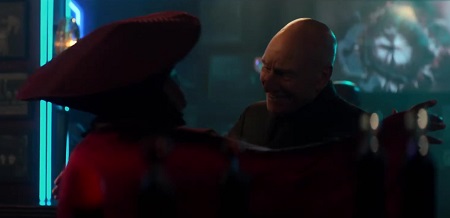
Thoughts on the potential Ceti Alpha V/Khan miniseries

Spoiler Warning: There are spoilers ahead for Star Trek II: The Wrath of Khan, Star Trek Into Darkness, Star Trek: Discovery, and for other iterations of the franchise.

If you don’t follow the ins and outs of the Star Trek rumour mill, maybe you missed talk of a potential Khan-focused project. I know I had until relatively recently! But apparently the proposed miniseries – codenamed Star Trek: Ceti Alpha V – has been written, and is floating somewhere in that nebulous “maybe” zone – better known as “development hell.”

This story, penned by The Wrath of Khan and The Undiscovered Country director Nicholas Meyer, would fill in a gap in the story of iconic villain Khan, focusing on his life in between his exile by Kirk in Space Seed and his re-discovery by the crew of the Reliant in The Wrath of Khan. Along with being the director of both of those films, which are generally considered among the best of cinematic Star Trek, Meyer also co-wrote their stories, so I don’t want to dismiss out of hand his work or ideas on this project.

That said… I’m not entirely sure this is something worth doing.

Khaaaaaan!

The fact that Ceti Alpha V is said to be a miniseries, perhaps consisting of a mere three episodes, would condense its story and avoid dragging it out too much – and that’s certainly a good thing. However, the reason why that might be necessary and the one saving grace this project has is because Ceti Alpha V would be looking at what is arguably the least-interesting part of Khan’s life and story.

Space Seed saw Khan awaken in a new century, still feeling superior to unaltered humans and intent on recapturing his long-lost empire. The Wrath of Khan saw him seek revenge on Kirk, the man who he feels wronged him by marooning him and his crew on the doomed world. Aside from the destruction of Ceti Alpha VI, which could be an interesting thing to see, I suppose, seeing Khan’s descent into madness and a revenge obsession just doesn’t feel necessary or interesting.

Khan in command of the USS Reliant in The Wrath of Khan.

The concept reminds me in some ways of the Star Wars prequels. Though that trilogy of films was beset by all kinds of issues, the fundamental problem was that it was telling the less-interesting part of an already-complete story – and that’s the trap Ceti Alpha V feels like it’s on the precipice of falling into. We didn’t need a three-film saga showing the awkward childhood and the rise and fall of Anakin Skywalker to understand that he was an evil villain who could be redeemed by the residual love he had for his son. All the elements of Darth Vader’s redemption story were already present in the first three Star Wars films, and the prequels ended up not just being unnecessary fluff, but they actively detracted from Vader as an imposing, intimidating villain.

What would Khan do in a potential Ceti Alpha V miniseries that we don’t already understand from both Space Seed and The Wrath of Khan? At best what we’ll see is a padded out version of what we already know happened: the explosion of Ceti Alpha VI, the ecological ruin of Ceti Alpha V, the deaths of his wife and members of his crew. And at worst we’ll see Khan engage in some awfully tacked-on story akin to the worst parts of the Star Wars Clone Wars cartoon.

Khan in Space Seed.

Sorry to keep hitting you with Star Wars comparisons, but the way I feel about this Ceti Alpha V project is similar in many ways to how I feel about the upcoming show Star Wars: Obi-Wan Kenobi. That series will follow Kenobi in between the prequels and the first Star Wars film… but the problem is that we already know what he did in those years: sat in exile in his desert hut.

Ceti Alpha V would also almost certainly recast the character of Khan for what will be the second time. Benedict Cumberbatch did a decent job in Star Trek Into Darkness a few years ago, but I seriously doubt he’d reprise the role here. While Star Trek has seen success with the recasting of classic characters – Captain Pike and Spock, most notably – doing so again here would just seem to add a further complication to the franchise.

Benedict Cumberbatch took over the role of Khan for Star Trek Into Darkness.

Unlike Star Wars, Star Trek has managed to successfully move beyond its original incarnation. The Original Series remains an important part of the franchise and its legacy, but as we look ahead to the 2020s – and hopefully beyond – we see projects like Prodigy, Lower Decks, the Section 31 series, and shows set in both the 25th Century with Picard and the 32nd Century with Discovery. I’m not sure that we need to revisit Khan right now – he’s a character whose story is arguably complete, and Star Trek as a whole is not in a place where this kind of backwards look is needed to bring in audiences.

As a Trekkie I would of course be interested to see a Khan miniseries. And also I’d be very interested to see any project with strong involvement from Nicholas Meyer. I just don’t see it being a necessary addition to the franchise based on where we are right now, and that’s before we get into the fact that, as mentioned, this would seem to be offering to tell the least-interesting part of a story that has already concluded.

The script for this project was written by Nicholas Meyer.
Photo Credit: Mike Muegel, CC BY 2.0 https://creativecommons.org/licenses/by/2.0, via Wikimedia Commons

There is plenty of scope for Star Trek to see the return of classic characters from The Original Series era – and we have seen a number of such characters in Discovery already. With Picard Season 2 in the offing and the return of Captain Janeway in Prodigy, we’re also welcoming back some characters from the 24th Century too. Maybe we just don’t need Khan right now?

Despite my feelings overall, I don’t think we should entirely dismiss the idea of Ceti Alpha V. I truly dislike the expression “nobody asked for this,” and I would point to Enterprise as a series that I likewise felt would have little to offer that ended up being a great Star Trek show that really embodied the spirit of exploration. So I don’t want to just say that Ceti Alpha V wouldn’t have merit; it may even succeed at bringing in fans of The Wrath of Khan – which is arguably the biggest point in its favour.

We already know how Khan’s story ends.

Will it get made? I don’t know. Meyer has suggested that the script itself is either almost complete or fully ready, so perhaps it’s only one step away from being greenlit. If I were in charge I think I’d look at other projects first before deciding whether or not to go ahead with something like this, though.

That’s just my opinion – and as I always say, the Star Trek franchise is a big tent, able to welcome all kinds of different stories. Just because this wouldn’t be top of my list doesn’t mean it lacks merit or would be unenjoyable – and I daresay if it does enter production I will tune in! One thing I definitely like the sound of are short-format stories like made-for-streaming films or miniseries. Just like Short Treks, miniseries like this proposal could be used to tell all kinds of stories in the Star Trek galaxy – and more Star Trek on our screens is always a good thing.

Star Trek II: The Wrath of Khan and all other Star Trek titles mentioned above are the copyright of ViacomCBS. This article contains the thoughts and opinions of one person only and is not intended to cause any offence.
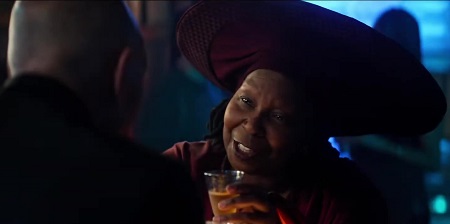
Five Star Trek episodes for Valentine’s Day!

Spoiler Warning: There are minor spoilers ahead for the episodes on this list.

Love is in the air! Happy Valentine’s Day – even though 2021 promises to be the strangest in a long time. If you have a special someone to spend today with, I bet you’re wondering what to watch to put you both in the mood. And if you don’t… perhaps you’re just wondering what to watch. So without further ado, here are a few Star Trek episodes worth watching on the most lovey-dovey day of the year – or at least tangentially related to it! As always, the list is in no particular order.

Number 1:
The Dauphin (Star Trek: The Next Generation)

Wesley’s first love is the story of The Dauphin.

It’s been a while since we talked about The Next Generation’s most controversial major character: Wesley Crusher! He’s the main focus of this episode, falling in love with the ruler of a war-torn planet. In a classic case of “bad timing,” Salia and Wesley’s relationship wasn’t to be. He learned a valuable lesson about love along the way, though, and while the episode has some cute moments and some awkward ones, it manages to be distinctly “Star Trek” all the while.

Number 2:
Choose Your Pain (Star Trek: Discovery)

Dr Culber and Stamets in Choose Your Pain.

I often call the relationship between Stamets and Dr Culber the “emotional core” of Discovery, yet looking back on the show’s 42 episodes, there are relatively few in which they are the main focus. Choose Your Pain has a lot going on, but one of the most significant points is how Hugh and Paul clash over the tardigrade – the space-dwelling lifeform that appears to be the key to making the Spore Drive work as intended. They’re able to resolve things, of course, but only when Stamets does something life-changing to himself in order to save the tardigrade’s life.

Number 3:
Threshold (Star Trek: Voyager)

Ah, Threshold.

When we think about Tom Paris, who’s his romantic partner? B’Elanna Torres, of course. But in Threshold – widely regarded as one of Voyager’s worst episodes – Paris and Janeway get together and even have kids! Had you forgotten about that? After passing the Warp 10 barrier and experiencing “hyper-evolution,” Paris kidnaps Janeway and flees to an uninhabited planet. The two hyper-evolve into lizards and apparently “do the nasty,” resulting in at least three offspring. The crew of Voyager opted to leave the hyper-evolved children behind when they rescued Paris and Janeway, though, and for some reason the events of Threshold were never mentioned again. I wonder why?

Number 4:
Amok Time (Star Trek: The Original Series)

One of the most memorable fights in all of Star Trek.

Amok Time is certainly one of the most iconic Star Trek episodes, having been imitated and parodied many times. It focuses on Spock and introduces us to the concept of pon farr – the Vulcan biological mating need. The Vulcans evidently practice arranged marriage, and when Spock’s betrothed chooses another man, Kirk and Spock must engage in a ritual fight to the “death.” As one of the first episodes to explore the Vulcans in depth, as well as our first visit to the planet Vulcan, Amok Time is incredibly important within the history of Star Trek. And as a love story, well there’s something kind of romantic about T’Pring choosing to escape her arranged marriage to be with someone she cares about… right?

Number 5:
Change of Heart (Star Trek: Deep Space Nine)

Jadzia and Worf in Change of Heart.

Workplace romances are bound to cause problems! After Worf arrived on the station at the beginning of Deep Space Nine’s fourth season, he and Jadzia Dax struck up a relationship. They eventually got married in the episode You Are Cordially Invited, and continued to work closely together. In Change of Heart they’re assigned a dangerous mission to evacuate a Federation spy at the height of the Dominion War. But when Jadzia is injured, Worf is forced to choose whether to save her life or complete the mission.

So that’s it. Five somewhat Valentine’s Day-related Star Trek episodes! Try not to take it too seriously; this was just a bit of fun to mark the occasion!

On a more serious note, Valentine’s Day can be difficult. It can be a day that brings home feelings of loneliness, that we aren’t loved or even that we’re unworthy or undeserving of finding someone special. If you feel that way, listen to me: it’s bullshit. You’re a King, a Queen, or non-binary Royalty and you are amazing. If you haven’t found somebody yet, that’s okay. There’s no pressure or time limit. I know people who found love well into their seventies and eighties, and a few years ago attended the wedding of a neighbour of mine who finally was able to marry his boyfriend – at the age of 85! Just because some people manage to find their special somebody early in life doesn’t mean you have to conform to that too. One thing I wish I’d learned a lot sooner is that it’s better to be single than to be in a bad relationship! So please try not to worry or let Valentine’s Day become an excuse to feel rotten. Your time will come. Until then, I wish you a very happy Valentine’s Day – platonically, of course!

The Star Trek franchise is available to stream now on CBS All Access (soon to be rebranded as Paramount+) in the United States, and on Netflix and/or Amazon Prime Video in the United Kingdom and elsewhere. Star Trek and all episodes and series listed above are the copyright of ViacomCBS. This article contains the thoughts and opinions of one person only and is not intended to cause any offence.

A willingness to change is the key difference between Star Trek and Star Wars in 2021

Spoiler Warning: There are spoilers ahead for the following: The Mandalorian Seasons 1-2, The Rise of Skywalker, Star Trek: Discovery Seasons 1-3, Star Trek: Picard. Minor spoilers may be present for other iterations of both the Star Wars and Star Trek franchises.

I’ve been working on my review of Season 2 of The Mandalorian, which was shown on Disney+ at the end of last year, and I found myself saying the same thing several times. I will (eventually) finish that review, but for now I wanted to take a step back and look at two of the biggest sci-fi/space fantasy franchises, and one crucial difference between them.

Whether it’s the prequel trilogy, sequel trilogy, spin-offs, or even the recently announced slate of upcoming projects, Star Wars is intent on sticking close to its roots. I’ve made this point before, but Star Wars as a whole has only ever told one real story – that of Palpatine, Anakin, Luke, and Rey. Every film and television series in Star Wars’ main canon either directly tells part of that story or is inextricably tied to it. The inclusion of Luke Skywalker and other legacy characters in The Mandalorian doubles down on this.

Luke Skywalker recently appeared in The Mandalorian.

In contrast, Star Trek has continually tried new and different things. The Next Generation took its timeline 80+ years into the future and left much of the franchise’s first incarnation behind. Deep Space Nine took the action away from starships to a space station. Enterprise was a prequel, but not one which told the early lives of any classic characters. The Kelvin films attempted to reboot Star Trek as a big screen popcorn blockbuster. Discovery took a serialised approach to its storytelling, and Picard picked up that format but used it to tell a very different type of story. Lower Decks is perhaps the biggest departure to date, branching out beyond sci-fi into the realm of animated comedy. Though there are common threads binding the franchise together, each project is one piece of a much larger whole, and the Star Trek galaxy feels – to me, at least – much more vast as a result.

Where Star Wars has told one overarching story, Star Trek has told hundreds, many of which are totally separate and distinct from one another. And that concept shows no sign of slowing down. Indeed, both franchises are doubling down on what they do best: Star Wars is focusing on classic characters and looking inwards, Star Trek is expanding and trying new things.

Captain Burnham will take Star Trek: Discovery to new places.

That willingness to change, to explore totally different and unrelated aspects of its setting, is what sets Star Trek apart from Star Wars right now – and arguably is one of the big points of divergence going all the way back to the mid-1980s. It may also explain why so many fans are excited about The Mandalorian and even the dire Rise of Skywalker, while some Star Trek fans have never been interested in Discovery, Picard, and Lower Decks.

Nostalgia is a big deal in entertainment, and while I would argue Star Wars has overplayed that particular card far too often, there’s no denying it has seen success with that formula. That’s why we’re seeing the Obi-Wan Kenobi series, the Ahsoka series, the Lando series, and even the Cassian Andor series all getting ready to debut on Disney+ in the next few years.

Star Wars continues to bring back characters, themes, and designs from its past.

Someone far cleverer than I am said something a while ago that really got me thinking. If a franchise – like Star Wars, in this case – relies so heavily on nostalgia to the point of never trying anything new, it won’t survive beyond its current generation of fans. Because bringing in new fans – the lifeblood of any franchise – is increasingly difficult when every project is designed exclusively with existing fans in mind. How can Star Wars survive when its current fanbase moves on if everything it does is fan service? What kind of appeal does the Obi-Wan Kenobi show have to someone new to Star Wars? Basically none.

With the exception of Star Trek: Picard, which did rely on the strength of its returning character, I think any Star Trek project has the potential to bring in new fans. Some shows and films are definitely enhanced by knowing more about Star Trek and its setting, but even in Discovery, where main character Michael Burnham is related to classic character Spock, there really wasn’t anything that required a lot of background knowledge.

Spock in Star Trek: Discovery.

Star Trek is not only trying new things, but the people in charge are conscious to allow each project to stand on its own two feet. They are parts of a greater whole – and while I have argued many times here on the website that Star Trek could do more to bind its ongoing series together, it’s still possible to watch one show and not the others without feeling like you’ve missed something important.

What we see are two very different approaches to storytelling. Both Star Trek and Star Wars were reborn in the mid-2010s out of a desire on the part of their parent companies to use nostalgia as a hook to bring in audiences. That should not be in dispute, and I don’t want to say that Star Trek somehow avoids the nostalgia trap. But where Star Wars really only has nostalgia going for it, Star Trek continues to branch out, using nostalgia as a base but not allowing it to overwhelm any project.

“Baby Yoda” is symbolic of Star Wars’ reliance on nostalgia in many ways.

Neither approach is “right” or “wrong;” such things are subjective. I don’t want to sound overly critical of Star Wars either, because despite my personal feelings, there’s no denying many of the creative decisions made are popular – even The Rise of Skywalker, which was eviscerated by critics, was well-received in some areas of the fandom. It just strikes me as interesting and noteworthy that these two major franchises are taking very different approaches to the way they construct their narratives.

Whether it’s the inclusion of Luke Skywalker himself, the aesthetic of practically everything in the show, or a storyline which returns the franchise to the Jedi and the Force, The Mandalorian oozes nostalgia from every orifice – and if that’s what fans want and will lap up, then that’s okay. It was too much for me, and I stand by what I said last year during the show’s first season: I was expecting to see “the adventures of a gunslinger far from the reaches of the New Republic;” a show which would take Star Wars away from some of those themes to new places. That was my preference – a personal preference, to be sure, and judging by the positive reaction not only to The Mandalorian but to spin-off announcements like the Obi-Wan Kenobi series (and the return of Darth Vader to that series) I’m in the minority.

Mandalorian armour (i.e. Boba Fett’s armour) seen in The Mandalorian.

Star Trek takes a different approach. Both Picard and Discovery in their most recent seasons moved the timeline forward, brought in new characters, and dealt with contemporary themes. There were touches of classic Star Trek in both shows, including in aesthetic elements like set design and costuming, but in both cases the franchise feels like it’s moving forward.

Costuming is an interesting point to consider, as it’s representative of where both franchises find themselves. As early as 2015’s The Force Awakens, Star Wars was stepping back, relying on Stormtrooper armour, First Order uniforms, and especially the costumes worn by Rey that were practically identical to those seen in the original films. This was continued in The Mandalorian, not only with the main character’s Boba Fett armour, but with the use of Original Trilogy Stormtrooper armour and costumes for many villains. In contrast, Star Trek took its main characters out of uniform entirely in Picard, and Discovery has introduced a whole new set of uniforms and a new combadge for the 32nd Century. Where Star Wars looks back to its heyday, Star Trek looks forward, incorporating some of its classic designs into wholly new variants.

Discovery’s new combadges (as seen in the opening titles).

What we see in these costuming choices is a reflection of where both franchises are narratively. Star Wars continues to look back at the only truly successful films the franchise has ever made: the Original Trilogy. Frightened of trying anything truly new and unwilling to leave that comfortable ground, it’s stuck. As I wrote once, the Original Trilogy has become a weight around the neck of modern Star Wars, as projects not only become constrained by those films, but continue to fail to live up to them.

Star Trek looks forward, tries new things, and embraces change. Not every new project will win huge support and be successful, but some will, and every project has the possibility to be a launchpad for others, taking the evolving franchise to completely different places.

The Original Trilogy is – in my opinion at least – holding Star Wars back.

It’s clear which approach I prefer, and that I’d like to see more innovation and change from Star Wars. Though I was certainly underwhelmed by some of the recent announcements made by Disney and LucasFilm, I’m hopeful that, despite being held back in many ways by an overreliance on nostalgia, some decent films and series may stumble out the door.

Each franchise could learn something from the other, though. Star Trek’s projects are split up, and while Discovery’s third season made an admirable effort to connect to Picard, that was not reciprocated. Lower Decks had many callbacks and references to ’90s Star Trek, but otherwise stands alone. The franchise could work harder to bind its different projects together, reminding audiences that they’re watching one piece of a greater whole.

The Qowat Milat, who debuted in Picard, later appeared in Discovery. But the franchise could do more to bring its projects together.

Star Wars could see how a successful sci-fi franchise doesn’t need to be constrained by its original incarnation, and that shaking things up can work. The Mandalorian felt to me as though it was retreating to Star Wars’ comfort zone, and while that move may be popular right now with the fandom, it doesn’t really provide a solid foundation for expansion in the way Star Trek’s shows and films have done.

At the end of the day, both franchises are testament to the power of nostalgia to bring fans back. But they undeniably take very different approaches to that. Star Wars is conscious to try to make everything feel like its first couple of films – to the point that it can be overwhelming. Star Trek certainly doesn’t overwhelm anyone with nostalgia – to the point that some recent projects have been criticised for feeling like they aren’t part of the franchise at all.

Whichever approach you ultimately feel works best, one thing is clear: neither franchise is disappearing any time soon! The first half of the 2020s -and hopefully beyond – will see several different projects from both Star Trek and Star Wars, and as a fan of both and of sci-fi and fantasy in general, that’s great news. Long may it continue!

The Star Trek franchise – including all properties mentioned above – is the copyright of ViacomCBS. The Star Wars franchise – including all properties mentioned above – is the copyright of LucasFilm and Disney. This article contains the thoughts and opinions of one person only and is not intended to cause any offence.

Star Trek: The Next Generation re-watch – Season 4, Episode 12: The Wounded

Spoiler Warning: There are spoilers ahead for Star Trek: The Next Generation, as well as for other iterations of the franchise.

Thirty years ago this very day, Star Trek: The Next Generation broadcast the twelfth episode of its fourth season: The Wounded. This would be a highly significant episode for the franchise going forward, and in many ways began to set the stage for the upcoming spin-off Deep Space Nine. At this stage work on pre-production of Deep Space Nine had already kicked off, and while The Wounded is by no means a backdoor pilot, there was a conscious effort on the part of Rick Berman – who was in charge of Star Trek at the time – to begin to put the pieces together for the new series.

The Wounded is the first episode to give future Deep Space Nine regular Miles O’Brien a significant role. Though present since Encounter at Farpoint at the beginning of Season 1, O’Brien had been a background character with little to do until this point. The episode also marked the debut of the Cardassians, with future Gul Dukat actor Marc Alaimo featuring as a different Cardassian – Gul Macet.

Gul Macet – the first Cardassian ever seen in Star Trek.

For both of those reasons, The Wounded is incredibly important within the history of Star Trek. The foundations of Deep Space Nine were laid here, and it was around this time, under Rick Berman’s direction, that Star Trek truly cemented its evolution from purely episodic storytelling to an interconnected franchise. Deep Space Nine would share The Next Generation’s time period and be broadcast while its sister show was still on the air. This was a marked change from the way The Next Generation was spun off from The Original Series, and one which allowed the different parts of the franchise to connect in ways that were unprecedented at the time.

After more than a decade of the Marvel Cinematic Universe and other such franchises, we almost take for granted this concept of big, interconnected fictional universes. But episodes like The Wounded are a big part of building that sense of connectedness within Star Trek, and in the early ’90s that was something entirely new. The difference between a good film or television show and one that can become one part of a greater franchise is that sense of interconnectivity, and it’s impossible to understate the importance of episodes like The Wounded on building up Star Trek as that kind of franchise.

The Wounded was instrumental in laying the groundwork for Deep Space Nine.

In that sense, it isn’t only Deep Space Nine which owes so much to The Wounded – and other similar episodes around this time in The Next Generation’s run – but also Voyager, and by extension Enterprise, the Kelvin films, Discovery, and the fact that Star Trek is still going strong thirty years later. It’s one of those incredibly significant moments in the history of the franchise – one of the moments at which Star Trek became an expanded franchise.

More than that, The Wounded is an especially good episode. As Star Trek has always done, it deals with real-world themes through its sci-fi lens, looking at war, post-traumatic stress, how feelings of hate can linger long after the event, and so on. It was also a rarity at this point in Star Trek to see Starfleet officers as anything other than exemplars of virtue, or the Federation as anything less than a utopia. Captain Maxwell is not a villain per se, but the actions he takes in The Wounded endanger the peace – a hard-won peace with the Cardassians. In that sense, the episode looks at the idea of how war can and should be justified, and whether it’s acceptable to sacrifice the truth to preserve the peace.

The episode’s title card.

Coming toward the end of the 1990-91 Gulf War, that makes The Wounded a very timely piece of television. Unlike the later Iraq War of 2003, the Gulf War was generally popular at the time, but even so there was a sense that there wasn’t a real plan for what to do after the initial military objectives had been achieved. Should the US and allies push on into Iraq and remove the Iraqi government? Or should they make peace even if doing so meant leaving a dictator in place? The Wounded doesn’t tackle all of these issues head-on, but the general theme of making peace with an enemy, the value of peace itself, and on a personal level, the toll war can take on those who serve, were all present in the narrative.

Finally, The Wounded draws on inspiration from the film Apocalypse Now, itself influenced by the novel Heart of Darkness, and in the vein of those classics features a story about a war hero going “mad.” Plot points like Captain Maxwell’s mental state and his foray into enemy territory are comparable to storylines in those classic works of literature and cinema. There’s a reason why audiences respond to such powerful themes and storylines, and The Wounded does an admirable job of translating them to Star Trek’s science fiction setting, doing so in a way that retains the original message, ensuring it isn’t buried too deeply in talk of aliens and spacecraft.

The Wounded follows a similar narrative to classic war film Apocalypse Now.

Because of the way The Next Generation was broadcast at the time, I can’t claim that this is the thirtieth anniversary of when I saw The Wounded! That would’ve been a couple of years later, as here in the UK that was the kind of delay we were looking at between an episode’s US premiere and when it would be broadcast here. Regardless, let’s take a look at The Wounded together.

The episode begins with a couple of sequences that set up the main storylines. Both via his captain’s log and on the bridge, Picard gives us a lot of information about the Cardassians – who were, as noted, new to Star Trek in this episode. The bridge crew briefly discuss the situation, and it emerges that Picard had been part of the conflict and negotiations to resolve it while in command of the Stargazer. The exact nature of Cardassian-Federation relations is a little confused; Picard says a “peace treaty” is in effect whereas Troi describes the Cardassians as “allies.”

Up next we get a sequence with Chief O’Brien and Keiko – whose wedding had been part of the previous episode, Data’s Day. In their quarters, O’Brien seems unimpressed with Keiko’s vegetarian cuisine. O’Brien got a fun line when looking at the kelp-based meal: “Sweetheart… I’m not a fish.” That line still wins a chuckle decades later! As O’Brien promises to prepare Keiko a meal of his childhood Irish classics, the ship comes under attack.

The attack on the Enterprise comes during Miles and Keiko’s breakfast.

On the bridge, the crew briefly discuss the minor damage to the ship. The Cardassians apparently fired without responding to hails. This sequence marked the first appearance of the Cardassian Galor-class warship, initially described here as a “scout ship.” Despite firing on the Enterprise-D while its shields were down, there is no major damage nor any casualties. A few phaser shots from the Enterprise-D causes damage to the Cardassian ship and forces its captain – Gul Macet – to hail. The Galor-class would go on to be one of the Cardassian mainstays during the Dominion War – where it was much more effective! Perhaps it got an upgrade. Macet alleges that a Federation ship attacked the Cardassians in violation of their peace treaty; he gives Picard one hour to find out what’s happened.

Star Trek: Picard and Star Trek: Discovery both have pretty understated theme music. They aren’t bad, but they’re closer to the themes from Deep Space Nine and Voyager in that they’re slower, quieter pieces of music. The Next Generation’s theme is in contrast to those! Taken from Star Trek: The Motion Picture, the up-tempo theme really conveys a sense of adventure in a way the others really don’t. Star Trek: Lower Decks, and to a degree the main theme from 2009’s Star Trek reboot film, both do this too, and both of those pieces of music are likewise up-tempo and adventurous. It’s only when coming back to The Next Generation after watching a full season of Discovery that I can really appreciate this difference in musical tone!

The Enterprise-D attacked by the Trager, the first Cardassian Galor-class ship seen in Star Trek.

After the opening titles Captain Picard receives a briefing from a Starfleet Admiral. He informs Picard that the USS Phoenix, under the command of Captain Maxwell, was responsible for destroying a Cardassian station – though they are unable to find out why as Captain Maxwell is not responding. The Enterprise-D – along with a small group of Cardassian “observers” – has been granted permission to enter Cardassian space and catch Maxwell.

The Admiral is very concerned with preserving a hard-won peace treaty, and makes it clear that he believes that the Federation is not prepared for another war with Cardassia – prescient, one might say, in light of how badly the Federation handled much of the Dominion War! Though the Dominion War arc hadn’t even been conceived at this stage, when looking back at The Wounded now that we know what happened, it’s possible to see how the Dominion War story built on what had previously been established in many ways. These smaller moments add up to a much greater whole, and are part of what makes for a believable narrative.

Admiral Haden speaks to Captain Picard.

Though Captain Picard is initially insistent that the three Cardassian observers be made welcome and not made to feel like “prisoners,” he acquiesces to Worf and Riker’s request that their access to the ship be limited. Worf intends to post guards at what he considers to be sensitive areas of the Enterprise-D for the duration of the Cardassians’ stay. Data establishes that O’Brien once served with Captain Maxwell aboard a ship called the Rutledge, and Picard tasks Counsellor Troi with looking after the crew, as he feels some officers may be uncomfortable with the Cardassians on board – foreshadowing what’s to come.

The Cardassians beam aboard and Riker and Troi are there to greet them, along with Chief O’Brien. The Wounded is the only episode of Star Trek to show off a different style of Cardassian uniform. Unlike the silver-grey mail-like armour that they would wear in the Deep Space Nine era, here the Cardassians wear a plain brown leather-like armour over some kind of undershirt. Most notably, this is the only episode which shows off Cardassian headgear – a kind of helmet that covers the back of the head with three bars connecting at the front. Though the outfit isn’t bad per se, I think it’s easy to see why it was changed later. Not only does the headgear look a little silly, it also covers up key aspects of the Cardassians’ facial features and makes them less distinguishable from one another. Gul Macet sports facial hair, too, and The Wounded would be the only time we would see that on a Cardassian character.

Gul Macet and his aide beam aboard.

It’s interesting that Marc Alaimo was the first Cardassian seen in Star Trek, and in another role would also go on to be the most significant Cardassian. In that sense he’s similar to Deep Space Nine co-star Armin Shimmerman, who was one of the first Ferengi seen in Season 1 of The Next Generation and also played Quark, the most famous Ferengi in Deep Space Nine. We don’t spend enough time with Gul Macet to really show off how different he is from Alaimo’s more well-known character of Gul Dukat, and in many ways the performance he puts in here is similar. Perhaps Macet and Dukat are related?

Counsellor Troi seems to pick up on O’Brien’s discomfort with the Cardassians as she and Riker escort them from the transporter room. In the briefing room, Geordi and Riker explain the basics of scanning for the Phoenix, and that they’re able to scan one sector per day. It’s worth pointing out that how big a “sector” is in Star Trek has never been consistently explained on screen! The Cardassians are sceptical – understandably so – but Picard is able to calm the tensions.

The briefing room scene.

Also present at the briefing room table is O’Brien, and Picard turns to him to ask him a little about Captain Maxwell, with whom he previously served. O’Brien explains that Maxwell’s family were killed during a Cardassian attack on the Setlik III outpost – and if Setlik III sounds familiar to you, it’s a name associated with O’Brien’s military service that would be brought up numerous times in Deep Space Nine, most significantly, perhaps, in the episode Empok Nor.

O’Brien responds aggressively when it’s suggested to him that Captain Maxwell is taking revenge for what happened to him, and it’s clear that he feels a strong sense of loyalty to his former commander. Gul Macet attempts to press the point when Picard intervenes, but before the discussion can continue the briefing is interrupted by Worf, who has located the Phoenix on long-range sensors.

O’Brien in the briefing room.

The briefing breaks up, and Captain Picard invites Gul Macet to the bridge with the senior officers. O’Brien and the two junior Cardassians leave together and end up sharing a turbolift. Here’s where we get one of the episode’s most interesting scenes. The Cardassians – who are, after all, just doing their jobs – attempt small-talk with O’Brien, but he isn’t having any of it.

After an invitation to join the Cardassians in Ten-Forward, O’Brien snaps. He tells them abruptly that he will cooperate with them when it comes to discussing technology or the search for Captain Maxwell if ordered to do so, but will not spend his free time with them. He then barges past them out of the turbolift.

O’Brien and the Cardassians in the turbolift.

It was around this time that we began to see cracks in the utopian/perfect veneer of Starfleet and humanity in Star Trek, proving that they haven’t entirely risen above the pettiness and conflicts we have in contemporary times. Gene Roddenberry was strongly opposed to the idea of Starfleet as a military outfit, and famously tried to have Star Trek VI: The Undiscovered Country re-written to cut out what he saw as anti-Klingon racism from Kirk. He felt such attitudes were beneath humanity in his vision of the future. I can only imagine he felt the same way about O’Brien in The Wounded. As an aside, The Undiscovered Country will also celebrate its 30th anniversary this year.

On the bridge, Picard orders the Enterprise-D to intercept the Phoenix, with Gul Macet watching over his shoulder. Macet wants the ship’s precise location so that he can have Cardassian vessels arrive first. He also asks for the ship’s transponder frequency – a neat callback to Star Trek II: The Wrath of Khan. Worf looks angry at this suggestion, which Captain Picard refuses – diplomatically, of course.

Picard and Gul Macet on the bridge.

O’Brien serves Keiko the promised meal in their quarters, though she seems unimpressed with his replicated potato casserole (which looks more like potato salad!) He sings an old song from his days on the Rutledge, and it seemed for a moment as though the unpleasantness with the Cardassians was forgotten. But it turns out the song – which Colm Meaney does his best to sing – was a favourite of Captain Maxwell’s. He pushes Keiko to comment on why someone – speaking abstractly – might not be comfortable with Cardassians, but appears in denial about his own feelings toward them.

This scene and the previous one really humanise O’Brien. What he’s feeling is, as Keiko explains, quite natural. Yet at the same time he’s not comfortable sharing with her exactly what it is that’s wrong. He brushes off his battle experiences calling them “skirmishes,” and refuses to accept or even recognise that he’s holding on to a degree of resentment.

O’Brien in his quarters.

On the bridge, the crew has detected that the Phoenix is in pursuit of a Cardassian vessel – a supply ship. Gul Macet is incredulous that Data can read Cardassian transponder codes and tell what kind of vessel it is at such range, but they have a more immediate problem. Maxwell is not responding to hails, and goes on to attack the ship while the Enterprise-D can only watch.

I do like the 2D graphics used to represent the positions of the Phoenix and the Cardassian ship on the main viewscreen. Though arguably not very “high tech,” it’s cleverly done and easy to understand for us as the audience. The remastered Blu-Ray version didn’t change this, but did upscale and improve it. Though in many ways Discovery and Picard have changed up the aesthetic of Star Trek for modern times, we have seen these flat, 2D maps in those series as well.

Watching the attack unfold.

Gul Macet again insists on being given the transponder frequency (or prefix code) for the Phoenix, and when Maxwell does not respond Picard orders Worf to send the code to the Cardassians. Worf loudly protests, but does carry out his orders. Despite sending the codes, however, the Phoenix is able to continue its attack and destroys both the Cardassian warship – to Gul Macet’s shock – and the supply ship it was initially targeting.

Following the battle – if it can be called that – Picard orders the Enterprise to increase speed to warp 9 to catch up. Given the urgency, I do wonder why the ship was only at warp 6 initially. Gul Macet leaves the bridge wordlessly.

The Phoenix destroys a Cardassian warship.

Picard goes to visit O’Brien in his transporter room. O’Brien again states how greatly he respects Captain Maxwell, saying he served with “the two finest captains in Starfleet,” putting Maxwell on par with Picard himself. He also says that he believes Captain Maxwell must have a reason for the actions he’s taken, reiterating that this isn’t some quest for revenge.

Captain Maxwell, according to O’Brien, took the loss of his family as well as one could, and continued to perform his duties despite the tragedy. Even hearing that Captain Maxwell has just killed 600 Cardassians does not shake O’Brien’s opinion, as he tells Picard that he “knows” them and that one must be careful around Cardassians, a race he clearly holds in low regard. What Picard says next about holding on to one’s anger clearly has an effect on O’Brien, and causes him to consider not only what Captain Maxwell is doing, but his own attitude to the Cardassians. It’s one of the most powerful moments in the episode – yet lasts mere seconds.

Captain Picard arrives in the transporter room.

Picard, in this statement, encapsulates the theme of the episode: that holding on to anger is never a good thing. Captain Maxwell may have pretended to be fine – as O’Brien was moments earlier with Keiko – but neither man ever got over their wartime experiences. It’s something that applies in the real world, too. At the time, the Gulf War was raging, but the peace treaty storyline reminds me more of the Vietnam War, and how Americans in this era might view their one-time enemies. It could even apply to the Second World War, and even today there are lingering feelings from that conflict in some areas.

In Ten-Forward, O’Brien joins one of the Cardassians for a drink. He initially offers an apology for his earlier actions, spurred no doubt by Captain Picard’s words. But as he talks to the Cardassian officer he spills more of his history with them – he was present on Setlik III after Captain Maxwell’s family was killed, and it was the first moment he ever killed someone. O’Brien’s words are very powerful: he doesn’t hate the Cardassians, he hates himself, and blames them for making him into a soldier and a killer.

O’Brien and the Cardassian officer in Ten-Forward.

On the bridge, Worf claims to have caught the other junior Cardassian accessing a computer on deck 35. Gul Macet reprimands him and confines him to quarters. The Cardassian officer’s staredown of Gul Macet seems to imply that he was carrying out his orders, but that point was not expanded upon further.

Gul Macet and Captain Picard speak in the ready-room. Macet says he will further discipline the man, Picard says it doesn’t matter, and that in order to have peace, no one individual must be allowed to disrupt it – a very self-serving statement under the circumstances, one might say! Macet sees Picard as a kindred spirit – both men desire peace above all else. Perhaps that comes as a surprise to both of them. Though it is hard to detach Marc Alaimo’s performance as Macet from his later role as Dukat, he is believable in this moment.

Gul Macet in Picard’s ready-room.

Data interrupts the conversation to tell Picard that they’re twenty minutes away from intercepting the USS Phoenix, and the very next scene shows the two ships together. Captain Maxwell beams aboard to discuss the situation with Captain Picard, and is greeted by O’Brien and Riker in the transporter room.

Far from being adversarial, Captain Maxwell is disarmingly pleasant, greeting Riker warmly and being pleased to see O’Brien after such a long time. Were it not for the previous twenty minutes we’d be forgiven for thinking this was any “normal” interaction between Starfleet officers! In that sense though, seeing this scene in context, there’s something very unsettling about it. Knowing that Captain Maxwell has gone rogue, knowing how many people he’s just murdered, and then seeing him as a jovial man in a Starfleet uniform offering friendly handshakes leaves a bad taste – intentionally so.

Captain Maxwell and O’Brien reunite in the transporter room.

O’Brien looks disturbed as Riker and Maxwell depart, the latter arriving in Picard’s ready-room for a showdown. Again, though, pleasantries were observed, and Maxwell initially retains his disarming persona. Soon, however, Maxwell appears to go off the rails. He insists that the Cardassians are re-arming, and that the science station he attacked was actually a military outpost.

When pushed by Picard for evidence, he offers nothing concrete, instead talking in vague terms about there being no need for a scientific station in the area and its strategic value from a military perspective. He didn’t contact Starfleet because he didn’t want to wait, believing that Federation bureaucracy would be too slow to recognise the threat.

Captain Maxwell in Picard’s ready-room.

Captain Maxwell genuinely expects to find a kindred spirit in Picard, a fellow veteran of the Cardassian border wars. Not only does he expect Picard to harbour the same anti-Cardassian sentiments he clearly holds, he seems to expect his so-called “evidence” – which is little more than guesswork – will be adequate to excuse his actions in Picard’s eyes.

When this doesn’t materialise, Maxwell begins to sound even more disconnected, talking in big but ultimately vague terms about the need to save lives. He argues that he’s trying to prevent a war by stopping what he sees as Cardassian aggression, and accuses Picard of losing his edge. He believes that the peace treaty was a ruse, and that he was doing necessary work by ignoring it.

Captain Picard responds to Maxwell.

Picard replies by giving his assessment of the situation. He suggests that Maxwell is not doing any of this for the good of the Federation, but simply for the sake of revenge. When Maxwell says that history will consider Picard a fool, Picard says he will accept that, but insists Maxwell stand down now and return to Federation space. Maxwell asks him to join him and scan one of the Cardassian supply ships together, but Picard refuses.

Can we argue, in light of what came next, that Maxwell was right? Not only in the sense of what the Cardassians were doing in The Wounded, but seen in hindsight after the Dominion War? The Cardassians were re-arming, and within five years of the events depicted in this episode, the Dominion War would break out. Captain Maxwell’s methods may have been wrong, but his basic point stands: the Cardassians did use the peace treaty to rebuild and re-arm. They were preparing for another conflict. In that sense, we can look at the Cardassians as one might look at Germany in the mid-1930s. Picard was arguing that peace was the most important goal, something worth making sacrifices for. Those same arguments were made by many in Britian, France, and elsewhere in the years preceding the Second World War. We might even call it appeasement.

Maxwell realises he’s misjudged Picard.

Maxwell initially agrees to Picard’s plan, agreeing to return to the Phoenix and accompany the Enterprise-D to a nearby Starbase. Picard was very strong and unwavering during the conversation, telling Captain Maxwell that he will “allow [him] the dignity” of returning to his own ship rather than putting him in the brig, then turning away to face the window after ordering Maxwell escorted out.

Predictably, though, Captain Maxwell does not stick to his side of the agreement. While en route to the Starbase, the Phoenix changes course, hunting down a Cardassian starship a light-year away. Picard orders the Enterprise-D to pursue, rapidly increasing speed. However, Data explains that the Phoenix is also accelerating and they won’t catch up in time.

The USS Phoenix changes course.

As an aside, I like the design of the Nebula-class ships. They debuted in The Best of Both Worlds, though this was the first time the ship design was named on-screen. The intention with the Nebula-class was to create a vessel comparable to the Galaxy-class but smaller, clearly giving the Enterprise-D an advantage. In that sense it’s an updated Miranda-class from Star Trek II: The Wrath of Khan, and in fact its saucer-plus-nacelles design is superficially similar. It’s a neat-looking starship, and though such things are 100% subjective I’ve always thought the Nebula-class was a fun design.

As Picard gives the order to ready the phasers, Riker informs him that O’Brien used to be Maxwell’s tactical officer, and he’s summoned to the bridge. The Enterprise-D catches up with the Phoenix just as it intercepts the Cardassian supply ship, and O’Brien arrives on the bridge to help out.

O’Brien and Data on the bridge.

The Phoenix has not powered up its weapons, and Data informs the bridge that they’re unable to scan the Cardassian ship. That does raise eyebrows – literally – but Picard first talks with O’Brien about Captain Maxwell, still hoping to avoid a Starfleet-on-Starfleet battle. Captain Maxwell hails the Enterprise and pleads with Picard to board the Cardassian ship, saying it will prove him right.

Picard, of course, is having none of it. With Maxwell no longer trustworthy he insists he beam aboard the Enterprise. Maxwell is looking increasingly desperate, threatening to destroy the Cardassian ship if Picard won’t board it. He ends the conversation when Picard doesn’t back down.

Captain Maxwell on the Enterprise-D’s viewscreen.

Captain Maxwell will strike if his back is against the wall, so says O’Brien. And mere seconds later the Phoenix is seen to power up its shields and weapons, reading an attack on the Cardassian vessel. Picard orders red alert, and prepares to take the extraordinary action of firing on another Starfleet vessel to defend a Cardassian ship.

O’Brien offers to beam aboard the Phoenix to talk Captain Maxwell down, and comes up with a technobabble plan to beam through the cycling shields of the Nebula-class vessel. With few other options, Picard authorises the mission. It would’ve been neat to see O’Brien in the transporter room pulling off this seemingly dangerous, complicated bit of transporter work! But instead the very next scene in in Captain Maxwell’s ready-room, with O’Brien having already beamed aboard.

Captain Maxwell looks out at the Enterprise-D.

Maxwell is shocked to see O’Brien, and pulls out a phaser. He refuses to believe Picard will attack his ship to protect “the enemy,” but when O’Brien insists that he will he becomes dejected. He asks O’Brien what happened in “this war,” but O’Brien retorts that there is no war any more, that the war is over and they have peace.

As they talk, it becomes clear to O’Brien – and to us as the audience – that Picard and Gul Macet were right: for Captain Maxwell this is all about what happened to his family on Setlik III. He says that the war is not over, that the Cardassians are butchers who “live to make war,” and O’Brien comes to realise that he was never able to let go of what happened.

Captain Maxwell points a phaser at O’Brien.

As O’Brien listens, Maxwell’s voice breaks. His children never had the chance to grow up, he lost his family, and he has been unable to let go of that anger toward the Cardassians. It has clouded his judgement. The two men talk and reminisce about their time on the Rutledge, and other officers they served with, including a man who died at Setlik III. O’Brien sings the song again, and Captain Maxwell joins in. It turns out the song was one sung by the man who was killed by the Cardassians.

As the song comes to an end, Captain Maxwell realises that it’s over. Whatever he was trying to do, whatever reasons he had, however he’d convinced himself and his crew that it was right, he couldn’t defeat the Enterprise and he couldn’t negotiate with Picard. As he says to O’Brien, he isn’t “going to win this one.”

Maxwell and O’Brien share a moment.

Picard confirms in a voiceover log that Captain Maxwell has been detained, and that the Phoenix has rejoined the Enterprise. In the briefing room, Picard thanks O’Brien for resolving what could’ve been a far worse situation. O’Brien expresses his pride at having served with Captain Maxwell, someone he still considers a “good man,” in spite of what he did. Picard dismisses him, and Gul Macet says he admires O’Brien’s loyalty, “even if it is misplaced.”

The Wounded has one final twist, though, as Picard explains to Gul Macet. After saying that Maxwell, who was a decorated war hero, simply could not find a role for himself when peace broke out, Picard drops the bombshell that Maxwell was right. The Cardassian ships were not carrying science equipment – they were, as Maxwell said, preparing for war.

Captain Picard talks to Gul Macet in the briefing room.

Gul Macet asks the obvious question: if Picard knew, why not board the ship? Picard responds that he was there to protect the peace; that was his only objective. He placed preserving the peace ahead of everything else, even when he knew that Maxwell was right and that the Cardassians were using the so-called science outpost for military purposes. As we discussed above, he chose to put peace ahead of all other considerations.

Picard tells Gul Macet to take a message back to the Cardassian Central Command: the Federation and Starfleet will be watching. They know what the Cardassians were trying to do, and though they did not take aggressive action this time, the option remains on the table. Any chance of a surprise attack is gone, the Cardassian objective has failed. Picard spins his chair around, signalling the end of the conversation – and the episode.

Gul Macet.

So that was The Wounded. It was fun to look back on this episode on its thirtieth anniversary – something which makes me feel very old indeed! The episode was a heavy one, with incredibly deep and meaningful themes that touched on issues which are still as relevant in 2021 as they were in 1991. It’s also an important piece of Star Trek history, introducing the Cardassians, giving O’Brien his first real storyline, and bringing Marc Alaimo into the franchise.

Though the Cardassians’ uniforms would be redesigned, their overall look, as well as the appearance of their Galor-class ships, would remain in use until the end of Deep Space Nine. We have briefly seen a Cardassian in the recent third season of Discovery, too, a design which is largely unchanged from that which debuted here. The Cardassians would go on to join the Klingons as one of the most-explored Star Trek factions thanks to their significant role in Deep Space Nine.

The Phoenix and the Enterprise-D.

As Gene Roddenberry stepped back from day-to-day work on Star Trek: The Next Generation, things began to change. Where the first season largely followed the formula Roddenberry used in The Original Series, by the end of Season 2 and certainly by the time The Wounded premiered, the series had taken a different path. In addition to the darker themes which looked at humans holding prejudiced views and even committing war crimes, Rick Berman and others were working hard to establish Star Trek as a growing, connected franchise with themes, characters, factions, and storylines that would all cross over.

Plans for Deep Space Nine were underway, and within two years that show would premiere with the episode Emissary. The Star Trek franchise we know today wasn’t created by The Wounded, but the episode plays an important role in taking Star Trek to new places, not only thematically but also in terms of expanding the roster of characters. O’Brien had his first major storyline here, and the success of his role in The Wounded established him as a major player in Star Trek, getting him ready for the move to Deep Space Nine.

I had fun re-watching this episode of The Next Generation. I have written up two other re-watches from the show, and you can find them here: Season 2’s The Measure of a Man and Season 7’s Lower Decks. This is something I do from time to time, and with no new Star Trek on the schedule at the moment, check back as I’m sure I’ll be writing up more episode re-watches this year!

Star Trek: The Next Generation is available to stream now on CBS All Access (soon to be Paramount+) in the United States, and on Netflix in the United Kingdom and elsewhere. The Star Trek franchise – including The Next Generation and all other properties mentioned above – is the copyright of ViacomCBS. This article contains the thoughts and opinions of one person only and is not intended to cause any offence.

The Section 31 series – a wishlist

Spoiler Warning: There are spoilers ahead for Star Trek: Discovery Season 3, Star Trek: Picard Season 1, Star Trek: Lower Decks Season 1, and for other iterations of the franchise.

Two years on from its announcement, we don’t know very much about the upcoming Section 31 series. It doesn’t even have an official title – we all assume it will be some variant of Star Trek: Section 31, but even that much has never been confirmed. Both Strange New Worlds and Prodigy were announced after the Section 31 series but have been given titles and have even seen major announcements.

Perhaps the lack of news is caused, in part, by main character Philippa Georgiou (the Mirror Universe version) being part of Star Trek: Discovery’s third season. There may have been a desire to avoid spoiling her storyline and ultimate fate, which is commendable – if true! However, there have also been rumours – which we must look at with a healthy dose of scepticism – that seem to suggest the scripts have undergone re-writes which may have contributed to the delay.

Georgiou recently departed the 32nd Century.

It’s been a while since I looked at the Section 31 series in any depth – though I have touched on it on a number of occasions in relation to Discovery – and despite the lack of anything concrete, now seems as good a time as any, so what I thought I’d do is put together a nice internet-friendly list and go over a few options for the series and what it could include.

Number 1: Some James Bond-style action.

Roger Moore as James Bond in 1981’s For Your Eyes Only.

You don’t make a series based around Starfleet’s answer to MI6 and not use it to tell some great action stories… do you? Spies work in the shadows, but no one wants to see Georgiou and her new crew sat behind desks listening in on subspace messages like a futuristic NSA. We want to see them out in the field, on dangerous black-ops assignments, making full use of their licenses to kill.

Section 31 is supposed to be the no-holds-barred last line of defence for the Federation, so action should be on the agenda. We could see them sabotaging spaceships, assassinating rogue planetary leaders, and chasing supervillains halfway across the universe. It should be sufficiently over-the-top, too, or we’ll be left wondering why Starfleet security couldn’t handle things!

Number 2: Enter the Picard time period.

The crew of La Sirena in Picard Season 1.

When Georgiou stepped into the Guardian of Forever’s portal in the Discovery third season episode Terra Firma, Part II, her destination was not clear. The Guardian merely said that he was sending her to a time period where the Mirror and Prime universes were closely aligned. Many have assumed that her destination is the 23rd Century – and everything we’ve heard so far suggests the series takes place then. But what if that isn’t the plan?

When I wrote up a shortlist of possible time periods during Discovery’s third season I suggested that, rather than the 23rd Century as predicted, Georgiou may instead arrive at the beginning of the 25th, the era in which Picard is set. This would connect all three eras that Star Trek currently has on the go (at least in live-action). Georgiou would be the one character who has spent time with Pike – soon to be of Strange New Worlds – as well as Burnham in the 32nd Century and potentially Picard – or someone else we met in that series.

Finding some way to tie the disparate parts of Star Trek together is a challenge facing the current creative team. At the moment, every ongoing Star Trek project occupies a different place in the timeline, with precious little binding them together beyond a brand name and some general themes. It’s not that I’m concerned about this as a creative decision – as a Trekkie I quite like seeing different eras and settings. But from the point of view of Star Trek’s general audience this starts to look convoluted to the point of being offputting. The franchise needs those casual viewers in order to remain profitable and successful, so simplifying the timeline would be one of my top priorities.

At the very least, I would hope that the Section 31 series doesn’t end up in a distinct time period of its own!

Number 3: A great supporting cast.

Maybe not quite that many…

Michelle Yeoh is a fine actress, but she can’t carry the series all by herself. Georgiou will need people around her, especially if she finds herself once again caught in a new time period.

These characters can’t all be morally ambiguous, butt-kicking super-spies either. Georgiou already fills that kind of role, so we’ll need to see some diversity in the personalities she works with. Each will also need a distinct role in the organisation – and here we leave the basic Star Trek formula behind. Even if the series is set aboard a single ship, the usual crew roster of a captain, doctor, scientist, and engineer won’t really fit with the kind of stories the Section 31 show could and should be telling.

Instead we’ll need to see roles closer to those in a series like Agents of SHIELD or the aforementioned Bond films – mission specialists, weapon and gadget experts, hackers/technology experts, as well as scientists, spies, and a commander to tie the team together. Georgiou may be the commander – but she could still have a superior to answer to; the overall head of Section 31.

There could be roles of that nature for half a dozen characters or more, and like Picard did, the show could expand beyond Starfleet to pick up a wide array of unique and interesting people.

Number 4: Moral ambiguity.

What should you do?

You’ve heard of the internet’s favourite philosophical question: the “trolley problem.” Would you be willing to actively kill one person to save the lives of several? Do the needs of the many outweigh the needs of the few – even if that means murdering the few? These are the kinds of questions Section 31 has the answer to – and it’s a solid “yes.”

In Deep Space Nine, Section 31 poisoned the Founders of the Dominion with a virus that they were unable to cure, potentially committing genocide against the changelings in pursuit of ending the destructive Dominion War. Whether it’s a season-long story arc or a single episode, I want to come away from the Section 31 show at least once wondering if the ends justified the means.

These people are not Starfleet – and they cannot let such things as Federation morality, the laws of war, or anything else get in the way of their objectives.

Number 5: A mix of standalone stories with a season-long arc.

Discovery Season 3 had both ongoing storylines and single-episode plots.

One thing that Discovery really managed to do well in Season 3 was blending standalone stories with its season-long plotlines. Strange New Worlds has promised something similar, and it would be great if the Section 31 show was likewise a mix. Picard showed that telling a single story across one season can be a lot of fun… but it also showed how that story has to really stick the landing to avoid feeling disappointing. A blend of episodic and serialised storytelling seems to be the direction of travel for Star Trek at the moment, and that’s probably for the best.

For example, we could see season-long character arcs which develop Georgiou and some of her fellow Section 31 operatives, while telling a handful of smaller one- or two-episode stories depicting some of their missions. There could be ongoing stories – like Discovery’s Burn or the search for the Federation – but allowing each episode (or at least some episodes) to stand on their own.

Number 6: A fun new starship design.

“It’s the Titan!”

Lower Decks gave us the California-class USS Cerritos. Picard gave us La Sirena. Discovery gave us the Crossfield-class USS Discovery. Along the way we’ve seen a few other neat starship designs, and in many ways the ship itself is a major part of any Star Trek show. Thus whatever ship the Section 31 folks use will need to look awesome.

The design used for the Section 31 ship in Discovery Season 2 may come back – I did note in Season 2 that a whole set had been built for that ship’s multi-level operations centre, so perhaps we can infer from that that we’ll see Georgiou on a similar vessel. There’s scope to redesign the craft, however, especially if the Section 31 series doesn’t return to the 23rd Century.

Though Star Trek has done one series set aboard a space station, the nature of Section 31 suggests the possibility of black ops missions all across the galaxy – and for that they’ll need a ship. Modern Star Trek has done well with ship designs, in my opinion, and I’m hopeful for another great one this time around.

Number 7: Why did Georgiou not warn Section 31 about the Burn?

The Burn happened in the 31st Century and devastated the Federation.

If Section 31 don’t care about the Prime Directive, surely they don’t care about its temporal equivalent either. It’s obvious that Georgiou won’t and can’t warn Section 31 about the impending Burn – but I think seeing her wrangle with that decision would be interesting.

Georgiou has a unique relationship with Michael Burnham, and her reasoning for never mentioning the Burn to anyone in this pre-Burn era may be simple: to avoid contaminating or changing the timeline Michael is currently living in. Doing so could have serious repercussions, and perhaps we’ll see her learn about that and come to the conclusion that she doesn’t want to put Michael in danger.

Or it could simply be that Georgiou does not care about the impending future devastation of the Federation!

Number 8: If returning to the 23rd Century, reunite with Captain Pike.

Pike, Number One, and Spock on the bridge of the Enterprise.

As mentioned above, the time period in which the Section 31 series will be set has not yet been confirmed. In some ways, the 23rd Century does not fit the Guardian of Forever’s statement that he was sending Georgiou to a time when the Mirror and Prime universes were in alignment – we know from what we’ve seen of the Mirror Universe in this era that it is very different! However, returning her to the 23rd Century would cure the fatal technobabble illness she was suffering from in Discovery, so it remains a likely option.

If she returns, I’d love to see her surprise Captain Pike. As far as Pike knows, she has forever left the 23rd Century, so it would be a shock to see her return! She could convey a message from Saru and Burnham to him, if she felt like it, but she could also be on a secret Section 31 mission where she needs the help of Pike, Spock, and the Enterprise – connecting the Section 31 show to Strange New Worlds.

Number 9: A time-loop storyline involving Kovich.

Kovich oversaw Georgiou’s debriefing in Discovery Season 3.

Why did Kovich – the ambiguous character played by David Cronenberg in Discovery’s third season – not warn Georgiou about the ailment she was about to experience? Why did he take a personal interest in debriefing her? Whether Kovich is a Section 31 operative or not, he’s clearly a high-ranking Federation official with a high security clearance. Georgiou may have been able to send a message to him by preserving it in Section 31.

This would explain some of Kovich’s actions in Discovery – such as why he didn’t tell Georgiou her health was about to suffer. He may have received the message from her at just the right moment, explaining exactly what he needed to do to ensure she would be sent back in time by the Guardian of Forever. If he’s working for Section 31 himself this would make more sense, but even if not it would be an interesting time-loop story.

Number 10: Bridge the gap between Discovery and Deep Space Nine.

Sloan, a Section 31 operative seen in Deep Space Nine.

Section 31 in Deep Space Nine was so deep underground that even Starfleet captains like Benjamin Sisko were not aware of its existence. All records of the organisation – which was relatively out in the open in the Discovery era – seem to have been purged, and memory of the organisation forgotten even by Starfleet. How did this happen? And why? That’s something the Section 31 series could explain.

I don’t think we need to go all-out on this one story point. It would be enough to show the organisation disappearing and heading underground, perhaps forcing senior Starfleet admirals to make its existence classified. We don’t need a repeat of Enterprise’s Klingon augment virus, perhaps showing Section 31 using Men In Black-style memory erasers on everyone who ever encountered them! Assuming the Section 31 series is set in this time period, at least paying lip service to the fact that the organisation has been depicted very differently in the past would be sufficient.

So that’s it. A short wishlist, or collection of ideas that the untitled Section 31 series could adopt.

It may be a while before we see Georgiou and the Section 31 show. Discovery Season 4 is currently filming, with Picard and Strange New Worlds both set to start filming sometime soon too. While there’s nothing to stop multiple shows being produced simultaneously, with the pandemic proving disruptive and with the two animated shows also being worked on, Section 31 may simply be at the back of the queue. I doubt we’ll see it premiere this year – but who knows, I’ve been wrong about such things before!

Georgiou steps into the Guardian of Forever’s portal… and into the new Section 31 show.

Speaking of being wrong – this entire list may be. I don’t claim to have any “insider information,” and as we’re so far away from seeing anything at all from the Section 31 show it may be futile to wish and speculate about what may be included. As always, I encourage you to be sceptical of anyone making such a claim, and also to keep in mind that no fan theory or wish is worth getting upset or worked up over.

With Georgiou having departed Discovery, the stage is set for the Section 31 series. Despite not being particularly excited about it at first, I think there’s potential here to tell some interesting – and perhaps quite different – stories set in the Star Trek universe. I’m interested to see what the franchise can do with a Bond-esque spy thriller.

The untitled Section 31 series currently has no broadcast date scheduled. However, it will almost certainly premiere on Paramount+ in the United States, Australia, and other countries and territories where the service is available. Further international distribution has not been announced. The Star Trek franchise – including the Section 31 series, Discovery, and all other titles mentioned above – is the copyright of ViacomCBS. This article contains the thoughts and opinions of one person only and is not intended to cause any offence.

Star Trek: Picard Season 1 – one year later

Spoiler Warning: There are spoilers ahead for Star Trek: Picard Season 1. There are also minor spoilers for Star Trek: Lower Decks and Star Trek: Discovery.

Time certainly flies, doesn’t it? It was one year ago today that Star Trek: Picard Season 1 debuted in the United States (and a day later in the rest of the world). It’s not unfair to say that I was incredibly excited about this series, which would take the Star Trek timeline forward in a significant way for the first time in eighteen years. Though I tried hard to keep my hype and expectations in check, there was no getting around how much I was looking forward to Star Trek: Picard.

As we hit the first anniversary, I thought it could be a good moment to look back on my remembrances (ha! get it?) of the show as well as what the first season achieved, what it did well, and where it came up short.

The opening title card.

If you were a regular reader a year ago, you’ll recall from my reviews that the season started very strongly. In fact, I named Remembrance (the season premiere) the best Star Trek episode of 2020 – a year which, for all its problems, saw 33 episodes across three shows. I rank Remembrance very highly among modern Star Trek episodes, and I’d even compare it favourably to Deep Space Nine’s Emissary, perhaps placing them joint-first as the best Star Trek premieres.

The finale, on the other hand, let the season down somewhat. Carefully-established mysteries that the show had slowly build up over the preceding eight episodes felt rushed through in a two-part conclusion that dumped new characters, a new location, a new faction, and whole new storylines into play right at the very end. The season also ended with a plot hole unexplained – why Dr Maddox travelled to Freecloud – and the disappearance of main character Narek, whose storyline was dropped halfway through the second part of the finale.

So despite enjoying Picard overall, as I look back a year later at Season 1, I’m afraid I have to say that it was a mixed bag.

Jean-Luc Picard.

From the moment Star Trek: Picard was announced it shot to the top of my list of shows I was excited for. I may have talked about this in the run-up to the season, but I remember feeling distinctly underwhelmed when Enterprise was announced in 1999. I wasn’t particularly interested in a Star Trek prequel, and while the show had heart and told some exciting stories, there was a sense really since Voyager ended and Nemesis had been in cinemas that Star Trek wasn’t moving forward.

Enterprise, the Kelvin reboot films, Discovery, and even Short Treks all told stories in the 22nd or 23rd Centuries, and though those stories were enjoyable and fun, there was a lot left behind in the 24th Century that was never explored. What would become of the characters we knew, of the Federation, of Starfleet, and all the other factions, races, and planets? The 24th Century had been Star Trek’s biggest era – with 517 episodes of television and four films starring three crews and a huge supporting cast of secondary and recurring characters.

Moving the timeline forward beyond Nemesis was something I really wanted to see from Star Trek.

The 24th Century was also “my” Star Trek era. The Next Generation was the first Star Trek series I watched, and it was literally my way into being a Trekkie. I have a great fondness for the shows of that era, and I consider it to be not only the time when Star Trek was at its most successful in terms of viewership (and finances) but also the closest the franchise has to a “Golden Age.” So to see that era abandoned for prequels and mid-quels wasn’t exactly disappointing, but it wasn’t something I was wild about.

So for eighteen years (Nemesis was released in 2002) Star Trek hadn’t moved forward in terms of the timeline. And even when Discovery launched and established itself with Short Treks and a spin-off, there was still no plan to revisit the 24th Century. Picard came along like a breath of fresh air, and I was incredibly excited, hyped up, and interested in what the series would bring. That was my mindset going into the premiere and each of the subsequent nine episodes.

The opening shot of the season.

Picard was not Season 8 of The Next Generation – and I didn’t want it to be. I was very keen that the new cast be given an opportunity to establish themselves within the franchise and become fan favourites for a new generation of Trekkies. What I hoped for was that, in thirty years’ time, people would be clamouring for a Dr Jurati series or Star Trek: Elnor with the same vigour I have for Picard. And I think, in that sense, we’ve begun to see at least the beginnings of that.

A lot of television shows don’t really settle in until Season 2, which is where the overused term “growing the beard” comes from. I’ve used that expression myself a few times, but in the aftermath of Discovery’s recent outing it seems to be the only phrase that critics are using to describe the show and it’s honestly put me off! But we’re off topic. There was perhaps a degree of leniency on my part going into Season 1 of Picard; a willingness to let some minor issues slide in order to see the show continue to build and grow. And as underwhelming as the Season 1 finale was, I’m hopeful that Season 2 can build on the foundation that has been laid.

The crew of La Sirena at the end of Season 1.

Though there was the mystery of Dr Maddox’s location, the Romulans’ scheme, and later the beacon to contact the super-synths, what Season 1 really was, when you boil it down, was a team-up story. Picard, over the course of ten episodes, put together a new crew and gave them a reason to work together. Establishing each member of the crew, giving them a side-quest of their own, and binding them together to follow Picard was the primary accomplishment of the season.

I’ve used the analogy of the Mass Effect video game series once in relation to Star Trek: Picard already – when it comes to the basic existence of the super-synths and their beacon. But there is a second point of comparison that is interesting to me, and may be to you if you’ve played those games. In Mass Effect 2, much of the game is comprised of Commander Shepard recruiting a crew. Each member of the crew needs to be brought on board, then later a side-mission is given in which players can earn their loyalty. Picard Season 1 played out similarly.

Elnor in Season 1. Recruiting him for the mission took up one episode.

Raffi wanted to go to Freecloud to reunite with her son. Dr Jurati had a secret plot to kill Dr Maddox. Elnor had to resolve his lingering emotional issues with Picard. Rios had to put together the pieces of what happened aboard the USS Ibn Majid. Seven of Nine wanted revenge for Icheb. Each of the main characters – at least those on the mission to save Soji – had to be recruited and then have their side-quest resolved before the story could reach its conclusion. This isn’t just a story from Mass Effect 2, it’s something many team-up stories do.

As I mentioned when considering some preliminary ideas for Season 2, finding a way to keep this crew together will be something that the next chapter of this story needs to address. Because they came together to do a single task – rescue Soji – and then continued to help the synths on Coppelius and prevent the arrival of the super-synths, they’re done. Their mission is complete, and Season 2 will have to find a believable reason for keeping them together. But that is a challenge for next time!

The super-synths were called off at the last moment.

Each character we met was interesting, and none felt unoriginal or bland in the way some secondary characters can in a story which primarily focuses on one person. We’ll deal with Picard himself in a moment, but for now: Elnor was a lonely member of an all-female sect, and also had abandonment issues after Picard’s disappearance. Rios pretended to be the roguish “Han Solo” type, but had serious post-traumatic stress following his former captain’s murder-suicide while aboard the USS Ibn Majid. Raffi was a flawed genius whose drug problem had dominated her life and cost her her most important relationships. Dr Jurati had been brainwashed into murdering someone she loved. Narek was the spy with a heart of gold – but instead of being a cliché he turned that trope on its head by sticking to his mission to the end. Dahj and Soji were different from one another – androids unaware of their synthetic nature. One was drawn to Picard, the other deeply suspicious of him.

Then we had the reintroduction of several legacy characters. Dr Maddox, who we met in The Next Generation, had continued his research after his meeting with Data, and eventually was able to develop his own line of androids. Seven of Nine had helped Icheb become a Starfleet officer, but lost him when she was betrayed by Bjayzl. Riker and Troi, who had married in Nemesis, had a family – but their son had died. Hugh was perhaps the most successful of all the legacy characters, the ex-Borg who had taken full advantage of his own liberation to assist hundreds or possibly thousands of other ex-Borg on the Artifact.

Hugh the Borg returned.

There was tragedy and drama aplenty in each of the characters we met, but none of it felt forced or contrived in the way some drama shows can. This wasn’t a soap opera, it was hard-hitting. Picard Season 1 may not have followed the traditional episodic Star Trek formula, but it had a distinctly Star Trek tone – it used its sci-fi setting to examine real world issues. It did so in a tense, dramatic, and exciting way, and expanded on themes from The Next Generation and elsewhere in the franchise, looking at basic rights such as the right to life.

The attack on Mars can be analogous to many different recent and historical events, but the reaction to it is certainly reminiscent of the western world’s post-9/11 outlook. The aftermath of a tragedy allowed a nefarious faction to push through a prohibition on certain groups of people. Islam was not “banned” after 9/11, but as recently as 2016 Donald Trump talked of a “ban on people from Muslim countries” – these restrictions were in place for much of his term as President.

The attack on Mars was a significant event in the years before Season 1 of Picard is set.

The theme of the season was in realising that we mustn’t judge whole groups of people by the actions of a few. This could apply just as much to the supporters and voters of Donald Trump in 2021 as it did to Muslims and others. The fanatics who attacked the United States Capitol a couple of weeks ago are no more representative of the 70+ million Trump voters as ISIS or al-Qaeda are of Islam. That is the message of this synthetic ban storyline: not to be so quick to judgement, and not to allow those with a pre-existing agenda to force the issue.

The Zhat Vash quietly infiltrated Starfleet, and slowly began poisoning the minds of Starfleet officers and Federation civilians. We have the literal expression of this metaphor via the mind-meld – this represents how those with an agenda are using propaganda and “fake news” to unduly influence the discourse. These themes are buried in the narrative, but they are there – and open to interpretation. This is how I see some of these storylines having real-world comparisons, but it may not be how you or someone else sees it. Fiction is always subjective, and that’s okay. If you disagree, that’s great!

Commodore Oh.

As I’ve said before, a story doesn’t just have merit because it can be seen through a real-world lens. In some cases, pushing too far in that direction can lead to a narrative being less enjoyable. So Picard balanced out some of these contemporary metaphors with a truly engaging and mysterious Star Trek story.

We saw these events from Picard’s point of view, and he’s such a great character for telling this story because he didn’t know exactly what happened and why, just as much as we as the audience didn’t know. So when the synths attacked Mars, his life, his career, and his whole world fell apart. We meet him at the beginning of the season premiere as someone who’s fallen into a major depression. Dahj would be the catalyst for bringing him out of that – but it wasn’t until the mysteries and conspiracies had been unravelled and brought to light that he could truly move on.

Picard in the Season 1 premiere.

We went on that journey with Picard. We began together, not knowing what had happened on Mars, not understanding why, and then along comes Dahj. She was equally mysterious: who was she, why was she seeking out Picard, who were the assassins that were trying to hurt her? And as we learned more about both of these elements of the story, this chapter of Picard’s life – and the lives of those around him – came into focus.

My criticisms of the season finale generally don’t stem from the fact that any of the narrative decisions were bad, but rather that I wanted to see more. We rushed through Sutra’s story, Dr Soong’s story, and the end of Narek’s story. We don’t know anything about the super-synths, and precious little about the civilisation on Coppelius. There was scope to know more if the season had been structured differently and perhaps extended by an episode or two, and that’s really where I felt things came unstuck.

Coppelius Station was the setting for the two-part finale.

From an aesthetic point of view, Picard blended The Next Generation-era elements with a style firmly centred in modern-day sci-fi. The design of La Sirena reflects this – it was clearly not a Starfleet ship. Inside and out, La Sirena has touches of Star Trek, but stands apart and very much does its own thing. Beginning with the redesign of the USS Enterprise in Star Trek: The Motion Picture and carrying all the way through to Discovery, we’ve seen starship interiors with certain visual elements – angled corridors and hallways, grey or blue pastel carpeting, panels with distinctive lines, the warp core as a glowing column, and so forth. La Sirena has some hints at some of these, but is much closer to ships seen in The Expanse, for example, and other modern sci-fi properties in other ways.

Within the Star Trek fandom, starship designs and uniforms are both subjective things with a range of opinions on which are best. And before anyone rushes to judgement to say La Sirena looks bad or they dislike the mermaid-combadges, I’d say that we need to give the show time for its aesthetic to grow on us. There have only been ten episodes of Picard compared with 176 of The Next Generation, and those episodes are only a year old. Obviously nothing in Picard will feel as “iconic” yet – but as time goes by and we spend more time in this era that may happen.

La Sirena.

I adored the design of La Sirena. It felt like a runabout mixed with a hot-rod, and I think that shows to some extent the personality of Captain Rios. This is his ship, and he’s put his personal stamp on it – as we saw in a very funny (and incredibly well-acted and well-filmed) sequence with five different Rios-holograms. After the blue boiler suits of Enterprise were followed up with another all-blue look in Discovery I was also glad to see more colour back in the two new Starfleet uniform designs which debuted in Picard. The one in the “current” time (that we saw people like Riker and Commodore Oh wearing) was my favourite of the two when compared to the design seen in flashbacks, but both were neat.

The only aesthetic problem I felt Season 1 had was its outdoor filming locations and their lack of variety. We visited locations on Earth which were supposedly in France, Japan, and North America, as well as half a dozen planets, and each looked exactly like southern California. Because Picard had ten episodes and almost all of them had some outdoor filming this was amplified far more than it had been in the likes of The Next Generation, which would see fewer outdoor shoots with more episodes in between them. But as the season progressed, the fact that each planet Picard visited was a barely-disguised location within a few miles of Los Angeles detracted from the look.

The surface of California… I mean Aia.

Some locations, like the planet of Aia, were beautifully created in CGI, but then ruined when scenes on the surface not only didn’t match the CGI creation of the planet (the colour and tone are way different). What made no sense to me about the Aia scenes in particular is with so little time spent there, why not use a sound stage? Rig up a planet that looks genuinely different instead of using an outdoor filming location. We only saw two or three scenes set on Aia, all around the beacon, and I honestly just thought it was a wasted opportunity. Vashti, Nepenthe, and Coppelius all felt very samey because of the decision to shoot outdoors in the same area, and that’s just a shame to me. I would love to see some more variety in Season 2 – either by travelling to shoot on location further afield, or by using indoor sound stages that can be made to look different each time.

So we come to the man himself: Jean-Luc Picard. I mentioned earlier that he was depressed, and the way this part of his story was conveyed was heartbreaking and wonderful. I recently wrote an article looking at the characterisation of Luke Skywalker in the 2017 film The Last Jedi, because he was also depressed in that story. It was one that some Star Wars fans hated, but it resonated with me. Picard’s story in Season 1 resonated with me too, for many of the same or similar reasons as I explained in that essay.

Jean-Luc Picard.

Depression and mental health are not easy subjects to convey in fiction, and Picard itself had a scene in the episode The End Is The Beginning which unfortunately painted a pretty stereotypical picture of mental health. But Picard’s story was much better, and very well done overall. It showed that anyone – no matter how heroic they have been in the past – can fall victim to depression. Picard lost his fleet, he lost his role in Starfleet, and instead of saying “no, the right thing to do is to help so I’m going to fight on,” he collapsed. He hit a problem that he couldn’t solve, suffered a humiliating defeat, and gave up. He spent years in quiet retirement – which was more like a self-imposed exile – because of how he felt.

That is powerful in itself, as it shows how anyone – even heroes that we want to put on a pedestal – can fall victim to depression. The same was true of Luke Skywalker. But what came next is equally important – Dahj gave Picard a reason to believe in something again. Not only was there a mystery to figure out, which can be tantalising in itself, but Picard was the only one capable and willing to help Soji – so he stepped up. Where he had fallen into the lowest point of his life, he found a reason to believe and that set him on the path to recovery. I find that a powerful and inspiring story.

Dahj inspired Picard and gave him a cause to believe in.

There were two cathartic moments for me in Season 1 that I didn’t know I needed to see. The first was with Seven of Nine. During the latter part of Voyager’s run, Seven was my least-favourite character. She was annoying, arrogant, and worst of all, after learning some “lesson in how to be human” from Captain Janeway or the Doctor, she’d seemingly reset and forget it ever happened by the next episode, requiring her to “learn” the same lesson in being human many times over. She was repetitive and boring. But in Picard she had finally moved past her Borg years and embraced her humanity and emotions – even though she lost Icheb, seeing her get so genuinely angry and react in such a human way was something wonderful to see – and was performed beautifully by Jeri Ryan.

The second cathartic moment came from Data. His death in Nemesis wasn’t something I was happy about, but within the story of that film I remember feeling at the time that it worked. However, looking back I can see how, for example, seeing Picard and the rest of the crew laughing and moving on at the end of the film was perhaps not the right way to end the story. Data didn’t get to say goodbye to anyone – his sacrifice happened in a brief moment, and after saving Picard he was just gone.

Data’s consciousness remained in the digital afterlife until Picard shut it down.

Picard carried that regret with him in a far more significant way than the closing moments of Nemesis hinted at. Riker and Troi did too, and we got to see both of them express that. Picard poured his heart out to Data when he was in the digital afterlife, and the scene between the two of them was something incredible. It was something I as a fan needed to see, to put Data to rest properly after all these years.

In a sense, Picard and Data’s story is an inversion of the story Kirk and Spock went through in The Search For Spock and The Voyage Home. After Spock’s death, Kirk would stop at nothing to find a way to bring his friend back to life – even stealing the Enterprise. While Picard set out on his journey to save Data’s “daughter” from harm, what he ended up doing was bringing a final end to Data’s life. There was no way to save Data, nor to transfer whatever remained of him into a new body. The only thing Picard could to for his friend was finally allow him his mortality, and permit him to die. As Kirk might’ve said, that sounds like a “no-win scenario.” But as Kirk never really had to learn – at least until the moment of his own death – those scenarios exist every day. It might sound cool to say “I don’t believe in no-win scenarios” and push to save everyone all the time, but that isn’t possible. It’s a fantasy – and Picard confronted the genuine reality of death in a way Kirk never had to.

Picard shut down the remaining part of Data permanently.

Data had desperately yearned to be more human. From his first appearance in Encounter at Farpoint when he struggled with whistling through to the introduction of his emotion chip in Generations and beyond, all Data wanted was to feel less like an android and more like a human. Mortality is one of humanity’s defining characteristics – especially when compared to machines and synthetic life. By shutting down Data’s remaining neurons and consciousness, Picard gave him perhaps the greatest gift he could give – and Data achieved his goal of getting as close to humanity as possible.

As I look back on Season 1 of Picard, I can see that it had some flaws and some issues. But none of them were catastrophic, and even though there was one episode that I described at the time as a “misfire and a dud,” the season as a whole was great. It started off with what is perhaps the best premiere of any Star Trek series, and though the ending was imperfect we got some amazing story-driven dramatic Star Trek.

Dr Jurati beams the crew of La Sirena aboard.

Perhaps Season 1’s legacy will be defined by what comes next. Not only by future seasons of Picard, but by other shows and films set in or around this time period, expanding the Star Trek franchise and pushing it to new places. The Next Generation served as a launchpad for two other series and four films, and perhaps Picard has similarly laid a foundation upon which more Star Trek will be built. That’s my hope, at any rate.

Even if that doesn’t happen, though, Season 1 was an entertaining ride – with a few bumps in the road as mentioned. We got to learn a lot more about some of Star Trek’s factions – the Romulans in particular, but also the Borg – and meet some genuinely interesting new characters. Despite some leftover story threads from Season 1, Season 2 is potentially wide open to tell some new and interesting stories when it’s finally ready to be broadcast. I can’t wait for that!

Star Trek: Picard Season 1 is available to stream now on CBS All Access in the United States, and on Amazon Prime Video in the United Kingdom and elsewhere. The Star Trek franchise – including Picard and all other properties mentioned above – is the copyright of ViacomCBS. This article contains the thoughts and opinions of one person only and is not intended to cause any offence.

Star Trek: Discovery – Was there a last-second change for Tilly?

Spoiler Warning: There are spoilers ahead for Star Trek: Discovery Season 3, including the finale.

Something interesting happened as I was going back over the Season 3 finale of Star Trek: Discovery, and it turns out I’m not the only person who noticed it. After the main storylines of That Hope Is You, Part 2 were over, we were launched into a short epilogue which tried to wrap up a few other plot points from across the season. At the end of this epilogue, Burnham was promoted by Admiral Vance and assumed command of the USS Discovery.

On what we assume is her first outing as captain, Burnham arrives on the bridge to be greeted by an honour guard made up of senior officers, bridge crew, and other characters from the season. Among them was, of course, Tilly. If you were eagle-eyed during her brief moment on screen you might’ve spotted that she’s apparently been promoted to the rank of lieutenant – a well-earned promotion after her efforts throughout all three seasons of the series, and not what this controversy is about!

Tilly in the epilogue.

Look at the close-up image of Tilly above. She, along with the rest of the crew, have been given new uniforms. These uniforms are grey with a coloured stripe on the right of the tunic (or jacket) denoting departments. Tilly’s is blue, which makes sense because she’s a science officer. But do you see something off about the blue stripe on her uniform?

I confess that I didn’t at first. When I watched That Hope Is You, Part 2 for the first and second times, and again when I went back to the episode to capture still-frames for my review and theory post I completely missed it. The excitement and emotion of this moment, coupled with Tilly only being on screen for a scant couple of seconds, meant I missed it entirely – but look closely. The coloured stripe is clearly the result of digital post-production work.

A closer look at the blue stripe.

Looking at it now it seems painfully obvious. It wouldn’t be Discovery’s first digital effect that missed the mark in Season 3 – remember when Mirror Burnham was stabbed in Terra Firma, Part II? But it raises two quite interesting questions: what colour was her uniform originally, and why was it changed at the last minute?

It’s possible that this literally was a last-second change; the low quality of the texture used for the blue stripe may mean it was something thrown together in a matter of days, and this makes me wonder if the change is indicative of Discovery switching things up while the season was already in motion.

This stabbing looked pretty bad earlier in the season.

By the season finale, Tilly was acting first officer aboard Discovery. With the departure of Saru, Burnham has assumed command on what seems to be a permanent basis – but who will be her XO? That wasn’t addressed, but given their close relationship I wouldn’t be shocked if Discovery originally intended for Burnham to retain Tilly in that post also on a permanent basis. The awkward blue stripe may have been covering up a red stripe on her uniform – red denoting the command division.

Tilly becoming first officer was not a popular point, as far as I can tell from my limited interactions with the Star Trek fan community. It didn’t bother me personally, though seen in the context of the season as a whole I’d argue that perhaps Burnham’s ascent to the captaincy didn’t need the bump in the road of disobeying orders and losing her role as XO. But considering that there was some degree of pushback from fans to Tilly’s role, could that explain this seemingly slapdash digital work?

Saru appointing Tilly temporary first officer in Unification III didn’t sit well with everyone.

There are no immediately obvious first officer candidates among Discovery’s cast, yet in Season 4 the ship will certainly need one. A new character could be introduced, of course, or a secondary character could be promoted. But it seems at least possible that the original plan was for Tilly to stay in that post. If those plans were changed, the question is why?

The reaction from viewers seems a good bet, but considering that this was not a huge story point in Season 3 it seems at least a little peculiar for the producers and writers to go out of their way to undo it in such an odd fashion so late in the season. But it’s also possible that the storyline of Season 4 requires either a new first officer or for Tilly to be in a scientific role.

Tilly with other senior officers in the epilogue. The blue stripe is again noticeable.

There could also be a simpler explanation: Tilly was originally wearing blue, but the low lighting on the bridge (which has been an issue at points for Discovery since Season 1) made her uniform look too dark in the finished shot. Rather than lighten the entire sequence the creative team tried to digitally recolour part of her uniform. Tilly is standing in a shadowy part of the set, so that’s a possibility.

However, that should have been known well in advance, and if it were changed for that reason it leaves the open question of why the finished effect looks so amateurish! It almost looks as though whoever worked on this retouching of her uniform simply pasted a single flat colour across the whole uniform stripe. If there had been time, you’d think that someone would have insisted that the digital effects team fix it before the episode was broadcast.

So it’s a minor mystery. What happened with Tilly’s uniform, and is it connected in any way to the minor backlash from some viewers to her role as first officer? We may never know!

Star Trek: Discovery Season 3 is available to stream on CBS All Access in the United States, and on Netflix in the United Kingdom and elsewhere. The Star Trek franchise – including Discovery and all other properties mentioned above – is the copyright of ViacomCBS. This article contains the thoughts and opinions of one person only and is not intended to cause any offence.

23 weeks of Star Trek comes to an end…

Spoiler Warning: There are spoilers ahead for Star Trek: Discovery Seasons 1-3, Star Trek: Lower Decks Season 1, Star Trek: Picard Season 1, and other iterations of the franchise.

Almost half a year ago (26 weeks would be a half-year) we sat down to watch Second Contact, the premiere episode of Star Trek: Lower Decks. This episode kicked off something ViacomCBS billed as “23 weeks of Star Trek” – ten weeks of Lower Decks followed immediately by thirteen weeks of Discovery. Now that we’ve had Discovery’s season finale, I thought it would be fun to look back on the past five-ish months and see how it went.

2020 was the first year since 2004 that saw more than twenty Star Trek episodes premiere, and with three different productions on the go for the first time since the 1990s it’s really beginning to feel that Star Trek is back! Assuming all of the currently-announced series and projects make it to screen, we’ll be seeing the franchise continue through at least the first half of the 2020s, hopefully even until the 60th anniversary in 2026. There have been bumps in the road – and more seem likely – but overall the franchise seems to be in a good place as these 23 weeks come to an end.

Burnham and Book in the third season premiere of Discovery.

Lower Decks did suffer because of the stupid decision to broadcast it in the United States months ahead of anywhere else. Of all the Star Trek projects we’ve seen announced in recent years, Lower Decks had the greatest potential to expand the fanbase. The entire purpose behind creating a show of this kind is to take Star Trek to new audiences, and that required a unified broadcast so fans everywhere could enjoy it and get hyped for it.

The sad consequence of Lower Decks being split up and shown to some fans but not others is that the buzz around the show died down in the weeks leading up to its broadcast. Many potential viewers tuned out or never even became aware of its existence, and we’ll simply never know how big it could’ve become were it not for that godawful decision. Could we be talking about Lower Decks hitting the mainstream like Rick and Morty? It’s good enough on its own merit, but we’ll never know now.

Ensign Mariner from Lower Decks.

When it was decided to press ahead with this 23 weeks of Star Trek, the team at ViacomCBS clearly knew that the pandemic had massively set back other projects in the franchise. Whereas we might’ve hoped to see Picard Season 2, Lower Decks Season 2, Prodigy Season 1, and maybe the Section 31 show or even Strange New Worlds in 2021, as things sit right now, no announcements have been made regarding any releases this year. Understandably so, of course, but to me it just compounds the stupidness of the Lower Decks decision.

Since we now know that Lower Decks will be broadcast internationally later this month, I’m left wondering why it was pushed out in North America first. We could have all enjoyed it together, and it would have filled a hole in the schedule in the first part of 2021. But that’s not the way it happened, and re-litigating the issue over and over accomplishes nothing! Instead, let’s look at some of the high points from these past 23 weeks. There have been quite a lot!

The USS Discovery crash-lands in Far From Home.

First up, Lower Decks itself. Despite a rocky start, by midway through the second episode the series was beginning to find its feet, and as the season went on it became a thoroughly enjoyable watch with plenty of laugh-out-loud moments. There were a ton of references and callbacks to past iterations of Star Trek, including The Next Generation era. Until Picard premiered earlier in 2020 the franchise had been looking backwards at reboots and prequels for almost twenty years, leaving little room to even name-drop something from The Next Generation onwards.

Discovery included fewer elements from The Next Generation’s era than I’d have liked to see. Partly that’s a consequence of shooting forward in time centuries beyond that time period, and partly it’s a creative choice. There were a couple of references though, like bringing back the Trill and introducing a new USS Voyager. I was especially pleased that the Qowat Milat – a Romulan faction introduced in Star Trek: Picard – also cropped up in Discovery.

Dr Gabrielle Burnham was a member of the Qowat Milat.

Bringing together the shows currently in production is something I hope to see more of going forward! I had theorised before we knew too much about Discovery’s third season that – due to time travel shenanigans – it could have been set at the dawn of the 25th Century along with Picard, but ultimately that didn’t happen. It would’ve been cool, though!

Lower Decks and Discovery didn’t really connect in any significant way during these 23 weeks. The most significant thing I noticed which came close to tying the two series together was that in both of their season premieres, a main character gets chewed on by an alien monster! In Second Contact it happened to Ensign Boimler, and in That Hope Is You, Part 1 it happened to Burnham. Maybe that was a conscious choice – but I suspect it may be little more than coincidence.

Boimler got chewed on by a monster…
…and so did Michael Burnham.

Both Star Trek: Lower Decks and Star Trek: Discovery represent a franchise stepping out of its comfort zone and trying to do something different. In Lower Decks’ case we see Star Trek trying a different genre – comedy. The particular style of comedy chosen may not be to everyone’s taste, but I would argue that fans of shows like Rick and Morty or The Orville would have found something to enjoy. Discovery took Star Trek away from the familiar ground of the 23rd and 24th Centuries in a major way for really the first time. We’d seen individual episodes or parts of episodes set in the far future before, but never a whole season.

Both shows felt like they were made with Star Trek fans firmly in mind. That may seem obvious, but we have to remember that hardcore fans are a small percentage of any franchise’s audience. Lower Decks in particular was a series that was largely episodic and that relied at key moments on references to somewhat obscure events in Star Trek’s wider canon, both for its comedy and for narrative beats. That was a bold move, and one which could have backfired.

The arrival of the USS Titan.

Discovery didn’t take an episodic approach, but there are more episodes in its third season which act as standalone stories than there were in Seasons 1 and 2 combined. The writers and producers have clearly tried to blend season-long storylines with shorter episodic stories, and while we can debate which episodes were the best and the worst, taken as a whole the season was definitely better for the inclusion of some of these smaller stories.

Though we won’t know for sure until the new show hits our screens, Star Trek: Strange New Worlds is supposedly going to take a similar approach: keeping the season-long arcs while at the same time flying the ship and crew to different adventures every week. Discovery Season 3 provides a good foundation to build on in that regard – provided the writers and producers pay attention to what worked and what didn’t!

Saru in command of the USS Discovery.

Though I plan to do a proper look back at both Season 1 of Lower Decks and Season 3 of Discovery in the weeks ahead, looking back at this 23 weeks of Star Trek I can already say that I had a great time. There were some stumbles and some storylines and episodes that didn’t work for a few different reasons, but the quality of both shows was generally high. I can’t fault the visual effects, the acting, the direction, the editing, the post-production work, or anything behind-the-scenes when considering the bigger picture. Narrative will always be something subjective, but I would encourage anyone to give both shows a try and to stick with them beyond the first couple of episodes.

The only thing I’d say is that, having set up this promotion between the two shows, it’s a little odd that there were essentially no references or crossovers between them. Because of the decision to send Discovery into the future, there was the possibility for Lower Decks to reference something from Discovery’s first two seasons, and for Discovery to reference something from Lower Decks’ first season. Maybe that’s something that can happen at some point in the future.

There will be more Lower Decks to come!

Though we don’t have access to viewing figures – something which, unfortunately, leads to a lot of speculation and misinformation floating around online – I hope that both shows did well. On merit I’d happily recommend both to any Star Trek fan, and to any fan of either animated comedies or action-sci fi. The upcoming rebranding of CBS All Access as Paramount+ may bring in more new viewers to both shows, and Lower Decks’ international broadcast later this month will hopefully attract some attention too.

As I said at the beginning, Star Trek feels like it’s in a good place. There are projects in the pipeline that should see the franchise grow and build on what both Discovery and Lower Decks have done over the last 23 weeks, and it’s my hope that it will remain viable and stay on our screens for many years to come. I have the same sort of feeling that I had in the mid-1990s when Deep Space Nine and Voyager had picked up the baton from The Next Generation; there’s a lot going on, and all of it is different or at least not afraid to try new things.

I will miss my Friday appointment with Discovery now that the third season has concluded. However, as I look ahead to the rest of 2021, I’m hopeful that we may see Prodigy and Lower Decks Season 2 even if we have to wait until 2022 for more live-action Star Trek! I hope you’ll stay tuned here on the website, as I’ll break down any news that comes our way regarding upcoming Star Trek projects as well as look back at some of the stories and themes that we saw over these 23 weeks. It really is a great time to be a Star Trek fan right now – or a fan of sci-fi and fantasy in general. I truly hope that you enjoyed the last 23 weeks as much as I did.

Star Trek: Lower Decks Season 1 is available to stream now on CBS All Access in the United States and will be available to stream on Amazon Prime Video on the 22nd of January in the rest of the world. Star Trek: Discovery Seasons 1-3 are available to stream now on CBS All Access in the United States and on Netflix in the rest of the world. The Star Trek franchise – including Lower Decks, Discovery, and all other properties mentioned above – is the copyright of ViacomCBS. This article contains the thoughts and opinions of one person only and is not intended to cause any offence.

End-of-Year Awards 2020

Spoiler Warning: There are spoilers ahead for some of the films, games, and television shows listed below.

Welcome to my first annual End-of-Year Awards! These are the best (and worst) entertainment events of the year – in my subjective opinion! Rather than writing a top ten list (like I did last year to mark the end of the decade) I’m instead choosing a few categories and awarding my picks for the best entertainment experiences of the year.

I’m including a few titles from the tail end of 2019 on this list simply because many people will have only got around to watching or playing them this year. These decisions are always difficult and I often feel that – because people put these lists together weeks or months before the end of the year – titles released in December tend to miss out. As such you’ll find a few titles from the final few weeks of 2019 being given an award – and perhaps next year there may be a title or two from the end of 2020 featured!

Most categories will have a runner-up and a winner; a few only have one, and in those cases that title wins by default.

A note about exclusions: if I haven’t seen or played a title for myself, for reasons that I hope are obvious it can’t be included. I’m only one person, and I don’t have every moment of the day to dedicate to entertainment. As such, some titles others may consider to be “massive releases” for 2020 aren’t going to be given an award. In the gaming realm, this also applies to titles that I haven’t completed. The exclusion from these awards of titles like Ghost of Tsushima and Tenet isn’t to say they aren’t good; they may be – but I have no experience with them so I’m unable to comment at this time.

With all of that out of the way let’s jump into the awards! If you like, you can try to imagine a fancy stage and some celebrity presenter handing out statuettes. That may or may not be what I’m doing as I write!

Web Series:

Nowadays many of us get at least a portion of our entertainment away from big-budget productions on websites and apps like YouTube. There are a number of top-tier YouTube shows that may have started off as typical amateur productions, but have since become far more professional. As better cameras and microphones become readily available, even low-budget YouTube productions can offer impressive audio and visuals.

Personally I watch a video or two on YouTube most days, and there are a number of channels which have produced top-quality entertainment this year. When the pandemic hit, many YouTube shows were able to keep going despite the chaos engulfing the wider entertainment industry. They had the means and the technology to do so, and that’s fantastic.

🥈Runner-up🥈
Linus Tech Tips

Linus Tech Tips is one of the first YouTube channels I began watching regularly, having stumbled upon it when looking for PC building tips a few years ago. Though some of what they do is complete overkill (what YouTube channel needs $20,000 cameras?) they have a lot of fun while doing it. Linus Tech Tips explores the high-end and cutting-edge of computers, cameras, and other technologies, and the presenters manage to make it entertaining.

The channel has continued its steady growth and now boasts a number of regular presenters in addition to the titular Linus, most of whom specialise in particular topics. There are also several other channels produced by the same team, including TechQuickie, Short Circuit, and TechLinked. The combined output of the main channel plus its subsidiaries means there’s at least one new video per day, which is great. Even less-interesting topics can be made fun when presented well, and the team at Linus Tech Tips manage to be interesting and entertaining every time.

🏆Winner🏆
SORTEDfood

I love a good cooking show. Not only can they be entertaining but also very relaxing. SORTEDfood has a usual output of two videos per week, and while in recent years they’ve stepped away from purely doing recipes and into things like kitchen gadget reviews, everything is food-themed and the enthusiasm that the five presenters have is infectious. During the coronavirus pandemic, London (where the show is recorded) was in lockdown. Despite that, the team found creative ways to get around it, and even incorporated it into their videos. In addition to recipes there were helpful things like reviews of food delivery services, which at the height of lockdown here in the UK was actually really useful. I was able to use a couple of the services they recommended to send gifts to people I couldn’t see in person; gift ideas I would never have had were it not for SORTEDfood.

Their pandemic programming was good, but when lockdown was lifted it was nice for the team to come back together and get back to their regular output. I’m a huge fan of their “ultimate battles” in particular, which pit the presenters head-to-head to create the best dish. The “pass it on” series, where all five take turns to create a single dish, is also fantastic – and often very funny. SORTEDfood manages to be both informative and entertaining, and their output during lockdown was phenomenal and undoubtedly helped many viewers during a difficult time. For all of those reaons, I’m crowing SORTEDfood the best web series of the year.

Documentaries:

I’m setting aside a whole category for documentaries because I’m a big fan. There have been some great ones in 2020, both standalone films and series. Netflix has surprised me over the last few years by growing to become a huge player in the documentary genre, funding many productions – including some Academy Award nominees. Disney+ joined the streaming wars late last year – or in March this year if you’re in the UK – and has also brought some fascinating pieces of documentary content to the small screen. It’s a great time for documentaries at the moment!

🥈Runner-up🥈
We Need To Talk About A.I.

This documentary was fascinating, if perhaps somewhat alarmist. Looking at the possible creation of general artificial intelligence, and the potential for such an AI to surpass humanity, it was a truly interesting peek behind the curtain at what researchers are doing on the cutting-edge of AI research. The documentary was presented by Keir Dullea, famous for his role as Dave in 2001: A Space Odyssey. That film saw his character go up against an out-of-control AI, and Dullea brings a gravitas to the role of narrator as a result.

The film made reference to a number of sci-fi films which look at rogue AI, most significantly Terminator 2: Judgement Day, whose director James Cameron was interviewed. From my perspective as a Trekkie, having just seen Star Trek: Discovery Season 2 and Star Trek: Picard Season 1, which both look at the potential for out-of-control AIs, the documentary brought the world of fiction uncomfortably close to the world we inhabit today. While most of the interviewees offered a fairly bleak look at future AI, particularly in the military realm, others did paint a more positive picture. The biggest thing I took away from it, though, it how little consensus there is among researchers and scientists not only on whether AI is a good idea, but whether it’s even truly possible, or how long it will take.

The film is a fascinating, slightly unnerving watch.

🏆Winner🏆
The Imagineering Story

Though it isn’t a subject I’ve talked about often here on the website, I have a great fondness for Disney’s theme parks. It’s doubtful given my health that I’ll be able to go any time soon, but I have fond memories of visits to several parks with both family and groups of friends. Combine that love of Disney with my aforementioned love of documentaries and I got what was one of the most underrated yet fascinating entertainment experiences of the year!

Prior to the launch of Disney+ in the UK in March, there was already a Disney-branded streaming platform here. I wasn’t sure what kind of an upgrade to expect when the new service arrived – except for The Mandalorian there didn’t seem to be much new. The Imagineering Story was one of the few documentaries on Disney+ at launch, but it’s absolutely fascinating, detailing the behind-the-scenes work that went into building Disney’s various parks and themed lands.

The addition of some National Geographic documentaries to Disney+ over the last year or so has made the platform into a good home for the format, though I would like to see more films and series either added from Disney’s extensive back catalogue or better yet, commissioned exclusively for Disney+.

But we’re off-topic! The Imagineering Story was beautifully narrated by Angela Bassett, and as a series made by Disney itself was able to get the perspectives of many senior people who worked at the parks and on many of the projects it covered.

Video Games:

Despite the all the chaos and pandemonium in the world in 2020, many new games – and two new consoles – managed to make it to release. While it’s true that some titles have suffered delays, by far the majority of planned and scheduled releases made it, and that’s no small accomplishment!

As a new console generation gets ready for its centre-stage moment, it’s often been the case that we get a quieter-than-average year as companies shift their focus. Despite that, though, we’ve seen some pretty big titles in 2020, including a couple that will likely be heralded as “game of the generation” or even “game of the decade!” If I’m still alive and kicking in 2029, by the way, check back as I may have a thing or two to say about that!

Though it’s far too early to say which of the two newly-launched consoles will do best in the years to come, 2020 has given all of us some great gaming experiences… and some crap ones.

Worst Game:

Let’s start by getting the worst games out of the way. 2020 has seen some stinkers, including big-budget titles from successful developers and publishers. They really ought to know better.

🥈Runner-up🥈
Marvel’s Avengers

Marvel’s Avengers is the Anthem of 2020. Or the Fallout 76 of 2020. Or the Destiny 1 of 2020. Or the The Culling II of 2020. Pick any of those live service, broken-at-launch disasters, and that’s what Marvel’s Avengers is. The “release now, fix later” business model has condemned what could have been a popular and successful title to failure. But Marvel’s Avengers hasn’t even failed spectacularly enough to be forever etched in the annals of gaming history alongside titles like 1982’s E.T. Instead it’s slowly fading away, and in six months or a year’s time, nobody will even remember it existed.

Disney and Square Enix looked at a long list of crappy video game business ideas, including paid battle-passes, console-exclusive characters, corporate tie-ins with unrelated brands like phone providers and chewing gum makers, in-game currencies, and microtransactions for each of the six main characters individually. They then decided to put all of these into the game, robbing it of any soul or heart it could have had and turning it into a bland corporate cash-grab. As soon as I heard the company planned the game as a “multi-year experience,” the writing was on the wall. If, underneath all of the corporate nonsense, there had been a halfway decent game with fun gameplay, perhaps more players would have stuck it out. But, as usual with these types of games, there wasn’t. I’m not the world’s biggest Marvel fan. So I’m not horribly offended by this game in the way some folks undoubtedly are. But I can sympathise with them, because fans deserve better than this steaming pile of crap to which Disney and Square Enix have attempted to affix the Marvel logo.

🏆Winner🏆
The Last of Us Part II

The Last Of Us Part II’s cover-based stealth/action gameplay is fine. Though better than the first game, I didn’t feel there was a colossal improvement in terms of gameplay – but that could be said about countless sequels over the last couple of console generations. Where The Last Of Us Part II fell down was its story. This was a game I was sceptical of from the beginning; the first title felt like lightning in a bottle, something that neither wanted nor required a follow-up. In 2020, though, practically every successful title ends up being spun out into a franchise.

With a theme of breaking the cycle of violence, The Last Of Us Part II considers itself “artistic” and clever. Unfortunately that theme led to a horribly unsatisfying narrative, with players not only forced to take on the role of the person who murdered Joel – the protagonist/anti-hero from the first title – but ends with Ellie letting her escape and refusing to take revenge. Had the same concept been part of a new game with new characters, it could have worked better. But crammed into this title it fell flat. I stuck with it out of stubbornness as a fan of the first title, but it was a profoundly unenjoyable ride, and that’s why The Last Of Us Part II is the worst game of 2020.

Best Casual Game:

How do we define a “casual” game? It’s a difficult one, and it’s one of those contentious topics where fans of a title who may have spent hundreds of hours in the game world will get upset at hearing their favourite game referred to as “casual.” When it came to choosing titles for this category, I looked at games that could be easily picked up for a short burst, then put down. Games that can be played for a few minutes and that have gameplay suited to that was one of the main criteria. Games in this category also had to be pick-up-and-play. Some casual games can indeed be hard to truly master, but for my money, any game to which we assign the “casual” title has to be accessible and easy to get started with.

So that was how I came to my shortlist. Now let’s look at the runner-up and winner… though if you’ve been a reader all year I doubt you’ll be too surprised!

🥈Runner-up🥈
Fall Guys

Fall Guys seemingly came out of nowhere in August. It wasn’t a title I’d heard of, let alone one I was looking forward to, but it turned out to be a lot of fun. Taking a format inspired by television game-shows like Gladiators or Total Wipeout, the basic gameplay consists of running a series of obstacle courses, looking to be the last one standing at the end to win a crown.

I’m not usually interested in online multiplayer titles, but Fall Guys was something so genuinely different that I was prepared to give it a go. And what I found was a game that was shockingly fun. Each round lasts barely a couple of minutes, meaning even if you don’t qualify it’s not a big deal. Just jump into the next game. Though there are microtransactions, at time of writing they aren’t intrusive and the game is quite generous with the in-game currency given out simply for playing. There are fun cosmetic items to dress up your adorable little jelly bean character in, and the whole game is cute and lots of fun. Though it did have a cheating problem for a while, the addition of anti-cheat software appears to have fixed things. I’m probably about done with Fall Guys as I move on to find new things to watch and play, but I had a wonderful time with it this summer and autumn.

🏆Winner🏆
Animal Crossing: New Horizons

With over 120 hours played, I’ve spent more time this year with Animal Crossing: New Horizons than with the next two games on my list put together. That’s no small accomplishment – even if my 120 hours seems paltry compared to the amount of time some players have put into this title. Time alone doesn’t make a title worthy of winning an award, though. Why Animal Crossing: New Horizons deserves the title is because practically all of those hours were enjoyable.

It’s true that the base game at launch was missing features from past entries in the series, notably 2013’s Animal Crossing: New Leaf. And I find that disappointing, even if updates have since improved the game. But despite the missing content, what the game did have was fantastic, and there really isn’t anything like New Horizons on the market. It’s cute wholesome fun, and the kind of game that can be played for even just a few minutes at a time. It doesn’t demand a huge commitment in the way some titles do – but if you get stuck into it, you’ll find yourself wanting to spend more and more time on your island.

Best Racing Game:

There’s only one game in this category this year, simply because the other racing games I’ve played in 2020 were released in previous years. I had a lot of fun with Forza Horizon 4 in particular, but as a 2018 title it can’t be included here for obvious reasons.

🏆Winner🏆
Hotshot Racing

Congratulations to Hotshot Racing for winning by default! Jokes aside, this game is a lot of fun. An unashamed arcade racer that makes no attempt at realism, it’s fast-paced, exciting, and ridiculous in equal measure! What attracted me to the game when it was released in September was its deliberately mid-90s aesthetic; a beautifully simple art style inspired by racing games of the Sega Saturn and PlayStation 1 era.

At a time when many games feel overpriced, the £15 I paid for Hotshot Racing actually feels cheap! For how much fun the game is, even when simply playing against the AI, it could arguably ask for a lot more money! Speaking of playing against the AI, that’s something Hotshot Racing encourages, and considering how many titles that supposedly offer a single-player mode still try to force players to go online, I appreciated that. In the mid-90s, some games could do four-player split-screen, but many titles were limited to just two players at the most, so racing against the AI was something all gamers had to do; that was just how those games were meant to be played!

As a visual throwback to games past, Hotshot Racing caught my eye. But there’s more to it than just the way it looks, and what’s under that cute retro skin is a genuinely fun arcade racer.

Best Star Wars Game:

It’s unusual for two games in a single franchise to release within a year of each other, but that’s what happened! There was even supposed to be a third Star Wars title this year – Lego Star Wars: The Skywalker Saga – but it was delayed until 2021.

🥈 Runner-up 🥈
Star Wars: Squadrons

Though Squadrons is less arcadey than classic starfighter titles like Rogue Squadron, it’s a remarkably fun game. If you’ve ever dreamed of being a pilot in a galaxy far, far away, this is about as close as you can get! Though I don’t play in VR, the option to use a VR headset – as well as to set up a proper HOTAS or other flight controller on PC – surely makes this the most immersive Star Wars experience out there. Even just with a control pad, though, Squadrons truly transports you to the cockpit of an X-Wing, TIE Fighter, or one of the game’s other starfighters.

The single-player campaign was fun, giving players the opportunity to fight on both sides of the war as the New Republic seeks to defeat the rump Empire – the game is set in the aftermath of Return of the Jedi. I’m not much of a multiplayer gamer, so the fact that there is an AI mode, allowing me to continue to have fun just playing against the computer, is fantastic. I had a truly enjoyable time with Star Wars: Squadrons, and I keep going back for more.

🏆Winner🏆
Star Wars Jedi: Fallen Order

Jedi: Fallen Order was released in November 2019, so including it on this list is a bit of a stretch, I admit. But I got to play it this year, and it was the first game where I fully documented my playthrough. Jedi: Fallen Order managed to feel like a cross between Knights of the Old Republic and the Uncharted series, with protagonist Cal taking on a quest to visit several ancient worlds in search of a Jedi Holocron.

There were twists and turns along the way, but the whole time I felt like I was taking part in a Star Was adventure all my own. After the disappointment of The Rise of Skywalker, playing through Jedi: Fallen Order convinced me that the Star Wars franchise was going to be okay, and that there were still new and original stories worth telling in this universe.

The gameplay was great too, with lots of exciting action and lightsabre-swinging as Cal took on the forces of the Empire. I won’t spoil the ending if you haven’t played it for yourself, but Jedi: Fallen Order was a wild and incredible ride, and one I heartily recommend.

Best Action or Adventure Game:

This category ended up with two first-person shooters, but I’m keeping the name the same! There were many great action, adventure, and first-person shooter titles released this year, and I didn’t have time to play all of them. Here are the two I enjoyed most.

🥈 Runner-up 🥈
Doom Eternal

The sequel to the wonderful 2016 reboot of Doom is just fantastic. Gone is the horror vibe that Doom 3 mistakenly introduced, and instead what you get is action and excitement – with some interesting platforming sections thrown in for good measure. There is a story, of course, but unlike many games I’m not really all that interested in it. I come to games like Doom Eternal to feel like a demon-killing badass, and that’s precisely what the game offers.

There was a lot of fun to be had in the days leading up to Doom Eternal’s launch, as it coincided with the launch of Animal Crossing: New Horizons. I greatly enjoyed the memes and artwork created by folks on the internet, depicting Doom Guy and characters from the Animal Crossing series together! All in all, this is just a fast-paced, fun shooter that doesn’t try to be anything more. It isn’t a jack-of-all-trades; it does one thing and does it to perfection.

🏆Winner🏆
Halo: The Master Chief Collection

Throughout 2020, developers 343 Industries have brought the Halo series to PC. Halo: Reach arrived late last year, and in the months since we’ve gotten every other title in the series – except for Halo 5! It had been a long time since I played Halo: Combat Evolved on the original Xbox, and I had a lot of fun rediscovering the series and enjoying it all over again. The updated graphics improved the experience in a lot of ways, but it was also fun (and innovative) to be able to switch between visual styles on the fly.

I hadn’t played either Halo 3: ODST or Halo 4, so I not only got to recreate my Halo experience from years past, but expand on it too. The setting the series uses is as unique and interesting as any sci-fi video game I’ve played, and I’m very curious to see what Halo Infinite can bring to the series when it’s eventually ready.

Television Shows:

There have been some wonderful television shows this year. While the pandemic led to the shutdown of cinemas and a delay in many films being released, a lot of television shows were able to press ahead – at least, those that had completed filming before the worst effects were felt. I hoped to include more categories, such as best miniseries, but time got away from me and I have a number of shows still on my list of things to watch!

Worst Television Series:

Luckily there’s only one in this category! If I’m not enjoying a television series I tend to just stop watching – unless there seems to be a real prospect of improvement. Likewise, if I feel something won’t be to my taste I’ll just skip it; life is too short, after all, for bad entertainment. That said, there are exceptions, and I found one in 2020.

🏆Winner🏆
Supernatural

Supernatural is the king of running too long – a crown it inherited from The Big Bang Theory! Fifteen years ago, when it debuted, there was a great premise as brothers Sam and Dean Winchester set out to hunt ghosts and monsters, all the while keeping an eye out for the demon that killed their mother and Sam’s girlfriend.

But by the time the show reached its third season, many of its ongoing storylines had concluded. The writers began reaching for new and different demons and creatures for Sam and Dean to tackle, and the quality dipped. By the time the show crossed over into the self-congratulatory fan-servicey mess it has been in recent seasons it had just become ridiculous; a parody of itself.

As the seasons dragged on, writers began pumping more and more Biblical themes into Supernatural, transforming its protagonists into invincible prophets anointed by God. An episode a few seasons back saw Sam and Dean cross over into a world where their adventures are a television show in what has to be one of the worst examples of fan-service I’ve ever seen.

Thankfully Supernatural has now wrapped up its final season. I tuned back in – against my better judgement – to see if the impending end of the series would make a difference to its quality. But it didn’t, and I stand by something I’ve been saying for years: many television shows have a natural lifespan. Supernatural had maybe three decent seasons, and should certainly have ended a long time ago.

Best Animated Series:

🥈 Runner-up 🥈
Rick & Morty

We got five episodes of Rick & Morty in 2020; the back half of Season 4, which had premiered last year. The show’s entire premise is wacky, sometimes over-the-top humour, and that doesn’t always stick the landing, especially when the creative team have been working on it for seven years already. So with that in mind, I consider four episodes out of five being decent to be a pretty good run.

When the show stopped flying under the radar and really hit the mainstream in 2017, there was a fear perhaps that the newfound popularity would lead to changes. But I don’t really think that’s happened, and I wouldn’t say that this year’s episodes were substantially different to those in past seasons. They weren’t necessarily any better, but certainly no worse.

There were some great jokes, some hilarious moments, and some weird and wonderful aliens as Rick and Morty (along with Summer, Jerry, and Beth) took off on their interdimensional adventures.

🏆Winner🏆
Star Trek: Lower Decks

It could hardly be anything else, right? Building on the success of both the Star Trek franchise and animated comedies like Rick and Morty, Star Trek: Lower Decks represented the franchise’s biggest attempt to try something new – and arguably its biggest risk – in a very long time. Despite the controversy surrounding Lower Decks’ lack of an international broadcast, judging the series on merit it was a very enjoyable ride.

There were plenty of laugh-out-loud moments in Lower Decks, but more than that, the show paid homage to my personal favourite era of Star Trek – the 24th Century. There were so many callbacks and references to events in The Next Generation, Deep Space Nine, and Voyager and the series managed to feel like Star Trek while at the same time having an overtly comedic style.

While its sense of humour won’t be to everyone’s taste, there’s no denying that Lower Decks was made by fans for fans, and I’m really excited to see its second season whenever that may come – especially now that the show’s international broadcast has been settled meaning that fans everywhere can enjoy it together.

Best Live-Action Television Series:

🥈 Runner-up 🥈
Cobra

Right at the beginning of the year I watched Cobra, a British thriller about a government dealing with the aftermath of a disaster. Such an interesting fictional concept, I thought. How innocent we were back then, eh?

Cobra wasn’t what I expected. Having read the pre-release marketing I was expecting a disaster series, something dealing with an apocalyptic event. Instead it’s much more of a thriller with elements of political drama. Even though that was completely not what I expected, I had an enjoyable time with the series.

Robert Carlyle – who plays the role of a British Prime Minister clearly inspired by Tony Blair – is an actor I’ve always felt was underrated. I saw him a few years ago in a miniseries called Hitler: The Rise of Evil, and ever since I’ve found him to be a decent actor who can take on a variety of roles. He was the star of Cobra – but didn’t overwhelm the series. It was an entertaining ride with some truly tense moments.

🏆Winner🏆
Star Trek: Picard

This should come as no surprise to anyone who’s followed my articles and columns this year! Star Trek: Picard did something I’d been desperately wanting the franchise to do for basically twenty years: move forward. Since Enterprise premiered shortly after the turn of the millennium, Star Trek has looked backwards, with all of its attention focused on prequels and reboots. Many of those stories were great, don’t get me wrong, but I wanted to know what came next, and Picard scratched that itch.

But its premise alone would not make it the best television series of the year! Star Trek: Picard told an engaging, mysterious story as the retired Admiral Picard set out on a new adventure. The story touched on contemporary themes of artificial intelligence, isolationism, and mental health, and was an enthralling watch. Though it stumbled as the first season drew to a close, the first eight episodes were outstanding, and have hopefully laid the groundwork not only for future seasons and more adventures with Picard and his new crew, but also for further Star Trek stories set at the dawn of the 25th Century.

It’s difficult to pick out one individual episode and say it was the best the season had to offer, because Star Trek: Picard is designed to be watched from beginning to end as one continuous story. But that doesn’t mean I won’t try!

Star Trek Episodes:

2020 was the first year since 1998 with three Star Trek productions, so there’s a lot of episodes to choose from! As Trekkies we’re spoilt for choice at the moment – long may that continue! This year I reviewed every single Star Trek episode that was broadcast. The year began with Picard in late January, then Lower Decks came along in August, and finally Discovery premiered in mid-October.

Worst Episode:

There weren’t a lot of options here, because the quality of modern Star Trek has been high. That said, every Star Trek show has misfires and duds from time to time, and this year was no exception.

🥈 Runner-up 🥈
Et in Arcadia Ego, Part 1 (Star Trek: Picard)

After an incredibly strong start, Star Trek: Picard stumbled as its first season drew to a close. My primary complaint about Et in Arcadia Ego as a whole (aside from that godawful gold makeup they used for the synths) was that it introduced too many new characters and storylines, most of which didn’t get enough screen time to properly develop. The first part of a finale needs to bring together everything that’s already happened, not dump an awful lot of new things onto the audience, but that’s what Et in Arcadia Ego, Part 1 did.

The episode was also very poorly-paced, which is down to a combination of scripting and editing. The story jumped from point to point without sufficient time for the audience to digest what was going on. It also skipped over what should’ve been massive emotional moments, like Picard and Soji learning Hugh’s fate, or Elnor learning of Picard’s illness. Dr Soong and Sutra in particular needed more development and more screen time – though Isa Briones’ terrible, one-dimensional performance means that’s something I’m half-glad we didn’t get!

Overall, this was Picard’s worst episode by far. The aesthetic, editing, and pacing were all wrong, and if the story of Season 1 wanted to include all of these new characters, factions, and settings, we needed not only more episodes, but to have brought them in much earlier.

🏆 Winner 🏆
Envoys (Star Trek: Lower Decks)

Envoys’ opening sequence, in which Ensign Mariner kidnaps a sentient energy lifeform “for a laugh,” was the closest I came to switching off Star Trek’s second animated series and not going back. Where Lower Decks succeeded was in making the regular goings-on in Starfleet comical. Where it failed was in attempting to set up Ensign Mariner as Star Trek’s answer to Rick Sanchez (from Rick & Morty). This sequence encapsulated all of Mariner’s worst qualities, and was about as un-Star Trek as it’s possible to get.

It’s a shame, because the episode’s B-plot starred Ensign Rutherford in what was one of his better stories as he hopped from role to role aboard the ship, trying out different postings in different departments. The main story stuck with Mariner and Boimler, and derived much of its attempted humour from her mean-spirited selfishness. The ending of the episode did go some way to humanising Mariner, and arguably set the stage for her becoming a much more likeable character across the remainder of the season. But that opening sequence in particular is awful, and is the main reason why I’m crowing Envoys as the worst Star Trek episode of the year.

Best Episode:

This is a much more fun category than the one above! And there are plenty of candidates. All three shows managed to have some real gems, and picking just two was not an easy task.

🥈 Runner-up 🥈
Far From Home (Star Trek: Discovery)

After Michael Burnham arrived in the 32nd Century in the season premiere, Far From Home saw Discovery and the rest of the crew arrive too. We were treated to an excellent crash landing sequence that was reminiscent of Voyager’s fourth season episode Timeless, and we got an interesting storyline which saw Saru and the crew forced to adapt to a very different and difficult future.

Saru and Tilly both stepped up, and the dynamic between these two characters has been continued through the rest of the season. As two main characters who hadn’t spent a huge amount of time together before this episode, their relationship was somewhat new and very interesting. Saru stepped up to become the captain we all hoped he could be in Far From Home, and Tilly showed us that there’s more to her than mere comic relief.

As the second half of the series premiere, Far From Home does a lot of world-building, establishing the violent, chaotic nature of the 32nd Century. It was also rare in that it was a Star Trek: Discovery episode with practically no input from Burnham – something which allowed many other crew members to shine in unexpected ways.

🏆Winner🏆
Remembrance (Star Trek: Picard)

I don’t think I’ve ever been more excited for a Star Trek episode than I was for Remembrance. This was the moment Star Trek returned to the 24th Century for the first time since 2002’s Nemesis – and it was the first time the overall story of the Star Trek galaxy had moved forward since we heard about the destruction of Romulus in 2009’s Star Trek.

Children of Mars – the Short Treks episode that served as a prologue to Picard – had been somewhat of a let-down, so there was a lot riding on Remembrance as far as I was concerned! And I’m so happy to report that it delivered. It was mysterious and exciting, with moments of tension and action, and although the now-retired Admiral Picard was not exactly the same as he was the last time we saw him, flickers of the man we knew were still there.

Remembrance set the stage beautifully for Season 1 of Star Trek: Picard. It took things slow and didn’t overwhelm us with storylines and heavy plot all at once. By the end of the episode we’d only really met two of the season’s principal characters. Perhaps seen in the light of the rushed finale this could be argued to be a mistake, and that we needed to get a quicker start. But I don’t think I agree with that assessment; Remembrance is perfect the way it is, and probably the best single episode of television I saw all year.

Films:

Let’s be blunt for a moment: 2020 has been a catastrophic year for the film industry. So many titles that should have been released simply didn’t come out due to the pandemic, and as a result it’s been slim pickings. A few bigger titles managed to premiere in January or February before the worst effects hit, but since the end of February very few titles have come out. We’ve missed out on films like No Time To Die, Ghostbusters: Afterlife, and Dune, all of which have been delayed to 2021. And there will be ramifications for years to come, as titles planned for 2021 are being pushed to 2022, and so on.

There have been some titles that managed to come out this year, and from my selfish point-of-view, I’m happy that more have come straight to streaming! My health is poor, and one thing that I sadly can’t do any more is get to the cinema (I haven’t been able to for several years). So in that sense I don’t feel that I personally have missed out in quite the same way! However, the massively-curtailed release schedule has had an effect, and as a result I don’t really have a lot of titles to choose from for this section of the awards. In another year I might’ve split up the films into several genres, but instead we just have three categories.

Worst Film:

Luckily there’s only one film in this category this year. If you recall my review of it from the spring, it perhaps won’t be a surprise!

🏆Winner🏆
Star Wars Episode IX: The Rise of Skywalker

The Rise of Skywalker is saved from being the worst Star Wars film solely by the existence of The Phantom Menace – and it’s not always clear which is worse. The clumsy insertion of Palpatine into a story that was clearly not supposed to have anything to do with him is perhaps the worst example of corporate-mandated fan service I’ve ever seen. Not only does Palpatine ruin The Rise of Skywalker, but the revelation that he’s been manipulating the entire story of Star Wars from behind the scenes undermines every other story that the cinematic franchise has tried to tell. It was a monumentally bad decision; the worst kind of deus ex machina. And his presence wasn’t even explained.

But while Palpatine stank up the plot, he wasn’t the only problem in The Rise of Skywalker. The ridiculously choppy editing meant no scene lasted more than a few seconds, leaving the audience no time to digest what was happening. There was some truly awful dialogue. General Hux’s story makes no sense at all and was totally out of character. Rose Tico was sidelined, despite her character being a huge part of the previous film. Palpatine’s plan – and his decision to announce it to the galaxy before enacting it – makes no sense. The stupid limitation to his fleet also makes no sense. Rey’s character arc across the trilogy was ruined by the decision to listen to bad fan theories. Poe and Finn basically did nothing of consequence. And the scenes with Leia – I’m sorry to say given Carrie Fisher’s untimely demise – were so obviously lifted from another film that it was painful.

JJ Abrams ran around undoing so many storylines from The Last Jedi that The Rise of Skywalker felt like two films haphazardly smashed together, but cut down to the runtime of a single picture. There was an occasional moment where either something funny happened or perhaps the nostalgia hit hard, but otherwise it was a total failure, and by far the worst film I’ve seen all year.

Best Animated Film:

🥈Runner-up🥈
Frozen II

Disney does not have a good track record when it comes to sequels. Most of the time their big animated features are one-offs, with any sequels being relegated to direct-to-video offerings. But Frozen had been such a cultural landmark after its 2013 release that a sequel was, perhaps, inevitable. And far from being an afterthought, Frozen II was a film that equalled – and occasionally surpassed – its illustrious predecessor.

There was some fantastic animation work in Frozen II, such as the effects used for the fog. There was less snow than in the first film, and the snow in Frozen was beautiful, so that’s a shame in a way! The soundtrack was fantastic too, with several catchy songs that are well worth listening to.

Frozen II’s story was engrossing and genuinely interesting, and unlike some Disney sequels managed to avoid feeling tacked-on. The parents of the two sisters at the heart of the story had been killed early in the first film – and Frozen II saw them learn more about what happened to them, as well as discovering the source of Elsa’s powers.

🏆Winner🏆
Phineas and Ferb the Movie: Candace Against the Universe

Phineas and Ferb went off the air in 2015, and as Disney Channel shows are usually one-and-done affairs I didn’t expect to see it return. But Candace Against the Universe premiered in August on Disney+ and was absolutely amazing.

After a five-year break the film brought back practically everything that made Phineas and Ferb great. There was a wacky but fun plot that brought together the kids and Dr Doofenshmirtz, there were some great musical numbers, and above all a deep story that had heart. Candace – the sister of the titular Phineas and Ferb – took centre-stage in a story that made depression accessible to even the film’s young target audience. It ended by telling a story that showed kids that they don’t have to be the centre of the universe to matter, and I think that’s an incredibly powerful message.

I’m a big advocate of sensitive depictions of mental health in entertainment. Not every story has to touch on the subject, of course, but Candace Against the Universe did – and it did so in a way that was relatable and understandable. But beyond that, it was a fun return to a series I thought was over. It’s possible the film could be the springboard for more Phineas and Ferb, but even if it isn’t I’m still glad we got to see it.

Best Live-Action Film:

Ordinarily I’d try to split up films by genre, and at least have sections for comedy, sci-fi, and maybe one or two others. But so few films have staggered out the door this year that there’s not really a lot of choice. As I’ve seen so few new films I just picked my top two. It wasn’t even all that difficult.

🥈Runner-up🥈
Sonic the Hedgehog

In any other year, Sonic the Hedgehog wouldn’t have got a look-in as one of the best releases. But this is 2020, and as we’ve already discussed, there aren’t a lot of options. After receiving backlash for its visual effects when the first trailer was released in 2019, the creative team behind Sonic the Hedgehog went back to the drawing board and redesigned the titular Sega mascot, bringing him closer to his video game appearance. The willingness of the studio to delay the project in response to fan criticism is appreciated, especially when many other studios have chosen to double-down in the face of such backlash.

The film itself is surprisingly fun, though as with 1993’s Super Mario Bros., features a storyline quite far-removed from the video game franchise it’s inspired by. Jim Carrey hasn’t exactly disappeared in recent years, but has been nowhere near as ubiquitous as he was in his late-90s heyday, so his performance here feels like a return to form. And that’s all I have to say, really. It was a fun film, and an enjoyable way to kill a couple of hours. Is Sonic the Hedgehog going to be hailed as a classic of modern cinema alongside Lincoln and Bohemian Rhapsody? Of course not. But out of the available titles this year, it’s one of the best.

🏆Winner🏆
1917

Now for a complete change of tone! 1917 was released in December last year, and is a truly epic war film that missed out on winning any of the top Academy Awards. However, despite the snub by the Oscars, it’s an outstanding piece of historical cinema, and though its novel “one-take” style of editing was perhaps less impressive than I expected it to be, it was nevertheless interesting.

I fully expect 1917 to be considered a classic of the war genre in decades to come, such is its quality. At its core is an emotional story of two young men thrown into a gut-wrenching situation. The First World War was one of the worst and bloodiest in history, yet few films have depicted that horror with such brutal accuracy as 1917.

Though it isn’t the kind of popcorn flick you’ll want to watch a dozen times in a row, 1917 is artistic and inspired in all the ways that matter. From the performances to the costuming to the camera work, every tiny detail has been honed and perfected. Director Sam Mendes deserves a lot of credit for putting together this masterpiece.

Announcements:

In this final section I’ll briefly cover a handful of announcements for upcoming productions that got me excited in 2020. There are so many interesting projects in the works, and while some of these may not see the light of day until 2022 or even later, they’re still genuinely appealing and I’m keeping my ear to the ground listening for news!

Video Games:

🏆Winner🏆
Mass Effect: Legendary Edition

I’d been hoping for an announcement of the remastered Mass Effect trilogy ever since rumours of its existence began to swirl earlier in the year. Though EA and Bioware kept us waiting, the remaster was finally announced a short time ago and is due for release in 2021. Whether it will really tick all the boxes, and whether enough time has passed for a remaster to feel like a substantial improvement are both open questions… but I’m very interested to find out!

Television Shows:

🥈Runner-up🥈
Alien

There’s a television show based on the 1979 classic Alien in development! Practically everything is being turned into a streaming television series right now, so perhaps that shouldn’t come as a surprise, but I’m truly interested to see what the Alien franchise can do with more than a couple of hours. Television as a medium allows for longer and more complex stories than can fit in a two-hour film, so there’s a lot of potential here.

🏆Winner🏆
Star Trek: Strange New Worlds

Almost since the moment he beamed aboard Discovery at the beginning of the second season, fans had been clamouring for a Captain Pike series, and Alex Kurtzman and ViacomCBS listened! Strange New Worlds was announced in May, along with a short video from its three principal cast members. The show has already begun production, and while I doubt it’ll see the light of day before 2022, it’s one of the things keeping me going right now!

Films:

🥈Runner-up🥈
The Matrix 4

Though I have no idea where the story of The Matrix 4 could possibly take the series, I’m cautiously interested. Filming has already begun, but was disrupted by – what else – the pandemic. The two sequels to 1999’s The Matrix didn’t quite live up to the first part of the saga, but nevertheless were solid action-sci fi titles. I’m hoping that, after the series has taken a long break and with access to better CGI than was available in the early 2000s, The Matrix 4 will be just as good as the first. Could this be the beginning of a greatly expanded franchise?

🏆Winner🏆
Dune

The first part of this new Dune duology should have been released this month, but because most cinemas remain closed it’s been pushed all the way back to December next year. Dune has previously been difficult to adapt, with at least one attempted film version never making it to screen, but this adaptation has clearly been a labour of love. It seems to feature a great cast, and based on the trailer will have some stunning visual effects. Here’s hoping that it can get the cinematic release that the director and studio hope for.

So that’s it!

Those are my picks for the entertainment highlights of 2020. It’s been a very unusual year in terms of what all of us have been able to watch and listen to. A number of big titles weren’t able to make it to release, especially in the realm of cinema. We’re also going to be feeling the knock-on effects of this disruption well into 2021 and 2022, even if things get back to normal relatively quickly – which hopefully will be the case!

2020 brought Star Trek back to the small screen in a huge way. There literally has not been this much Star Trek to get stuck into for decades, and as a big fan of the franchise I think that’s just fantastic. It’s also been a year which has accelerated the move toward streaming as a main way of accessing content. I wouldn’t like to guess how many cable or satellite subscriptions have been cancelled in favour of Netflix, Disney+, CBS All Access, and the like!

I hope that you managed to find some fun things to watch and play this year – even as the outside world seemed to be falling apart. Entertainment is great escapism, and we all needed some of that in 2020. This may be my last post of the year, so all that remains to be said is this: see you in 2021!

All titles listed above are the copyright of their respective company, studio, broadcaster, publisher, distributor, etc. Some promotional images and artwork courtesy of IGDB. Stock photos courtesy of Unsplash. This article contains the thoughts and opinions of one person only and is not intended to cause any offence.

Axanar, Discovery, and the fan community coming back together

Update 2022: Unfortunately the video that I’m referring to has been set to “private” since I wrote this article.

I sporadically check in with fan project Star Trek Axanar. After Tim Russ’ and Walter Koenig’s Star Trek Renegades, Axanar was the fan film I was most interested in seeing when it was announced a few years ago. I was surprised to see Alec Peters – the creator and star of Axanar – had released a video titled In Defense of Alex Kurtzman – Why Star Trek is going to be OK on the fan film’s official YouTube channel a few days ago, and while I don’t normally do “responses,” I thought it was very interesting and worth drawing your attention to.

If you aren’t familiar with the development of Axanar, here’s a quick recap – and it should explain why the aforementioned video came as a bit of a surprise. In 2014, a fan film titled Prelude to Axanar was released. Produced by Alec Peters, the film served as a prologue to a longer crowd-funded fan film he and his team hoped to create. Star Trek Axanar would look at Garth of Izar, the famed Starfleet captain who was encountered by Kirk and co. in The Original Series’ third season episode Whom Gods Destroy. Fleet Captain Garth was the hero of an event known as the Battle of Axanar, and Peters intended to depict the events surrounding the battle in this fan film, which would feature a number of Star Trek actors.

However, CBS took exception to Axanar and ended up suing Peters and the team behind the fan film. The details of the lawsuit are complicated, but suffice to say CBS went after the production on copyright grounds, and the end result was a set of rules handed down that all fan films would be expected to follow. In addition, the Axanar team lost a lot of time and money that had been originally intended for the film.

Prelude to Axanar was released on YouTube in 2014.

All of this took place in the run-up to the first season of Star Trek: Discovery, and proved incredibly divisive for the fan community. Many folks backed Peters and Axanar, feeling that CBS was being unfair and attacking Star Trek’s most passionate fans. Others suggested that the motivation behind the lawsuit was that CBS was concerned that Axanar would be better than Discovery. Though it wasn’t the main reason why some Trekkies aren’t fans of Discovery and other modern Star Trek productions, the real-life battle over Axanar was certainly a factor.

CBS – now ViacomCBS – has certainly been tone-deaf when it comes to the fandom on occasion. I’ve talked at length about the decision to broadcast Lower Decks in North America only, and we can also point to things like the forced shutdown of fan project Stage 9 at a time when ViacomCBS doesn’t seem to be making any Star Trek games or comparable interactive experiences. So I can certainly understand the position of fans who took an anti-CBS position in the wake of the Axanar lawsuit.

I’ve written previously about divisions within the Star Trek fandom, and how people often present it as “old” Star Trek versus “new” Star Trek. Since 2017 Star Trek has been, in many respects, different from how it was in the 1960s or even the 1990s. And as I always say, individual tastes are subjective – we like different things, even within a single franchise. Some fans love The Wrath of Khan, others like The Motion Picture, just to give a single example. As the Star Trek franchise approaches its fifty-fifth anniversary and its 800th episode, it’s no wonder there are debates about which series or style of storytelling are the best!

ViacomCBS hasn’t always done right by Star Trek fans.

What I was so pleased to see from Alec Peters and Axanar in this video was a respect for what ViacomCBS and the Star Trek franchise are doing. Alex Kurtzman’s leadership has seen three new Star Trek shows premiere, with at least four others in the pipeline. It looks certain that the franchise will live to see its sixtieth anniversary in 2026 with new episodes still being broadcast, and as we enter the 2020s the franchise is, perhaps, on the cusp of a new era that could rival its 1990s heyday.

There is room within a fandom like Star Trek for Discovery and Axanar to coexist. We aren’t gatekeepers, telling other Trekkies that they aren’t “real fans” because the show or film they like best isn’t “real Star Trek.” That has never been what the franchise is all about, and anyone saying such nonsense has missed the point. Sometimes it’s hard to see the forest for the trees; to get so bogged down in the minutia and detail that we miss the big picture.

The Star Trek fandom has always been a welcoming community. I remember my first visit to a Star Trek fan meetup in England in the mid-1990s, and as a younger guy I was welcomed by other fans to their event. This would have been sometime after Star Trek: Generations has been in cinemas, and while I was a huge fan of The Next Generation and Deep Space Nine, I wasn’t fully caught up on The Original Series outside of its films. Despite that, fans of The Original Series who I met didn’t tell me that I wasn’t a “real fan” or that I had never seen “real Star Trek.” They were incredibly welcoming, and most people seemed thrilled that the franchise was still alive and kicking.

The logo for Axanar.

The Next Generation was controversial when it premiered in 1987. People who entered the fandom in the 1990s or later – as I did – missed that controversy, but it happened. Deep Space Nine was controversial too, with its static setting and darker tone. I know some Trekkies who utterly hated the Dominion War arc, feeling it went counter to the franchise’s optimistic tone.

The point is that we all have things within the franchise that we like and things that we aren’t keen on. But we would never dream of telling someone who’s a fan of The Next Generation and Voyager but dislikes Deep Space Nine that they somehow aren’t a “real fan.” And the same is true of the Star Trek projects of today. Discovery, Picard, and Lower Decks are “real” Star Trek, just as much as any other series or film. It’s okay to disagree about every aspect of those productions, and people will always do so. But they are part of the franchise, and just because they aren’t to some people’s taste doesn’t make them invalid.

Alec Peters and the team behind Axanar have largely avoided commenting on Discovery, Picard, and Lower Decks. I was pleasantly surprised to see them do so this time, and even more so to learn that Peters is a fan of Picard. There is a lot to like in modern Star Trek, and a lot to like in past Star Trek too. And Axanar still looks like an interesting proposition, one I will certainly tune in to see when the final version of the film (or episodes) are released.

Discovery is real Star Trek.

There are so many things in the modern world to divide us. But I would argue that, as Trekkies, we have much more in common with one another than we do with, for example, fans of celebrity reality television shows! There are, sadly, people who have begun to make money cashing in on this division, widening the gap between different groups of fans and trying to convince their audiences that only one kind of Star Trek fan is a “real fan.” I’m glad to see that Axanar isn’t on board with that, because there is room in the franchise for all of us. We can be passionate about what we like and dislike, and everyone is entitled to their own opinions about what makes for a good Star Trek story. But there’s no need to get nasty or aggressive toward someone who expresses a different opinion.

Watching the video I was struck by how mature Peters was in his tone. Axanar may have been controversial, but there’s no denying that he – and the team he built to bring the project to fruition – are deeply passionate Star Trek fans. What I took away from his video, though, was that he can appreciate that Alex Kurtzman is a fan too. Kurtzman and Peters may have very different attitudes to Star Trek and storytelling, but to express respect across that divide is something I believe many fans needed to see.

I liked what he had to say about giving Kurtzman time, too. Though I don’t necessarily agree that every Star Trek show’s first two seasons “suck,” as Peters put it, we certainly should give the new team at ViacomCBS time to tell more of the stories that they want to tell. For a lot of younger fans, Star Trek has always been a complete product. Every episode was available on DVD or streaming, and it’s easy for someone younger to look back at the franchise as a single entity, not appreciating the decades of work that went into it. Star Trek developed gradually, over a long period of time, in order to become the franchise it was in the 1990s. For fans who didn’t see any part of that process, for whom Star Trek has always existed in its current form, it’s perhaps easier to criticise modern productions as they find their feet and grow.

A screengrab from the video.

We are certainly in a new era of television storytelling, and this is another point Peters brought up. Star Trek – like any franchise – has to adapt to meet audience expectations in the 2020s; many episodes and stories that we look back on fondly would struggle if made today. As Trekkies, we’re a tiny portion of Star Trek’s audience. The franchise has to have broad appeal to a wider audience beyond this niche if it’s going to survive, and someone like Alex Kurtzman was brought on board because the people at ViacomCBS believe he has the creative vision to help the franchise grow. It’s never nice to be told “this wasn’t made for you,” but in a sense it’s true – and always has been. Even The Original Series was produced with a wider audience in mind, and we can trace the franchise’s move away from ethereal sci-fi toward more action-oriented stories to at least 1982’s The Wrath of Khan.

The point is, Star Trek has always been evolving. It’s a franchise that has tried many different things over the years, and the current era is no different. As Alec Peters pointed out, Kurtzman and his team are listening. That’s why we got Strange New Worlds, that’s why some of the storytelling decisions were made in Discovery, and even while Kurtzman and his team focus on bringing Star Trek to new fans and a wider audience, they are trying to balance that with feedback from fans.

It’s not up to Alec Peters or myself to defend Alex Kurtzman and his vision for the franchise, at the end of the day. It’s okay to dislike Discovery, Picard, or any other Star Trek project that you feel didn’t appeal to you or didn’t work very well. But I think we could all agree that the fandom would be a nicer place for everyone if we didn’t try to play gatekeeper and tell genuine Trekkies that they aren’t welcome because they like the “wrong” show or film. It’s a big galaxy, and there’s room for all of us.

You can find Alec Peters’ video embedded below.

The Star Trek franchise – including all properties mentioned above – is the copyright of ViacomCBS. Star Trek Axanar, Prelude to Axanar, and the Axanar logos were created by fans. The video above is hosted on YouTube, and merely embedded (linked) here on Trekking with Dennis. This article contains the thoughts and opinions of one person only and is not intended to cause any offence.

Star Trek: Discovery review – Season 3, Episode 6: Scavengers

Spoiler Warning: There are spoilers ahead for Star Trek: Discovery Seasons 1-3, Star Trek: Picard, and other iterations of the Star Trek franchise.

Welcome back to another Star Trek: Discovery episode review. Time really flies, doesn’t it? We’re practically halfway through Discovery’s third season already; six episodes down, seven remaining! It seems like yesterday that we were theorising and speculating in the run-up to the season premiere! Where does the time go?

Season 3 has been enjoyable so far. The main mystery at the core of the series – the Burn – remains a driving force for much of the story, but its origin is still unknown, and finding some way of fixing the damage done seems a long way off. Scavengers brought us a macguffin that may help in that regard… but at the cost of a story for Michael Burnham that dragged her, almost full-circle, back to the self-centred, arrogant character we met at the beginning of Season 1.

Burnham in the Season 1 premiere.

Though I didn’t enjoy Season 1’s two-part premiere, the rest of the season went some way to making up for some of its wrongs. The attempted character arc for Burnham started on far too negative a note for my liking, but by the end of the season she had rediscovered her faith in Starfleet and the promise of the Federation. This continued into Season 2, where she put others first and ended up saving the galaxy. By this point in Discovery’s run, Burnham had changed… or so it seemed.

The beginnings of this undoing of her growth had been laid in Far From Home and expanded upon in People of Earth, when we learned Burnham had spent a year in the 32nd Century before Discovery’s arrival; a year in which she developed an appreciation for a life outside the confines of Starfleet that allowed her the freedom to go where she wanted and pursue leads on the Burn in the manner she saw fit. Clearly this wasn’t compatible with a return to serving under someone else’s command. I had been speculating for a couple of weeks that this storyline was perhaps setting up Burnham’s departure from Discovery. That may yet be true, but in the immediate term we have to deal with her selfish decision to disobey orders.

When Discovery arrived in Far From Home, Burnham had already been in the 32nd Century for a year.

While I may be in the minority on this, I see this as a cheap recycling of the worst part of Burnham’s first-season storyline, and that just isn’t what I wanted – or expected – from Season 3. Discovery is repeating its biggest mistake from back then: telling us that Burnham was right to do what she did because the ends justify the means. Is that the message Star Trek has always tried to teach?

If this was the first time she’d behaved in this way, I think I’d have come away from Scavengers with my heart breaking for the tough choice she made: deciding to do what she felt was right even if it went against her orders. But it isn’t the first time we’ve been down this road with Burnham, and aside from the repetitive storyline, it makes me feel she learned nothing. At her core, she’s still the same arrogant wannabe-captain who thinks she knows better, and that because of how unique and wonderful she is the chain of command should not apply. These were Burnham’s worst character traits in Season 1, and apparently they’re back again in Season 3.

For that reason alone, Scavengers is currently my least-favourite episode of the season.

Burnham commandeered Book’s ship for her own purposes in Scavengers.

Let’s get into the rest of the story, then. Despite my gripes with the way Burnham’s storyline was handled, Scavengers was otherwise a decent episode, one with plenty of action, some interesting upgrades to Discovery itself, and the return of Book – and Grudge! There’s plenty to enjoy, and despite his limited screen time I want to single out Doug Jones’ performance as Saru, which was once again intensely emotional.

Scavengers begins with a truly impressive CGI sequence showing Discovery’s retrofit. Saru notes in a voiceover (that soon merges neatly into a briefing he’s participating with senior Starfleet officers) some of the changes to the ship: the integration of programmable matter, detachable nacelles, and a host of other upgrades which presumably bring the 930-year-old vessel up to 32nd Century specs. No longer will she be outgunned against the likes of the “Emerald Chain” – the Andorian-Orion alliance first named last week, and who may be in charge of the Hima trading post Burnham visited in That Hope Is You.

Discovery’s retrofit.

Discovery is also given an updated number: NCC 1031-A. Although I don’t doubt some fans will argue over whether retrofitted ships are renumbered (the Enterprise wasn’t in The Motion Picture, for example) for me personally this worked well. Season 3 – despite my complaint about Burnham’s characterisation above – has been a soft reboot of Discovery in many ways, including of course the new 32nd Century setting. The renumbering and retrofit of the ship is symbolic of this break with the show’s past – even if the interior of the ship has been left more or less the same from a visual standpoint.

I can also foresee detached nacelles being controversial among Trekkies, particularly those who goggle over starship design! On the surface it doesn’t seem to make sense; how can the nacelles propel Discovery to warp if they aren’t physically connected to the ship? The answer, no doubt, lies in forcefields, tractor beams, warp bubbles, or some kind of technology to keep the nacelles bound to the ship even when they aren’t physically connected. It does make me wonder, though… if the ship were to lose all power, would the nacelles just float away? Can the nacelles go to warp independently? Maybe this is setting up a future episode where Discovery’s nacelles get stolen!

Discovery’s new detachable nacelles.

Compared to Star Trek’s past “hero” ships, Discovery has always had a somewhat clunky design. The saucer has long been my favourite part, with its spinning rings, and the “neck” and star-drive section have these sharp lines that definitely succeeded in Season 1 of indicating that this was a pre-Original Series ship. The detachable nacelles give the star-drive section a bit more visual interest, not least because that concept is something we’ve never really seen before. Overall the changes glimpsed in this opening sequence are positive – iterative improvements to Discovery without launching into an all-out retrofit like the original Enterprise saw. I look forward to seeing Discovery in action soon, as this week we only saw her in dock.

While we’re looking at little details, Saru is the first Discovery character to don the new 32nd Century Starfleet badge in place of the simpler Original Series-inspired gold emblem the crew have worn since Season 1. The rest of the crew will get their badges in a scene we’ll look at in a moment, but purely as an aesthetic, I quite like this design. As above with the ship’s retrofit, this feels like Discovery taking another step to reboot itself, symbolically moving away from Seasons 1 & 2. The badge itself is an oval shape, one that reminds me at least a little of the Bajoran combadges sported by Odo and Kira in Deep Space Nine. It keeps the familiar Starfleet logo (or Delta) but splits it cleanly in two – perhaps a metaphor for the fractured Federation? In addition, the badges show rank – in Saru’s case, four pips indicate he’s a captain. This idea isn’t new, and we’d seen combadges that could show rank in some episodes of The Next Generation that were set in alternate timelines. Taken as a whole, there are inspirations from across the wider Star Trek canon, but above all the badges look great.

Saru’s new combadge.

Several of the other Federation captains and/or flag officers learn about the Spore Drive at this meeting with Saru and Admiral Vance; its existence is to remain a secret on Vance’s orders. I picked up the smallest of hints here that maybe some of the other Starfleet officers present weren’t happy with the Spore Drive – for whatever reason – and we’ll look at that theory in more detail in the coming days!

Saru tells Admiral Vance that Burnham is in charge of re-training the crew and helping them acclimate to the 32nd Century; this process has been ongoing for three weeks or so, along with the retrofit of the ship. It would have been nice to see some of that – even just in a montage – as it would have helped us get to really see how the crew feel about their new situation. Saru tells us that they’re adjusting, but as I’ve said on a couple of occasions already this season: show, don’t just tell!

The senior officers’ meeting, chaired by Admiral Vance.

The crew get their new badges in the next scene, and we learn how far technology has come! In addition to being combadges – which are already new to the 23rd Century Discovery crew – the badges are holo-projectors, padds, tricorders, and personal transporters! All those devices are now rolled into one, which is pretty cool! Star Trek’s technology has always been influenced by current trends, and what we see today with the likes of smartphones is the condensing of multiple tools into one piece of kit. This is reflected by Discovery in these new badges, and I think we all feel what Tilly says aloud: “this is my new favourite thing!”

This sequence also featured some of the bridge crew getting to grips with some of the new features, including programmable matter. The Detmer storyline may have been advanced off-screen, but she clearly isn’t 100% back to normal, still suffering the lingering effects of her injury and mental health issues. Random Blonde Bridge Officer – who last week we learned is called Lieutenant Nilsson – gets another line here, as Linus the Saurian mistakenly arrives on the bridge via his personal transporter; this would be a recurring joke throughout the episode, and although it was silly, it was definitely funny. Scavengers had several great moments of humour like that, but it’s just nice to see the wider crew having some screen time. I’ve written previously that expanding the characters who are in play is something I’d like to see Discovery do, and this was a short sequence, but they all add up.

Owosekun gets to grips with the new programmable matter interface on the bridge.

Book’s ship makes a surprise arrival, kicking off the Burnham plot. The ship has arrived on autopilot, and Book tells Burnham via a recorded holo-message that he’s gone in search of a Federation black box. She takes this to Saru, as finding the black box might help them triangulate the original source of the Burn – perhaps allowing them to figure out what caused it. Saru, however, has his orders from Admiral Vance about the need to be ready to jump to another system, and tells Burnham that her idea of chasing after Book will have to wait.

It was patently obvious from this scene what Burnham was going to do next – just as it became apparent from her conversations with Sarek in the Season 1 premiere that she was similarly going to go rogue. Burnham had already decided that what she wanted to do was more important, and being unwilling to follow the chain of command or be patient and wait perhaps 12 hours, she immediately schemes with Georgiou. I don’t always like Mirror Georgiou – she can feel flat and one-dimensional – but here she actually acts as the voice of reason, telling Burnham she’ll be potentially doing harm to Saru and the whole crew by rushing off half-cocked. It was a change of pace for her, no question, but one that worked well at the outset of a storyline that otherwise didn’t. I particularly liked Georgiou’s line referencing Burnham’s Season 1 mutiny having “a very familar ring.” It was written beautifully and delivered with perfection.

Burnham and Georgiou scheme to disobey Saru’s orders.

After the opening titles, we immediately see Burnham and Georgiou aboard Book’s ship in flight. For story reasons, Book’s ship kind of had to be present, but in a galaxy lacking in fuel for warp travel, couldn’t he have transmitted Burnham a message some other way? Admiral Vance did mention that some of Starfleet’s subspace relays were not working, but it hasn’t been conclusively established that all faster-than-light communication doesn’t work. It just seems odd that someone as concerned with dilithium supplies as Book would send his entire ship in search of Burnham. There’s also the question of how far from Earth Federation HQ is located; Book was last seen in the vicinity of Earth.

Those are nitpicks, but in a story which generally didn’t work very well, I find myself more inclined to pick at elements I might’ve overlooked in a better episode!

This sequence continues something we saw last time – there’s something wrong with Georgiou. She appears to zone out while Burnham talks to her, as we saw her do at the end of last week’s episode. This is definitely something which has potential, adding a new dimension to an otherwise flat character. The writers seem to want us to infer that whatever is happening with Georgiou is related to her interrogation last week by the Starfleet officer (played by David Cronenberg) who may be working for Section 31. It seems too much of a coincidence that she suddenly developed a repressed memory or other psychological ailment immediately after that event and have the two be entirely unrelated – but at this stage we don’t know.

Georgiou is hallucinating.

This new storyline opens up new possibilities for Georgiou, no matter what the ultimate cause of this hallucination turns out to be. Her initial appearance as the Terran Empress in Season 1 was purely for shock value – and it worked. But after Burnham “saved” her and brought her aboard Discovery she’s been rudderless. Assigning her to Section 31 was actually a sensible use of her unique perspective, but even so as a character she has no nuance or depth; I once called her a “23rd Century Heinz Doofenshmirtz,” i.e. a childish cariacture of a villain. However, the possibility that she’s been brainwashed, tampered with, or is suffering some kind of illness or the reappearance of repressed memories could take her in different directions and to new places.

If Starfleet, led by Kovich, has done something to her, I would expect to see her seek revenge, and that in itself could be an interesting storyline. This may even set the stage for her working against Starfleet’s interests, or, as I’ve been theorising, travelling back in time to the 23rd Century in time to link up with the Section 31 series that’s currently in production and is supposedly set in that era. In short, this storyline opens up numerous possibilities for a character I’ve never been particularly keen on within the show to actually do something different and interesting. I’m all for that!

Part of Georgiou’s hallucination.

While Burnham and Georgiou travel to a junkyard planet and talk their way to the surface, Tilly realises Burnham is absent. For the first time this season – and perhaps for the first time since Reno joined the crew in Season 2 – Tilly is used as some light-hearted comic relief. I adored her scene with Grudge in her quarters as she realised Burnham is missing; I was laughing out loud as she asked Grudge “did you eat her?!” That was perhaps the funniest line of the season so far. Tilly is a great character for comedic purposes; Mary Wiseman has great timing and delivery. However, I’m glad she’s not just been a comic character this season.

Her scene with Saru in engineering was interesting. Of note was the fact that she didn’t go to her captain to let him know Burnham is missing right away; he had to track her down and ask. Though the scene was short, any time Saru and Tilly are together makes for great television, particularly after their bonding in Far From Home. Saru once again demonstrates how good of a captain he is, telling Tilly he doesn’t believe she would do the same as Burnham did (i.e. disobey orders) in the same situation. This gentle mentoring of his crew is something we’ve seen Saru do at several key moments. Without being aggressive or dictating orders, he’s shepherding them to make the right decisions for themselves. Tilly would not do what Burnham did, not only because she’s better than that but because she wouldn’t want to let Saru down. He’s instilling in the crew a respect for his authority in a different way; not simply relying on rank, nor on his strictness, he’s building a genuine rapport with officers like Tilly.

Tilly and Saru in Main Engineering.

As Admiral Vance points out later, Saru failed with Burnham in that regard. Not only that, but I felt Admiral Vance was absolutely fair to point out to Saru that he should have told his superior about Burnham and Book’s information; even if they couldn’t have undertook the mission immediately it may have been worth the risk very soon thereafter. Vance impresses on Saru that he’s not happy, but in a not dissimilar manner to Saru does so in a calmly angry manner. I stand by what I said last week: the casting for Admiral Vance was inspired.

But we’ve raced ahead almost to the end of Scavengers! The junkyard location was aesthetically interesting, but I didn’t really get a sense of being in the “far future.” Perhaps that’s the work of the Burn setting things back, but even so the facility seemed rather present-day in some respects. I also got a bit of a Star Wars vibe, as the junkyard reminded me a little of some locations in that franchise. It was interesting to see some of the salvage at the junkyard; I spotted a 24th Century phaser, which was a nice touch, and the return of the self-sealing stem bolt was low-key hilarious to Trekkies!

The 24th Century phaser.

Burnham and Book are reunited; Book having been captured while searching for the black box. I can’t help but feel that Book’s side of this story is the part I’d rather have seen – searching for the black box on a dangerous world and ultimately getting captured by Andorian-Orion slavers seems like it has the potential to make for an exciting Book-centric episode. However, that’s not what we got!

It’s apparent from Scavengers that Burnham and Book’s relationship progressed far more than she let on. Whether they were ever an “official item” is not clear, but there are strong feelings reciprocated by both parties. As I said a few weeks ago, giving Burnham a love interest has the potential to humanise her and blunt the edge of some of her less-attractive character traits; ironic, considering what happened in Scavengers amplified those same traits as she raced off to rescue him!

Book and Burnham at the junkyard.

The escape from the junkyard was tense, exciting, and action-packed. The junkyard’s security system utilises a head-exploding technology – one which Georgiou was able to disable using a macguffin that seemed to consist of two pieces of junk from the facility itself, which doesn’t seem all that secure. But as a concept it was interesting, and made Book’s escape seem implausible.

Book’s Andorian friend Ryn was an interesting character. At first I was sure he was going to meet his end at the junkyard; the story seemed to be setting him up as the sacrificial lamb to allow Book’s escape. When he was shot during the slaves’ escape it was a saddening moment, but not one that was entirely unexpected. What was a surprise, however, was Ryn’s subsequent survival. Has Book acquired a new permanent ally, or will we never see Ryn again? I’d be interested to learn more about him, and if one part of the season’s Starfleet storyline will involve a conflict with this Emerald Chain faction, perhaps Ryn will prove useful. We’ll have to wait and see, but as a character he has a lot of potential. I’m glad he made it!

Ryn the Andorian.

I think I’ve hit most of the points I wanted to about the junkyard, which is where most of the action took place this week. It was an interesting setting, freeing the slaves was suitably tense and exciting, and it gave Georgiou and Burnham a chance to catch up. None of that was problematic, and if I were to criticise one part of the junkyard storyline it would be to say that the main Orion villain – Tolor – was bland and uninteresting; a cardboard cut-out who was only there to give Burnham, Book, and Georgiou an antagonist. The rest of it was fine, and even managed to be a combination of exciting and interesting.

Were it not for the way this had been set up, with Burnham’s total regression to her Season 1 characterisation, I would have enjoyed all of the junkyard sequences a lot more. To be clear, it’s no criticism of Sonequa Martin-Green, who always gives her all when portraying Burnham, but in this case I’m not sold on this kind of storyline for her. It recycled the worst parts of what she did in Season 1 that, for me at least, made her very difficult to root for as a protagonist. Maybe Scavengers is setting up something greater for her in future, but even if that’s the case I come back to the same argument I had against Burnham in Season 1: making your protagonist unlikeable through dumb, arrogant decisions is not the way to an inspiring character arc. It’s absolutely possible to show a character make mistakes, learn from them, grow, and for that story to be engrossing, entertaining, and inspiring. But you don’t accomplish that by making your main character arrogant and self-centred, and you certainly don’t accomplish it by dragging your main character back and undoing two years’ of positive growth.

Georgiou and Burnham aboard Book’s ship.

At the close of the episode, after he received a dressing-down of his own from Admiral Vance, Saru tells Burnham her services as his first officer will no longer be required. This scene was emotional, and it’s hard not to feel for Saru as his heartbreak at Burnham’s selfishness was plain to see. He put his trust in her – twice – and she’s taken advantage of that. We can absolutely entertain the argument that Saru trusts her too readily, but this is all on her. I liked the idea of Burnham as Saru’s first officer when she first took the position in People of Earth, but after a mere three episodes she’s thrown it away again. He certainly can’t offer it to her again; as a story point that would be too unbelievable, even setting aside the in-universe way Saru must be feeling. And if any Discovery fan was under any illusion that Burnham should ascend to the captaincy herself, well I think it’s fair to say that Scavengers demonstrates why she won’t.

Her line to Saru that he’s doing the right thing was unwarranted, and again feeds into the (unintentional) narrative that Burnham is incredibly arrogant. He’s already made his decision as captain to strip her of the first officer’s post, yet she feels the need to give him her opinion. Are we meant to feel that she’s being logical and looking at the situation objectively? That if the roles were reversed, she knows she would have to fire her first officer? Because it doesn’t come across that way. It comes across as Burnham trying, once again, to put herself at the centre. It’s not about Saru’s decision any more, it’s about Burnham, and what she would have done in his place.

Saru strips Burnham of her role as first officer.

I thought Discovery was over this. The warning signs of a Burnham obsession have been present this season, as she’s been forced into roles in two episodes that were better-suited to other characters, so I should certainly have been prepared for something like this. But that doesn’t make it any less disappointing. If Burnham were a side character, a secondary character or someone less important to the series, I think what happened this week would be more acceptable. But she’s the main protagonist, the character we’re supposed to root for and support no matter what. After two-and-a-half seasons, I was there. I was a Burnham supporter. But seeing her like this again: self-centred, insubordinate, and believing that because she’s special that everyone needs to do what she wants, when she wants, felt like being at the start of Season 1 again.

I’m confused. Discovery has given us a protagonist it wants us to support, but it’s going out of its way to make her as unlikeable as she was back then. How are fans supposed to get on board with this version of Burnham? What’s confusing is where the show goes from here. On the one hand we have Saru and the rest of the crew, getting to know their retrofitted ship with its fancy new technology. There’s a real chance they can help bring the Federation together, and that’s a story I truly want to see. But what of Burnham? What role does she have now? Maybe she’s found some clue in this black box that will begin to unravel the Burn, but even if she has, can we trust her to stick with the crew as they chase down this mystery? And more importantly, for such an arrogant and selfish person, do we want to see her help? Do we want to see this victory become her victory? I’m not sure any more.

Burnham loses her role as Saru’s first officer.

I missed out the whole Stamets-Adira bonding, and I did want to compliment the writers on those sequences. Adira and Stamets have a lot in common, and it was great to see them both reaching out for each other. I’m glad Adira has someone to talk to about Gray, and Stamets is kind and understanding. It was nice to see him take her under his wing.

Speaking of Stamets, we also got a brief scene between him and Culber. Fixing their relationship was on my wishlist for the season, and it seems to have happened. I’m so glad, because their cute relationship can be an emotional anchor for the otherwise fast-paced, action-packed Discovery.

So that was Scavengers. Overall, a mixed bag. The scenes aboard Discovery were great. Tilly got to step back into her comic shoes for a short time, Saru was on fine form as captain, Adira and Gray got some screen time, the bridge crew got to grips with the retrofitted ship, and as mentioned, Stamets got moments with Adira and Culber. But the main focus of the episode was Burnham and her incomprehensible decision to put herself first, to ignore the chain of command, and to arrogantly and unilaterally decide that what she wanted was most important. I can’t support that or get behind it, and if Discovery continues with Burnham in this fashion it’s going to be a difficult watch over the next few episodes.

The new combadge.

Above all, I’m disappointed that we seem to be back in the same place we were at the beginning of Season 1. Discovery improved in leaps and bounds in the intervening two-and-a-half seasons, but right now there’s a real risk of much of that growth – at least as far as Burnham is concerned – being undone.

I’m a little anxious about what Unification III will bring. Hopefully it can begin the task of repairing the damage done to Burnham this week, or perhaps sideline her and tell a different story utilising other members of the crew. A continuation of this trend will be unfortunate.

Star Trek: Discovery is available to watch now on CBS All Access in the United States, and on Netflix in the United Kingdom and elsewhere. The Star Trek franchise – including Discovery – is the copyright of ViacomCBS. This article contains the thoughts and opinions of one person only and is not intended to cause any offence.

Star Trek: Voyager re-watch – The Haunting of Deck Twelve

Spoiler Warning: There are spoilers ahead for Star Trek: Voyager, Star Trek: Picard, and for other iterations of the Star Trek franchise.

Happy Halloween! With the scariest day of the year upon us, I thought it could be fun to delve into Star Trek’s spooky side for a change! The Haunting of Deck Twelve was the penultimate episode of Voyager’s sixth season, and premiered in the United States on the 17th of May 2000. It’s framed as a campfire ghost story, with Neelix recounting the supposedly-true story of spooky goings-on aboard the ship to the Borg children: Icheb, Mezoti, Azan, and Rebi. Naomi Wildman, the USS Voyager’s other child, is conspicuously absent.

When it was announced earlier this month that Kate Mulgrew will reprise her role as Captain Janeway in the upcoming animated series Star Trek: Prodigy, I wanted to write up a Voyager episode here on the website. Despite being up and running for almost a year now I haven’t done so, though I did pick out ten great episodes from the series. Voyager is, to many fans, a less-favoured series than The Next Generation or Deep Space Nine, and can sometimes feel like an also-ran among Star Trek’s canon. However, I definitely feel that the show got a lot of things right, had some excellent characters, and told some unique and interesting stories. Many of Voyager’s alien races were different from what we’d seen before (due to the Delta Quadrant setting) and have yet to be revisited in any detail.

The episode’s title card.

Voyager is certainly a series I enjoy. I find ranking the different Star Trek shows very difficult, because each one really brings something different to the table. Voyager is comparable in many ways to The Original Series and The Next Generation in that it’s set aboard a moving starship and the crew routinely conduct missions of exploration. However, its overarching story of the ship being stranded a long way from home makes it something different. Not every aspect of Voyager was perfect – the “one ship, two crews” storyline never really took off, and in later seasons especially, I found Seven of Nine to be a pretty boring, flat character – but as a series it tried to do some different things and succeeded in telling some excellent stories.

Is The Haunting of Deck Twelve one of them? Well, that’s an interesting question!

The episode begins with a beautiful shot of the ship in flight. The usual inspiring musical score immediately sours, however, and we get a horror-style minor chord sting as the camera fades in to Neelix in an empty mess hall. Neelix walks around looking concerned – an expression that can’t be easy to convey under such heavy prosthetic makeup – and nervously straightens a chair before turning out the lights. He’s then startled by Seven of Nine as he turns to leave, and tells her he’s feeling jumpy “after what happened last time.” A suitably mysterious line!

A nervous Neelix prepares to leave the mess hall.

Seven explains that main power will soon be shut down, interrupting the Borg children’s regeneration (remember that Borg don’t “sleep,” but rather regenerate in alcoves) and she wants Neelix to keep them company. This is the setup for the frame narrative that much of the rest of the episode would use.

On the bridge we get a comparatively rare example of a starship powering down its engines and using inertia to continue moving. In Star Trek, ships at warp don’t seem able to do this (presumably for reasons related to subspace) but there’s no reason why a ship traveling at sublight speeds shouldn’t be able to fire its engines and then coast! Yet for some reason it isn’t mentioned very often. As Voyager drifts toward a nebula, Tom Paris and Harry Kim comment on its spooky appearance; the nebula is depicted in shades of brown, orange, purple, and blueish-grey, but I wouldn’t have said it looks any more frightening than any of the other nebulae the ship has visited. Perhaps the officers’ overactive imaginations (which Tuvok is happy to point out) stem from the fact that they know what’s coming. As the audience, we still don’t!

The nebula on Voyager’s viewscreen.

Harry confirms that the ship is ready – and we soon see what for. Main power is deactivated ship-wide; the bridge goes dark, a corridor soon follows, and the Doctor deactivates himself in sickbay. The shot of two background crew members in the hallway was particularly well put together. Filmed from a low angle, the lights in the hallway went out in sequence, and the pair of officers then activated their wrist-mounted torches. Seven of Nine’s astrometrics lab goes dark too, save for a single computer panel on the wall. Seven was oftentimes a rule-breaker, and on first viewing I wondered if she had unilaterally decided her work was too important to stop!

In the cargo bay, Neelix greets the Borg children as they’re shocked awake by the shutting down of their Borg alcoves. And it was my first time seeing Icheb since his reappearance in the episode Stardust City Rag from Star Trek: Picard Season 1 earlier in the year. In main engineering, Torres and the crew shut down the warp core, presumably completing the process of turning off everything aboard the ship, which is now illuminated only by wrist-mounted torches and lanterns. Spooky stuff.

B’Elanna Torres and her team switch off the warp core.

There are many things we can consider iconic within Star Trek, and for my money the warp core is absolutely one of them. The concept of the warp core as an upright glowing column first appeared in Star Trek: The Motion Picture in 1979 and has carried through the franchise in some form ever since, even reappearing in Lower Decks and Short Treks. Though the way this vital piece of technology functions has always been deliberately ambiguous, its design and aesthetic are emblematic of Star Trek, and when you see a warp core you know you’re aboard a Federation starship.

Back on the bridge, Harry confirms every deck is without power. Janeway signals Seven of Nine with the cryptic message “we’re ready.” And after a neat shot of the unpowered ship coasting into the nebula – which suddenly appears a much brighter shade of purple than it had on the viewscreen – the opening titles roll.

Is this the same nebula we saw a minute ago?

Voyager followed on from Deep Space Nine in having a slower-tempo, softer theme. The themes for The Original Series and The Next Generation were upbeat, representing the excitement of adventure and exploration. Voyager’s stands in contrast to that, but is nevertheless a beautiful piece of music in its own right. The title sequence itself is a representation of the long journey the ship and crew will take; no one scene lingers, and Voyager moves past different planets and nebulae before going to warp.

When the action resumes we’re back in the cargo bay with Neelix and the kids. Icheb immediately demands to know about the loss of main power, and seems dissatisfied with Neelix’s explanation. Neelix tries to distract the kids with various campfire supplies, but they aren’t buying it. The way this scene was set up and shot was clever; there’s only one light source (a lantern) which serves as the “campfire” analogue, leaving the rest of the cargo bay in darkness. There’s just enough light to illuminate Neelix and the kids, but that’s all.

Neelix in the cargo bay.

Icheb insists that Neelix be more forthright about what’s happening, and Mezoti asks if what’s going on is related to deck 12, which she has heard is haunted. It’s clear that, with part of the deck under lockdown and inaccessible without a high security clearance, something is going on!

After very little persuasion, Neelix relents and agrees to tell the kids about what’s happening and how it connects to deck 12. In a way, this is just as cathartic for him as it is for them, as he’s nervous about Voyager’s mission to the nebula. And I think we get a showcase in how great a character Neelix can be in episodes like this. Though the “one ship, two crews” concept never really worked in Voyager, as the Maquis had been wholly assimilated into the Starfleet crew even as early as the first season, Neelix always stood apart. At times he would bend the rules because he isn’t from a Starfleet background, and here, with the kids, he’s quite happy to go against what he was asked to do and tell them a story about what’s going on.

Sitting around the “campfire.”

We get a “Borg take things too literally” joke when Neelix tells the kids that the story isn’t suitable for “the faint of heart,” which was funny. Contrary to what some folks wanted to tell you in the run-up to the release of Star Trek: Lower Decks earlier in the year, the franchise has always had these moments of humour. And this one was on point – even if the “Borg takes things too literally” joke was generally overdone on Voyager thanks to Seven of Nine!

As the children insist Neelix tell them everything, he gives them a final warning that it’s a spooky story! It all began with a routine deuterium-collecting mission to a nebula several months ago… and thus begins the bulk of the episode, told in flashbacks with occasional narration from Neelix, who seems more than happy at the chance to tell a story!

Neelix and Tuvok in a flashback.

Neelix tells Tuvok that he’s concerned about “crew morale,” despite Tuvok noting that the crew in the mess hall seem perfectly fine. Neelix wants to know how long the ship will be in the nebula – so he can reassure everyone else, of course. Tuvok, very perceptively, realises that it’s Neelix who’s on edge, and his suspicions are confirmed when Neelix seems to snap at him in the middle of the mess hall. Clearly the stress of the nebula has been getting to him.

It will take days before the deuterium collection work is finished, though, and all Tuvok can suggest is that Neelix put up some curtains. A truly helpful and empathetic response from Voyager’s resident Vulcan! Neelix seems happy with this, however, and dashes off to find some material with which to make curtains.

Tuvok speaks with Neelix in the mess hall.

Meanwhile on the bridge, the turbulence is getting worse. Harry suggests to the captain a technobabble explanation for why the nebula is “destabilising,” and then we get a jump-cut back to Neelix and the kids in the cargo bay. Icheb accuses Neelix of misleading them on the specifics, noting that “bussard collectors do not emit nadeon emissions.” Neelix tells him that the specifics aren’t important to the story – and we have another part of the setup, the “unreliable narrator.”

Using this term might be a bit of a stretch, but it’s important for the remainder of the story. Neelix’s recollections are imperfect, and while the main thrust of the episode’s narrative is ultimately revealed to be true, it’s not unfair to think that Neelix has embellished certain other elements for the sake of storytelling! I liked the way this was set up, and for a story with a frame narrative like this one, it works really well.

Neelix’s recollection of what Harry Kim said was not accurate – according to Icheb, at least.

Neelix wasn’t on the bridge during this moment, so how could he have known everything that was said? Again, this is something we’ll keep in mind during any scene where Neelix isn’t physically present! As Neelix prepares to hand out a plate of snacks to the kids in the cargo bay, we jump back to the action on the bridge.

A minor inconsistency, perhaps, as Janeway contacts Torres to tell her they’re going to stop the “dilithium” collection – not deuterium, which is what everyone else had been talking about – but this could simply be another of Neelix’s misremembrances. Before the ship can successfully leave the nebula, however, it’s struck by some kind of electrical discharge! The kids pipe up, asking if this was the ghost.

Voyager is zapped!

On the bridge, the crew report minor damage and some power outages, but nothing serious and no injuries. Voyager resumes its course having harvested as much dilithium/deuterium as it could, and everyone seems to think that they got away with it. However, as Neelix explains, the ship had picked up a “mysterious stowaway.” At the same time, we see a CGI rendition of the ship leaving the nebula, complete with a glowing ball of lightning that slips through the hull – just like a ghost would!

The late 1990s and early 2000s weren’t a great time for CGI. However, on the small screen it looks a lot better – or at least less bad – than it does in some big-screen productions made around the same time. I’m looking at you, Star Wars prequels. Star Trek had been experimenting with CGI since The Next Generation was on the air, and while I’d absolutely love nothing more than for Voyager to be properly remastered, which would include redoing almost all of these CGI effects, I have to admit that it doesn’t look too bad here.

The stowaway.

The kids ask a bunch of questions about the stowaway, and Neelix confirms that it was a space-dwelling creature. However, they keep trying to press him to tell what exactly the life-form was, but when offered the choice between debating what the creature was and resuming the story, the kids ultimately choose – after exchanging glances – to continue with the story. Thank goodness, I want to know how it ends!

After leaving the nebula, Voyager begins to suffer some unusual malfunctions. Chakotay reports to Captain Janeway some of the damage done by the “zap” as the ship escaped the nebula, including the loss of artificial gravity on one deck. That would’ve been fun to see! We so rarely see a loss of gravity on Star Trek – due, of course, to the practical difficulties in filming such a sequence. The artificial gravity systems aboard a starship are invariably the last things to fail even when every other system is compromised, so for it to have been damaged here is, I would argue, a major issue.

Chakotay in the captain’s ready-room.

As Chakotay explains his findings, the captain’s replicator malfunctions, and I just love Janeway’s nonchalant response as she tells Chakotay he can “add replicators to [his] list.” Even when annoyed she manages to be in control, and I have no doubt she’ll make a great captain in the upcoming series Star Trek: Prodigy.

As Janeway speaks to the ship, Chakotay tells her that he used to have similar chats with his Maquis vessel – something I think we saw him do in Caretaker, the series premiere. Either way, it was a fun acknowledgement of Chakotay’s Maquis past. Chakotay didn’t get many scenes, let alone stories of his own, during the latter part of Voyager’s run, so it was nice to see him here alongside Captain Janeway. Though he lost his Maquis side pretty quickly as the show got going, he found a role as Janeway’s older and more seasoned advisor, as well as her moral compass. Those roles suited him. Looking out the ready-room window Janeway spots a meteorite cluster – and thinks it’s the same one Voyager has already been past. Is the ship now flying in circles?

Chakotay and Janeway spot the meteorites.

Not to nitpick, but technically a “meteorite” is something that falls to Earth, not something in space! On the bridge, Tom Paris insists the ship hasn’t been traveling backwards or in circles, yet the presence of the meteors suggests otherwise. Tuvok runs a (very fast) diagnostic that reveals a problem – Voyager is heading back the way it came.

As the captain orders an all-stop, Paris begins to launch into a speech about how the ship relies too much on sensors and technology. Before he can say too much, however, the warp engines activate by themselves and can’t be shut down. The malfunctions suddenly get a lot worse. The communications system goes down. The computer, when asked to locate B’Elanna, lists the locations of every officer aboard the ship, and Chakotay’s turbolift to engineering takes him to the mess hall instead.

Tom Paris at his post – just before the warp engines malfunction.

As Chakotay steps back into the turbolift and, once again, asks it to go to engineering, we get a rare look inside the turbolift shaft. As Neelix explains in a voiceover that the turbolift was falling, we see a neat CGI sequence of the turbolift itself, including the inside of the turboshaft, complete with horizontal tubes. This is a rarity, and for us nerds, a bit of a treat to catch a glimpse of the inner mechanisms of one of the franchise’s staple technologies.

Chakotay’s turbolift inside the turboshaft.

Another jump-cut back to the cargo bay sees Neelix teasing the kids by pausing his story, offering them snacks. Mezoti informs him that “snacks are irrelevant!” and insists he continue the story. I loved this line, it was very “Borg,” but also a typical reaction from a little girl who wants her story. Not to mention that it was funny.

Here I think we see the frame narrative working well. The story of the malfunctions is interesting, as is the idea of a nebula-dwelling life-form, but Neelix and the kids give the episode a kind of light-hearted brevity that stands in contrast to the serious goings-on, yet somehow works really well.

“Snacks are irrelevant!”

The frame narrative also allows The Haunting of Deck Twelve to still tell us as the audience about some dramatic events – like Chakotay being pinned to the ceiling of the turbolift as it fell – but without having to go to the expense of filming them! Chakotay storms into engineering, but B’Elanna says she’s pinpointed the problem and is on her way to fix it.

Crewman Celes – who appeared in Good Shepherd a few episodes previously – makes a welcome return. One thing Voyager lacked was a Deep Space Nine-style secondary cast, yet its “lost in space” narrative would have allowed for that. Some background officers like Vorik, Chell, and Carey got to make repeated appearances, but none had a major impact on the story in the same way as Deep Space Nine’s secondary characters did.

Crewman Celes with Seven of Nine.

Seven of Nine accuses Crewman Celes of causing a power failure, despite her having only just opened a panel. It was clear, despite Seven’s rush to judgement, that this was connected to the ongoing malfunctions aboard the ship. Seven of Nine presses a few buttons on the exposed panel, and the lights in the hallway begin to flicker.

Chakotay and B’Elanna have arrived at their destination – some damaged gel-packs. Voyager uses “bio-neural circuitry” in its systems, something that was set up way back in Season 1. These systems are supposedly faster and more reliable, but more difficult to replace. The aesthetic used for the gel-packs – which are a neon blue colour – was pretty neat, and I think still holds up today as a fun and suitably futuristic piece of technology.

The gel-packs.

The problem has “jumped” from one set of gel-packs to another, this time near Seven of Nine’s cargo bay 2. With no communications, Neelix explains in voiceover, B’Elanna and Chakotay couldn’t contact her to warn her something was going on! As the camera focuses in on Seven, who is working at her console in the cargo bay, the mysterious stowaway appears to materialise behind her…

Seven of Nine and the nebula life-form.

The Borg kids are shocked and alarmed – this was happening in this very cargo bay! Mezoti once again insists on Neelix telling the rest of the story, and shuts down Icheb when he tries to interrupt! The life-form jumped into the Borg alcoves near to Seven of Nine, and then released a strange gas into the cargo bay; gas that looked a lot like the nebulae we’ve seen!

Unable to escape the cargo bay – as forcefields have been set up outside the main doorway – Seven is trapped and begins to choke on the gas. The lantern in the cargo bay suddenly goes out, just as the kids are beginning to get excited and anxious about the story and what happened to Seven of Nine. Neelix is able to fix it easily – I wonder if he did that on purpose!

Seven of Nine chokes on the gas.

Chakotay and B’Elanna arrive just in the nick of time, and after phasering the forcefield control panel manage to get Seven of Nine to sickbay. Malfunctions increase across the ship, including in the mess hall where Neelix is cooking and Harry Kim is having a meal.

Kim – despite being just an ensign – orders everyone to report to their stations. The lights continue to flicker, and Neelix nervously asks if he can tag along with Harry. However, Kim reminds him that the mess hall is his post before departing, leaving a nervous Neelix alone in the mess hall – as the lights go out.

Neelix and Harry.

Neelix says to the kids that Voyager was “dead in space,” though gravity and life-support still seem to be working! The bridge is overheating, and we got a cute moment with Paris and Tuvok as the latter explains the Vulcans don’t sweat unless the temperature reaches a staggering 350°K – about 77°C or 170°F.

Following the earlier scene with Chakotay in the ready-room, Captain Janeway once again tries talking to the ship. This time, she offers to make a deal, a maintenance overhaul in exchange for no more malfunctions! I like this side to her character; it took a serious story but gave it another light-hearted aspect that I think worked well in conjunction with Neelix’s frame narrative.

Janeway tries to bargain with Voyager.

Her bargaining seems to have worked – helm control has been restored! But as soon as Paris steps up to the console to plot a course he’s zapped by an energy discharge – leaving him with some nasty-looking burns. As Janeway and another bridge officer try to help Paris, the bridge is suddenly deprived of oxygen and they must all evacuate. The practical makeup effects for Paris’ burns were gruesome – and come as quite a shock.

Paris is brought to sickbay – where it seems that injuries are becoming a problem across the ship. The Doctor immediately diagnoses Paris as the victim of an EM surge, similar to the electrical discharge that struck Seven of Nine when she was trapped with the nebula gas. Standing around Tom’s bio-bed, Seven, Chakotay, B’Elanna, the Doctor, and Captain Janeway come to a typical Star Trek realisation – there’s an alien intelligence at work.

The group in sickbay.

The alien is trying to use Voyager’s systems to make an environment for itself – just like the nebula. And it’s attacking anyone who tries to interfere or undo its work, as all of the crew it’s hit have been doing precisely that. I called this a “typical Star Trek revelation” because it’s not uncommon in the franchise when something unusual or unexplained happens for the reason to ultimately be “life, Jim, but not as we know it!” That line, by the way, was used in the song Star Trekkin’.

The Doctor suddenly goes off-line (though no one seemed to move when Janeway ordered his programme to be transferred to the mobile emitter) and power fails in sickbay. In voiceover, Neelix explains how power was failing across the ship, deck by deck. In a dark hallway, lit only by the intermittent red alert/emergency lights, Harry Kim gets a scare – and so do we! It turns out he’s just bumped into Crewman Celes, and neither of them know what’s happening. This sequence was very atmospheric, with the intermittent red lights and Harry’s wrist-mounted torch being the only sources of illumination. It felt very eerie, and meant that when Celes appears, it’s hard not to jump even if you know what’s coming!

Harry in the dark hallway.

Celes starts rambling about Borg and Hirogen and the ship being under attack, and Harry tries his best to calm her down. The two set off for engineering, where Kim assumes the captain will have set up a command post due to the environmental failure on the bridge.

Neelix, meanwhile, has been stuck at his post in the mess hall. He’s lit a fire under one of the pans which provides some additional light alongside his torch, and we hear the doors hiss open. This music across the episode has been fantastic, horror-inspired and very atmospheric. Here it reaches another high, adding tension to an already-tense moment as Neelix looks around the deserted mess hall.

The Haunting of Deck Twelve uses light in imaginative ways to build tension.

As Neelix exits the mess hall, with no one answering his calls, he sees the source of the noise: a malfunctioning door opens and closes repeatedly at the end of a hallway. This shot was another that builds up that sense of fear; Neelix is all alone, and I think many ghost stories have some kind of door opening or closing of its own volition, meaning the episode plays off that trope. It was very spooky indeed!

When Tuvok wordlessly appears behind Neelix as he investigates the door, all of the tension from the mess hall through the hallway scene boils over, and we get the second of two jumpy moments! Tuvok has come to the mess hall to evacuate Neelix, and is wearing some kind of portable oxygen mask. Neelix admits to the kids that he was very frightened as he and Tuvok must crawl through the jeffries’ tubes and descend eight decks to make it to the captain’s command post.

Tuvok in his mask.

In a break from the flashbacks, Neelix gives the kids a lesson in fear. Icheb tells him he shouldn’t be afraid, but Neelix retorts that fear can be good thing – keeping people safe. For kids especially, I think this is a very important message. Not only because it shows that it really is okay to be scared and that everybody gets scared sometimes, but that there’s nothing to be ashamed or embarrassed about with showing fear. Fear, as Neelix rightly says, can be useful, and it’s an important emotion. The Borg kids need to know this as they rediscover their emotions, but many of Star Trek’s younger viewers would do well to remember this too!

After Mezoti elaborates on her first experience with being afraid, Neelix gets back to the story. Aside from Collective, the episode which introduced us to the Borg kids, I’d argue that The Haunting of Deck Twelve is one of the most important for their development, particularly as they wrangle with the feelings and emotions they have after being disconnected from the Borg collective. This is precisely for the reasons we discussed – learning to show and handle emotions is vital. In the flashback, Neelix tells the kids that he was stuck with only Tuvok for company.

Tuvok and Neelix on their journey.

Neelix attempts to make small-talk, but Tuvok isn’t having it. While crawling through the tubes, Neelix begins to tell a story-within-a-story: that of a Talaxian ship that similarly underwent a systems failure, leading to the crew drawing lots to see who would survive. Mezoti and Icheb pipe up, wondering what the bodies of the dead Talaxians looked like, and whether they resorted to cannibalism, before Neelix resumes his story. This moment definitely felt like “ghost stories around the campfire” in the way the episode was going for!

Neelix and Tuvok encounter a jeffries’ tube slowly filling with nebula gas and can’t progress any further. Tuvok opens a panel and plans to vent the gas – but we know that anyone doing so has been attacked! There is an alternate route, but Tuvok says it will take hours to reach engineering that way. I was still nervous for Tuvok as Neelix jumps the story to engineering…

Tuvok attempts to use environmental controls to vent the gas.

In main engineering, Harry expresses regret at leaving Neelix in the mess hall. The nebula life-form has gotten into the main computer, and is now unable to be contained. However, the life-form uses the communications network to contact the captain. She responds to its attempts to communicate, assuming the life-form has learned how to use the systems to communicate.

Using the ship’s computer, the life-form summons the captain to astrometrics, and it’s worth taking a moment to remember Majel Barret-Roddenberry, who was the voice of Starfleet’s computers from The Original Series all the way through The Next Generation era and even up to 2009’s Star Trek. She was the wife of Gene Roddenberry, Star Trek’s creator, and has almost certainly appeared – in voiceover form – in more Star Trek episodes than anyone else. Here, as the life-form attempts to communicate, it’s her voice it uses.

Janeway decides to go to astrometrics.

Despite Chakotay’s concern about a trap, Janeway proceeds to astrometrics. There isn’t much of a choice, as the alternative appears to be letting the life-form take over the ship. Back in the jeffries’ tube, Tuvok works on the panel while attempting to calm Neelix down. We get a flashback-within-a-flashback, as Neelix remembers with fondness his birthday party.

However, the memory turns sour as Neelix imagines himself attacked by the nebula gas! This was another well-executed deception, taking what should have been a safe moment for Neelix, and for us as the audience, and turning it into something scary. I loved the visual before that moment as Neelix sat down with the crew all around him. He clearly has great fondness for all of them – and they for him.

Neelix’s birthday dinner.

Tuvok jumps as Neelix yells out, and the kids ask what happened. In astrometrics, the life-form points Janeway to the nebula and restores helm control. Seven of Nine objects, thinking it may be a precursor to an invasion. However, Janeway believes the life-form just wants to return to its home and agrees. The malfunctions are not as random as they appeared; all were designed to push Voyager back to the nebula.

Janeway can empathise strongly with the desire to return home – after all, that’s what she and the crew are doing too. Perhaps with that in mind she agrees to return the ship to the nebula. It allows her access to the bridge as Neelix tells us in voiceover that the relationship between them was “fragile.”

Captain Janeway makes a breakthrough in communicating with the life-form.

Upon returning to the nebula, however, there’s a problem: there is no longer a nebula! Whatever happened to destabilise it earlier has caused it to dissipate entirely, leading to the life-form throwing a major tantrum! It tries to turn off life support and tells the crew to abandon ship, but luckily Captain Janeway is able to talk it down.

This is classic Janeway – she’s an explorer and a scientist, but also a diplomat. When the life-form threatens her crew, she steps up and shows her diplomatic abilities, saving the ship and crew. This is the climax of the storyline, as Janeway must act to save the ship, and it shows why she’s such an amazing captain.

Janeway on the bridge trying to talk to the life-form.

Neelix explains to the kids that this was Voyager’s only chance, but it doesn’t go well at first. The life-form refuses to communicate or unlock any more systems, and Janeway appears to be out of options.

Back in the tube, Tuvok is – perhaps predictably – shocked by a discharge from the panel he was working on. Neelix describes this as one of his worst fears. Again we see great makeup work to represent Tuvok’s grisly plasma/EM burns. Neelix uses the story of the Talaxian ship from earlier as a bad example, saying that he won’t leave the injured Tuvok to his fate despite nebula gases pouring into the tube. Tuvok attempts to order Neelix, but in an uncharacteristic moment of bravery, Neelix disobeys and lifts Tuvok to his feet. Neelix can certainly be a scaredy-cat, and at times Voyager derived humour from that. But here he, like the captain, steps up and does what’s needed. Fear may be important, as we discussed earlier, but so is overcoming it.

Neelix carries Tuvok away from the nebula gas.

The two share the single oxygen mask as they make their way through the gas. Why Tuvok didn’t bring a second mask with him on his mission to retrieve Neelix is, well… unknown. But it makes the story more exciting, so perhaps it’s best not to nitpick!

Janeway is making her way back through the deserted ship, continuing to reason with the life-form. She tells the life-form to run a diagnostic, confirming that systems will fail aboard the ship. This means that the life-form cannot survive aboard Voyager without the crew, and it’s this revelation which turns the tide.

Janeway continues to negotiate.

Neelix and Tuvok reach main engineering just as the captain has given the order to abandon ship. The crew race to the escape pods, though B’Elanna’s warning that the pods may not be able to be ejected felt ominous. The reply that “we’ll push them out if we have to” feels unhelpful here too, and little more than hyperbole!

Chakotay is the second-to-last to reach a shuttlebay/escape pod, but before Capain Janeway can join him the door is sealed. The life-form seems to think it can keep the captain as its slave to maintain the ship’s systems, but she refuses, telling the life-form that they will die together. The life-form, however, was bluffing, and realising it cannot survive aboard Voyager without the crew, relents. Kate Mulgrew’s performance as the pained and asphyxiating captain was riveting, and I couldn’t look away from the horrifying scene.

Janeway suffocates in the nebula gas.

As Neelix explains, the creature’s bluff had been called. The crew were able to return and all systems were restored. However, one section of deck 12 was set aside for the creature to live, and the captain pledged to return it to a suitable nebula as soon as the ship detected one. Mezoti turns to Icheb to gloat; she told him there was a monster on deck 12!

It was no monster, of course, just a lost creature that wanted to return home. Moments later, main power is restored and the lights are back on. As the kids head back to their alcoves, Neelix says he made the whole thing up, and had this been the end it would have been a disappointment on par with “it was all just a dream.” Icheb in particular seems content to believe Neelix made it up, and the kids step back into their alcoves and begin regenerating.

The kids get into their alcoves.

However, this wasn’t the end of the episode! In the final scenes, Neelix returns to the bridge. The whole trip to the nebula took three hours, and he reassures the captain that the kids weren’t frightened. He told them a story, he says, to pass the time.

Neelix then asks if everything is alright. Harry activates the viewscreen, showing the nebula from the beginning of the episode. It now seems to crackle with lightning or some kind of electrical energy – the life-form is home. Neelix says he hopes it “lives happily ever after” in its new nebula.

Neelix delivers the final line of the episode.

So there we go. Star Trek: Voyager’s campfire ghost story! The life-form, despite Neelix’s claim at the end, was indeed real. But how much of his story was, and how much did he embellish or exaggerate for the sake of making it engrossing for the kids? I suppose we’ll never know, but I choose to believe that it was largely accurate.

It was a truly fun piece of television, something different from Star Trek’s usual output while, at the same time, being very familiar. The “it wants to communicate” trope is something we see a lot, particularly in older Star Trek shows, and it’s a trademark of the franchise at this point! But the manner in which The Haunting of Deck Twelve uses this familiar theme makes it stand out. We could have just had the story from the flashbacks, but instead it was chosen to use Neelix and the kids around their “campfire” as a frame, and I really think that worked. It made the episode something different from Star Trek’s past offerings, and I like that.

The campfire frame narrative made The Haunting of Deck Twelve something different.

So I hope this was a bit of fun for Halloween! Whatever you’re doing today or tonight, I hope you have a great time and some spooky fun. I will be writing up this week’s episode of Discovery, so don’t worry. But I didn’t want to let Halloween pass unmarked, and The Haunting of Deck Twelve ticked a lot of boxes for being a fun Star Trek story to re-watch at this time of year.

Star Trek: Voyager is available to stream now on CBS All Access in the United States, and on Netflix in the United Kingdom and elsewhere. The series is also available on DVD. The Star Trek franchise – including Star Trek: Voyager – is the copyright of ViacomCBS. This article contains the thoughts and opinions of one person only and is not intended to cause any offence.

Star Trek: Discovery review – Season 3, Episode 2: Far From Home

Spoiler Warning: There are spoilers ahead for Star Trek: Discovery, as well as for Star Trek: Picard, Star Trek: Lower Decks, and for other iterations of the Star Trek franchise.

Star Trek: Discovery Season 3 got off to a slow but decent start. That Hope Is You focused exclusively on Michael Burnham and new character Book as Burnham arrived in the 32nd Century and learned of the Federation’s collapse. But Burnham did not travel to the future alone, and this week we got to see the USS Discovery’s arrival in the future. Things didn’t exactly go to plan for Saru and the crew!

After the aforementioned solid start last week, I was hoping for something at least as good this time around – and I wasn’t left disappointed. Far From Home was on par with the season premiere, and in many ways was a co-equal half of the season premiere, continuing the world-building begun last week. We didn’t get any closer to answers about the Federation, the Burn, or any of the season’s other mysteries, but we did get more background to frame those questions. We also marked the welcome return of the USS Discovery and the rest of her crew, who had of course been absent last week. As in many Star Trek episodes, it wasn’t possible for every character to have a major impact on the story, but everyone got some amount of screen time and the chance to make their debut in the 32nd Century.

Far From Home brought back Saru and the rest of the crew, and focused on their arrival in the 32nd Century.

Usually I’d skip over the recap of the “story so far” at the beginning of the episode, but there’s something about the end of Discovery Season 2 that’s bugged me for the last eighteen months, and it happened to be included so it’s a good time to talk about it. The whole reason for taking the ship into the future was to keep the Sphere data from falling into the hands of Control. But when Control was trapped in the spore cube and incapacitated, that seemed to bring the battle to a halt. Even if that wasn’t the end of Control altogether, and the AI was still operating on one of the ships or at its home base, surely that at the very least warranted a pause from Pike, Saru, Burnham, and the rest of the crew. Maybe, if Control was fully dead, there was no need to leave the 23rd Century behind. Wouldn’t that be a cruel twist of fate for the crew? …Or a plot hole.

Anyway, with the Control storyline definitely brought to a somewhat squelchy end, I doubt the issue will be revisited. So on to Far From Home. The episode begins with the USS Discovery exiting the time-wormhole. Unlike Burnham, who was presumably offered greater protection from the time-wormhole thanks to the Red Angel suit, the crew of Discovery are all rendered unconscious and injured by the transit. They awaken as the ship is rapidly drifting to an asteroid field, and with damage sustained in transit are unable to keep control. The ship plummets to the surface of a nearby planet – perhaps the same one Burnham landed on, though that was not clear – and crashes on a glacier.

The USS Discovery’s crash-landing.

The whole crash sequence was visually impressive, and reminded me of the USS Voyager crashing in the fifth season episode Timeless (perhaps because both sequences saw the ships crashing on ice). When we saw the shot of the ship after its crash-landing in the second trailer, I felt it looked pretty crappy compared to a lot of the other CGI work. I was pleased to see that this sequence looked a lot better. Whether that’s to do with touch-up work done in the last few weeks or just because the trailer was on YouTube, which is somewhat notorious for its video compression, I can’t say. But the sequence looked fantastic, and was accompanied by a great score to make it tense and exciting.

The crash was reminiscent of the USS Voyager’s crash-landing in Timeless from Season 5.

One thing I think is interesting about the way both Burnham and the ship arrived in the future is that it was difficult. Star Trek has by no means been consistent in its portrayal of the rules surrounding time travel, but one thread of similarity tying together many time travel stories is that it isn’t particularly difficult, and this is especially true when we look to The Original Series. Episodes like City on the Edge of Forever and Assignment: Earth show time travel being a relatively painless experience for the ship and crew.

After Discovery crashes we get the opening titles, and I have just one thing to ask: is that a DOT-type robot? As seen in the Short Treks episode Ephraim and Dot? Because it sure looks that way!

Is this a DOT-type robot?

The crash saw Lieutenant Detmer – the cyborg-eyed helm officer – thrown from her seat. She appears to be concussed and is sent by Saru to sickbay. And this storyline seemed to go nowhere after that. It was implied that Detmer is suffering some kind of implant-related injury, especially after the doctor couldn’t find anything physically wrong with her. But by the end of the episode, Detmer is back at the helm and seems to snap out of her “concussed” state when she sees – spoiler – Burnham appear in the episode’s closing scene. So… what was the point of that, exactly? We didn’t spend a ton of time focusing on Detmer, but there were enough scenes interspersed through the episode to hint that she was injured, or perhaps even dying, only for it to seemingly come to naught. It’s possible that the Detmer storyline will pick up next time, in which case what we got this week will be the start, but those closing moments in particular seemed to put the storyline to bed, and I’m curious to see if anything more will come. Killing off a character we’ve been with since the premiere would be a bold move – but perhaps one Discovery should make at some point this season as part of its reinvention. Have we seen the first hints of who might not make it?

Despite the fact that the ship has literally just crashed and the damage means they have no propulsion, the bridge crew seem a little too focused on their inability to contact Burnham in the next sequence, and if I were to have one point of criticism at all for this episode it would be that. The ship has crashed on an unknown world in an unknown time and, at several points, the topic of discussion is Burnham. Anxiousness about what happened to her makes sense, but perhaps not this much of it under the circumstances. I have a specific complaint about Georgiou in this regard that we’ll come to as well.

Owosekun on the bridge after the crash-landing.

Saru gives a great speech about needing to focus on repairs to the ship before they can accomplish anything else, and the crew puts a plan in place to use tricorders in place of the non-functional internal sensors to find and replace damaged EPS relays. Saru has done a good job stepping up to be acting captain after the losses of both Lorca and Pike, and it’s a role I hope he’s able to continue in from this point in the series on. Discovery has seen two commanding officers come and go across its first two seasons, and it’s time to get some consistency in the captain’s chair. At this point it can only be Saru, so here’s hoping the position will become his on a permanent basis.

Mirror Georgiou makes her reappearance in the next scene, interrupting Tilly and Saru while they investigate the damage to the ship. As mentioned above, I have a bit of a complaint about the way she seems obsessed with Burnham. We saw this in the Season 2 episode The Red Angel, and for the second time Mirror Georgiou acts completely out-of-character when it comes to Burnham. Remember that this is not the Georgiou who was Burnham’s friend, mentor, and quasi-mother figure we met in the Season 1 premiere. This is the hardened ex-Empress of the Terran Empire from the Mirror Universe, who does not care about anyone except insofar as they can help her win power and influence. Yet here she’s frightened for Burnham’s safety, desperate to contact her, and just fawning over her in the way a doting mother would.

Mirror Georgiou is obsessed with Burnham in an out-of-character manner.

One thing I wasn’t sure how the show would handle was the remains of Control. I didn’t expect Control to be able to reassert itself, but I did wonder whether Captain Leland might somehow survive his “assimilation” experience. Whether he would have survived or not is now purely an academic discussion, however, as it turns out Georgiou destroyed his body at some point between the defeat of Control and Saru’s inspection of the ship. That’s a shame in some ways, as Leland was a potentially-interesting character who we only spent a little time with before his assimilation by Control, and having him awaken from that experience in the far future would have been an interesting angle to pursue. Everyone else is along for the ride voluntarily, but Leland wouldn’t have been, and that could have been a source of tension.

Speaking of people who voluntarily travelled into the future: there are a heck of a lot more of them than I expected. During Such Sweet Sorrow, Part 2 (the Season 2 finale) Saru, Tilly, Spock, and a handful of other main characters assembled in one of Discovery’s hallways to tell Burnham that they were staying on board and would accompany her into the future. Perhaps naïvely, I assumed that we were dealing with just those people, not what seems to be practically the entire ship’s complement! I know that, for the sake of the story, there have to be background characters… but this was presented as a voluntary mission that meant leaving all of their friends and family behind, not to mention the life they’ve always known. It’s true that many Starfleet officers are altruistic, but I’m still surprised how many junior officers on the lower decks of Discovery were content to follow Burnham and Saru.

Saru and Tilly in a rather crowded hallway.

The damage to a vital piece of communication equipment sets up the next phase of the story. After a technobabble explanation, it’s apparent that there is no way to repair communications aboard the ship without acquiring raw materials, but luckily a nearby settlement may have just what they need. Saru chooses to go in person, and also picks Tilly to accompany him. The pairing of these two characters worked really well, and as they haven’t had many other opportunities to work closely together in the series so far, was an interesting departure from what came before. Though there are myriad issues with the way the change in Saru’s character was handled in Season 2, having him less cowardly and more assertive does, admittedly, make him not only a better commander, but also a more interesting and easy to root for character.

One thing I was hoping Season 3 would deliver is a proper repair to the adorable Stamets-Culber relationship, and based on what we saw this week, we’re going to get it. In a touching scene in sickbay, Dr Culber awakens Stamets from an induced coma – as they need his bio-bed. This sequence was lovely, and not only did we see Dr Culber demonstrate how much he cares for his husband, but also Anthony Rapp put in a fantastic performance as the injured and suffering Stamets. All in all, a great scene.

Stamets and Culber in sickbay.

After a continuation of the Saru-Georgiou argument from earlier – which, again, had too strong a focus on Burnham as I see it – Tilly and Saru leave for their away mission. I liked seeing Discovery’s ready-room so badly damaged, particularly the desk used by both Captains Lorca and Pike being wrecked. Would it be too much of a stretch to call this symbolic of Discovery making an emphatic break with the past as it moves into this new phase of its run? The team behind the series have talked about Season 3 as a semi-reboot, and how writing it has been akin to writing a brand-new show in some respects. I take some of these images as on-screen representations of that (even if that isn’t how they’re intended!)

Nhan is also present at the conference, having transferred from the USS Enterprise in order to accompany Discovery. I was pleased to see Rachael Ancheril has been promoted from guest-star to main cast member for the season, as she puts in a wonderful performance as the Barzan character. Immediately after this we get a grizzly sequence in engineering showing the remains of Captain Leland being disposed of. Whatever techno-magic happened in the spore cube to Control’s nanobots, it’s safe to say they aren’t coming back. Modern Star Trek has been far less restricted that shows of the past when it comes to visceral, gruesome imagery, and this follows on from the sequence with Icheb earlier in the year in the Star Trek: Picard episode Stardust City Rag as an example of that. Partly the change is due to changing attitudes and a greater acceptance of brutality in the ever-advancing quest for visual realism on our screens, and partly it’s because modern Star Trek series are on streaming platforms and aren’t constrained by the rules (or censors) of broadcast television.

The remains of Captain Leland.

Stamets is back on his feet, and I enjoyed his scene in engineering with Reno. Tig Notaro is just fantastic in her deadpan delivery as Reno, and has been a wonderful addition to Discovery. Reno’s injury (though a little unclear earlier in the episode) will set up a great moment later on, and was explained better here. Something about the trip through the wormhole has caused a spinal injury, meaning she’ll spend most of the rest of the episode sat on what I think is some kind of modified engineering workstation.

Last week I made a big deal of Discovery’s filming locations – especially when contrasted with Picard, which used too many locations within a few miles of Los Angeles! I mentioned that the show is filmed in Canada, and while that is true, many of the outdoor scenes both this week and last week were, in fact, filmed on location in Iceland. The location shoots truly bring a lot to the table, leading to the planet Discovery has crashed on feeling truly different from practically any other we’ve seen in Star Trek. It was desperately sad, though, to see the glacier where the sequence was filmed slowly melting away, leaving a large body of water behind.

The melting glacier.

As mentioned, I greatly enjoyed this character pairing. It would be great to see more uncommon character match-ups across the season or into next season, as I can think of many members of Discovery’s crew who’ve barely said more than a couple of words to each other after two full seasons! Tilly has often been little more than comic relief, so it was touching to see the respect Saru has for her and her abilities. I especially liked this line: “We are introducing ourselves to the future; you, Ensign Tilly, are a wonderful first impression.” Not only did this moment between the two of them cement Tilly as more than just a comic character, it also served as a further demonstration of Saru’s confidence and his ability to serve as a commanding officer.

Tilly and Saru spot a figure in the distance, watching them; presumably someone who had seen or detected the crash and arrived to investigate. This figure doesn’t approach them or try to communicate in any way, and they end up following him for a while. The buildings depicted on the surface of this planet reminded me of the Star Wars franchise, and if I had only seen the establishing shot of the pair trekking across the Icelandic landscape I’d have said it must surely be a scene from one of the Star Wars films. Something about the way the mining buildings were constructed, I think. It isn’t a bad look – modern Star Wars films are visually impressive, after all – just something different. And considering how far into the future the ship and crew have come, they’re bound to see many different things!

Something about this landscape and these buildings looked very “Star Wars” to me.

After rounding a corner and disappearing briefly from Tilly and Saru’s sight, the figure they’ve been following vanishes. This effect was the same as that used for the 32nd Century transporters in last week’s episode, so it’s assumed he beamed somewhere. Tilly and Saru soon find out where, as they’re similarly transported from the same spot to a ledge outside a bar. Star Trek was originally inspired by mid-century Westerns, and we see a continuation of that in the saloon doors used for the bar that Tilly and Saru enter. Not only that, but in true Western style, the patrons all go silent and turn to look at the incomers! It was a great little homage to not only the Western genre, but to Star Trek’s own origins, and I loved this moment.

The bar’s occupants are sceptical of Tilly and Saru – understandable to us as the audience, given what we know of the future, but a shock to the duo. Last week we met Mr Sahil, a “true believer” in the legends of Starfleet and the Federation, and here we meet a second character who is similarly a Federation devotee. I didn’t recognise this race of aliens at first, but they aren’t new to Star Trek; the Coridanites debuted in Enterprise.

Kal the Coridanite vouches for Tilly and Saru.

Though the Coridanties remain uneasy about Tilly and Saru, they agree to a trade when Saru mentions that they have dilithium. As we learned last time, the Burn was the explosive loss of most of the galaxy’s dilithium, meaning the important mineral is in short supply. Though the miners have ships they currently lack dilithium to power them, meaning the trade is perhaps their only option if they want to leave this planet.

The planet that I think we all assumed to be Hima (since that’s where Burnham arrived) turns out not to be. Earlier, when the crew detected several settlements I wondered if one might’ve been the trading post Burnham and Book visited, but it seems that this is an altogether different planet after all.

This planet is known simply as “The Colony.”

A brief scene with Stamets and Reno back aboard the ship sees Stamets climb up a ladder into the jeffries tubes in search of blown power relays. Reno, due to her injury, is unable to go. This sets up a moment later in the story, and again Reno is a fun character so it’s always good to have her on screen.

Back at the bar, Kal is easily able to replace the damaged component from Discovery using “programmable matter,” the first genuinely futuristic-feeling technology that we’ve seen. Mr Sahil’s office appears to make use of the same or similar tech, and we saw that in last week’s opening sequence, but here we got to see a more useful application of the tech as well as get an explanation for it. Kal was, naturally, surprised to see how unfamiliar Tilly seemed with what appears to be a fairly ubiquitous and commonly-used piece of kit. She rather unconvincingly tries to tell him she was “just testing” him, which I liked. It was a very “Tilly” way to respond!

Programmable matter.

Though Kal is receptive to the Starfleet officers and generally helpful, others in the bar are not. They mention their courier, Zareh, will surely be coming to investigate the crash, and that he’s bad news. We saw last week how some of the couriers – like Book’s rival Cosmo – can be aggressive, and the occupants of the bar would not be so afraid of Zareh without good reason. It seemed like an inevitability that Tilly and Saru would encounter him before long, and right on cue he arrived. Kal tried to tell Tilly and Saru to escape out the back, but for some reason they made no attempt to flee.

Zareh appears to be human, and arrives in dramatic fashion accompanied by several armed goons. Saru attempting to bluff his way through the conversation without the knowledge of the Burn or the status of the Federation made for a tense moment, but having abandoned his cowardice in Season 2 he handled himself very well. I was reminded of the moment in Star Trek Into Darkness when Sulu has to bluff his way through a conversation with John Harrison – both characters stepped up and gave it their best shot!

Zareh, the feared courier.

Evidently Zareh considers himself to be in control of this planet and its inhabitants, as they are reliant on him for any resources they can’t make locally. He detected Discovery’s arrival and crash-landing, and makes it very clear from the start that he knows they’re time-travellers, even though he doesn’t come out and say it until much later. The performance from guest actor Jake Weber was magnificent; he portrays Zareh as cold-hearted and creepy, especially towards Tilly.

Tilly eventually reveals the reason she and Saru are in the bar – the repaired component. Saru attempts to stand up for Kal when Zareh threatens him, which is yet another demonstration of his ability to command and his leadership qualities. However, it wasn’t enough for Zareh, who kills Kal in cold blood in front of everybody. Saru and Tilly are shocked; their simple mission to repair a damaged component has now got an innocent person killed.

Kal is killed.

After the show of force, Zareh insists on being taken to Discovery. Saru, however, stands his ground and says that he will offer a trade of dilithium, but only if they stay at the bar to negotiate. Zareh and his goons converse in “pidgin” – a language to Star Trek that isn’t wholly new, having been glimpsed in the Short Treks episode Calypso. But we’ll come to that in a moment. One of the most useful pieces of technology in Star Trek is the universal translator: a piece of kit able to translate between perhaps millions of languages, allowing the Federation to communicate with other aliens and with itself. Discovery has shown the universal translator many times, most notably in the second season episode An Obol For Charon, where the translator malfunctions and practically everyone on the crew is shown to speak a different language natively. So I’m afraid this moment, where Saru asks Zareh to speak in “the common tongue” is not consistent with Star Trek canon, nor even internally consistent within Discovery.

The writers evidently wanted to show that this “pidgin” language is in common use in the 32nd Century, but I feel the way they did so throws up more problems than it resolves. And aside from one word that Zareh uses that we’ll talk about in a moment, there wasn’t any real need for the “pidgin” language anyway. It may be something that becomes important later in the season, somehow, but in terms of the story of this episode it added nothing, and now the confusion surrounding the “common tongue” is going to be an annoyance. Star Wars uses this kind of setup for its fictional languages; “galactic basic” is their lingua franca, with various aliens having their own languages. But although we’ve seen other languages in Star Trek – Klingon most prominently, but there have been others – they’ve always been shown in the context of the universal translator. And for some reason, Discovery has chosen to abandon that here – despite the fact that just last season it was firmly established to be in use.

Saru and Zareh negotiate.

It was eventually decided that Tilly should be sent back to the ship to retrieve some dilithium, while Saru would wait with Zareh and his goons at the bar. This was despite a warning from the Coridanites that after nightfall it will be too difficult and dangerous to traverse the ice. Apparently the ice Discovery landed on is “parasitic,” which seems to imply that the ice itself is alive! Back aboard the ship, Nhan and the crew are struggling with that as they’ve begun to realise the ice is not what it seems.

We get a brief scene aboard Discovery showing Nhan had lost Georgiou, and another great sarcastic line from Reno. Back at the bar, we find out where she went. She’d been captured (or, I assume, allowed herself to be captured) by two of Zareh’s goons who were out on patrol. She’s thrown onto the floor of the bar where she proceeds to engage in a “who’s more evil” contest with Zareh. This is the moment I alluded to above, the one which partly explains the use of “pidgin.” Zareh uses the term “V’draysh” to refer to the remains of the Federation – a term we first heard used in the Short Treks episode Calypso. In that story, the V’draysh were said to be at war with another faction for whom protagonist Craft had been a soldier. Most interestingly, though, that episode showed the USS Discovery abandoned in a nebula, seemingly having been hidden there for almost a milennium. Fans have been speculating ever since how Calypso might connect to the rest of the series, and this seems to be the biggest indication yet that Calypso is set around the same time as Season 3. What does that mean for the ship? Will it be sent back in time only to be left derelict for a millennium? That would be one way to allow Mirror Georgiou to return to the 23rd Century in time for the untitled Section 31 series! But we’ll have to see whether any further connections to Calypso emerge.

Craft’s escape pod and the USS Discovery as seen in the Short Treks episode Calypso.

Georgiou, in her single-minded obsession with Burnham, wants to recover the repaired communications kit so she can contact her. With Zareh and his goons in the way, it was only going to end in a fight, and during the scuffle we got a very cool moment where Saru used his head-spikes to defeat one of the courier’s guards. This isn’t something technological nor some augmentation; every member of Saru’s species has this kind of built-in biological defence mechanism, and seeing him use it in anger for what I think is the first time was incredibly interesting.

The fight ends with Zareh alive but his goons defeated. Georgiou and Saru then have a standoff – Saru wants to let him live, Georgiou advocates killing him. And here, for the first time in the season so far, I felt the promised optimism. Post-apocalyptic settings – which Discovery’s 32nd Century kind of is (and kind of isn’t) – can be a great vehicle for telling positive, hopeful stories. And Saru’s reasoning that killing Zareh would be wrong because it isn’t who Starfleet is was exactly the kind of thing that these settings can do very well. I had been sceptical of a post-apocalyptic setting from the moment we saw the first Season 3 trailer, but so far that side of the galaxy hasn’t been as bad as I had feared. And here, we get to see the way such a setting can be used to tell positive stories and to generate positivity. I liked that – even if I agree with Georgiou that Zareh is too dangerous to keep alive. I have a theory that he’ll return later in the season – probably at an inopportune moment – but we’ll save that for my theory-crafting article!

Georgiou threatens to kill Zareh.

Tilly points out to Georgiou and Saru that the sun has set, presumably making the parasitic ice come to life. The scene ends and we’re back aboard the ship, where Reno has summoned Dr Culber to engineering. Stamets is in a bad way in the jeffries tube, but manages – with the help and support of Culber (and, to a lesser extent, Reno) – to complete the repair task, fixing Discovery’s systems and bringing power back to the ship. We got a great look inside the jeffries tube here, and also at the damaged EPS relay. The way it was designed was reminiscent of similar locations and systems seen in past iterations of the franchise – particularly in The Next Generation’s era. I liked that, and seeing Stamets work on the ship was great fun. The drama and tension of the scene was ramped up by his injury; hopefully Dr Culber can patch him up in time for next week!

After continuing to argue about what to do with Zareh, Saru and Georgiou eventually agree on letting him go. He says he won’t survive the night alone on the planet – but as mentioned, I don’t think we’ve seen the last of him. After returning to the ship, the repaired communications equipment was able to be installed. However, the parasitic ice is trapping the ship, and despite Detmer’s best efforts it seems like they’re trapped.

A seemingly-recovered Detmer tries to break Discovery free of the ice.

The arrival of another ship is presented as a problem. The crew anticipate that it is an ally of Zareh who may be seeking revenge (or to steal their dilithium). However, I wasn’t at all convinced by this. It seemed patently obvious that this ship – which locks a tractor beam onto Discovery – would be Burnham and Book, and I don’t know if that’s because I’d read all the episode synopses, seen the trailers, or what. But something about this moment didn’t work as intended and lacked any real tension.

As expected, Burnham and Book arrive to save the day, pulling Discovery free from the ice. To the surprise of the crew, Burnham has been in the 32nd Century for about a year – and if you remember what I said last time, with time-travel such things are possible! I’d wondered if we might’ve learned that it was somehow Discovery that arrived first, but instead it was the other way around and it was Burnham who’d been here for a long time. She’s thrilled to have finally found the ship and crew, and they’re just as relieved and happy to see her.

Burnham appears on the main viewscreen.

So that was Far From Home. There were some great character moments this week, and some great pairings too. The decision to have Saru team up with Tilly worked very well, and it was great to see Stamets back with Culber and Reno at various points. Saru has stepped up to become a captain the ship and crew will want to follow, and that character development has been great to see. The return of Nhan was nice, even though she didn’t have too much to do this week.

Mirror Georgiou is still a one-dimensional character, and I don’t really like her Burnham obsession in a series that already goes out of its way at times to tell us how amazing its protagonist is. Georgiou can be useful, though, and given the chaotic and violent nature of the 32nd Century her assistance may prove invaluable. Despite that, however, I’m not sold on her as a character as things currently sit, and I don’t really see much of a pathway for development given her background as a Terran.

Georgiou kills one of Zareh’s goons.

The other character whose story seemed wasted this week was Detmer. It’s possible her implant-concussion is setting up something that will be paid off in a future episode, in which case I’m all for it and I’m happy to wait and see what comes of it. However, in this week’s story it felt like something superflous, especially considering that by the end when she was back on the bridge she seemed okay.

The only other point of criticism is the confusion the episode introduced regarding the universal translator. That’s something only nerds like us would be bothered by, and perhaps if the “common tongue” is never referenced again it will be a single-episode inconsistency (of which, admittedly, there are many in Star Trek!)

As the second part of the season premiere, Far From Home was good. It was a solid, enjoyable episode with a lot going on. It gave us some tantalising hints at a possible resolution to the story from Calypso, and gave us some further background to establish the 32nd Century as a setting. It was a solidly enjoyable episode, one which gives me confidence that the season is on firm foundations. Roll on next week, which will see the ship and crew head to Earth!

Star Trek: Discovery is available to watch now on CBS All Access in the United States, and on Netflix in the United Kingdom and elsewhere. The Star Trek franchise – including Discovery – is the copyright of ViacomCBS. This article contains the thoughts and opinions of one person only and is not intended to cause any offence.

Star Trek: Discovery review – Season 3, Episode 1: That Hope Is You

Spoiler Warning: There are spoilers ahead for Star Trek: Discovery Seasons 1-3, including the latest episode. There are also spoilers for Star Trek: Picard Season 1, Star Trek: Lower Decks Season 1, and other iterations of the Star Trek franchise.

1998 was a pretty good year. Japan hosted the Winter Olympics, Windows 98 gave the world’s computers a major upgrade, and Billie Piper (later of Doctor Who fame) released Because We Want To, her debut single, which went straight to number one in the charts. Catchy stuff. It’s also the most recent year in which three different Star Trek productions all debuted. We got the film Star Trek: Insurrection, the seventh season of Star Trek: Deep Space Nine, and the fifth season of Star Trek: Voyager. It seemed in those days that the franchise was an unstoppable juggernaut! It’s taken over two decades for there to once again be three productions in one year, but here we are. Despite everything going on in the world we’ve had Star Trek: Picard’s first season, Star Trek: Lower Decks’ first season, and now finally the third season of Star Trek: Discovery!

Oh boy it’s been a long wait! Season 2 wrapped up in April 2019, meaning we’ve had to stay on the edge of our seats wondering what will become of Burnham, Saru, and the rest of the crew for eighteen months! If you missed it, I’ve written a summary of the story so far, up to the end of Season 2. I think that serves as a decent recap of the adventures of the ship and crew over the first two seasons, and if it’s been a while since you last saw Discovery it could be worth a read to get back up to speed. You can find that article by clicking or tapping here.

Captain Pike and Spock watch Burnham and the USS Discovery disappear into the future at the end of Such Sweet Sorrow, Part 2 – the Season 2 finale.

After the abject failure of ViacomCBS to secure an international broadcast for Lower Decks, I confess being a little concerned that Discovery would have similar issues. With Paramount+ – Star Trek’s new digital home – supposedly being rolled out internationally in 2021, I could quite understand Netflix saying they didn’t want to broadcast a show that will soon be taken down and made available on a competing service. Luckily, however, Netflix is content to broadcast Discovery here in the UK – and in 187 other countries and territories too! The episodes are broadcast on Netflix a day after their CBS All Access premiere, and since that’s the version I have access to, it means I’ll be 24 hours behind the curve when it comes to writing my reviews this season. Sorry, but there’s nothing I can do about that!

Without further ado, let’s jump into the season premiere. That Hope Is You was decent. It wasn’t Discovery’s finest, but it was far and away not the worst episode! Like the premiere of Star Trek: Picard earlier in the year, That Hope Is You builds up slowly and lays a foundation on which the story of the season can build. There was one especially bad line of dialogue, but other than that no colossal negatives to drag it down. The episode focused exclusively on two characters – Burnham and new character Book. This idea of slowly introducing characters instead of dumping them all in at once worked well in Picard, and I’m sure will work here too based on what we saw this week.

That Hope Is You focuses on Burnham and Book.

After the mandatory recap of last season’s story, we get a slow opening to the new season depicting the Federation official from the Season 3 trailers as he goes about his routine. I loved the holo-bird alarm clock, and the way the furniture in his room rearranges itself. Though other parts of the episode would struggle, at points, to show technology that looked suitably futuristic, much of what we saw in Mr Sahil’s quarters and at his workplace did seem well-suited to the 32nd Century.

This sequence set up, for folks who hadn’t seen either of the trailers and had avoided online speculation, the entire premise of the season. It communicated to us as the audience – entirely wordlessly – that the Federation exists in a vastly weakened state. But it also showed, thanks to Mr Sahil himself, that some people were still hard at work, even if things looked bleak and they weren’t able to find what they’re looking for. I actually inferred from the moment where Mr Sahil begins scanning that he was deliberately looking for Burnham and/or the USS Discovery – that somehow he had been forewarned of their arrival. Luckily this wasn’t the case, as I think that would have complicated the plot significantly.

Mr Sahil with his holographic galaxy map.

Burnham’s arrival in the future was not smooth. Through what can only be described as colossal bad luck, given the absolute vastness of space, she exits the time-wormhole and immediately crashes into a ship piloted by new character Booker, who had been in a dogfight against a character who I believe is a Yridian (a race first seen in The Next Generation sixth season two-parter Birthright). Both Burnham and Book crash-land on a nearby planet.

After the sequence in space the action jumps to the planet’s surface, and begins with a (slightly cliché) animated moment featuring two bugs. The animation and CGI work in Discovery has always been fantastic, and these two critters, while clearly alien, managed to look very real. Burnham then disrupts the peace of the planet’s surface by crash-landing, and while the sequence showing her struggling to reboot the damaged suit was certainly tense, as the audience we expected her to survive her fall from space. And she did.

Burnham – in the Red Angel suit – falls to the ground.

After struggling to her feet, Burnham removes the Red Angel suit. The suit’s on-board computer confirms that there are life-signs on the planet she crashed on, resulting in an outpouring of emotion. In the trailer I was a little sceptical of this scene and Burnham’s screaming reaction, but after seeing it in context I’m happy to say that it worked. Burnham is elated that her mission to save lives worked, and it shows.

With the wormhole about to close – despite the USS Discovery nowhere in sight – Burnham programs the suit to send the final “red burst” to confirm to Pike, Spock, and everyone left behind that they made it. She also tells the suit to self-destruct (though why she did that wasn’t completely clear). The suit, apparently undamaged by its fall through the atmosphere, launches back into space just as the time-wormhole is closing, stranding Burnham on the surface of what we assume to be Terralysium.

The Red Angel suit scans for life signs in the 32nd Century.

Terralysium, by the way, was the planet first encountered in the Season 2 episode New Eden, and was apparently the “anchor” point of Dr Gabrielle Burnham, Michael’s mother, when her own Red Angel suit malfunctioned. In the finale of Season 2, Burnham deliberately chose Terralysium as her destination for that reason. The year she arrived is confirmed to be 3188 – though why the suit chose to use the Gregorian calendar instead of stardates is unclear. Perhaps that was to make it easier for us as the audience to understand? It does seem a little odd, though.

Now all alone in the future, and with no indication of where she is or where to go, Burnham grabs her emergency kit. Inside we see a communicator, tricorder, phaser pistol, and a couple of miscellaneous items that Burnham identifies as ration packs. A nearby hill is smoking from what appears to be the crash-landing of the ship Burnham slammed into when she exited the wormhole, and with no other landmarks on the semi-barren world she sets off.

Burnham tells herself to “walk.”

Here’s one thing Discovery has in its favour over Picard: filming locations. Picard was filmed in Los Angeles and the surrounding area, and if you recall what I said during Season 1… it showed. Every location that the crew of La Sirena visited was a barely-disguised California, and as the season wore on my enjoyment of those settings wore out. Discovery, by contrast, is filmed in Canada. As such many of its filming locations are either wholly new to Star Trek or have only been seen once or twice before, giving its worlds a much less familiar feel. Something as abstract as the filming location can be hard to put your finger on when caught up in watching an interesting and engaging narrative, but in Picard, the obviously-California setting began to get in the way. Here we get something new and fresh, and I appreciate that.

After a montage, Burnham makes it to the crashed ship and is set upon by its pilot. This fight scene dragged a little, at least for me. Perhaps it’s because I’ve spent so long in past months poring over the trailers, but because I knew Burnham and Book were going to end up working together I just thought to myself “c’mon, let’s get this over with and move to the next part of the story!”

The first meeting between Book and Burnham didn’t go well!

We also got the title sequence in between Burnham’s trek and the fight scene, and it’s worth noting some of the imagery from it. The main one that I noticed was the Starfleet badge. It transitions from the DiscoveryOriginal Series style that we’ve been familiar with to an altogether different one that’s still based on the familiar Starfleet emblem, but is clearly quite different. Its oval outer shape reminded me at least a little of the Bajoran badges used by Major Kira, Odo, and others in Deep Space Nine, and perhaps we could suggest that the fact that the logo is split into a couple of pieces is somehow a metaphor for the divided Federation. Too far? Maybe!

The titles also showed off Book’s ship, which sports a design unlike anything we’ve really seen before, being almost wedge-shaped. The phaser pistols also transition from the style we’ve seen in Discovery (and obviously based on The Original Series) to a new style which reminded me at least a little of The Next Generation-era Klingon disruptors. The title music has remained the same (and after the enjoyment of Lower Decks’ theme feels a bit of a downgrade!) and of course we have the new font used for the main titles.

The new Starfleet badge/logo.

Book brings Burnham aboard his ship after she gives him a speech about needing to trust someone. The damage to his ship appears minimal, but he mentions that he needs to get more dilithium in order to complete his courier run. I liked the name-drop of both slipstream technology (seen in Voyager) and the tachyon solar sails (seen on an ancient Bajoran ship Sisko recreated in Deep Space Nine). We’re also introduced to Grudge – Book’s cat. What a majestic cat she is, too!

After establishing that they could trade Burnham’s “antique” tricorder for some dilithium at a nearby settlement, Book and Burnham set off. And it’s during their journey to the trading post that Burnham learns what we’ve all known since the trailers – the Federation is gone. Book tells her of the Burn, an event that occurred over a century earlier. Somehow this event destroyed much of the dilithium in the known galaxy. And let’s be honest for a second: Book’s line explaining it was atrocious. Truly terrible writing. “Dilithum… One day, most of it just went ‘boom'” has to be a contender for one of the worst-written lines in Star Trek. Ever. It just felt completely unnatural, like Book wasn’t speaking but reading a script. And that’s no criticism of actor David Ajala, who put in an astonishingly good performance across the whole episode. It’s purely the writing.

Burnham aboard Book’s ship.

I get that the writers want to keep the events of the Burn mysterious. Indeed, part of the story of the season is going to be unravelling this event, figuring out what it was, what happened, and perhaps finding a way to undo it or prevent a reoccurrence. But there had to have been a better way to explain it that to say “it just went ‘boom.'” I’m astounded at how bad that line is, and honestly it detracts from the entire episode.

However, we do have the beginnings of an explanation for the Burn and the Federation’s collapse. The Burn, somehow, has destroyed dilithium across the known galaxy, seemingly explosively. It also sounds as though this happened near-simultaneously. Curiously, Book is aware of the Federation’s response to the Burn, which was to tell the peoples of the galaxy that they didn’t know what happened and couldn’t guarantee it wouldn’t happen again. I’m inferring a lot here, and we will deal with this in a day or two when I write up my theories and predictions, but it sounds as though the poor response from the Federation is as much of a reason for its collapse as the Burn itself. Perhaps people were dissatisfied with the response, and star systems began withdrawing or seceding until there were very few left. Book’s next line that the Federation had collapsed “I guess,” strongly hints that he’s never encountered Starfleet or any official Federation representative.

Book explains the Burn.

The settlement Book and Burnham visited in the aftermath of this conversation reminded me of Freecloud, the planet visited by the crew of La Sirena in Picard. Though this place was perhaps a little more run-down, both have that “dystopian futuristic city” vibe that we often get in modern science fiction. I did like the design of part of the settlement, with large rotating rings seeming to orbit a walkway as Book and Burnham entered.

The Andorians are an interesting race in Star Trek. Though they appeared in The Original Series, and were heralded as one of the founding members of the Federation, they were almost entirely absent during The Next Generation era. It was only in Enterprise that we got to spend any real time with Andorian characters, and though they have made background appearances in modern Star Trek, the scene we got with Book and Bunham at the entry to the trading post is the first to prominently feature an Andorian in years. I’m a big supporter of bringing back classic races and factions, and this time is was done exceptionally well as the grouchy Andorian guard has to be persuaded to let Burnham inside the trading post.

The entrance to the trading post.

After strolling through the trading post, Book and Burnham make a trade – he directs her where to go to try to contact Discovery, and in exchange she gives him her tricorder, which now has value as an example of very old technology! However, it soon emerges that Book has not been true to his word, and has instead sent Burnham into a restricted area (described as a “vault”) where she is immediately captured. Book steals her emergency kit and leaves. As a surprise twist, I think this worked quite well. I’m sure a lot of viewers will claim to have seen it coming – Book’s nature had been well-established by this point as someone untrustworthy. Even so, the suddenness with which Burnham was trapped and then robbed made the moment work very well.

The story splits in two at this point, following both Burnham as she’s drugged and interrogated by two of the trading post’s security guards, as well as Book in his attempts to pawn Burnham’s gear. Whatever drug was given to Burnham clearly has a major effect on her, as she begins blabbing about everything that’s happened to her over the last few days – remember, of course, that this episode is set immediately after the Season 2 finale (though walking from the ship to the trading post clearly took time).

Book betrays Burnham.

As a sequence depicting Burnham under the influence of this “truth serum,” I think it worked overall. However, its success depends much more on the camera work and effects used to represent the impact of the drug rather than on Sonequa Martin-Green’s performance. For all my earlier criticism of Burnham as a character, especially in Discovery’s premiere, Martin-Green has always done a standout job in the role. Here, though, I have to say the performance was a little unconvincing. The sequence worked as a whole, but was salvaged thanks to the way it was filmed and edited.

Book has no luck selling Burnham’s emergency kit, despite the fact that someone higher-up at the trading post saw the gear and let Burnham in. This is a minor inconsistency, as it initially appeared that the now-antique kit would have value, yet the way the traders behave (at least towards Book) indicates that it doesn’t.

Burnham drugged by the trading post guards.

After the drug causes Burnham to tell the guards about Book they take her out of her cell and back onto the main floor of the trading post to point him out. Meanwhile Book has been accosted by the Yridian he was battling in space – Cosmo. Cosmo is looking for his cargo that he claims Book stole when Burnham and her guards arrive. Cosmo is a tad one-dimensional as villains go, but his threat to hurt Grudge the cat definitely spurred me on to support Book all the more!

After being surrounded by the facility’s guards, Book and Burnham team up to fight them off in what was a very exciting sequence. I stand by what I said during my look at the trailers – the weapons used by the people of the 32nd Century don’t appear to be particularly advanced compared to the 24th or 23rd. Partly that’s a result of the Burn and the impact on galactic events. But at the same time, the Burn is something a long way in the past, and something which doesn’t appear to have been quite as devastating as feared. While the 32nd Century is definitely different to how we as the audience (and Burnham) may have expected, it isn’t exactly fair to call it “post-apocalyptic.” There is still technology, and there is still a functioning society, even though that society isn’t the Federation. So my point about technology is valid, and this is an issue any science fiction franchise can fall victim to. How do you make technology feel suitably advanced?

An Andorian guard wielding a 32nd Century handheld weapon.

During their fight against the security team, Burnham was able to grab a number of fragments of dilithium crystal – hopefully enough to power Book’s warp drive. The duo then go through a prolonged escape-fight, escape-fight sequence using Book’s portable transporter. The third time of escaping they transport inside a body of water, where apparently they can’t be tracked. It’s here that we finally get a break from the constant battling, long enough to slow the episode back down and to allow Book and Burnham to have another conversation.

Book has figured out that Burnham is a “time-traveller,” despite time travel in the 32nd Century having been prohibited. I’m not 100% convinced on that point – and I wonder whether we’ll see the remainder of Starfleet abide by that ban later in the season. However, it was interesting and contained an oblique reference to Enterprise when Book mentioned the “temporal wars.”

Burnham and Book after escaping the trading post.

We also see a mysterious side to Book. Not only does he offer up a prayer in some alien language, but doing so leads to some kind of glowing marks on his face. My bet is that these are technological rather than biological (they looked similar in colour to his holographic interface) but exactly what the prayer means and what Book’s true nature is is unclear at this point. His prayer allowed him to pull from the water some kind of plant which contained a healing serum for a wound to Burnham’s arm. How all of this works, and whether Book has some kind of cybernetics or other augmentations is a mystery.

After returning to Book’s ship, the duo are once again set upon by Cosmo and the trading post’s guards. The guards execute Cosmo for losing his cargo, then plan to do the same to Book and Burnham. As we’ve now seen several Orions amongst this group, I wonder if the operators of the trading post – and thus at least one of Book’s employers – is the Orion Syndicate. The Orion Syndicate first appeared in The Original Series and was referenced a few times in both Deep Space Nine and Enterprise. In the 22nd-24th Centuries it was an underground criminal group, kind of analogous to the Mafia or similar gangs today. It’s possible that, in the power vacuum caused by the Burn and the collapse of the Federation, the Orion Syndicate is now out in the open.

Book’s prayer – and possible augmentation.

Rather than simply shoot Book and Burnham, the group insist on seeing Book’s cargo. The guards had become interested in it when Burnham mentioned it was temperature-sensitive, and upon opening the hold of his ship the cargo is revealed: a giant worm-like creature that looked kind of like a cross between a puppy and Jabba the Hutt! The space-worm makes short work of the assembled guards, eating one and forcing the others to flee. Book is able to calm it – apparently it’s another of his pets – but not before it can eat Burnham!

Okay, “eat” is a strong word. It picks her up with its mouth before Book convinces it to spit her out. But considering it had just chopped an Andorian in half with its mouth, I’d say Burnham got lucky! This is the second Star Trek season premiere this year which involved a main character being chewed on by a large alien creature! Ensign Boimler was similarly picked up and chewed by a large critter in Lower Decks’ premiere episode, Second Contact. I wonder if that’s purely a coincidence or if it was planned that way?

This happened in That Hope Is You…
…and this happened in Second Contact.

Back aboard Book’s ship, and the true purpose of his mission is revealed. The space-worms are an endangered species, and Book – along with a collective of others – is rescuing them and relocating them to sanctuary worlds. I had theorised only a few days ago that the Burn might have caused warp drive to not function. Though the loss of much of the galaxy’s dilithium has certainly limited warp drive, as we see from Book’s ship that theory was incorrect. Our first debunking of the season!

After releasing the space-worm at the sanctuary, Book takes Burnham to a “waypoint” that couriers like him use – a damaged Federation relay station. This is the facility operated by Mr Sahil, who we saw at the beginning of the episode. Though the performance was great from guest star Adil Hussain, I can’t help but feel that Sahil is an underdeveloped character. We’re told that he, like his father and grandfather, mans the relay station because he believes in what the Federation used to stand for. Yet he’s been there for his entire life (or so it seems) without any contact from anyone else in the Federation. There are very few people who would have that kind of semi-religious dedication to a long-dead cause, and while on the one hand Sahil’s story here was emotional, particularly when Burnham spoke highly of him and offered him a commission, it also felt just a little unrealistic.

Mr Sahil and Burnham at the relay station.

Sahil’s relay station has the ability to scan a radius of 600 light-years, and assuming it’s located somewhat close to Hima/Terralysium, should be able to detect the arrival of the USS Discovery. Assuming, that is, that Discovery arrives in the future not the past! Time-travel stories can get complicated like that, which is why they’ve never been my favourites in Star Trek.

I do like Mr Sahil, despite my criticism above, and the sequence between him and Burnham was the emotional heart of the episode. It’s implied that he’s never met a Starfleet officer, so even meeting Burnham is a big deal for him, and the emotion on his face when Burnham tells him she’s proud of his dedication to the Federation was just beautiful, really. Together, Sahil and Burnham raise the Federation flag on the damaged outpost, signalling – in line with the theme of the season as a whole – that the Federation is coming back.

Mr Sahil and Burnham shake hands.

One point of interest from the flag is the missing stars. This is what first prompted me to consider the season as perhaps seeing a declining Federation way back when we got the first Season 3 trailer last year. The missing stars could simply be an aesthetic choice on the part of the Federation – but equally, those missing stars could represent seceded or withdrawn planets and races. If the latter is true, I wonder if it means those secessions happened before the Burn. Perhaps the Federation was already in decline, and the Burn was simply the last straw? Let’s save the theorising for my theory post!

Interestingly, Mr Sahil noted that two Starfleet vessels were in flight in the area he was able to scan. I had speculated that Starfleet and the Federation weren’t entirely gone, and this settles it. There are still Starfleet ships, even if there are only two within 600 light-years and even though Book has never seen one! I’m sure that, as the season progresses, we’ll get to spend time with this era’s Starfleet. Rebuilding the Federation is going to be a major theme of the season, and I’m excited for that. But I’m also excited to see what the contemporary Federation looks like.

Mr Sahil notes that Federation vessels are active in the area.

And with that, the episode was over. That Hope Is You was a genuinely interesting start to the season. It built up slowly, introducing us to only two major characters, and perhaps a recurring or side character depending on how often Mr Sahil will return. Book is interesting, and I’m curious to learn more about his potential augmentations and/or cybernetics, as well as why he dedicates his time to rescuing space-worms.

There were a couple of badly-written lines that, unfortunately, detracted from the episode. Of course we’ve covered the line about the Burn, but there was also Book referring to himself as being “space broke” that I felt just didn’t work. Other than that, though, there aren’t any massive points to criticise from the premiere. The story worked well, it had some exciting moments, some quieter moments, and an emotional tug toward the end. It was a decent, solid way for Discovery to return to our screens.

Book and Burnham approach the trading post.

One thing I hope we see more of are references to past iterations of Star Trek, especially to the events of the 24th Century. There wasn’t much of that at all this time, and although we are hundreds of years further along the timeline, finding ways for Discovery to tie itself to the wider franchise – and especially to series currently in production – will be important. Even more so now that we have a fourth season confirmed. That’s right, Discovery is coming back for Season 4 next year, much to the chagrin of followers of anti-Star Trek social media groups!

The setting for Season 3, while still shrouded in mystery, is not as strongly post-apocalyptic as I’d feared. Even the Federation itself is not entirely gone – Sahil confirmed this when he said that there are two Starfleet vessels in operation just in his relatively small patch. Though the Federation is clearly far smaller and lesser than we’ve ever seen it, there is a rump from which it can be rebuilt. The Burn is also not as catastrophic as feared, and there are clearly many millions, billions, or more who survived those events. All of these are positive things. Star Trek has always been a franchise that presents an optimistic future, and while I wouldn’t call the 32nd Century “optimistic,” it’s also not as pessimistic as perhaps I’d feared from seeing the trailers.

Book, Burnham, and Mr Sahil stand by the Federation flag.

That Hope Is You has given Discovery a solid foundation upon which to build. The next episode will reintroduce Saru and the rest of the crew, and I’m really excited to see them back! I hope you’ll join me in the next few days for some theory-crafting, and next week I’ll be back to break down and review episode 2 – Far From Home. I’m looking forward to it already!

Star Trek: Discovery is available to watch now on CBS All Access in the United States, and on Netflix in the United Kingdom and elsewhere. The Star Trek franchise – including Discovery – is the copyright of ViacomCBS. This article contains the thoughts and opinions of one person only and is not intended to cause any offence.

Star Trek: Lower Decks review – Season 1, Episode 8: Veritas

Spoiler Warning: There are spoilers ahead for the first eight episodes of Star Trek: Lower Decks. Spoilers may also be present for other iterations of the Star Trek franchise.

In the mid-2000s, a former television presenter named Robert Kilroy-Silk founded a right-wing, anti-European Union political party in the UK. The party’s name? Veritas. After achieving little success in the UK’s European Parliament elections in the late 2000s, the party was dissolved a few years later. There. That’s a thing you know now.

“Veritas” is also the Latin word for “truth,” and happens to be the title of this week’s episode of Star Trek: Lower Decks. There absolutely were some laugh-out-loud moments this week, but they came in a confused story that jumped wildly from place to place and ended with a twist that – sorry to say – felt rather cheap.

The title card.

Ever the optimist(!) I’d been hoping – despite evidence to the contrary – that Lower Decks might somehow manage to secure an international broadcast before the first season wraps up in North America. As we’ve now passed the eighth episode, only two weeks remain in Season 1 and it seems all but certain that won’t be the case. With the recent announcement of Paramount+ – a reworked CBS All Access with additional content from Paramount, Nickelodeon, and others – becoming Star Trek’s new streaming platform not just in the United States but also internationally, I wouldn’t be at all surprised to learn that the series won’t get an international broadcast until Paramount+ rolls out. Whether that will be good enough to pick up a significant international audience is anyone’s guess – the ill will generated by this stupid decision will take time to abate.

Of course, as Lower Decks remains unavailable in my native Britain, I had no choice but to up sticks and move to the United States in order to watch it lawfully. I’m kicking back in my second home as we speak. I never thought I’d enjoy the Deep South, but I have to admit that it’s grown on me in my time here in the state of Idaho. The Mississippi river runs east to west through the state on its way to Hudson Bay, and I’m having a great time exploring the Everglades National Park.

This is definitely my house. And it’s clearly in the United States. Which is where I obviously am.

Veritas attempts to use a frame narrative to tell different, semi-connected stories of a mission the Cerritos undertook that led to what appears to be a trial on an alien world in which the four ensigns are participants. Three of the four – Mariner, Rutherford, and Tendi – would take turns telling their parts, which were communicated to us as the audience via flashbacks.

This style of storytelling has worked before in Star Trek. The Deep Space Nine Season 5 episode Trials and Tribble-ations uses a frame narrative and flashbacks very well, but in that case the flashbacks formed a single story, not three-and-a-bit separate, almost unrelated parts. Lower Decks has enthusiastically tried different things across its first season, and that’s to be commended. But here it didn’t work. Perhaps in a longer episode, where more time could have been dedicated to both the frame and the individual flashbacks, we might’ve got something better, but even so the nature of the vaguely-connected stories would still have led to the story being muddled. Despite some enjoyable moments and some great jokes, this week’s outing was a disappointing watch overall.

This alien was part of the episode’s frame narrative.

The teaser jumps right into the main story, as we see the ensigns thrown into an alien prison cell. None of them seem to know where they are or why they’re there, and the only other information to gleam is that perhaps the senior staff have been similarly imprisoned. This setup was fine, and suitably mysterious.

After the opening titles, the ensigns’ prison cell ascends into a darkened room. The senior officers are suspended in a beam of light, and while a sinister alien peers down from up high, another steps forward to interrogate them. The design of these aliens was okay, but compared to some other new aliens introduced in Lower Decks came off feeling rather generic.

The trial room.

The ensigns are called on to bear witness to unspecified events leading to the trial, and Mariner is up first. We thus enter the first of the vaguely-connected flashbacks. Rutherford “improved” the Red Alert klaxon in the ensigns’ workspace, but of course his improvements inadvertently caused the alarm not to sound. When the ship goes to Red Alert, Mariner and Boimler are late for bridge duty and rush to get there in time. This was perhaps the first overplayed, overstretched joke in the episode, as Boimler struggles and squirms trying to talk his way out of not knowing what’s going on for slightly too long.

The captain has had a meeting with an alien – possibly of the same race as the ones putting them on trial, they looked so generic it was hard to be sure – and has acquired a map that very clearly states “neutral zone.” Why the Federation need to contact an alien to get a map of their own border is unknown. But in the process of getting/purchasing the map she’s upset the alien captain, and when she orders Mariner to “send them a message,” Mariner opens fire. That wasn’t what the captain meant, of course, and this was a pretty funny gag.

While Ransom holds the map, Mariner fires on the alien ship.

The alien is dissatisfied with Mariner’s story, so calls on Rutherford. Rutherford’s implants grant him essentially perfect memory, but when the alien mentions the specific stardate Rutherford becomes very uncomfortable. The flashback begins with Shaxs and the moustachioed bridge officer (whose name I forgot but is apparently Billups) insisting Rutherford join them on a mission. However, he needs to reset his implant, and doing so puts him to sleep.

This “falling asleep” gag was massively overstretched; it wanted to make a point about updates and patches – something that is definitely relevant in 2020 given the tech we use and the frequency of updates! But it just went on too long, and while it was funny to see Rutherford awakening in progressively weirder and more difficult situations, as a whole the gag was overdone. I did like the Gorn wedding though, that was pretty funny. And the design of the Gorn was a nice blend of the original rubber suits with the Enterprise CGI model. Ultimately, Rutherford’s story explained that he and Shaxs stole a Romulan Bird-of-Prey from a Federation museum. In addition to the Bird-of-Prey itself, there was a nice little callback to the security uniforms used in The Wrath of Khan and The Search for Spock, complete with helmets. There was also a callback to Uhura’s dance from The Final Frontier. Rutherford’s full first name was turned into a gag. If it weren’t for the fact that this was a complete reuse of the joke surrounding Boimler’s first name a couple of episodes ago it might’ve been funnier, but it did win a chuckle nevertheless.

The Romulan Bird-of-Prey.

The alien interrogator is still upset with the story so far and calls on Tendi. She’s unwilling to comply at first, leading to Mariner and Rutherford being threatened with a menacing-looking tank filled with eels. The eel tank was kind of funny, especially the way Mariner reacted to it. Tendi does eventually give in and tell her story, which begins with her cleaning the conference room. Apparently this is considered a pretty big deal among the ensigns, and I liked seeing Mariner upset that she was never given that particular assignment. While Tendi is cleaning Catian fur off the chairs, Ransom and several “censored” officers enter the room. They mistake Tendi, who is cleaning, for a member of their team nicknamed “the cleaner,” and she ends up on an away mission aboard the stolen Romulan Bird-of-Prey.

Two jokes in Tendi’s story were overdone – the “censoring” of the crewmen and certain words, which was funny for a while but wore off, and the fact that she can’t find the right time to tell them she’s not supposed to be there. The away mission takes the stolen ship and its occupants through the Neutral Zone to a Romulan base where they extract a large box – ultimately revealed to contain a prisoner in stasis. When Tendi is called on to help the team, she does so by fighting a bunch of Romulan guards hand-to-hand, which was a pretty cool sequence.

The overdone joke here was that Tendi wasn’t supposed to be assigned this mission.

Finally the alien interrogator turns to Boimler, and thankfully we’re spared a fourth set of flashbacks. When the lives of his three friends – and the senior staff – are threatened, Boimler steps up and launches into a speech about how the whole trial is unfair. The senior staff, he explains, don’t always have time to keep everyone informed of what’s going on, and thus he can’t answer the alien’s questions because he doesn’t know what happened on the stardate in question.

I liked Boimler’s speech in defence of his colleagues, and were it not for what happened immediately after I’d probably say it was one of the high points not just of this episode but of the whole season. He was passionate, brave, and spoke clearly and confidently despite his previously-shown anxieties and the difficult situation he was in. There could have been a powerful message here about overcoming anxiety, but instead the whole speech was rendered essentially meaningless by the revelation that they aren’t on trial and that no one is really in danger; this is supposed to be a celebration that the alien is throwing to commemorate his rescue by the crew of the Cerritos – he was the one rescued from Romulan custody, and unbeknownst to them, the four ensigns all played a role.

Boimler stands up for Starfleet and his friends.

This was the twist that felt so cheap. In a show like Lower Decks, randomness is to be expected. And we have to keep in mind that the adventures of the Cerritos and its crew are “unimportant.” But even so, up to this point Veritas had been trying hard to tell a story – a disjointed, difficult-to-follow story – one that ended up with the crew in a perilous situation. To rip that away in an instant was clearly intended to be another funny joke – and as Lower Decks is a comedy series, not only is that fair enough but it should’ve been expected. But I wasn’t expecting it (for some reason) and as a result the joke didn’t land and the “twist” ending just felt cheap and hollow.

The alien is left disappointed by his homecoming party not going to plan, and back aboard the Cerritos the four ensigns are debriefed by a disappointed senior staff. Captain Freeman does say she’s pleased that they acted bravely when they thought they were in danger, but since nobody ever was in any danger this was again rendered pretty meaningless. This was supposed to be the biggest joke of the episode; the punchline on which the entire rest of the story could hang. But coming on the back of an underexplained, jumpy mess of flashbacks, and following on from several other jokes that went on too long and lost their humour, I didn’t really find it particularly funny.

With the lights turned up, the room feels a lot less intimidating.

The other disappointment in Veritas was Q’s appearance. I like John de Lancie, and he performs the role of Q just as well in voiceover as he does in live-action – helped, no doubt, by his role as Discord in My Little Pony: Friendship is Magic. Unfortunately for such an important character to Trekkies, Q felt wasted here. He appeared very briefly in a flashback, where he apparently forced the senior officers to play a game, and again at the end of the episode where he was seen chasing the ensigns just before the credits rolled.

There are so many ways an animated comedy series could use Q and his limitless abilities. A whole Q episode could have been made, and with animation being able to do things that would be impossible or prohibitively expensive in live-action, the possibilities for the mischief he could get up to would be almost unlimited. Instead we got a cameo, and in principle I don’t object to that. Cameos can be great fun. It just felt that, in what was already a somewhat disappointing episode, Q’s appearance was so much less than it could have been.

Q’s appearance – and John de Lancie’s return to the character – felt underutilised.

So that was Veritas. After several strong episodes in recent weeks, it was surely only a matter of time before we got one that was a bit of a dud! Veritas wasn’t the worst Star Trek story, not by a long way, and there were some great jokes, funny moments, and other enjoyable things to take away from it. I liked, for example, the gag about Dr T’Ana boarding the wrong ship, the randomness of punishment by eel, and the callbacks to The Original Series films in Rutherford’s flashback story. Unfortunately, several factors came together to make Veritas less fun than other stories in the first season. I don’t want to call it “the worst” episode of Lower Decks, because the first couple of episodes where Mariner was particularly toxic and offensive probably were less enjoyable. But it’s definitely not one of Season 1’s better offerings.

Next week’s story, titled Crisis Point, looks like a lot of fun. If you haven’t seen the promo I won’t spoil anything, but suffice to say I’m looking forward to it. Hopefully it will be a return to form!

The first eight episodes of Star Trek: Lower Decks are available to stream now on CBS All Access in the United States. The Star Trek franchise – including Star Trek: Lower Decks – is the copyright of ViacomCBS. This article contains the thoughts and opinions of one person only and is not intended to cause any offence.

Star Trek: Discovery – the road to Season 3

Spoiler Warning: There are spoilers ahead for Seasons 1-2 of Star Trek: Discovery as well as the trailers for Season 3.

It isn’t long now until eighteen months of waiting for Star Trek: Discovery Season 3 will be finally over! With the new season imminent I thought it would be a good idea to briefly recap what came before, and explain how Michael Burnham and the USS Discovery came to leave the 23rd Century behind.

We can start by looking briefly at the production side of things, because Discovery’s story is an interesting one. As Trekkies we’re more interested in what goes on in-universe, but sometimes it’s worth knowing about how events in the real world have shaped the Star Trek shows we care about. In Discovery’s case, there are several factors to consider.

When Star Trek: Enterprise was cancelled in 2005 it really did seem as though Star Trek was dead and wasn’t coming back. Enterprise had been losing viewers for a long time, and talk of cancellation was brewing from at least its second season. It was over a year later, in 2006, that rumours began to swirl of a reboot to the Star Trek franchise; this would ultimately take the form of 2009’s Star Trek and the two subsequent Kelvin timeline films.

The road to the creation of Star Trek: Discovery begins – arguably – with the cancellation of Star Trek: Enterprise in 2005.

During development of the third Kelvin timeline film, Star Trek Beyond, it was announced that the franchise was returning to television. This was tied up with the announcement of CBS All Access, and the as-yet-untitled show was to be one of the new platform’s headline attractions. Bryan Fuller, who had previously written a number of Star Trek episodes, had been selected as the show’s executive producer. Interestingly, Fuller’s pitch for a new Star Trek series was one of several floating around in the 2010s; others included a “Captain Worf” series that had been proposed by Michael Dorn.

Fuller would ultimately leave Discovery in order to helm American Gods, and day-to-day running of the series would fall to Gretchen Berg and Aaron Harberts, with Akiva Goldsman joining the team too. Goldsman would go on to produce Star Trek: Picard. The series was delayed from its “early 2017” planned premiere first to May 2017 and then ultimately to September, and while there are rumours as to why nothing is really confirmed. The key thing, I think, to take away from this is that the show’s creator, Bryan Fuller, left the project while it was relatively early in production. It would almost certainly have been a different show had he stayed on board. That doesn’t necessarily mean better or worse, merely different.

Nevertheless, Season 1 of Discovery mostly followed Fuller’s original ideas – the Klingon War and the Mirror Universe storylines were part of the original pitch. Season 2 – despite Fuller’s credit as a “consultant” – was drawn up without much input from him, and as Berg and Harberts departed, Alex Kurtzman took over as the lead on the new season. Kurtzman is also in overall control of the Star Trek franchise.

Bryan Fuller, the original creator of Star Trek: Discovery.
Picture Credit: Gage Skidmore on WikiMedia Commons.
Creative Commons Attribution-ShareAlike 2.0

The biggest decision made in Season 2 was of course the decision for Burnham and the USS Discovery to leave the 23rd Century. This is speculation on my part, so take it with a grain of salt, but I wonder whether this decision was made in part as a result of fan criticism of Discovery’s place in the timeline and treatment of canon. Ever since it was announced as a prequel, a vocal group of fans expressed their dislike of the setting. This was compounded by Discovery being, in some respects, different to past iterations of the Star Trek franchise. The show took flak for things like the redesign of the Klingons, visiting the Mirror Universe before Kirk, the militarised and not-hidden Section 31, and many other points besides. When considering Discovery’s massive leap forward in time, we need to be aware of that context – even if ViacomCBS and everyone involved denies that fan backlash had any bearing on the decision.

So that’s a very brief recap of the production side of things. Now let’s get into the story of Discovery’s first two seasons.

One of the odd things about the two-part premiere – The Vulcan Hello and Battle at the Binary Stars – is that it doesn’t take place aboard the USS Discovery, nor feature most of the series’ regular cast. Absent from the premiere are: Culber, Lorca, Stamets, Tilly, and Tyler. These characters wouldn’t be introduced until episode 3 or later, along with the ship itself. Instead we got the USS Shenzhou and Captain Georgiou – neither of which would survive! It was a potentially explosive start for the new series, pinning down the idea that anything could happen and that being a heroic Starfleet officer was no guarantee of safety. As I’ve written before, there’s a distinct influence of successful shows like Game of Thrones in the way Discovery was written and produced.

The USS Shenzhou in the series premiere.

Unfortunately the premiere was awful almost across the board; the visual effects and a Federation-Klingon battle being the only saving graces. Michael Burnham was introduced as a deeply flawed and unlikeable character, and it took a lot of work for the show to recover going into the rest of the first season.

The basic story of the premiere was that a resurgent Klingon Empire was on the verge of unifying behind a new leader. Burnham, for reasons that are still difficult to understand three years later, decides that the best way to avoid a war with the Klingons is to shoot first and attack their ship. When Captain Georgiou orders her to stop being such an idiot she tries to stage a one-person mutiny, attacking the captain and attempting to shoot the Klingon flagship.

Burnham spends much of the rest of the premiere in the brig, and in the subsequent battle a number of Starfleet vessels are lost. A last-ditch plan by Burnham and Georgiou cripples the Klingon flagship, and while attempting to capture the new Klingon leader, Georgiou is killed. This battle kicks off the Federation-Klingon war which would rage for the rest of the season.

I have a detailed write-up of the premiere, and you can find it by clicking or tapping here.

The titular Battle at the Binary Stars.

In episode 3, Context is for Kings, we finally meet Captain Lorca and most of the rest of the USS Discovery’s crew. Several officers from the USS Shenzhou transferred to Discovery, including first officer Saru and helm officer Detmer. The USS Discovery has an experimental spore drive – a mushroom-based method of propulsion that, in theory, allows the ship to travel through the mycelial network. This technology allows Discovery, and its sister ship the USS Glenn, to theoretically travel any distance in a very short span of time, potentially meaning it can hop halfway across the galaxy in the blink of an eye. However, early in the season the spore drive isn’t functional, and the ship has only been able to move very short distances. The term “black alert” is used aboard the ship whenever the spore drive is engaged.

Captain Lorca intercepts Burnham’s prison transport, and when she arrives aboard the USS Discovery he offers her a chance at redemption by becoming a specialist under his command. Burnham has to overcome the (100% justified) judgement of her shipmates, including those who had been wounded or lost friends during the first few weeks of the war.

Burnham is assigned quarters with a cadet – Sylvia Tilly – and now holds no formal rank. However, the clandestine nature of Discovery’s mission gave Lorca broad powers over who to bring aboard, and despite Burnham’s conviction she’s allowed to serve.

Cadet Sylvia Tilly – Burnham’s roommate.

The first half of Season 1 documented Lorca and Stamets’ work to get the spore drive operational. Discovery’s sister ship, the USS Glenn, made a breakthrough by discovering a space-dwelling lifeform that could navigate the mycelial network. However, the creature was dangerous and got loose, killing the Glenn’s crew. The creature – known as a tardigrade – is able to be used to fix issues with the spore drive, and despite the loss of the USS Glenn, Stamets and the engineering team are able to use it to “drive” the ship.

Lorca is taken prisoner by the Klingons, and meets Ash Tyler. Tyler had been taken prisoner some time previously, and the two were able to escape and return to Discovery. Tyler is given a role as security officer aboard the ship – despite clearly suffering PTSD. Tyler and Burnham would develop a relationship across the rest of the season.

When it becomes clear to Burnham and Stamets that they’re abusing the tardigrade by forcing it to work as part of the ship’s spore drive, Stamets augments his DNA with the tardigrade’s. This allowed him to take the tardigrade’s place as Discovery’s “navigator” in the mycelial network.

The tardigrade proved invaluable to the success of the spore drive.

After a mission to the planet Pahvo, Discovery made numerous spore drive jumps. Outwardly, the plan was to use sensor data gained by making numerous jumps around a Klingon ship to crack the Klingons’ cloaking device, which had given them a massive advantage in the war. However, at the last moment Lorca overrode the jump sequence and forced Discovery into the Mirror Universe. The Mirror Universe was first seen in The Original Series’ second season episode Mirror, Mirror, and in the 23rd Century was dominated by the Terran Empire – a human-supremacist, authoritarian state.

Lorca managed to maintain his cover for a time, but it would later become apparent that he’s not from the prime universe. Lorca was in fact a native of the Mirror Universe, and had arrived in the prime universe via a transporter accident. He plotted to return in order to overthrow the Empress – who is the Mirror Universe version of Burnham’s former captain Philippa Georgiou.

Lorca was killed while attempting his coup, but other plotters had been made aware of the Empress’ weaknesses and were planning attacks of their own. In order to save her, at the last second Burnham beamed her aboard Discovery. From this point on, Mirror Georgiou would be a recurring character. But it’s important to remember she’s native to the Mirror Universe!

Lorca was killed in the Mirror Universe.

Thanks to Stamets, Discovery was able to return to the prime universe the same way it left: via the mycelial network. However, Dr Culber was killed by Tyler – who turned out to be a Klingon in disguise, not the real Tyler – and in Discovery’s absence the war had gone very badly for the Federation, leaving the Klingons on the brink of victory.

Admiral Cornwell hatched a plan to render the Klingon homeworld uninhabitable using a device to make all of its volcanoes erupt simultaneously. When Burnham and the others learn of this plan (which had been devised by Mirror Georgiou) they rebel. Burnham leads a second mutiny, and convinces everyone to go along with a different plan. “Tyler” had introduced the crew to L’Rell, and she took possession of the volcanic device, using it to become Klingon Chancellor, unite the Great Houses, and end the war.

The first season ended with Burnham and the crew given medals for their roles in bringing the war to an end.

Season 1 ended with a medal ceremony for the crew of the USS Discovery.

Season 2 shook things up a lot. With Lorca gone, the big question was that of who would sit in the captain’s chair. It couldn’t be Mirror Georgiou, and with her mutiny conviction it could hardly be Burnham. Saru was next in line, but Star Trek had never had an alien captain before – not to mention Saru is kind of a coward! The surprise announcement came that the role of Christopher Pike – the captain of the USS Enterprise in The Original Series’ first pilot, The Cage – was to assume the role. I wasn’t impressed by this initially, as I felt we’d only recently spent time with the Kelvin timeline version of Pike, and recasting the character for a second time so soon might not work. I’m happy to hold my hands up and admit to being thoroughly wrong!

When the USS Enterprise suffered a catastrophic computer failure – perhaps attributed to its holo-communicators – Captain Pike transferred to the USS Discovery to continue his mission. Starfleet had detected temporal anomalies described as “red bursts,” and Pike was investigating at the time of the Enterprise’s problems.

At the same time, Pike’s science officer – and Burnham’s adoptive brother – Spock, has gone missing.

Season 2 introduced a familiar character – Captain Christopher Pike.

The crew discover that a figure from Spock’s youth, once dismissed as a dream or hallucination, that he termed the Red Angel is responsible for setting the red bursts. Who this person is, and what they hope to gain is not clear, and the investigation continues. The second episode of the season, New Eden, takes the ship 40,000 light-years away to a small colony of humans. The Red Angel saved these people during a conflict in Earth’s past and transported them halfway across the galaxy. The plot thickens!

On the Klingon homeworld, Section 31 arrange for “Tyler” and his son to be evacuated in order to maintain the current power structure. Their artificial intelligence, Control, came to be heavily relied on during the Klingon war, and Starfleet now uses Control regularly. Mirror Georgiou has joined Section 31, as has Ash Tyler, and both serve under the command of Captain Leland, a Section 31 officer.

In An Obol for Charon, a planetoid-sized lifeform referred to as the “Sphere” is encountered by Discovery. The lifeform is dying, and in its death throes gives Discovery a gift: all of the data it has accrued over the hundreds of thousands of years it had lived. Amongst the data was information on Saru’s species, the Kelpiens, and Pike and the crew are able to use that to aid the Kelpiens in their conflict against the Ba’ul, a race who dominate their homeworld.

The Sphere.

The Sphere’s data would be coveted by Control, as gaining access to the data would allow it to evolve and become fully sentient. This would set up the main story of the remainder of Season 2, as well as laying the groundwork for Burnham and the USS Discovery to leave the 23rd Century behind – they did so in order to keep the Sphere data away from Control.

Control “assimilated” Captain Leland using nanites/nanobots in a scene reminiscent of how the Borg operate. This led many – including me – to speculate that Control would somehow be tied to the origins of the Borg. I maintain that storyline was at least a possibility; perhaps something included in the story pitch that never made it to screen.

Control also killed off many Section 31 leaders and operatives, and was able to gain control of Commander Ariam’s cybernetic implants, forcing her to try to transfer the Sphere data. Ariam was killed before she could complete the transfer, greatly upsetting Discovery’s crew.

Meanwhile, Burnham took off on a mission to rescue Spock. Section 31 was hunting for him too, but she was able to get to him first as he was being sheltered on Vulcan. Spock, now a fugitive, insists on being taken to Talos IV – a planet he had visited years prior that was home to the Talosians, a race whose telepathic powers could help him.

The Talosians.

The mission to Talos leads to Spock being able to explain more about the Red Angel – the mysterious figure is human, and someone who is trying to change the current timeline; a time-traveler.

After analysing the Red Angel based on scans taken at one of its earlier appearances, the crew come to the shocking conclusion that Burnham is the Red Angel. They devise a plan to capture her – or rather, her in her future form – using the current-timeline version of Burnham as bait. For many, many reasons, The Red Angel was the worst episode of Season 2 and encapsulated why time travel stories are so difficult to get right! However, one upshot of the otherwise-abysmal episode is that the Red Angel is revealed not to be Burnham herself, but her mother.

Burnham’s parents had been killed years earlier, when Michael was a child. Unbeknownst to her, they were scientists working on a new method of time travel alongside Section 31. However, they were attacked by Klingons and the time travel suit – Project Daedalus – was shelved and considered not to be working. Unknown to Michael Burnham and Section 31, Dr Gabrielle Burnham survived the Klingon attack and used the time travel suit – aka the Red Angel suit. However, she became trapped in the 32nd Century. The Red Angel suit allowed her to make temporary visits to other time periods, but at the end she would always be pulled back to the same spot in the 32nd Century.

Michael and Gabrielle Burnham.

That sounds like torture enough for poor Dr Burnham, but it gets worse: the galaxy in the 32nd Century was entirely devoid of sentient life. After investigating, Dr Burnham came to the conclusion that Control – Section 31’s AI – was to blame. In a timeline in which Control successfully acquired the Sphere data it became sentient and murderous, wiping out all sentient life in the galaxy. Dr Burnham resolved to prevent it doing so, and made numerous interventions in the timeline, including moving the Sphere so that the USS Discovery could intercept it and saving the humans by moving them to Terralysium.

The crew decide that it may simply be best to destroy the Sphere data, but are unable to do so; the data is “protecting itself.” Dr Burnham’s connection to Spock is revealed; in childhood, Spock suffered the Vulcan equivalent of dyslexia. The difference in the way his brain worked allowed him – and only him – to interact with the Red Angel.

Using Captain Leland as its vessel, Control attempts to steal the data from Discovery’s computer, but is unsuccessful. Learning the truth of Leland’s assimilation, the crew try to get as far away from him and Section 31 as possible.

The Control AI possessed Captain Leland of Section 31.

When a new red burst is detected on the Klingon world Boreth, the ship and crew travel there. Boreth is the only known world where time crystals are found – and time crystals are needed to make a working Red Angel suit. The crystal in the original Red Angel suit was destroyed – stranding Dr Burnham in the 32nd Century – but the crew have decided that the best way to keep the Sphere data away from Control may be to take it out of the 23rd Century, so they want to get another one. Captain Pike goes to the Klingon monastery on Boreth and acquires a time crystal – but doing so cements a future timeline in which he will become crippled by delta radiation (as seen in The Original Series).

As the crew race to build a second Red Angel suit using Dr Burnham’s original design, the stage is set for a showdown with Control. Captain Leland’s body remains alive, but it seems as though Control has killed off most of Section 31. However, it is able to use their extensive fleet of ships to pursue Discovery. Despite the spore drive being able to traverse huge distances, the crew join up with the USS Enterprise to make a stand. Initially the plan is to destroy Discovery, but the Sphere data won’t allow itself to be destroyed.

The USS Enterprise and USS Discovery prepare to battle Control’s Section 31 armada.

While Discovery and the Enterprise fight off the Section 31 ships, Burnham uses the new Red Angel suit to travel through time and set off the red bursts – meaning the whole season is a complicated time-loop-paradox thing. With the red bursts set, and with no other options to prevent Control gaining access to the data (despite Captain Leland being incapacitated seeming to pause the fighting) Burnham activates the Red Angel suit, sets the destination for the same point in the future where her mother was trapped, and opens a time-wormhole.

Saru and several other main and secondary characters volunteered to accompany Burnham and the Sphere data into the future, leaving the 23rd Century behind. Pike, Spock, and Tyler are not among them, however, and remain behind aboard the USS Enterprise. Later, Burnham sets off a final red burst, confirming to Spock and Pike that she successfully arrived in the future. Presumably, in the aftermath of the battle, Starfleet was able to shut down Control. Ash Tyler was appointed head of Section 31, and from what we know of the organisation based on its later appearances, began the process of taking the clandestine organisation underground.

Burnham and the USS Discovery enter the time-wormhole and leave the 23rd Century forever.

So that’s a very broad outline of Discovery’s first two seasons! The plot of Season 2 got a little tied up at points, simply because of the nature of time travel stories, but overall it was a thoroughly enjoyable ride. I hope this recap helps remind you of some of the key plot points that led up to the third season’s premiere – now only three weeks away.

Obviously I didn’t include every sub-plot and storyline; this article was already far too long. I tried to stick to the key ongoing story threads from both seasons, and if I missed something you enjoyed or considered important then I apologise for the oversight! This was really just an exercise in recapping, in a broad way, the overall story so far so that as we get started with Season 3 we haven’t completely forgotten what came before!

When Season 3 kicks off next month I’ll be reviewing each episode in turn and perhaps crafting some theories. I hope you’ll stop by for those posts.

Star Trek: Discovery Season 3 premieres on the 15th of October on CBS All Access in the United States, and on the 16th of October on Netflix in the United Kingdom and other countries and territories. The Star Trek franchise – including Star Trek: Discovery – is the copyright of ViacomCBS. This article contains the thoughts and opinions of one person only and is not intended to cause any offence.

Star Trek: Voyager – Elite Force (Twenty Years Later)

Spoiler Warning: There are minor spoilers ahead for Star Trek: Voyager – Elite Force and for Star Trek: Voyager.

On the 20th of September 2000, Star Trek: Voyager – Elite Force was released. That’s twenty years ago – to my great shock – so it seems like a great opportunity to take a brief look back at what is arguably one of Star Trek’s best and most successful video game adaptations.

The Star Trek franchise hasn’t had a lot of luck in the video game arena, despite the fact that there’s a good deal of crossover between Trekkies and gamers. Most Star Trek games really only appealed to existing fans, and failed to either cross over and win support among a wider gaming audience, or to bring in any new fans. Elite Force was – for a time, at least – an exception to that. As a result it’s fondly remembered not only by Trekkies but by many fans of first-person shooters in the early 2000s.

Star Trek: Voyager – Elite Force was released twenty years ago!

Elite Force was the first game released that was made using the Quake III engine (also known as id Tech 3) except for the original Quake III Arena, and many first-person shooter fans just after the millennium were excited to see what this new game engine would bring to the table. Elite Force also offered local and online multiplayer on PC at a time when the idea of playing games via LAN or online was becoming a bigger and bigger deal in the PC gaming sphere; it was certainly the first such game I ever played at a LAN party!

Using the tagline “Set phasers to frag!” – where “frag” is (or was) a gaming term for “kill” – Elite Force became a moderate success for its multiplayer mode. Gaming as a hobby was much smaller around the turn of the millennium than it is today, and also skewed younger in terms of the average age of gamers. Most players at the time were aware of Star Trek, which had been on a roll through the ’90s, and where Elite Force truly broke new ground for a Star Trek game was in reaching out beyond the franchise’s usual fanbase to appeal to non-fans. It’s unfortunate that the game’s release coincided with the end of The Next Generation’s era; I think if it had been released earlier in Voyager’s lifetime it might have been able to retain some of those new players and convert them to Trekkies. The idea of the “box set” hadn’t really materialised in 2000, so with Voyager already into its final season, and with The Next Generation and Deep Space Nine already over, there wasn’t much Star Trek content for those who did enjoy the game and its setting to get stuck into.

A cut-scene set in the briefing room.

In that sense, Elite Force was released at a time when the Star Trek franchise was entering a period of decline, and the end of Voyager’s run a few months after the game was released meant that the franchise wasn’t able to keep many of the players who gave Star Trek a chance. That’s a shame, but it can’t be helped!

Beyond its multiplayer mode, Elite Force told a really interesting story. The game begins with the explanation that Captain Janeway and Tuvok have created a specialist “Hazard Team” for the USS Voyager, of which the player character is a member. Elite Force was one of the first games I played that allowed players to choose their character’s gender; Ensign Munro could be male or female. It was groundbreaking in the sense that the game didn’t change at all depending on the player’s decision – if Ensign Munro was a woman she was just as capable as if she were a man, and no one aboard the ship would behave differently. That decision alone represents Star Trek’s vision of an equal future. Gender representation in games is getting better, and there are some great female protagonists. But some franchises and series have still never offered players a female lead, and others struggle with writing a female protagonist successfully. Elite Force got this right twenty years ago, so there’s no excuse!

Elite Force let players choose to play as a female or male character. Both were fully-voiced.

To get back to the story, Hazard Team has been assembled in response to the threat of the Borg and other dangers the ship faces in the Delta Quadrant. The first level of the game is set aboard a Borg vessel – which soon turns out to be a holodeck simulation! I liked the creative use of Star Trek’s technology to explain some in-game features; players were said to have a personal transporter buffer which contained their inventory, explaining how it was possible to carry so many items at once. That was a neat little addition!

The USS Voyager itself was recreated using the aforementioned Quake III engine, and remains one of the best in-game depictions of any Starfleet vessel. It was such a shame when fan project Stage 9 was forcibly shut down by ViacomCBS a few months ago, as their recreation of the Enterprise-D was stunning. Elite Force did something similar with Voyager, and in between missions several large areas of the ship were able to be explored. This was a complete novelty at the time, and it was amazing to be able to wander around the ship looking at every little detail that developers Raven Software had built.

The bridge of the USS Voyager was one of many locations on the ship that could be explored.

When the USS Voyager is pulled into a rift in space, it comes under attack by scavengers who reside there. The Hazard Team is deployed on a number of missions to recover supplies, defeat opponents, and find a way for the ship and crew to escape. Interestingly, some Alpha Quadrant races (including humans) are present in the “graveyard,” along with Delta Quadrant races like the Malon.

I don’t want to spoil the story too much, because it is still possible to find copies of the game both for PC and PlayStation 2 second-hand if you want to try it for yourself. Suffice to say that I found the story of the single-player campaign to have a solid Star Trek feel to it. Fans of the franchise might find a couple of nitpicks here and there, but generally it was great fun. Voyager would use a somewhat similar premise – getting sucked into a rift in space populated by scavengers – in the seventh season episode The Void, which was broadcast a few months after the game was released.

The USS Voyager in the “graveyard.”

Almost the whole Voyager cast stepped in to voice their characters. The main two in terms of the storyline and in terms of who Ensign Munro interacted with were Tuvok – who is the head of security and nominal leader of the Hazard Team – and Captain Janeway. Aside from Jeri Ryan, who was unable to voice Seven of Nine, and Jennifer Lien, whose character of Kes was not part of the game, the entire main cast were present. A couple of Voyager’s minor recurring characters (Chell and Vorik) were also voiced by their television series actors, which was a nice touch. The game was certainly far better for having the proper voice cast!

A darling of early-2000s LAN parties and a pioneer of first-person shooters in the online multiplayer space, Elite Force is a rare example of a Star Trek video game that broke the mould and expanded beyond the fandom. It’s also one of the better Star Trek video games both in terms of gameplay, where the Quake III engine provided a rock solid first-person shooter experience, and in terms of storyline, which for the most part felt like players were taking part in a real episode of Voyager. It’s a wonderful game, well worth playing for any Trekkie, and it would have been a shame to let its twentieth anniversary pass by unnoticed.

So here’s to Star Trek: Voyager – Elite Force! Happy anniversary!


Star Trek: Voyager – Elite Force probably remains the copyright of Activision-Blizzard. Star Trek: Voyager – Elite Force is available for purchase on PC via GOG. The Star Trek franchise – including Star Trek: Voyager – is the copyright of ViacomCBS. This article contains the thoughts and opinions of one person only and is not intended to cause any offence.

Star Trek: Lower Decks and the ethics of piracy

No, not piracy on the high seas. We’re going to take a look at copyright infringement, and this is a contentious topic so let’s be clear up front: in practically every jurisdiction around the world, piracy is illegal. I am categorically not encouraging it nor am I condoning it. This column aims to be an honest discussion on the moral and ethical implications only, not the legal ramifications.

The journey to writing this column began in July, when Star Trek: Lower Decks was announced. The announcement came with a US/Canada premiere date and weekly release schedule, but nothing for the rest of the world. Trekkies like myself who aren’t from North America held our breath and waited. More information about the show came out, but no international release date. Then a trailer was published, but again no international release date. Star Trek’s Comic-Con panel approached, and I considered this the last reasonable chance for news of an international broadcast. But again, fans were let down.

Lower Decks premiered on the 6th of August, but only for North American viewers. ViacomCBS not only chose not to broadcast the series internationally, they haven’t made any public statement on the issue. And don’t get this twisted around saying it isn’t the company’s fault because of coronavirus or some other issue; they are in full control over when to broadcast the series in the United States, and if they couldn’t secure the international broadcast rights for whatever reason before the 6th of August, it was entirely within their power to delay the series until they had come to an agreement with an international distributor or broadcaster. It was thus ViacomCBS’ decision – and their decision alone – for Lower Decks to be split up and shown to some fans but not others. And it is undeniably their decision not to address the problem in public.

In such an environment, is it any surprise that Trekkies outside the US and Canada turned to piracy to access the series? If it’s literally unavailable any other way, and there is radio silence on when it may become available, what choice to fans have? The answer is that there is no choice, and ViacomCBS made it that way. They practically invited piracy of Lower Decks not once but twice: first through the utterly moronic decision to segregate the show by geography, and secondly by not even giving lip service to the problem. Look at any social media post from official Star Trek pages in July and early August – each one received many comments asking about Lower Decks’ international broadcast, and every single one was ignored.

We can set aside my usual arguments about how this harms ViacomCBS’ own negotiating position – assuming they still plan to sell the show internationally – because that’s something I’ve covered repeatedly and it isn’t what this column is about. Purely from a moral and ethical standpoint, is it wrong to pirate Lower Decks?

When a television series, film, or video game is made available to the general public, I think most people would say that piracy is not acceptable. Most of us agree that the actors and behind-the-scenes staff deserve to be paid for their work, and the investors in the company who bankrolled the project deserve to see a return on their investment. We can talk at length about how some large media corporations make excessive profits for a select few shareholders and managers, but as a general rule, most people agree with the principle of paying entertainers for the entertainment they provide.

This is the reality of how entertainment works. Companies producing a television series, video game, or film need to raise money to create their project and see it to fruition, and somehow they need to recoup that money as well as make a profit to fund their next title. Nowadays there are myriad ways to do this, including streaming platforms online. If everybody engaged in piracy, it would be very hard for any company to make any new work of entertainment, because they would have no way of making their money back.

So when a work of entertainment is made available, most people stick to doing one of two things – pay to enjoy it, or don’t participate.

But that argument is only valid in cases where content is available via lawful methods. Lower Decks, as we’ve already established, is only in that category if you’re lucky enough to live in the United States or Canada; the two countries combined are home to less than 5% of the world’s population. So if 95% of the population are denied access to something, what options do they have? Wait an indeterminate and possibly unlimited amount of time? It’s been over a month since Lower Decks debuted and in that time ViacomCBS has said precisely nothing. How long are we supposed to sit on our hands?

In the case of another recent series that made this mistake, waiting became incredibly problematic. We could argue from the point of view of “hardcore” Trekkies that nothing in Lower Decks has been a massive spoiler. There isn’t one character or one moment to point to – at least, in the first six episodes – which if it had been spoiled ahead of time would have majorly ruined our enjoyment. But in some shows that isn’t the case. Disney+ launched in the United States months ahead of the rest of the world, and one of its big draws was the first ever live-action Star Wars series: The Mandalorian. The end of the first episode contained perhaps the biggest twist in the entire first season: the Mandalorian’s target is a child, nicknamed “baby Yoda” by the internet.

Baby Yoda was everywhere in November and December last year. Screenshots and clips were all over the internet, and baby Yoda was in so many memes! Friends and family members of mine who don’t know the first thing about Star Wars had seen baby Yoda – so imagine being a Star Wars fan, unable to watch The Mandalorian simply because of where you live, having that massive reveal and the emotional core of the series spoiled months before you could see it.

Before the dawn of the internet it wouldn’t have mattered. In the 1990s, when I watched Star Trek: The Next Generation and the other shows of that era, the fact that we in the UK were getting them a couple of years after their American premiere wasn’t something I ever noticed. Even within Star Trek fan clubs and at Star Trek fan events in the ’90s, there were no spoilers. And yes, I went to numerous such meet-ups and events at the time.

But in 2020, companies can’t get away with that any more. Not because of the tiny minority of people who take a kind of twisted pleasure in deliberately spoiling something for others, but because social media and the internet in general becomes awash with spoilers. If you follow Star Trek’s official social media, as I do, you’ll have picked up numerous spoilers for Lower Decks, as their social media channels throw out plot points, lists of Easter eggs, and all manner of other things almost daily. And that’s not to mention fan-run pages and groups. In short, if you’re a fan of anything in 2020, chances are that, in some way, you go online to engage in that fandom, and that’s a breeding ground for spoilers.

In the case of The Mandalorian, baby Yoda hit the mainstream such that even the most careful fan wouldn’t have been able to avoid seeing or hearing about it. And when you’ve been burned by spoilers once or twice, it’s very easy to get upset and annoyed – and to turn to piracy.

When it comes to shows like The Mandalorian and Star Trek: Lower Decks, I think what I’d say is that piracy may still be legally wrong, but it’s much harder to claim that it’s morally wrong. We live in an interconnected, globalised world, where the internet means people from everywhere can be connected to each other and to the franchises they love at all times. Companies like ViacomCBS have actively encouraged this kind of globalism because it means a bigger market and more profit. But creating a global brand comes with a responsibility that extends beyond national borders. In the global, interconnected world that these massive corporations have encouraged, the least they could do is make their content available. ViacomCBS has been keen to promote Star Trek as a brand outside the United States, even setting up events in Europe like Destination Star Trek where actors and producers routinely draw huge crowds.

The franchise, at ViacomCBS’ behest, has become a global brand. There are Star Trek fans from the Falkland Islands to Timbuktu, all because the company has chosen to sell Star Trek and its merchandise to every country it can. But it seems that ViacomCBS only cares about its international audience for as much money as it can wring out of us, because as soon as there’s a tiny bump in the road they’re quite happy to cut us off and not share their most recent creation.

Star Trek doesn’t belong to Americans. It depicts a future where humanity is working together to learn and grow together to build a better world, something which seems the complete antithesis of a major American corporation cutting off its overseas fans with no information thrown our way.

With ViacomCBS being so disrespectful to its international audience, is it any wonder that Lower Decks has become one of the most-pirated shows of the last few weeks? I don’t think it should be a surprise to anyone, because when there is no other way to access the series, piracy – by definition – becomes the only option. Anyone with a computer and even the tiniest inclination can find out how to download or stream Lower Decks, and when you consider that for 95% of the people around the world – including many Trekkies and casual fans of the franchise – it can’t be lawfully accessed, from a moral and philosophical point of view I can’t see any reason why they shouldn’t.

Piracy is definitely against the law – but in this case, that doesn’t make it wrong.

Downloading and uploading of copyrighted material (“piracy” for the purposes of this discussion) is against the law in practically every jurisdiction around the world. This column should not be interpreted as encouraging piracy or copyright infringement for any television series, film, video game, or entertainment franchise. The Star Trek brand – including Star Trek: Lower Decks – remains the copyright of ViacomCBS. This column contains the thoughts and opinions of one person only and is not intended to cause any offence.
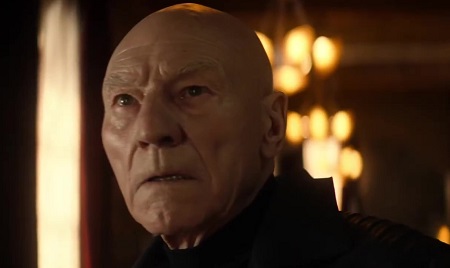
Aliens of Star Trek: The M-113 Creature

Happy Star Trek Day! Today marks fifty-four years since the first episode of The Original Series aired on American television, kicking off a franchise which is still going strong today. The Man Trap featured an alien called the M-113 Creature, but you may know it by its unofficial name: the Salt Vampire!

The early production history of Star Trek is complicated! After The Cage – the show’s original pilot – wasn’t picked up by network NBC, a second pilot was commissioned. This was very unusual, and rumours abound as to what happened. Gene Roddenberry and co. went away to work on a new pilot, and what resulted was Where No Man Has Gone Before. The new pilot dropped most of The Cage’s characters – only Spock would be retained – and reworked the series. It ultimately led to Star Trek being greenlit, and the show was picked up for a full season. Several episodes were filmed, including The Man Trap, and when NBC came to deciding the order in which the stories would air, it was selected as the premiere as its story was considered easier to follow by the executives at the network.

Happy 54th anniversary to The Man Trap… and to Star Trek!

So that’s a potted history of how The Man Trap came to be Star Trek’s first episode, despite the fact it wasn’t filmed first! The episode would see the crew take on a nefarious alien which was the last of its kind: the M-113 Creature.

I’m going to go out on a limb and say that I really like the design of the creature and the special effects used to pull it off. The heavy rubber suits used for some of The Original Series’ aliens and creatures have a distinct aesthetic, but it’s one I think really works. The suits were very cleverly and lovingly designed, and compared to a lot of contemporary special effects have held up remarkably well over the decades. I’d even compare these kind of practical effects very favourably to lots of digital effects and CGI; no one will ever convince me that Enterprise’s CGI Gorn looks better than The Original Series’ rubber suit!

I think this Gorn still looks pretty good in 2020!

Though the M-113 creature was only seen in its true form very briefly, the same kind of special effects brought it to life in a horrifying way, yet with a unique look that is now emblematic of the Star Trek franchise. Many people who are only dimly aware of Star Trek would recognise the M-113 Creature and be able to identify it as a Star Trek alien; in that sense the creature is up there with races like the Borg and Klingons as being iconic.

It’s been great to see a couple of recent references within Star Trek to the M-113 creature. It appeared in Ephraim and Dot – an animated episode of Short Treks that aired back in December. And just last week we caught a glimpse of the M-113 Creature in Cupid’s Errant Arrow, the fifth episode of Star Trek: Lower Decks. These fun little “Easter eggs” to Trekkies were greatly appreciated, and serve as a reminder of Star Trek’s origins all these years later.

The M-113 Creature seen in Ephraim and Dot…
…and again in Cupid’s Errant Arrow.

Though the creature the crew of the Enterprise encountered in The Man Trap was said to be the last of its kind, it’s arguable that may no longer be the case. Being mentioned in Lower Decks could be seen to imply that further M-113 Creatures have been discovered later in the 23rd and 24th Centuries, so we may not have seen the last of this iconic villain.

Nicknamed the “Salt Vampire” because of its ability to extract all of the salt from its victims, the M-113 Creature was a shapeshifter, able to take the form of other species, including humans. It also seems to have been sentient – able to mimic human behaviour and even hold in-depth conversations and form relationships.

The M-113 Creature was able to assume many forms.

Though distinct from later shapeshifting races – most notably the Founders of the Dominion – the M-113 Creature was the first such alien encountered in Star Trek. We’ve since seen a number of others, all of which owe at least a little something to their predecessor from The Man Trap. The concept of a shapeshifter is frightening, and that aspect has been used to great effect in several Star Trek stories.

The M-113 Creature also possessed several other abilities that made it a formidable adversary: it could telepathically sense the minds of sentient life forms – including humans – and use what it found to choose its appearance. This kind of tactic allowed it to get close to its prey and get them to let their guard down. It was also capable of paralysing people in order to get close to them when in its true form, and was incredibly physically strong – far more so than humans and Vulcans.

The M-113 Creature in its true form.

In The Man Trap, the sole surviving M-113 Creature (that we know of) took the form of Nancy Crater, a woman Dr McCoy had known; “that one woman”, as Captain Kirk put it. It lived with Crater’s husband, Robert, on the planet M-113 for a number of years. It was speculated that there had once been a civilisation of M-113 Creatures, but that the majority had gone extinct when the planet’s supply of salt was used up. Robert and Nancy Crater led an archaeological expedition to the world, encountering what could be the last survivor of the race.

Despite possessing some degree of sentience, it wasn’t possible for the crew of the Enterprise to reason with the M-113 Creature that they encountered, and it was killed by Dr McCoy while attempting to feed on Captain Kirk. If it were possible to negotiate with it – or others of its race – Starfleet could have provided the aliens with a supply of salt in exchange for peace. Perhaps such a story could be included in a future episode of Star Trek!

The M-113 Creature after being killed by Dr McCoy.

Despite its monstrous appearance and villainous role in the story, the death of the M-113 Creature in The Man Trap is a sad occasion. Potentially the last of its kind, the entire race and everything they had created now seems lost to history. Starfleet aims not only to seek out new life, but also to find ways – where possible – to peacefully coexist. It’s ironic, considering subsequent Star Trek stories, that the first encounter with an alien ended with its death!

But in a way, the aftermath of the M-113 Creature’s death is what established Star Trek as being more than just typical mid-century B-movie sci-fi fare. It took an emotional toll on Dr McCoy to kill what he thought was his long-lost love, and it took a toll on Kirk and the crew to have killed off the last member of a species. But as the Enterprise prepares to leave orbit, Kirk, Spock, and McCoy gather on the bridge and remember the creature in what was a very poignant moment.

The crew of the Enterprise at the end of The Man Trap.

It’s moments like this, across The Original Series’ early episodes, that set up Star Trek as being something special. There was more to the story of the M-113 Creature than just a horrible monster for our heroes to outsmart. That story was emotional and complex, bringing up issues of morality that other television series and films struggle to get across even today.

Star Trek offered – and continues to offer, fifty-four years later – much more to its audience than just exciting space adventures. This is why the franchise has endured so long, and it all began on the 8th of September 1966 with The Man Trap and the M-113 Creature.

Star Trek: The Original Series is available to stream now on CBS All Access in the United States and on Netflix in the United Kingdom and other countries and territories. The series is also available on DVD and Blu-ray. The Star Trek franchise – including The Original Series and all other properties listed above – is the copyright of ViacomCBS. This article contains the thoughts and opinions of one person only and is not intended to cause any offence.

Star Trek: Lower Decks review – Season 1, Episode 5: Cupid’s Errant Arrow

Spoiler Warning: There are spoilers ahead for the first five episodes of Star Trek: Lower Decks. Further spoilers may be present for other iterations of the Star Trek franchise.

Despite an underwhelming start, Lower Decks has gone from strength to strength in the last few weeks, with each episode being progressively better than the last. In terms of laugh-out-loud moments of comedy, I think there were more in Cupid’s Errant Arrow than there had been last time, though some of the humour was not to my taste. But a sense of humour and jokes are always subjective things, and taken as a whole I greatly enjoyed what the episode had to offer.

The cringe comedy that I disliked wasn’t something I downright hated, it’s just something I’ve known for decades isn’t “my thing”. Shows like Friends relied on this style of comedy a lot, where jokes are built around embarrassing and cringeworthy situations, and it’s clearly something that a lot of people find amusing. I hope that at least some of those comedy fans have found their way to Lower Decks by now – if they have, I bet they’ll have enjoyed what Cupid’s Errant Arrow had to offer.

The opening shot of the episode – note the font from The Next Generation. I love this little touch.

Of course, only American and Canadian fans would be able to get that enjoyment; Lower Decks remains unavailable anywhere else in the world. Even series creator Mike McMahan, who had rather clumsily talked about the situation a few weeks ago, has gone radio-silent. A search for “Star Trek: Lower Decks international” on Google now only yields results more than a month old; ViacomCBS has simply refused to even acknowledge the problem. This is despite the fact that the lack of an international broadcast has killed the hype and excitement that the show needed to build, and that the widespread piracy across the world continues to reduce the value of Lower Decks from a financial perspective. From the point of view of Netflix or Amazon, why should they pay a lot of money for a show with little international attention and whose hardcore fans have already seen it? The answer is they shouldn’t – and they won’t.

But of course I’d never indulge in such skulduggery as piracy. When ViacomCBS refused to broadcast the show internationally, I – a disabled man with hardly any money – had no choice but to move to America so I could watch it. I’m comfortably settled in my second home – a beautiful log cabin in the state of Alaska, a mere half hour’s drive from downtown New Orleans. I went into town just this morning to sample one of its signature dishes – the Philly cheesesteak. Delicious.

This is totally my house. And it’s in America, obviously. Which is where I definitely am.

Cupid’s Errant Arrow is the first episode not to have a teaser before the opening titles, which is uncommon across any Star Trek series. I’m not really sure why that was the case – at first I wondered if the copy I was watching had a missing piece – because although after the titles we did jump right into the story there was still scope to move the titles to structure the episode more traditionally. This isn’t a complaint, though I do consider it worth noting.

The story begins with Ensign Boimler recording a log. The Cerritos has been tasked with supporting the USS Vancouver – a Parliament-class ship that seems to be superior to the Cerritos in almost every way. The design of the Vancouver was very clever; it managed to look bigger, tougher, and more “heroic” for want of a better word, emphasising its importance over the lowly Cerritos, but while retaining a similar enough aesthetic that it was clearly part of the same fleet.

The USS Vancouver overshadows the USS Cerritos.

Star Trek has often used logs to set up stories, and it worked well here. The Vancouver and Cerritos are tasked with saving the planet Mixtus III and its people from a moon that has become unstable. When I first saw this moon in one of the promo images or trailers released before the series I thought it might’ve been the Klingon moon Praxis, as seen in The Undiscovered Country. Though the damage to this moon is less extensive, it still felt like a little callback.

Though we don’t spend too much time with them this week, the bridge crew (or at least, the captain and first officer) have to first negotiate with the native aliens, as there seem to be competing factions who are all squabbling. Though Lower Decks was in production well before the current pandemic, this sequence – with the bickering factions unable to agree on anything in the face of a looming problem – feels rather timely!

The moon of Mixtus III in Cupid’s Errant Arrow…
…and the Klingon moon Praxis in The Undiscovered Country.

The arguing delegates checked all of the boxes when comparing them to the problem-deniers of today: the conspiracy theorists, the ultra-religious, the not-in-my-backyard types. Though perhaps intended as an analogy for something like climate change, it works surprisingly well considering the response to the pandemic has faced hurdles from the same types of people!

Boimler concludes his log by saying that he’s very excited to get to work side-by-side with his girlfriend for the first time. They’ve been dating via subspace, as she serves on the Vancouver. Of course Mariner is sceptical, questioning the existence of Barbara, Boimler’s girlfriend. Apparently he’s been recording lots of personal logs about her too, which is kind of cute. This conversation dropped a couple of references: Q and Captain Picard Day, and the concept of holo-addiction, that we saw Barclay struggle with in The Next Generation. Mariner’s teasing of Boimler felt more good-natured than mean-spirited here, and it was a scene that furthered their friendship.

Mariner gently teases Boimler about his new girlfriend.

Up next were Tendi and Rutherford, paired up for the B-plot of Cupid’s Errant Arrow. Tendi has felt a little rudderless since the show began, and I don’t think has properly found her feet yet as a character. Last time she seemed to be mimicking Mariner at one point, and here, as she demonstrates excitement for the mundane aspects of the Cerritos and Vancouver, it feels like she’s a second copy of Rutherford. The new ensign wowed by everything has, perhaps, been a difficult character to write for.

Tendi and Rutherford visit the USS Vancouver with Mariner and Boimler, and rush off excitedly to see the ship. I think Tendi’s line about the Vancouver being the “best ship [she’s] ever seen” was word-for-word what she said about the Cerritos in the premiere; if not it was still similar enough to be funny. Boimler waits for Barbara while Mariner continues to say she doesn’t believe she’s real. There was a reference to the Phylosians – a race of sentient plants seen in The Animated Series, which was a neat callback. It was around this point that Mariner crossed over from gently teasing her friend to something more sinister as she continues to insist Barbara isn’t real or must have some nefarious reason for dating Boimler.

Mariner, Tendi, and Rutherford aboard the USS Vancouver.

Because of how I’ve felt about Mariner in past episodes, I was at least slightly concerned that she’d turn out to be right and Barbara wouldn’t be real, or would immediately turn out to be some kind of fake or monster. That would have felt a little too obvious, and perhaps would have given Mariner another excuse to see herself as better and smarter than everyone around her. Luckily it didn’t pan out that way!

Barbara is, of course, real. And human (as far as we can tell). She and Boimler are perhaps a little over-the-top in their kissing and cuddling – but that’s all part of the humour. Mariner, after getting over her initial shock, continues to probe her about why she’d date Boimler, but the trio is interrupted by one of Barbara’s colleagues – they’ll be working together, to Boimler’s dismay.

Barbara and Boimler with Mariner.

One very minor point of criticism that I’d have about some of the shipboard scenes this week is that it wasn’t always obvious which of the two vessels the characters were on. The rooms and corridors aboard the Vancouver look very similar to those aboard the Cerritos – even the bridge design is identical – and I wasn’t always sure which ship scenes were set on. In past Star Trek shows, redressing sets or simply reusing sets has created this issue numerous times, but in animation it should be much easier to make some tweaks and changes to give each ship distinguishing features. Otherwise, there’s almost no reason to have two different classes of ship!

It was pretty obvious that the lieutenant Barbara met was, in fact, an ex. The way Boimler reacted, and the way the pair showed such familiarity, telegraphed that story point. This set up the next part of the story: while Mariner will be scrambling around trying to figure out what kind of nefarious imposter Barbara is, Boimler will be scrambling around trying to win her back from what he perceives to be the threat of her ex.

Barbara meets her ex.

The latter of these stories – Boimler trying different tactics to win over Barbara – is where the cringe humour that I mentioned at the beginning really kicks in. It makes sense in a way; it’s a style often seen in romantic comedies, and Cupid’s Errant Arrow is perhaps as close as Star Trek has come to truly having a romantic comedy storyline… except for Picard and Lwaxana Troi in The Next Generation!

By this point, Cupid’s Errant Arrow had established its storylines. Unlike last week, where I felt Boimler’s C-plot went nowhere, there seemed to be enough time for all three stories to play out effectively. We have Captain Freeman’s struggle with the planet’s natives, Tendi and Rutherford aboard the Vancouver, and the Boimler-Mariner-Barbara-Barbara’s ex quadrangle. All three would play out with enough time dedicated to them to feel fully-rounded.

Mariner, Boimler, Barbara, and her ex.

Lower Decks is always picking on Boimler – in a fun way, of course – and this time we learn his full first name: Bradward. This greatly amuses Mariner, and it is kind of a silly name. Sorry to all the Bradwards out there! I suppose we could say it’s surprising that Mariner seems to have known Boimler a while without learning his actual name, but firstly it’s a comedy show so not every point has to be 100% serious, and secondly… I’ve been there. There are people I worked with or knew for years whose names I never learned/remembered! So it’s not actually that unusual a situation.

Aboard the Vancouver, Tendi and Rutherford meet with a senior officer who has some kind of new scanner – the T88. Since the episode aired I’ve been racking my brain trying to figure out what this is a reference to! At first I thought it might’ve been something from Star Wars, then I wondered if it was a reference to The Terminator… in any case it was repeated so often in the episode that I assume it’s a reference to something, but as with Rutherford’s pudding joke last time I’m just not sure what!

Tendi and Rutherford are excited about the T88 scanner.

Regardless, the pair are very excited about the scanners, and the senior officer promises whoever completes a scanning task first will get to keep a T88. As mentioned, I feel this works way better for Rutherford’s character than Tendi – who is still kind of an unknown quantity even several episodes in.

Back aboard the Cerritos, Boimler is trying to find ways to impress Barbara. At first he tries working out – doing push-ups. Mariner continues to espouse her theory that Barbara is some kind of intruder, alien, or spy and that Boimler is in danger. At first this seemed like “typical Mariner” – assuming she must be right because she knows best – but I was pleasantly surprised when the episode informed us why she’s so paranoid about the prospect of someone she cares about – and she does clearly care about Boimler – being the target of some kind of evil alien.

Mariner tries to convince Boimler that Barbara is evil.

By the way: in the image above, which takes place in the ensigns’ dormitory, does that look like a forcefield behind Mariner? Or is it supposed to be a window? It seems odd to me that the Cerritos would be flying around with a giant hole in its crew quarters – a loss of power would blow them all out into space! But we’re off-topic.

In a flashback sequence we see Mariner a few years previously. Wearing the uniform design used in First Contact and the back half of Deep Space Nine, she and a friend are visiting Quark’s. Mariner appears to still be an ensign at this time, though whether that’s because she’s new to Starfleet or had been promoted and demoted wasn’t clear. Her friend has a new boyfriend, but he turns out to be an evil alien shapeshifter and eats her! So now we know her concern about Barbara doesn’t just come from nowhere for the sake of setting up a funny story – she’s motivated by past trauma. And while we can definitely say she needs to work through that trauma instead of taking it out on Boimler, this moment humanised her in a way few moments in Lower Decks have managed to so far.

Mariner sees a friend eaten by a shapeshifting boyfriend in a flashback sequence.

It was nice to see Quark’s – albeit very briefly – as well as the uniforms of the Deep Space Nine era. We could do a whole series of articles on which uniforms are the “best”, and there will always be differing opinions on that, but I certainly like the grey-and-black variant seen here, and just like when they were included in Star Trek: Picard earlier in the year, it was a nostalgic treat to see them back here too.

Mariner’s determination to help Boimler was sweet, if a little misguided, and the fact that it was basically derived from seeing him as someone unlikely to get a girlfriend was a very “Mariner” way of looking at the situation. In that sense it stayed true to her character, while allowing her to help out. The flashback provided her ample motivation, and this storyline worked well.

Mariner is determined to “help” Boimler.

Up next we had another scene with the captain and the arguing natives. Despite limited screen time, I enjoyed this aspect of the story. The aliens (presumably Mixtusians?) follow on from several others we’ve seen in Lower Decks as being at least slightly more “alien” in appearance than some Star Trek races. Animation as a format allows for this much more easily than live-action, and I think it’s fair to say that we’ve seen Lower Decks take advantage of this as much as possible.

The captain manages to resolve most of their problems – moving homes, installing gravity generators, etc. – but one robed alien still is unsatisfied. He claims that imploding the moon will send debris to his people on Mixtus II, so it looks like there’s still a problem to be overcome after all!

Captain Freeman, Commander Ransom, and the Mixtus III aliens.

In his first attempt to win over Barbara (despite the fact he doesn’t need to) Boimler interrupts a meeting she’s giving about the mission. This scene was by far the worst in terms of cringe humour, and while that really isn’t my thing for fans of that style of comedy I have no doubt it worked.

While Boimler interrupts to try to stake his claim to Barbara in front of her ex (and several of her colleagues) Mariner is trying to prove she’s an impostor. At first she believes Barbara to be an android, programming her tricorder to disable any androids present. The two are eventually forced to leave the meeting and this scene (thankfully) came to an end.

Boimler and Mariner disrupt Barbara’s mission briefing.

Tendi and Rutherford bicker over who has the best claim to the T88 scanner – there seems to be only one available and they both want to take it back to the Cerritos for their various departments. It was never really explained why the T88 is so good – or even really what it does – so I didn’t feel this storyline had particularly high stakes. For the most part it followed a fairly common trope: two friends end up competing against each other, only to realise that their friendship matters more than the prize on offer.

Mariner has a number of theories about Barbara, and these checked off a number of creatures and characters from past iterations of Star Trek. She mentioned the “salt vampire” from The Original Series Season 1 episode The Man Trap, a transporter duplicate from The Next Generation Season 6 episode Second Chances, the Suliban from Enterprise, and a “surgically-altered Cardassian spy”, which is of course a reference to Seska from Voyager. The pinboard she has with lots of pictures and string was funny, and I liked seeing her get deeper and deeper into this rabbit hole. I’m also pretty sure this marks the first reference to the Suliban outside of Enterprise.

Mariner’s conspiracy theories about Barbara referenced a number of past Star Trek stories.

Boimler has a funny line here; while criticising Mariner for not accepting Barbara, he plans to change everything about himself to trick her. The comedy built and built on this, as Boimler confidently asks the replicator for an outfit combining the coolest people in history – in “boys size small”.

The outfit was suitably ridiculous: unmatched boots, two halves of a jacket, an (American) football, and pink sunglasses. I’m sure each piece represents a classic film or television series; I struggled to name them all. But the overall look was so over-the-top and stupid that I had to pause the episode from laughing so hard. This entire sequence was great – but it built up to another cringe moment as Boimler interrupts Barbara in the mess hall.

Cool Boimler.

After Boimler ruins things with Barbara (and spills beer on her) she storms off with her ex. Mariner is increasingly convinced she’s some kind of reptile in disguise, using Barbara calling Boimler “sexy” as evidence.

A misunderstanding in the shuttle bay eventually leads to Boimler and Barbara reconciling; there was never anything between her and her ex as of course we knew. Mariner hasn’t given up, though, and pulls Barbara’s pants down in an effort to expose her as an alien infiltrator. As I mentioned I’m glad Mariner was wrong on this point, as making her someone who’s always right about everything doesn’t tend to make for a fun and relatable character.

Mariner tries – and fails – to expose Barbara as an alien.

Just when it seemed sure that Barbara was human, she and Boimler leave to complete the next part of the mission. As they leave, Mariner finds something on the ground: a husk. After scanning it she’s sure that Barbara is a parasite (or is being controlled by one). She rushes off to tell Boimler.

Tendi and Rutherford complete their task together, but the officer on the Vancouver who gave them the assignment tells them they’re going to be transferred to his ship. Despite loving the Vancouver for its fancy systems and technology, both would prefer to stay on the Cerritos, and a slapstick chase ensues after they steal the officer’s padd – preventing him from submitting the transfer order. This scene was okay, and led to a funny payoff at the end that we’ll come to, but it wasn’t anything spectacular. Slapstick comedy like this can be fine, but something about it didn’t feel right here.

Rutherford and Tendi steal the padd to prevent their transfer to the USS Vancouver.

Meanwhile, Mariner is racing to get to Boimler before the Barbara-parasite can harm him. She puts on a spacesuit and jumps out of the airlock, racing to an orbital platform near the moon. She comes aboard only to find Boimler naked and waiting for Barbara – in another incredibly cringeworthy moment of comedy!

Mariner remains convinced that Barbara is the parasite, but Boimler – clearly fed up with her antics – isn’t buying it. He tries to get Mariner to leave, but because of the delay in destroying the moon thanks to the intransigence of the Mixtus II alien, the platform shakes and Boimler is knocked out.

Nobody wants to see that…

Commander Ransom alerts the captain to the problem on the bridge, while Barbara and Mariner fight over Boimler on the orbital platform. Apparently Barbara has been feeling the same way about Mariner, wondering if she’s an impostor and what her interest is in Boimler, which was kind of funny. This set the stage for the two to reconcile, realising that each other had Boimler’s best interests at heart.

With the moon about to cause devastation on Mixtus III, Captain Freeman feels she has no choice but to act. And in a very funny moment – that also served as a commentary on wealth inequality – the Mixtus II alien admits it’s just him and his wife on the planet; they’re very rich. The captain gives the order to implode the moon, saving Mixtus III from harm despite the rich alien protesting.

Captain Freeman and the Mixtus II alien.

After ending their fight, Mariner and Barbara bond over stories about Boimler. Though these tales almost all put him in a negative light, it was a funny sequence that was perhaps even a little sweet. They both realised that neither was a threat, and that their fighting was borne from a misunderstanding. I liked this resolution to a story that could have made Barbara an alien menace; I think it worked far better.

While Boimler lay unconscious, the two gossiped about him and some of his silly moments – messing up, touching aliens in an inappropriate way, etc. Mariner had a cute line where she said that Boimler is a dork, but he’s her dork. After seeing her being unkind and even bullying him in earlier episodes, this moment (and others earlier on) really hit home the fact that they’re friends, and I liked that.

Boimler lays unconscious in the foreground while Barbara and Mariner chat about their adventures with him.

Meanwhile Tendi and Rutherford have managed to uncover the Vancouver officer’s horrible secret – while transferring them to his ship, he plans to transfer himself to the Cerritos! I loved this moment, as the officer pleads to return to a less exciting ship. He can’t handle the pressure of being on such a cool ship and wants a quieter life. We’ve never really seen that idea explored in Star Trek – that an officer might not want that kind of life. Though it was a brief moment in a secondary plot, acknowledging the idea that some in Starfleet may prefer life in the slow lane was nice, and I appreciated its inclusion.

On the orbital platform, Mariner and Barbara finally uncover the source of the husk Mariner found – Boimler is the one who’s picked up a parasite! The green louse-like creature had affixed itself to his head, but Barbara was able to remove it. It turns out this was the reason why she liked him – the parasite gave off pheromones that made him much more attractive! This was another twist, but a fun resolution to the plot. Mariner was half-right after all – there was a parasite involved. Just not in the way she expected. Though the timeframe of Lower Decks is not at all clear, Boimler was supposed to have picked up the parasite more than a month ago – does that mean he’s had it in every episode so far? Or is it something he picked up between last week’s episode and Cupid’s Errant Arrow? If it’s the former, perhaps we can expect to see some changes in him going forward now that it’s been removed.

Barbara finds the parasite.

In keeping with Lower Decks’ style of returning to episodic storytelling, all of the storylines are wrapped up by the end of the episode. Barbara breaks up with Boimler, removing her from the picture. Tendi and Rutherford return to the Cerritos – with armfuls of T88 scanners! And the ship and crew have completed their moon mission, ready for another adventure next time.

Cupid’s Errant Arrow was fun, and despite the cringe humour that it made use of at points, there were some laugh-out-loud moments. I had a lot of fun with the episode, and I’m enjoying spending time with the characters. Tendi still feels underdeveloped, as if the writers don’t really know what to make of her. But the other three are finding the niches. Mariner’s turn away from being self-centred has been to the series’ benefit in a huge way, and I’m having fun with her, laughing along at her shenanigans rather than rolling my eyes.

The stolen T88 scanners.

This was an episode which really took the action away from what would have been the “main” story in another Star Trek series – saving Mixtus III from the crashing moon. This was always what Lower Decks promised to do: focusing on the unimportant characters rather than the main bridge crew. Several previous episodes had the ensigns participate in the main story in more of a major way, but this time they really didn’t, and thus Cupid’s Errant Arrow is an episode to point to as one that encapsulates the Lower Decks concept.

The teaser for next week’s episode looks like a lot of fun – and while I won’t spoil anything, I’ll say that I’m definitely looking forward to the crew’s next adventure. I hope you’ll come back after you’ve seen it for another review!

The first five episodes of Star Trek: Lower Decks are available to stream now on CBS All Access in the United States. The Star Trek franchise – including Lower Decks – is the copyright of ViacomCBS. This article contains the thoughts and opinions of one person only and is not intended to cause any offence.

Star Trek: Lower Decks review – Season 1, Episode 4: Moist Vessel

Spoiler Warning: There are spoilers ahead for the first four episodes of Star Trek: Lower Decks, and for other iterations of the Star Trek franchise.

Last week’s episode, Temporal Edict, was fantastic. I had a great time with that story – as I’m sure you could tell from my review – and I especially enjoyed seeing Ensign Mariner step up and start being more of a protagonist I could get behind. I was optimistic and even excited for this week’s episode after what I saw last time, and although Moist Vessel started with a scene that got me worried Mariner would wholly regress back to being vain, selfish, and annoying, I was pleasantly surprised with another largely enjoyable episode.

Even now that we’re four weeks into Season 1, there’s still no news regarding an international broadcast. Practically nobody outside the United States and Canada is paying any attention to Lower Decks any more, and what was probably Star Trek’s best opportunity since the 2009 reboot to reach out to new would-be fans has been thoroughly wasted. It’s such a shame to see the hard work put in by Mike McMahan and the rest of the team behind the show being squandered by ViacomCBS in what has to be one of the worst business decisions in Star Trek’s recent history. As I predicted, Lower Decks is being heavily pirated practically all over the world, reducing its value in a packed market – assuming ViacomCBS still hopes to sell the international rights. With no one at the company even acknowledging Star Trek’s international fans, and with no information as to when or even if the show will get an international release, piracy is quite literally the only option for fans who don’t want to miss out.

But of course I’d never sink so low! As you know, when it became apparent that Lower Decks wasn’t going to be coming to the UK I had no choice but to up sticks and move to America. I’m relaxing in my home in northern California as we speak, looking out on the Blue Ridge Mountains in Yellowstone National Park. Tomorrow I’m going to take a short drive to Atlantic City to sample the famous New England cuisine. I can hardly wait!

This is undeniably my house. It’s in the United States, of course. That’s where I definitely am.

As I indicated at the beginning, Moist Vessel begins with another scene in which the humour was supposed to come from Mariner’s selfish “I-don’t-care” attitude. And as I’ve covered several times already, those moments generally don’t work for me. I find that side of her character childish and rude, and the attempted humour derived from that isn’t my thing – at least not in a Star Trek setting.

A scene in the Cerritos’ briefing room introduced the first major Tellarite character to appear in Star Trek for a very long time – Captain Durango of the USS Merced. The Cerritos and Merced will be working together on a mission to tow a long-lost “generation ship” that contains a previously-unknown kind of terraforming fluid.

Mariner isn’t a good source of humour in moments like this, when the entire “joke” is centred around her selfishness.

I liked this setup; it felt very “Star Trek”. Bringing in a second minor ship – the Merced appears to be a California-class like the Cerritos – was a nice touch too, and allowed the rest of the story to work better than if we’d just been following the Cerritos. Animation as a format allows for more variety and versatility than live-action in a lot of ways, and including a second ship is much less of an expense in an animated series than it would be in a live action show. In a way I’d have liked to see the Merced as a different starship class; as I noted in the finale of Star Trek: Picard, having lots of identical ships doesn’t look as good as having varied styles. But that’s just a minor point really.

The generation ship was massive, far larger than the Starfleet ships. And it wasn’t made obvious which species it belonged to – it’s possible the crew of the Cerritos didn’t know either. It’s clear that the generation ship had already been discovered and explored by a previous Federation crew; the Cerritos and Merced are just there to tow it back to Starfleet. This ties in with Lower Decks’ premise of following an unimportant ship, but was done in such a way as to still give the crew a genuine adventure.

The scale of the generation ship was impressive.

After the title sequence, Mariner is getting another well-deserved dressing-down from Captain Freeman; her mother. When we learned at the end of the premiere that Freeman and Mariner were mother and daughter it was surely only a matter of time until that fact became relevant, and here we get to see the first real interaction between them. As happened in either the first or second episode, I was wholly on the side of the officer giving Mariner a stern telling-off, despite her being the show’s supposed protagonist.

Mariner’s anti-authority streak has a distinct feel of teenage rebellion, which is compounded in this scene by the fact that it’s her own mother that she’s in trouble with. Perhaps that kind of character appeals to, well, teenagers and children, but it’s a trait I find particularly annoying in Mariner. I was hoping after last week’s episode she may have turned a page, but this scene – complete with sarcasm, whining, and a Vulcan salute delivered in the way one might flip the middle finger – was Mariner right back where she’d been. I was disappointed by this, though she would regain some of her standing from last week via her actions later in the story.

Mariner gets scolded like a misbehaving child.

Captain Freeman is upset, and along with Commander Ransom hatches a plan to force Mariner to request a transfer – giving her the worst jobs on the ship. Ransom allows his captain to take credit for what had been his idea – I got the impression that’s something he does a lot. He seems to know how to deal with Captain Freeman, and while he had seemed to take a shine to Mariner last week, it’s clear where his loyalties lie.

The second-in-command coming up with an idea that the captain pretends or thinks is their own is a pretty common trope, though, and while it was okay as a one-off joke, I’m not sure how well it works for Freeman’s character. We know her as a pretty strict captain with ambitions for her ship and crew, and to show her as vain or easily manipulated like this makes her far less relatable and likeable. Neither of which are good things.

“That’s why you’re the captain!”

The ensigns are given their assignments in the next scene. Boimler would be absent for much of the episode, but was present here briefly. As Ransom and Freeman had planned, Mariner is given the worst jobs, though Rutherford initially seems unhappy with his – he wanted a different kind of calibrating.

This sequence sets up the B-plot, which this time focuses on Tendi. She’s given the opportunity to witness an “ascension” – a seemingly human crew member is going to ascend to become a “being of pure energy”. Rutherford compares the process to becoming a Q or being the Traveller (from The Next Generation), and though Tendi dismisses those comparisons it seems like a fairly similar process.

Tendi expresses her excitement to Rutherford.

Along with Boimler, we won’t see much of Rutherford until near the end of the episode; Moist Vessel follows Mariner and Tendi’s stories much more closely. And that’s okay, many Star Trek episodes focus on a particular character or group of characters, and we’ve spent time with Boimler and Rutherford before, and surely will again.

When trying to make a comedy series like Lower Decks, it must be hard to give each character a fully-rounded personality while still keeping open possibilities for jokes and humour. In the next scene, Tendi is at the ascension ceremony when she becomes distracted and ultimately disrupts the proceedings in what was an incredibly slapstick sequence. I don’t mind slapstick, visual comedy, but in a similar way to making Captain Freeman easily-manipulated, oblivious, or someone who takes credit for her officers’ ideas, turning Tendi into a bumbling idiot wouldn’t have been my choice.

Tendi ruins the ascension ceremony.

Tendi doesn’t appear to have done any research or read her assignment brief, as she turns up late (the ceremony was already in progress) and doesn’t know what to do or even whether she’s supposed to observe or participate. But then, midway through, she becomes distracted and wanders off to look at an object in the room – this is what leads to the slapstick falling over and ruining the ceremony. I could excuse accidentally knocking something over, but the way she put herself and her own interest in the gong ahead of everything else that was happening was selfish and childish – something we might have expected from Mariner, but not Tendi.

Keeping each of the four ensigns’ characters and personalities distinct is a pretty basic expectation, and the fact that Lower Decks is an animated comedy series may lower the bar in some ways, but it doesn’t work as a catch-all excuse for everything. And in this scene, Tendi seemed to act way out of character; this would have been an acceptable (but still silly) storyline for Mariner. Boimler has been established as the “by the books” anxiety-riddled nerd. Rutherford is the workaholic who loves even the most tedious of tasks in engineering. Mariner doesn’t care about Starfleet. Tendi doesn’t really have a personality yet, and this was a good opportunity to show off what she could be. Instead we got her dumped into a sequence that didn’t seem to fit, and while she wasn’t exactly Mariner 2.0, she wasn’t her own character either.

This sequence with Tendi wasn’t my favourite.

The ceremony, and Tendi messing it up, was really just the setup for what would be the B-plot of the episode, though, and if I’m being charitable I guess I could say I can see why the audience might have found it funny on a visual level. I liked that Tendi tried to replicate more sand for the sand-design that she ruined; that was an amusing moment.

Boimler and Mariner are up next, and he’s teasing her about being assigned the worst jobs while he gets a (comparatively) better one. Boimler seems to have picked up some of Mariner’s traits as well, as he repeats the sarcastic Vulcan salute that she used earlier in the episode. Mariner telling him it doesn’t look cool when he does it, only to admit a moment later that it did was a pretty funny joke, and I certainly cracked a smile at this point. Mariner and Boimler can work well as a duo provided their bickering stays on the friendly side and doesn’t cross over into anything mean-spirited. In this instance I think they stayed on the right side of the line.

Mariner, dejected about her duties, and Boimler.

The next sequence showed Mariner undertaking the various dirty jobs on the ship, including cleaning out the holodeck filters (yuck), applying grease to a turbolift, and phasering carbon from a carbon filter. I’ll excuse the fact that these tasks could be performed by robots (even today, in some cases) because we were always going to get moments like this. It didn’t harm canon and it wasn’t immersion-breaking; in many ways, this is what Lower Decks promised to be about. We were going to see unimportant crewmen performing unimportant tasks on an unimportant ship. The sequence was great; it had some comical moments and I enjoyed it.

At the end, though, was a moment that didn’t work particularly well. As Mariner turns her final task – cleaning the carbon filter using a phaser – into a fun game and seems to be enjoying herself, Ransom spots her. He reports back to the captain that Mariner is “finding little ways to inject joy into otherwise horrible tasks”. It was incredibly on-the-nose for a character to say aloud; the audience saw Mariner doing that firsthand, so we didn’t need to have it explained in such an obvious way. It felt pretty patronising, as if the team behind the series didn’t trust the audience to understand what was going on.

Did Ransom really need to say out loud that Mariner was having fun right after we’d seen this sequence?

Tendi is trying to make up for her earlier mistake, as she feels awful – so she’s definitely not Marinier after all! It was pretty funny that the lieutenant who was supposed to be so calm and zen that he was on the verge of ascending from this plane of existence became very grumpy and annoyed with Tendi, and this being played for laughs worked pretty well – at least the first time it was done.

The storyline between these two characters was kind of a cliché though. Someone trying to make up for a mistake while the person they wronged wants nothing to do with them has been done and overdone in countless comedies and dramas over the years, played both humorously and straight, and nothing about Lower Decks’ take was original or innovative. It was fine, and there were some funny moments, but it wasn’t spectacular.

Tendi spends much of the episode trying to make up for her mistake.

Freeman and Ransom are still scheming about how to get Mariner to request a transfer off the ship. From Freeman’s conversation with Mariner’s dad in the premiere, it sounded like her parents had an understanding that one of them would keep an eye on her on her Starfleet postings – and I would suggest that perhaps the only reason she’s still employed as an ensign is because they’ve been intervening on her behalf. So it seems to run counter to that conversation that Freeman would now be plotting to get her removed from the ship.

Interestingly, my (totally legal) version of the episode had one word censored when talking about the holodeck filters. I assume this was done on CBS All Access, perhaps it was deemed too raunchy for TV? Regardless, Freeman hits on the perfect solution. She’s found the thing Mariner would hate even more than the dirty, disgusting jobs: being promoted.

Mariner does not want a promotion!

This scene, in which Mariner is promoted to lieutenant, kicks off what I guess was supposed to be the C-plot of the episode. Boimler, who was cleaning the conference room while Mariner was receiving her unwarranted promotion, decides that he needs to be a rule-breaker like her in order to get ahead in his Starfleet career. But in what was a busy episode there wasn’t enough time for this to play out, and it’s pretty clear that trying to run three storylines each featuring a main character is too much to cram into an episode barely twenty minutes long. Boimler’s sub-plot added nothing, and was a blink-and-you’ll-miss-it thing anyway, taking up practically no screen time.

Star Trek shows of the past have rarely tried to have three or more stories on the go at once, and they were all using far longer episodes. It was never going to work, and it’s a shame in a way because the idea of Boimler trying to put on a Mariner-esque persona could have been funny (so long as it was clear he wasn’t committed to being a selfish jerk). But it feels totally wasted here, and if this was the one attempt this season to try that concept, it’s a shame. Maybe it will be revisited in more detail in another episode, though.

Boimler’s reaction to Mariner’s promotion. His story had potential but there was simply not enough time in the episode to do it justice.

Should we talk about nepotism in Starfleet? Because Moist Vessel seems to suggest that the practice is possible and relatively easy to get away with. We’ve seen situations before in which an arguably undeserving character is given a position aboard ship (I’m looking at you, Wesley Crusher) simply by having a good relationship with the captain, so it isn’t wholly without precedent. However, it raises some alarming questions about elitism within the organisation. Starfleet has usually been presented as meritocratic, but if Freeman can promote Mariner – her own daughter – when she’s clearly undeserving, presumably any captain or admiral can do the same to their relatives? It’s definitely worth considering the implications of this, I think.

I keep saying that we need to treat Lower Decks as an animated comedy first and a Star Trek show second. And it’s true, the show works way better when putting canon and the minutia of the franchise to one side. But moments like this raise questions, and because Lower Decks is officially part of canon and in the same timeline and universe as all the other series, sometimes it’s hard to avoid comparing the way Starfleet is presented here with how it’s been presented elsewhere. Perhaps the topic needs looking at in more detail; I’ll add it to my writing pile!

Sometimes it’s not what you know, it’s who you know…

A montage goes on to show Mariner not enjoying her time as a lieutenant, and some of the activities we might’ve enjoyed seeing the senior officers engaged in in other Star Trek shows are clearly not to Mariner’s taste. Some of these – like the poker game – were little references to past iterations of Star Trek, which I appreciated.

Tendi is explaining to Rutherford how she’s trying to make up for her mistake, and while he’s sympathetic and clearly a good listener, he doesn’t put much stock in her plan. She seems to think she can get the lieutenant – named O’Connor – back on track with his ascension by studying spirituality, but Rutherford is a voice of reason telling her it doesn’t work like that. Tendi is not dissuaded, however, and rushes off with her collection of books. She leaves her unfinished lunch to Rutherford who seems excited that she left her pudding; I’m sure this was a reference to something – but I have no idea what!

Though I’ve no idea what this moment was about, it surely will have made sense to some viewers.

Mariner has received new quarters to go along with her promotion, and Boimler visits her. This furthers the underdeveloped C-plot that we discussed earlier, and it really feels like a way to force Boimler into a story which offered no organic role for him.

In Engineering, Tendi is trying different spiritual techniques to help O’Connor ascend, and as I said this storyline started leaning heavily into the trope of one character trying to help and the other not wanting their help. It was fine, but not particularly funny or interesting from my point of view. O’Connor being so grumpy and annoyed when he’s supposed to be on the verge of ascending due to his calmness and composure was funny the first time, but that should’ve been a one-time-use joke, and building this whole story around it stretched it past breaking point.

O’Connor shouts at Tendi in engineering.

When Mariner and Freeman had their next scene in what looked like a lounge or perhaps the captain’s ready room, Mariner was close to cracking. She clearly hates the role of a senior officer, along with all of the “boring” things they have to do – like attending a birthday party for Commander Ransom, who will apparently play the guitar. Despite that, she is unwilling to admit defeat and request a transfer. This scene had perhaps the funniest one-liner of the episode, too. When Freeman says she’s doing what she needs to do, and “it’s called being a captain”, Mariner hits back with “no, it’s called being a dick!” That definitely won a laugh from me.

In the next scene, there’s a contrivance to suit the plot. It’s not worth getting too worked up over – animated comedy first, Star Trek show second, remember? – but Captain Durango moves the Merced closer to the generation ship, believing he should be in that position as its “his” mission. Moving out of formation ruptures the generation ship’s hull, spewing out the terraforming liquid. Because the liquid transforms everything it touches, whole sections of the Merced are affected, disabling the ship in an instant.

The USS Merced (left) is disabled after being hit with the terraforming liquid.

The Cerritos is soon affected too, as the terraforming liquid is drawn to the ship along the tractor beam. On the bridge, Commander Ransom ordered an evasive action, but it was too late. Across the ship, various crystals and plants emerge, transformed from the ship’s own hull and material. I love the way the terraforming liquid works – it’s something we could have absolutely seen in past iterations of Star Trek. The idea of the ship itself being transformed harkens back to Masks, from the seventh season of The Next Generation, where something similar happened to the Enterprise-D.

From here, the story follows two pairs of characters – Freeman and Mariner, who had been together when the crisis occurred, as well as Tendi and O’Connor. Both pairings put together characters who had been antagonistic to each other earlier in the story, and this concept can work very well. We’ve seen Star Trek stories of the past do similar things; one example that comes to mind is the episode Disaster, from the fifth season of The Next Generation. Disaster made my list of ten great episodes from that show, as it’s one I really enjoy.

Freeman and Mariner will have to work together…

The terraforming liquid has also introduced large volumes of water to parts of the ship – including engineering, where Tendi and O’Connor are. Just as Freeman and Mariner will have to put aside their disagreements to work together, so too will Tendi and O’Connor. No one seems to know what to do amidst the chaos to save the ship, but Freeman and Mariner both come up with the same idea – and it turns out that Mariner had read the mission brief after all. Tying in with last week’s theme of Mariner stepping up when the ship and crew need her to, this worked so well.

When the episode began with Mariner having seemed to regress, I was concerned that Lower Decks was going to continue to use her selfishness as one of its key points of humour, and as I keep saying, “Ensign Rick Sanchez” just doesn’t work for me in this Star Trek setting. But I’m glad that she once again proved she isn’t just interested in herself, and that despite proclaiming boredom and lack of interest at the way Starfleet operates, she still does the work – including reading the brief.

Tendi and O’Connor in a flooded and overgrown engineering.

Both pairs of characters overcome their differences thanks to the chaotic situation. Tendi realises that her desperation to help O’Connor is motivated by a desire to be liked by everyone on the ship, while Mariner’s dislike of her mother and authority seems to come from being treated like a child and smothered. In Mariner’s case, I have to say I’m still kind of on the captain’s side – Mariner does undeniably behave like a bratty teenager, and if I were responsible for someone who behaved that way, I’d certainly treat them accordingly.

However, this sequence was really interesting from a character point of view, and we got to see the mother-daughter relationship in detail. Freeman and Mariner are more alike – especially in terms of how stubborn they are – than either would be willing to acknowledge. Both are also – in their own ways – dedicated to their friends and crewmates, and while Mariner might sulk at the notion of spending an evening at Ransom’s birthday party while he plays the guitar, she wouldn’t let him down if he needed her help. This side to her character goes a long way to making up for her attitude, and after the last two episodes showed this, I have much more respect and admiration for Mariner and her abilities.

Freeman and Mariner tunnelling their way through the partly-terraformed ship.

The dichotomy in Mariner has always been that she’s perfectly capable officer, but she has such a bad attitude and a selfish streak that she doesn’t make use of her talents. The past two episodes have put her in situations that required her to step up, and this has been great news for her character – it’s made her far more likeable and relatable, which are qualities a protagonist needs to have. I just hope these traits stick around for the rest of the season and aren’t lost as the show retains an episodic approach to storytelling.

Lower Decks’ episodic nature, though, has been in many ways a welcome reprieve. Television storytelling in recent years has become all about serialised stories, season-long arcs, and the like. Star Trek shows of the past – especially prior to the Dominion War arc in Deep Space Nine – took this much more episodic approach, and in that respect, Lower Decks feels like a return to that kind of Star Trek story. The downside, as I suggested, is that we can go from what feels like a genuine character arc to a regression in the next episode if that transformation doesn’t stick!

Still digging that tunnel…

After their journey to the environmental control room, Freeman and Mariner are able to reverse the transformation – thanks to some very Star Trek-y technobabble! They even shared a hug as the terraforming was reversed, in what was a very sweet moment.

After Tendi managed to use an exploding pod to drain the water from engineering, saving her and O’Connor’s lives, he returned the favour by saving her life when a large crystal or rock fell from the ceiling. Doing so helped him find his centre and his composure, and he was finally able to ascend – though it looked very painful! This was another joke that dragged just a little too long, in my opinion, and the humour wore off by the time O’Connor was finally fully ascended. But that’s just personal taste, and for many animated comedy fans I think it would be right in line with what they like.

O’Connor’s painful ascension.

It wasn’t possible to use the same process to reverse the damage done to the USS Merced, which seems to have been more severely damaged. However, Mariner and Freeman were able to use the Cerritos’ transporters to beam the Merced’s crew to the generation ship where they’ll be safe – and I liked their shared joke about dumping the boring Captain Durango with the mummies and fossils!

Freeman gets a little over-excited, thinking that this concordance with Mariner may last. It won’t, of course, and the idea that the mother-daughter team will work this closely going forward was put to rest pretty quickly! Despite how well it worked here, Lower Decks’ fundamental premise means we won’t be seeing it happen any time soon.

Mariner and Freeman share a hug.

With Tendi having made her peace with O’Connor and him having ascended, all that was left for the episode to do was reset Mariner’s status in time for the next story – and by insulting an admiral in front of the captain, she was demoted back to ensign and rejoins her crewmates in their shared living space.

Tendi isn’t quite as okay with not being liked as she thought, though; she presses Rutherford to tell her who else aboard the Cerritos doesn’t like her when he suggests there may be others besides O’Connor. Boimler is upset that Mariner got everything he wanted – i.e. the promotion – but rejected it. But Mariner is back where she she’s happiest, and I think we can agree that (if she belongs anywhere in Starfleet) she belongs there.

Mariner is back where she wants to be.

So that was Moist Vessel. Another slow start, perhaps, but another solid and enjoyable episode followed after the opening titles. It was nice to get to spend more time with Tendi, even though at the beginning of her story she felt a little out of place. She grew into it, though, and by the time the ship was in peril she had firmly established who she was and how she was going to react. In that sense, this episode laid the groundwork for establishing Tendi as more than someone who’s just wowed by everything in Starfleet because she’s new.

Mariner once again stepped up to be the officer we know she can be. I could certainly leave behind the attitude and the brattiness, but if she continues to demonstrate that she’s a decent person underneath it, I’ll put up with it. Boimler’s storyline was a waste in Moist Vessel, though, and added nothing whatsoever. I’d like to see this angle explored again – the idea of Boimler trying to be more like Mariner – because I think it has the potential to be both funny and interesting. Unfortunately in an episode barely twenty minutes long there just wasn’t enough time to dedicate to it; it really needs to be the focus of half an episode or more to work effectively.

Boimler’s story needed more time.

At time of writing I don’t believe a title for episode 5 has been announced. Perhaps that’s to avoid spoilers, or perhaps it’s something that will be coming imminently. Either way, Lower Decks is off to a good start and I’m very much looking forward to next week’s offering. I hope you’ll check back afterwards for my review; I’ll be looking at every episode this season as they air.

Star Trek: Lower Decks is available to stream now on CBS All Access in the United States. No international broadcast has been announced. The Star Trek franchise – including Lower Decks – is the copyright of ViacomCBS. This article contains the thoughts and opinions of one person only and is not intended to cause any offence.

Star Trekkin’ – a number one hit!

Here in the UK, we have a long tradition of supporting what are politely termed “novelty” songs. That is, songs which are just plain silly. We’ve seen number one successes for such titles as John Kettley (Is A Weatherman), Ernie (The Fastest Milkman in the West), and the dreaded Crazy Frog… which still gets stuck in my head sometimes! There was also a successful campaign a few years ago to get hard rock band Rage Against The Machine a Christmas number one hit to protest the success of televised talent shows like X Factor and Pop Idol. And more recently there was a charity song called I Love Sausage Rolls, which was a parody of the song I Love Rock n’ Roll.

So you’ll believe me, then, when I tell you that there was a novelty song about Star Trek that was a number one hit in 1987. You do believe me, right?

This was a real song. About a real weather presenter.

Star Trekkin’, by a band called The Firm, actually has an interesting story behind it – at least according to the people who created the song. In the early 1980s, The Firm had been a one-hit wonder with another novelty song, but hadn’t made any new music for several years. One of the musicians was involved in an English Civil War re-enactment, and while sitting around the campfire dressed up as a Roundhead or Cavalier, overheard another member of the re-enactment society strumming an old song but reworking it to include a couple of lines from Star Trek – “there’s Klingons on the starboard bow” and “it’s life, Jim, but not as we know it”.

Inspired by what he’d heard, he asked his fellow re-enactor if he’d be willing to record his version of the tune, and he did. It took some time, but eventually the band found out who “wrote” the lines that had been included in the song, and after making a number of changes, recorded their own version. The members of the band came back together for the song, and each of them recorded a line in the style of one of five Star Trek characters – Spock, Uhura, Kirk, McCoy, and Scotty. It was actually the wife of one of the bandmates who voiced Uhura.

The song was – perhaps understandably – rejected by several record labels. According to the story they took one look at it and turned it down hard. But the members of The Firm were convinced they had a winner, and at their own expense funded an initial release of 500 copies – the source I have says they were on vinyl, but it seems more likely to me they would have used cassettes in 1987 to make recordings cheaply. That’s a bit of a mystery. But we’re off-topic.

The cover.

After sending a number of the copies to radio stations in the UK, the song blew up. The first week it was released it peaked at a lowly 74 in the music charts, but soon rocketed up all the way to the coveted number one spot. It’s hard to think back nowadays, but until a few years ago the music singles chart was a much bigger deal than it is today, especially here in the UK. Having a number one hit was an astounding achievement for a group of amateurs!

But the saga wasn’t over. A number one hit meant that the band would need to appear on Top of the Pops – a weekly television show where the chart-toppers of the week were performed live (or lip-synced). The Firm felt that appearing in person would “ruin” Star Trekkin’ – seeing the people behind the silly, repetitive hit would rob it of its humour. So they decided to produce a music video… in less than a week!

After attempts to create a video with puppets were shot down by the high cost and length of time required, the band hired an independent animation studio – which was really just a handful of students – to make a claymotion video to accompany the song. The resulting video was completed with just hours to spare, and was shown on that week’s Top of the Pops as planned.

The bridge of the Enterprise in the music video.

The video adds to the song’s weirdness. The characters are made from potatoes with claymotion mouths, there are aliens made from papier-mâché, and at one point the Enterprise appears to be made of sausages and pizza. The whole thing is completely bizarre, and has to be seen to be believed. Yet despite the amateurish way it was thrown together, Star Trekkin’ was a number one hit, and among some British Trekkies, retains a cult status even today, some 33 years later.

The song consists of a few lines from Star Trek – or misattributed to it by the writers.

Here they are:
“There’s Klingons on the starboard bow.” – Uhura
“It’s life, Jim, but not as we know it.” – Spock
“It’s worse than that, he’s dead Jim!” – Dr McCoy
“We come in peace… shoot to kill, men!” – Kirk
“I cannae change the laws of physics!” – Scotty

The line sung by “Spock” in the song is one frequently believed to have been spoken in the series, but that isn’t actually the case. In fact, it’s possible that the song itself is the reason why the line in that form is so often attributed to Spock (though that seems like a circular argument!) The voices are actually done very well – all of them (except maybe Uhura) sound like reasonable approximations of the characters, and it’s clear they put effort in to get their voices to sound that way! Other than those five lines, there’s the refrain “Star Trekkin’ across the universe!” And that’s it really. The song repeats those same lines, getting faster and faster until it ends. It’s wacky, unique, and kind of catchy.

Spock, as you probably never saw him before.

I remember owning Star Trekkin’ on cassette, and when I was on the bus going to school I’d keep the volume on my walkman low so that no one nearby would overhear and make fun of me! It isn’t the kind of song that I want to listen to all the time, of course – it can get annoying to say the least – but when I’m in the mood for some light-hearted Star Trek-themed weirdness, I’ll find the video on YouTube (or the mp3 on my PC, because you know I bought it for a second time in the digital era) and give it a listen.

Star Trek has been parodied and paid homage to on many occasions since the 1960s, including in song. But Star Trekkin’ has to be one of the strangest examples out there. It’s well worth a listen for any Trekkie who hasn’t heard it, and while I don’t promise you’ll enjoy it as a piece of music, you might just crack a smile. You can find the music video below. Enjoy!

The song Star Trekkin’ is the copyright of The Firm, and rights may be held by Bark Records, Bush Ranger Music, and/or Orchard Enterprises. This article contains the thoughts and opinions of one person only and is not intended to cause any offence.

Ten character ideas for Star Trek: Picard Season 2

Spoiler Warning: There are spoilers ahead for Star Trek: Picard Season 1 as well as for other iterations of the Star Trek franchise.

I really hope Star Trek: Picard Season 2 goes ahead. With all of the delays and cancellations flying around in this unpredictable environment, and with California – where the show is filmed – being one of the worst-hit locales, I’ll be at least slightly concerned about the show’s future until I know for sure that filming has wrapped!

Regardless of events in the real world, I wanted to take a look at some characters from past iterations of Star Trek that it could be fun to see make a return in Season 2 of Picard. I wrote a similar list of characters that I think would make fun additions to Strange New Worlds, and this one is going to be in a similar vein.

Jean-Luc Picard.

The usual caveat that I always give applies here: I have no “insider information”. Nor am I suggesting in any way that any of these characters will appear. I’m simply saying that I think it could make for a fun and interesting story if they did.

Season 1 surprised me by bringing back several characters that I would have never expected – Seven of Nine, Icheb (briefly), Hugh the Borg, and of course Bruce Maddox, who was the driving force behind the plot of the first half of the season in particular. With that in mind, here are a few picks for characters it could be fun to see return.

Number 1: Dr Beverly Crusher

Dr Crusher with her son Wesley in Star Trek: Nemesis.

Of The Next Generation’s main cast, only Beverly and Wesley Crusher weren’t confirmed to be alive in Picard Season 1. Data has died, of course, and we saw the return of Riker and Troi. La Forge and Worf were both mentioned by name, and I take that as confirmation that they’re alive. But no mention was made of the Crushers, and given Picard’s closeness with Beverly in particular, that strikes me as odd.

Is Dr Crusher dead? We have no evidence for that really – and no, lack of evidence that she’s alive is not evidence that she’s dead! There weren’t really any points at which the conversations Picard had could have turned to discuss Dr Crusher, so it may simply be the case that he was busy and so didn’t talk to or about her during his mission to find Soji.

In at least one future timeline – that seen in The Next Generation’s finale, All Good Things – Picard and Dr Crusher had married. Again there was no evidence of this in Season 1 of the show, and I took several remarks by and about Picard to mean that he had been alone in his retirement in France. But there’s nothing to say that he couldn’t have had a relationship with Dr Crusher in the years between Nemesis and his resignation from Starfleet.

Picard and Crusher had come close to romance at several points but never crossed that line. Partly this was Picard feeling responsible for the death of her first husband, who died under his command years previously. But perhaps something could have inspired them to take their relationship beyond friendship – such as two close friends of theirs rediscovering their own romance. In Nemesis, Riker and Troi were married, and indeed remain so as of Picard Season 1. Could that event have been the catalyst for Picard and Crusher to realise it was now or never for them?

Number 2: Narek

Narek’s storyline may not have been everyone’s favourite in Season 1, but I liked that it was unpredictable and that he didn’t follow the trope of being the “spy with a heart of gold” who falls in love with his target. Sadly, Narek was simply abandoned about halfway through Et in Arcadia Ego, Part 2. We don’t know what became of him after he worked with Rios, Raffi, and Dr Soong to try to stop Soji building the beacon.

The last we saw of Narek he was being wrestled to the ground by Soji’s synth allies – in what was a pretty weak scene. But we’ll set aside criticisms of the finale for now. What happened to him next is a mystery.

There are several possibilities, though. He may have been taken into captivity by the synths as he was a Romulan spy and had been instrumental in leading the Zhat Vash to Coppelius. He could have been recovered by the Romulans during their brief visit to the system, probably by beaming him aboard one of their ships. He could have been taken into custody by the Federation to be interrogated about the Zhat Vash. It’s even possible – though unlikely – that he left Coppelius aboard La Sirena with Picard.

Regardless, Narek’s story feels incomplete. I want to see more of him and learn what impact Soji’s decision to stand down had on him. Did he still believe synths needed to be destroyed when he saw firsthand that Soji could be reasoned with, and that the prophecy he believed in was not going to come true? We simply don’t know, as the finale robbed his character of any conclusion. There’s more for Narek to say and do – and though I don’t expect to see him back, I hope we at least learn what became of him.

Number 3: The Lower Decks ensigns.

No, not those ones. The four survivors from The Next Generation Season 7 episode Lower Decks. There was Lavelle, who was promoted to lieutenant at the end of the episode, Nurse Ogawa, Taurik, and Ben the waiter. Of the four, perhaps the one I’d be most interested to see is Lavelle, whose story of receiving a promotion in the aftermath of the death of his friend could certainly be given an epilogue. I picture him having ascended through the ranks to be a commander or captain by this point in the timeline.

Nurse Ogawa would be nice to bring back too, given her role as a secondary character across a number of episodes from Seasons 4-7 of The Next Generation – as well as two films. In an episode which focused on Dr Crusher’s reunion with Picard, perhaps she could make an appearance too. She could also be a senior medical officer in her own right, perhaps being someone Picard or one of La Sirena’s crew seeks help from.

I recently re-watched Lower Decks, and you can find my thoughts on the episode by clicking or tapping here.

Number 4: Ezri Dax

This ties into a theory I have that the Dax symbiont could make an appearance in Star Trek: Discovery, which we know from the trailer is going to have Trill characters. I keep talking about the need for modern Star Trek to get some threads of consistency going between the various shows – which are split up across multiple time periods right now. One way this could happen is for Dax to appear in both Discovery and Picard.

What became of Dax after the end of Deep Space Nine is totally unknown. There were novels in which she became a captain, but of all the Star Trek novels, those struck me as some of the worst examples of fan-fiction! I think it’s much more likely she continued her role as a counsellor and scientist rather than made an attempt to move into command, though twenty-five years on from when we last saw her she could really be doing almost anything. She and Dr Bashir may still be together – or their relationship at the end of Deep Space Nine may have been little more than a fling.

Because Ezri only got one season before Deep Space Nine ended, she’s a character we didn’t get to know as well as we otherwise might’ve, and even the last time we saw her she was still adjusting to her new life as a joined Trill. Just like with Seven of Nine in Season 1 of Picard, it would be great to see her years later having made that transition and adjustment and being a more settled character.

Picard may even have need of a counsellor – having your consciousness transplanted into a new body is going to be a shock for anyone, and as someone who seemed to have made his peace with dying, he’s now been thrust into a new phase of life. Maybe Ezri, whose own life was majorly disrupted by the Dax symbiont, could offer her services?

Number 5: Sela

When I looked at the Romulans in the run-up to Season 1, I wrote that I didn’t think we’d see Sela back, and I wasn’t particularly bothered because she wasn’t someone Picard knew very well. That was in the context of Sela being some kind of high-ranking Romulan, and after two major defeats in her two engagements with Picard, I highly doubt she’s in any kind of leadership position.

Whether the Romulans will feature as prominently in Season 2 is unclear, but perhaps there could be an opportunity to see Sela again in a different way. She could be a minor officer, having been demoted after her failures and may even hold a grudge against Picard. She could have been involved with the Zhat Vash. Or she could have been exiled by the Romulans, perhaps as a result of her failures in The Next Generation.

Sela is not the most interesting Star Trek villain, and she’s not the most exciting adversary Picard ever faced. But now that the series has survived its first season and is standing on its own, Sela could make a return in a way that would be interesting. Her relationship with Picard as the daughter of Tasha Yar was touched on in The Next Generation, but arguably never resolved. Perhaps there’s a chance to resolve it now, one way or another.

Number 6: Ro Laren and Thomas Riker

Although these two characters never interacted on screen, they share a similar – and ambiguous – fate. Both Ro Laren and Thomas Riker defected to the Maquis in the years before the Cardassian-Dominion alliance and the Dominion War, and what became of them after that is unclear.

Thomas Riker (a transporter-created clone of William Riker) was taken into captivity by the Cardassians not long before war broke out, and as far as we know, remained in captivity from that point onward. However, it seems logical to assume that – if he survived the war – he would have been rescued by the Federation. With William Riker having made an appearance in the first season, the potential conflict between the two characters could be an interesting reason to bring back Thomas as well.

Ro Laren’s fate is a little less clear. The Maquis were wiped out by the Cardassians and their Dominion allies when they were on the verge of declaring independence, and many Maquis were killed. However, it stands to reason that some were captured alive, so it’s possible Ro was among them.

The reason why I feel they could show up together is if Season 2 were to take a look at Cardassia, Bajor, and the aftermath of the war, they may be able to play a role in that story. I doubt they could both still be in Cardassian captivity twenty-five years later, but they may be working together in the former Maquis territories. With Picard taking a look at the Federation and Starfleet from the outside, and showing both organisations as being flawed, a potential Maquis story could take advantage of that.

Number 7: Q

Q could be an interesting character to bookend Picard’s story. He appeared in Encounter at Farpoint, when we first met the Enterprise-D’s captain, and there would be something poetic about Q appearing in whatever season or episode will mark Picard’s end as a Star Trek character. While I hope there will be a third and perhaps fourth season of Picard, if it is to end with Season 2 I’d definitely bring Q back.

When Picard “died” in the Season 1 finale, I half-expected him to encounter Q in the afterlife. This would have been wrong for many reasons, of course – not least because it would have been very confusing to large parts of the audience! Nevertheless, if that were to have been Picard’s end it could have been very fitting.

Q in “the afterlife” in the episode Tapestry.

I wonder if we’ll learn that Q visited Picard during his self-imposed isolation in France. That seems like something he might have done – to try to prompt some kind of reaction from his adversary. Q has no concept of ageing or even of death really, so the notion of Picard getting old and becoming depressed would be things he might have wanted to examine.

Q seemed to consider Picard a friend, if it’s possible for him to have friends, and he certainly went out of his way to help him on several occasions. I’m sure Q would be upset at the thought of Picard dying, and even if he were to have no impact on the story, could still be one of the characters seen at a funeral service or wake for Picard if the show is to end with the character’s death.

Number 8: Nella Daren

This is a sad one, as original actress Wendy Hughes passed away in 2014, but her character could be recast as Dr Maddox and Icheb were in Season 1. Lieutenant Commander Daren was an officer who briefly served aboard the Enterprise-D as a scientist. But more interestingly, she was one of the few characters linked romantically to Picard during The Next Generation’s run.

Could she have resumed her relationship with Picard at a later date, when they weren’t serving together? As with Dr Crusher above, it’s at least possible. The episode which featured Daren was Lessons, from the sixth season of The Next Generation, and it was a solid episode that appears to have been well-received. There’s no reason why we couldn’t learn what happened to her after she was transferred off the Enterprise-D.

Giving Picard a romantic interest may not seem to be a natural fit for the series. But romance (or past romance) can be a great source of drama in storytelling, and as he readjusts to life outside his vineyard Picard may be interested in rekindling relationships that fell by the wayside.

Number 9: Thadiun Okona

Okona was only seen in one episode of The Next Generation’s second season – but so was Bruce Maddox, so we shouldn’t count that against him! Why would this roguish character be a good fit, though? Well, Picard is currently operating outside of Starfleet, and unless that changes, finding allies who know their way around the rules could be useful and important.

I see at least a little of Okona in the character of Chris Rios, perhaps because they’re both independent captains of small ships. I wonder how they’d react to one another? A story which required Picard and the crew of La Sirena to think creatively could suit a character like the “outrageous” Okona.

William O. Campbell, who played Okona, was recently the lead in a series called Helix on the SyFy channel, so he is still active as an actor. Perhaps he could be tempted to reprise the role.

Number 10: Dr Leah Brahms

Dr Brahms appeared twice in The Next Generation, albeit once only as a hologram. She was a colleague and love interest for Geordi La Forge, and it was implied in at least one future timeline that they had married. Any story featuring him could thus include Brahms as well.

Dr Brahms was also said to work at the Daystrom Institute – which would potentially make her a colleague of Dr Jurati, assuming she was still there after more than twenty years. Perhaps they know each other, and that could be another point of connection. Dr Brahms was an expert in warp drive, and if La Sirena needed to undergo repairs or upgrades, she could prove useful in such a story.

So that’s it. Ten characters who could – but most likely won’t – appear in Star Trek: Picard Season 2. I managed to avoid putting Benjamin Sisko on a list of character reappearances for once! Whoever would have guessed that, eh?

Jokes aside, I think we will see several characters from past iterations of Star Trek crop up in Star Trek: Picard Season 2, whenever it may eventually be broadcast. Season 1 brought back several unexpected characters, and I hope we’ll get more of that next time as well.

Some of these characters may not be a good fit for whatever story the showrunners and writers have in mind for Season 2, so we’ll have to wait a little longer to learn what became of them after we last saw them. That’s okay, because what matters most is that whichever characters come back are the right ones for the story.

It remains my hope that Star Trek: Picard will serve as a launchpad for more Star Trek adventures at the dawn of the 25th Century, and while there has been no confirmation of that just yet, there is at least one other Star Trek project in development that we have no details on. Could it be another show in the same era? Possibly!

The Star Trek franchise – including Star Trek: Picard and all shows and films mentioned above – is the copyright of ViacomCBS. This article contains the thoughts and opinions of one person only and is not intended to cause any offence.

The pros and cons of a fourth Kelvin timeline film

Spoiler Warning: There are spoilers ahead for the three Kelvin timeline films and for other iterations of the Star Trek franchise.

A couple of weeks ago it was reported that a fourth Kelvin timeline film, which has supposedly been worked on since at least 2019, was “paused”. That’s usually Hollywood-speak for “cancelled” and “never going to happen”, but there are other potential Star Trek film projects in the works, so the Kelvin timeline may yet be granted a reprieve. While rumours can be all over the place when looking at the production side of Star Trek, two things came up often in discussions around the potential film: the return of Chris Hemsworth’s character of George Kirk being a story point, and the salaries of some of the main cast – including Kirk actor Chris Pine – being a stumbling block. I have no idea whether there’s even a grain of truth to any of these rumours, but the potential for a fourth Kelvin timeline film got me thinking.

What would be the pros and cons of a new film in the alternate reality – especially now that we have prime timeline Star Trek back on the small screen? It’s a big question, and I’ve broken it down into a short list of points for and against making a new film in this series. Let’s look at them in turn.

Pro:
Star Trek Beyond clearly teased a sequel.

The Enterprise-A was seen at the end of Star Trek Beyond.

The Kelvin timeline story hasn’t ended. The crew are back together, and despite the loss of the original USS Enterprise, at the end of Beyond we saw the christening of a new Enterprise-A – the clear implication being that Kirk would assume command and bring his crew with him.

Something similar happened in the prime timeline at the end of Star Trek IV: The Voyage Home. In 1986, when that film premiered, Star Trek: The Next Generation was in early production, and some may have argued that Star Trek was moving on and didn’t need another Kirk-led film. While the next film in the series, The Final Frontier, was hardly a great success, The Undiscovered Country was – and it was a far better send-off for the original crew. If the Star Trek films had ended with The Voyage Home we’d have missed out on a great story and a more fitting end to Kirk and the crew’s adventures.

If the film series were to end now, it would arguably feel incomplete. The tease at the end of Beyond would still be there, taunting fans with a never-realised continuation to the story.

Con:
And which fans are those?

Look, it’s all of the Kelvin timeline’s hardcore fans.

Despite their popularity with a wider audience – something which we’ll look at in a moment – I’ve never really found that the Kelvin timeline films had much of a following of their own. They’re summer blockbusters in the vein of something like the Transformers series; popcorn flicks that people will happily watch – and then immediately forget about.

Within the Star Trek fan community, the Kelvin timeline films haven’t picked up a following of their own. I’m not even counting the many Trekkies who didn’t see the films because they didn’t like the premise; the Kelvin timeline just doesn’t have its own fandom. People have other iterations of the franchise that they prefer – the Kelvin timeline films are, at best, someone’s second choice.

There are sub-groups of Trekkies – some may like The Original Series, others favour The Next Generation or Deep Space Nine, etc. And the new Star Trek shows since 2017 have fans of their own too. But the Kelvin timeline films don’t seem to have that kind of following; there’s no group of dedicated Trekkies who favour them above everything else in the franchise. People I’ve spoken with are in two camps: they either detest the Kelvin timeline films or they think they’re just okay.

With all that in mind – who would a fourth film even be made for?

Pro:
The films brought in huge numbers of non-Trekkies.

The Kelvin timeline films appealed to a wider audience than any prior Star Trek production.

Though they may lack a hardcore following, the Kelvin timeline films succeeded beyond any other Star Trek project at bringing in huge audiences. 2009’s Star Trek was an overwhelming box office success, bringing in more than double the money of any other film in the series – and Into Darkness did even better, becoming the high-water mark of the entire Star Trek film franchise’s financial success. Beyond was considered a “disappointment” – but it still raked in over $340 million on a $180 million budget, making it hugely profitable for Paramount Pictures. 2009’s Star Trek also won an Academy Award – the only Star Trek film to ever achieve that feat.

So there’s clearly an audience for another film set in the Kelvin timeline, and any such project should be a guaranteed money-maker for Paramount and ViacomCBS. Bringing the crew back together and putting a seasoned director in charge – as they did in 2009 – would generate plenty of buzz, and the aforementioned wider audience that saw and enjoyed the first three films will surely show up for the next entry.

Star Trek isn’t made for Trekkies. That may sound odd, but it’s true. Hardcore fans will only ever be a small portion of any franchise’s audience, and I’ve said countless times that the Star Trek franchise needs to reach out far beyond this small pond if it’s to survive long-term. The new animated series Star Trek: Lower Decks has potential to help in that regard, but so does a new Kelvin timeline film.

Con:
The unique premise of the films no longer exists.

Cadet Kirk.

In 2008-09, during the buildup to the release of Star Trek, one angle that was really interesting was the idea that the films would show “young” Kirk and Spock in their Starfleet Academy years. We’d get to see how all of the characters came to meet one another, and although the films would be recasting the classic characters, we’d see them in their younger days, before Kirk assumed command of the Enterprise and set out on his five-year mission.

That premise no longer exists. The end of Star Trek saw the characters graduate from the Academy, and Beyond explained that Kirk and his crew were engaged in their five-year mission of exploration. That premise is exactly the same as The Original Series, and the unique aspect of the films is gone, replaced by a copy of what came before.

With Strange New Worlds looking to pick up the exploration angle of Star Trek, do we really need a Kelvin timeline film to do the same thing? It’s certainly arguable that we don’t.

Pro:
There’s the possibility for crossovers.

A Pike-Pike story? Heck yes, sign me up!

I mentioned this as one concept that could be fun to see in Strange New Worlds – but how about a crossover? Pike and Spock from the Kelvin timeline and Pike and Spock from the prime timeline working together to achieve some goal or defeat a nefarious villain could be a fascinating story and a great piece of cinema or television.

This concept doesn’t just have to be limited to Pike and Spock either; we could see crossovers with literally any group of characters. The idea of a ship and crew from one side of the divide between parallel realities having to work with others to make it home again is something that could be really fun to watch.

Con:
The Kelvin timeline will be retreading too much ground.

Spock, Kirk, and McCoy during their five-year mission.

Pike and Spock are the leads in their own upcoming series – Strange New Worlds. Do we really need two “young Spocks” in Star Trek? There’s a risk that the two productions will trip over one another, and that the Kelvin timeline film will do nothing for Spock’s character in particular that hasn’t been done in Discovery or Strange New Worlds.

That’s in addition to the point mentioned above – that we’ll be seeing Kirk, Spock, McCoy, and the rest of the crew undertaking the same five-year mission that was depicted in The Original Series. Some fans have argued for a return to Star Trek’s spirit of exploration, but with at least one television show focusing on precisely that, where would a Kelvin timeline film fit in?

Fundamentally this comes down to a couple of characters – most notably Spock. Ethan Peck’s version of the character has gone down very well with fans of Discovery, and I’m just not convinced the franchise has room for two identical characters. If I had to choose only one… I’m sorry to Zachary Quinto but I’d rather keep Ethan Peck’s take on the character.

Pro:
Quentin Tarantino may be working on a script.

Renowned director Quentin Tarantino has supposedly pitched a Star Trek film.
Photo credit: Georges Biard via Wikimedia Commons

Quentin Tarantino has written and directed some of cinema’s recent classics. Titles like Reservoir Dogs, Pulp Fiction, the Kill Bill duology, Inglorious Basterds, and Once Upon A Time In Hollywood are all hailed as phenomenal works of cinema. His violent style can be controversial – and some may argue a bad fit for Star Trek – but he’s an incredibly talented filmmaker, one that any franchise would love to bring on board.

It’s worth pointing out that there’s no guarantee his pitch – if it even exists and is still being considered – would involve the Kelvin timeline crew. But the timing of the rumour coincided with the Kelvin timeline’s production, so it’s at least a possibility.

I know some people dislike Tarantino’s style. But even they would have to admit that he does what he does very well, and any film that has his name attached draws a lot of attention – which translates into big numbers at the box office.

An R-rated Star Trek film just for the sake of it wouldn’t be my first choice. But if the story works well, I’m not opposed to it either. Recent Star Trek projects have not been shy about trying new things, so Tarantino could be a good fit for an expanded franchise.

Con:
Anton Yelchin’s tragic death means that a major character will be absent.

Anton Yelchin in 2015.
Photo credit: GabboT on Flickr via Wikimedia Commons
Image used under the Creative Commons Attribution-ShareAlike 2.0 license.

Anton Yelchin died tragically in 2016, shortly before the premiere of Star Trek Beyond. This is a sensitive topic, and I thought long and hard about including it here, but I think it’s important because it’s hard to imagine another film without him.

Yelchin had taken over the role of Pavel Chekov in 2009’s Star Trek, and while Chekov is arguably less of a “main” character than Kirk, Spock, or McCoy, he was still a big part of all three of the Kelvin timeline films. In 2016, the producers of Star Trek Beyond stated that the role would not be recast for any future films, and it would be very difficult for a new creative team to go back on that promise without the support of Yelchin’s family, the other cast members, and the wider fan community.

Chekov’s absence would be hugely significant and very noticeable; a hole at the heart of the crew. While it’s possible to work around that, as other films have done under similar circumstances, I’m not sure how well it would succeed. Chekov filled a unique role in the crew as its youngest member, and without his occasionally comedic presence, there will be a key element missing from any future story.

Pro:
The alternate reality setting allows for a huge amount of creative license.

Could we see Kirk face off against the Borg? Maybe… but only in the Kelvin timeline.

Now we come to perhaps the biggest point in favour of the alternate reality: nothing after Enterprise happened. Canon is nonexistent – aside from that established by the first three films – so writers and producers have a blank slate to tell any kind of story they want without worrying about treading on the toes of established canon.

Have you always wanted to know how Kirk would fare against the Borg? The Kelvin timeline could do that, as bringing the Borg into a story doesn’t affect prime canon. How about the Dominion War breaking out more than a century earlier? The Kelvin timeline could do that too. Or what if William Shater finally got his wish to reprise the role of Kirk? He mentioned it as recently as a few weeks ago, and the best way to bring back Shatner’s Kirk – who of course died in the prime timeline – could be in the alternate reality.

When considering 2009’s Star Trek as a reboot, one of the best things it did was use an alternate reality setting, because that has opened up endless possibilities for the film franchise going forward. The examples above are just a few options off the top of my head, but there are so many more, including stories that could never work in the prime timeline.

Con:
The Star Trek franchise will be more convoluted than it already is.

The official Star Trek website posted this guide to the franchise’s timeline(s) a few months ago.

It’s only fair to follow the biggest pro with the biggest con, and in my opinion the biggest drawback to continuing the Kelvin timeline films now is that the Star Trek universe is already incredibly complicated. It’s difficult for casual viewers to get the hang of which show is taking place in which time period, but if you throw an alternate reality into the mix as well, the whole thing just becomes convoluted.

Bringing in and retaining new fans is the key challenge for the Star Trek franchise going forward, and one thing that has to be avoided is putting people off. Star Trek has been running for so long and has so many different iterations that it can already feel overwhelming for newcomers; the Kelvin timeline films may draw large crowds, but if those crowds don’t stick around and jump over to other parts of the franchise because it’s too complicated, it’s almost not worth the trouble.

So that’s it.

Some of the pros and cons of making a fourth Kelvin timeline film. As always, the caveat applies that this is just my opinion; I don’t know whether a film will be made or is even under consideration.

Kirk and Spock (with John Harrison in the background) in Star Trek Into Darkness.

If it were left up to me, I think what I’d say is that the Kelvin timeline films have run their course. They achieved what they set out to: rebooting a Star Trek franchise which had become stale after decades in production, and set the stage for a resurgence in the franchise’s wider popularity, which culminated in Discovery, Picard, and Star Trek’s return to the small screen.

While there is certainly scope to use the alternate reality setting to tell more stories, I don’t feel that it’s necessary right now. There are so many other Star Trek projects in various stages of production that the franchise is hardly going to be lacking in content at least through the first half of the 2020s. A Kelvin timeline film would be a complete outlier when compared to the rest of the franchise, simply because of its setting. That’s not to say that there’s no place for a new film and never will be, just that it would be superfluous at the moment.

The Enterprise goes to warp.

Hopefully the Star Trek franchise, having found a new home on CBS All Access, will remain in production for a long time to come. Branching out into different genres, and telling stories in a more modern way has certainly helped build a foundation for future success. I’ll always be grateful for what the Kelvin timeline films did. They took Star Trek from a run-down franchise that was losing fans and viewership and turned it around. Not only that, they modernised the franchise and proved that it still had a huge potential audience. Star Trek’s current success is built on the shoulders of what these three films did. But despite that, I don’t think there’s a need to return to the same setting and the same cast to make another film.

One thing we’ve seen Star Trek attempt to do with Short Treks is tell one-off stories. Take a one-off story and make it last two-and-a-half hours and you’ve got a feature film – and there are so many possibilities within the franchise to tell such stories. With CBS All Access being Star Trek’s new home, the franchise could even experiment with direct-to-streaming films (something that may have to happen if this pandemic drags on), and there are countless possibilities for what kind of films could be made and what kind of stories could be told. There’s no reason why a Kelvin timeline film can’t be part of that… but there’s also no compelling reason that I can see why it needs to be either.

The Star Trek film franchise – including all titles mentioned above – is the copyright of Paramount Pictures and ViacomCBS. Photos and stock images courtesy of Unsplash and Wikimedia Commons. This article contains the thoughts and opinions of one person only and is not intended to cause any offence.

Could Voyager’s Doctor appear in Star Trek: Discovery?

Spoiler Warning: There are spoilers ahead for Star Trek: Picard Season 1, Star Trek: Discovery Season 2, Star Trek: Voyager, and other iterations of the franchise.

Star Trek: Discovery’s premiere brought back Sarek, Spock’s father who had been first introduced in The Original Series. Season 2 saw Spock himself as well as Captain Pike and Number One make appearances, so Discovery is a series that has no qualms about reintroducing legacy characters. But its 23rd Century, pre-The Original Series setting precluded the use of most of Star Trek’s characters, as the bulk of the franchise’s 780+ episodes and films take place later in the timeline.

Discovery’s move forward in time should also mean that no legacy characters could have significant roles. After all, who could possibly still be alive more than eight centuries after the events of Star Trek: Picard? I can think of one character, but not in the way you might expect!

Voyager’s Doctor – or at least a version of him – could be alive in the 32nd Century.

As a hologram who doesn’t age, we could definitely argue that The Doctor – played by Robert Picardo for all seven seasons of Star Trek: Voyager – might have survived this long. But that isn’t the angle I’m taking.

The 23rd episode of Season 4 of Star Trek: Voyager, Living Witness, takes place in the 31st Century. After the USS Voyager had an encounter with a species called the Kyrians in the 24th Century, some pieces of technology were left behind, including a backup copy of The Doctor. Reawakened in the 31st Century, he stayed with the Kyrians for a number of years, righting the wrongs in their historical records about Voyager and its crew.

The episode is interesting in itself, and well worth a watch, but from our point of view today what I want to consider is the episode’s ending. After living with the Kyrians for years – perhaps decades – The Doctor took one of their ships and left the planet, hoping to retrace Voyager’s path and return to the Alpha Quadrant.

A photo of The Doctor in a museum at the end of Living Witness.

We know from later seasons of Voyager that it only took them another three years or so after leaving Kyrian space to make it home – though that did involve the use of the Borg transwarp network, among other helping hands – so the journey is definitely achievable. The Doctor, unlike us mere humans, doesn’t need food or any other supplies personally, so as long as his ship was functional, even if it took him decades he would have been able to make it back to Federation space – and if it took him several decades, the timeline starts to line up for a crossover with Discovery.

One thing that I’m cautiously interested in when it comes to Discovery’s third season is the potential to learn more about what happened to some of the characters we knew in other Star Trek shows. Perhaps we won’t learn the specifics of what happened to individuals, but we may learn broad strokes about what happened to their planets and cultures, and we could infer from that what may have happened to them. The series looks – if we take its trailer at face value – as if part of the story will be about restoring a declining or defeated Federation. Characters who originated in an era where the Federation was strong and just would be well-suited to that task, and they may find an unlikely ally in this version of The Doctor.

Restoring the Federation may be part of Discovery’s third season storyline.

On the production side of things, Star Trek has recently had great success bringing back Brent Spiner as Data and Sir Patrick Stewart as Jean-Luc Picard. Spiner’s role as Data is a great comparison, because both Data and The Doctor are artificial, and thus not susceptible to ageing. Brent Spiner had said as early as the mid-2000s that he felt he’d “aged out” of the role of Data, yet the makeup and visual effects used in Star Trek: Picard worked very well. Obviously if you try to compare the way he looked earlier this year to the way he looked in 1987’s Encounter at Farpoint there’s a difference, but it’s not immersion-breaking. All this is to say that there’s no reason why Robert Picardo couldn’t reprise his role too.

Digital de-ageing effects have been used more and more often in recent years, even on television, and while the technology isn’t cheap, it shouldn’t be prohibitively expensive either. So that option would be viable for the team behind Star Trek as well.

But the big question is what kind of role The Doctor could play in a 32nd Century Discovery story.

Robert Picardo in a 2017 episode of Lucifer.

If I were writing it, the way I’d see him involved would be working alongside Burnham, Saru, and the crew of Discovery to restore the Federation. They’re looking at things from a 23rd Century viewpoint, but The Doctor could fill in more than a century’s worth of gaps in their knowledge. The Federation in the 24th Century is very similar to how it was in the 23rd in terms of morals and outlook, so I could absolutely see them working in common cause.

Rebuilding or reinvigorating the Federation is a noble task, and while I’ve documented my misgivings about Star Trek taking on a kind of post-apocalyptic setting previously, one way I think it could be made to work is if at the end of the season the Federation was back up and running. The Doctor could be invaluable to Discovery’s crew in accomplishing such a task, and with Data now permanently gone from the Star Trek universe, there aren’t many others who could still be around in this era.

The Doctor could help the crew of Discovery in the 32nd Century.

Perhaps after Season 2, which brought back several legacy characters for major roles, Discovery wants to stand on its own two feet again. Indeed, part of the reason for shifting the show’s timeline so far into the future is specifically because the producers and showrunners wanted to get away from the constraints of the 23rd Century – and the fan criticisms that came as a result of using that setting. So perhaps bringing back a legacy character in Season 3 isn’t on the agenda.

But The Doctor could still appear in Season 4 – and reports suggest that pre-production is underway on Discovery’s next adventure. While I think that The Doctor could be a good fit for a “rebuilding” type of storyline for the reasons already mentioned, if Season 4 takes the show in a different direction, perhaps that would be something more suited to his medical expertise, such as curing a disease. For all we know at this stage, a disease could be involved in damaging the Federation in this time period!

If not The Doctor, there are a few other characters who could – in theory – still be active in the 32nd Century. Let’s look at them briefly:

Number 1: Soji

Spoiler warning for Star Trek: Picard Season 1, but Soji is synthetic; an android. At the end of the season, Picard was told that his new synthetic body wouldn’t keep him alive for centuries, but there’s no reason Soji should have the same limitation. In many ways, Soji would make for a better crossover character than almost anyone else, as she’s a main character in an ongoing series. The crossover would thus be between two Star Trek shows that are currently in production, providing a link between them.

We could also add into the mix the other synths from Coppelius, including Sutra (aka Evil Soji) and even Dr Soong, if he was successful in creating himself a new synthetic body (and there’s no reason why he wouldn’t have been).

Number 2: Lore

Lore was said to have been disassembled after his final appearance in The Next Generation, but we learned nothing of his fate after that. I speculated during Star Trek: Picard’s first season that Dr Maddox may have had access to Lore’s components while working on Soji and the other synths, but this was never confirmed on screen. It’s at least possible that Lore survived in disassembled form until the 32nd Century.

However, with Star Trek having gone out of its way to write Data out of the franchise, and to give Brent Spiner a new character in Dr Soong, I think any re-emergence of Lore is highly unlikely.

Number 3: Benjamin Sisko

I’ve mentioned Captain Sisko so often in relation to characters who could re-appear that you may think he’s become an obsession of mine! However, his story as of the end of Deep Space Nine was deliberately written in such a way that he could come back at literally any point in the Star Trek timeline. After being saved by the Bajoran Prophets, Sisko went to stay with them for a while – and they exist outside of linear time, meaning he could essentially travel to any point in time, including the 32nd Century.

Avery Brooks, who played Sisko, hasn’t always seemed willing to reprise the role, and recently declined to appear in the documentary What We Left Behind. However, there’s no reason why the character couldn’t be recast for future appearances.

Number 4: The Dax symbiont

While still arguably unlikely, this seems perhaps the least-unlikely of all the characters we’ve looked at so far. The trailer for Discovery’s third season showed Trill characters as well as what looked like a scene set on the Trill homeworld. We know, thanks to Deep Space Nine, that Trill symbionts can live for centuries; how many centuries exactly has never been stated as far as I’m aware. That leaves an opening for Discovery to bring back Dax – as well as an excuse to recast the character.

With centuries of knowledge, Dax could be a huge help to the crew of Discovery for the same reasons we’ve already talked about. Rebuilding the Federation will be a huge task, and it will take people who knew how it worked to help out.

So that’s it. A handful of other characters to go along with The Doctor who could – but probably won’t – appear in Star Trek: Discovery’s 32nd Century setting. As the show gets nearer to being broadcast (mid-October, in case you missed that announcement) my optimism is growing. Season 2 was decent, and despite my misgivings about taking the series away from its setting and into the far future, I think it has potential to tell interesting stories. I’m cautiously optimistic!

It seems unlikely that The Doctor, or any of the other characters mentioned, will make an appearance, but from an in-universe perspective it’s not entirely impossible. We’ve seen with Star Trek: Picard that bringing back legacy characters and referencing events that took place in a past episode or story are both things that the people in charge of Star Trek are willing to consider, so it’s at least possible to think we could see someone from the past reappear in Discovery.

Most of all, this was a bit of fun. We got to look back at Living Witness, which was a unique entry in Star Trek: Voyager, as well as speculate on the fates of The Doctor and some other well-known characters from past and present iterations of Star Trek. I’ll take any excuse to spend more time in the Star Trek galaxy!

Star Trek: Voyager is available to watch now on CBS All Access in the United States, and on Netflix in the United Kingdom and elsewhere. Star Trek: Discovery Season 3 will be available to stream beginning on the 15th of October 2020. The Star Trek franchise – including all properties mentioned above – is the copyright of ViacomCBS.

Star Trek: Picard Season 1 theory roundup!

Spoiler Warning: There are spoilers ahead for the entirety of Star Trek: Picard Season 1, including its ending. There may also be spoilers for other iterations of the Star Trek franchise.

Star Trek: Picard’s first season wrapped up at the end of March – and it feels like forever ago, what with everything that’s happened in the world since! While the season was running, in addition to reviewing each of the episodes in turn I also concocted a number of different theories for what was going on in the show. Star Trek: Picard very carefully set up a number of mysteries, and even heading into the second half of the finale, it wasn’t clear exactly how they would be resolved.

I’d argue that the first season’s two-part finale wasn’t the show at its best, and it felt as though a season which started incredibly strongly ended up stumbling a little as it crossed the finish line. There were a number of reasons for this – which I covered at the time – but it boils down to some of the show’s mysteries not being fully explained, and some storylines being dropped or left unresolved. That and the truly awful gold makeup used for the synths on Coppelius!

Yikes.

If you’d like to read all of my theories from Star Trek: Picard Season 1, you can find them on my dedicated Star Trek: Picard page. Click or tap here to be taken there!

This time, what I’d like to do is take a look back at some of the theories I postulated while the season was running. I’ll explain why I thought they seemed viable – and why they ended up being total misses! In a way, part of the fun of theory-crafting and speculating is knowing that you won’t always get it right… and boy oh boy did I have some seriously wrong theories!

Number 1:
Dahj and Soji aren’t synthetics, they’re genetically-engineered humans.

Soji in the episode Nepenthe.

This is a theory I first came up with right at the beginning of the series, almost from the very moment Picard begins to suspect that Dahj is synthetic. It seemed like it could’ve been a clever idea for a double-bluff – establishing Dahj and Soji as synths, only to rip that away and challenge both Picard’s and the audience’s expectations. However, it didn’t pan out that way, and looking back, this theory was kind of ridiculous!

Genetic enhancements, similar to those made on characters like Dr Bashir and Khan, could have given Dahj the incredible speed and strength that she possessed in Remembrance, so from that point of view it wasn’t wholly unthinkable. But looking back, while Star Trek: Picard did aim to be a show that kept us guessing and didn’t telegraph every aspect of its storyline, this kind of subversion of expectations would have been a step too far. We didn’t know anything about Dahj or Soji at the beginning of the series, and to take the one established fact about them and make it a lie or a misunderstanding would have been a storytelling mistake.

Dahj during her fight against Zhat Vash operatives in Remembrance.

There was also plenty of evidence that Dahj and Soji were synthetic: Picard’s meeting with Dr Jurati, Narek’s interest in Soji, and the strong connection Picard felt to Dahj (and later to Soji) because of his friendship with Data. All of that would have made no sense in the story if we’d ended up dealing with genetically-enhanced humans!

I brought this theory back after episode 3, The End is the Beginning, based on a line spoken by one of the Romulans who attempted to assassinate Picard: “she’s not what you think she is!” This of course referred to Soji, and it struck me that, as Picard and his comrades believed Soji to be a synth, perhaps the Romulan knew that she was not. However, as the story progressed it became abundantly clear that Soji and Dahj were the synthetics that the story established them to be, and that I was barking up the wrong tree with this one!

Number 2:
Section 31 will make an appearance in the show.

A black Section 31 combadge from Star Trek: Discovery.

This theory was crafted not so much because of anything that directly happened in the plot of the show, but rather for production reasons. In short, the Star Trek timeline is seriously fractured, with shows being produced simultaneously occupying very different timeframes. When Discovery’s third season kicks off in a few weeks time, there will be four shows occupying four time periods. This complicates the franchise, and what that means is that some threads of continuity would be very helpful, especially for casual viewers.

Section 31 featured heavily in Discovery’s second season, and in addition, a spin-off based on the organisation is currently being worked on. It seemed logical that Star Trek: Picard might want to find some way of incorporating Section 31 if for no other reason than having one of those threads of continuity running through the franchise, tying things loosely together and being a frame of reference for casual viewers.

My first thought for a potential Section 31 appearance was that they could’ve been responsible for the attack on Mars and the destruction of Picard’s armada. I theorised they might have taken such aggressive action to prevent the Federation giving aid to the Romulans. This was extended to include Section 31 hacking the Mars synths as part of this plan.

F8’s eyes during a flashback sequence that depicted the hack.

I next had two potential Section 31 operatives pegged – Chris Rios and Seven of Nine. Rios because he worked aboard a Starfleet ship that was “erased” from the records, and Seven of Nine because it wasn’t clear who she worked for or why she was following Picard.

Finally, as these other theories fell by the wayside, I speculated that Section 31 may have arrived to take control of the Artifact after it was abandoned by the Romulans and later crashed on Coppelius. While I suppose you could argue that might yet happen, it didn’t happen in Season 1, and thus any real benefit of the organisation crossing over from a behind-the-scenes perspective was lost.

I maintain that this theory makes a lot of sense from a production perspective, and my final idea in particular – Section 31 taking control of the Artifact to study it – could have been accomplished without making any changes whatsoever to the season’s storyline. However, it didn’t happen!

Number 3:
Soji’s Trill friend will end up getting assimilated or killed.

Soji with Dr Kunamadéstifee in Maps and Legends.

Episode 2, Maps and Legends, introduced a Trill doctor working aboard the Artifact along with Soji. She ultimately only appeared in one sequence, but that sequence seemed to contain a lot of horror film-style foreshadowing, and for weeks I was insistent that we’d see this character meet an unpleasant end! Aboard a Borg cube – even a disabled one – the most likely way that would manifest would’ve been her assimiliation.

After Soji helped Dr Kunamadéstifee with her uniform, the two stood together while they listened to a speech from one of the Artifact’s Romulan guards. He stated that the area they were about to enter was incredibly dangerous, and a nearby sign seemed to reinforce the possibility of assimilation by counting the days since it had last happened. This seemed as thought it could tie in with Soji working on de-assimilating Borg drones; was she about to see her friend end up on her operating table?

Dr Kunamadéstifee again.

It turned out, of course, that I was reading too much into one side character and one short sequence, because not only didn’t Dr Kunamadéstifee end up assimilated, she was never seen again after Maps and Legends, which was a shame because she seemed like a potentially interesting character. Soji spent much of her time from episodes 2-6 with Narek, and giving her someone else to interact with was a good idea. My theory was that their friendship may have built up a little more, leading to shock and sadness for Soji upon learning of Dr Kunamadéstifee’s fate.

I suppose in theory we could say that it’s unlikely that she survived the various disasters which befell the Artifact, from Narissa executing huge numbers of ex-Borg to the ship crashing on Coppelius, but nothing was ever seen on screen to even hint at her fate.

Number 4:
Commodore Oh is a synthetic.

Commodore Oh in the episode Broken Pieces.

As with Soji and Dahj being human, this was kind of an “out there” theory! But the whole point of theory crafting is to make wild guesses sometimes, and there were a couple of reasons why I considered this a possibility. First of all, it would have been thoroughly unexpected and shocking. Many recent films, games, and television series have tried to pull off genuinely unexpected twists, and had this been true, it would have been one heck of a shock!

Secondly, the premise of Star Trek: Picard’s first season had been the cloak-and-dagger factions vying to thwart or create synthetic life. The Zhat Vash and the Tal Shiar were on one side, Maddox and his team on the other. There were rogue traders, Romulans, ex-Borg, and all sorts of shadowy figures involved – any one of whom could have not been what they seemed. The show crafted mysteries for us to examine. As we learned more about the Zhat Vash and their mission, I began to wonder if they could have been infiltrated by someone who wanted to stop them harming synths. This later evolved into wondering if they’d been infiltrated by someone who wanted to bring about the very disaster they sought to prevent.

Commodore Oh on the bridge of her ship.

Dahj and Soji were both unaware of their true synthetic natures, which built on past iterations of Star Trek that showed synths can be programmed to not realise they’re synths. Commodore Oh could have genuinely believed in the Zhat Vash cause – but been programmed to “activate” at the opportune moment. We later learned that the Zhat Vash feared the arrival of a faction of super-synths that I dubbed the “Mass Effect Reapers” (because they were very similar to that video game faction) and I incorporated that into this theory, suggesting that Commodore Oh may be working for the “Mass Effect Reapers” to try and bring about their arrival.

Of course it was a complete bust! Commodore Oh was a Zhat Vash operative to the core, and as far as we know, wholly organic in nature! I still think she’s a fascinating character, and I wrote an article a few months back looking at her place in the Star Trek timeline. You can find it by clicking or tapping here.

Number 5:
Picard telling everyone that their enemies are the Tal Shiar – and not the Zhat Vash – will have consequences.

A Zhat Vash operative.

One thing that Star Trek: Picard didn’t do particularly well, in my opinion, was staying consistent in how it referred to its antagonists. In Remembrance, the faction who attacked Picard and Dahj weren’t named, but in Maps and Legends we learned of the existence of the Zhat Vash – an ancient, shadowy organisation which operated within, yet were distinct from, the Tal Shiar.

Yet for several episodes, Picard and others kept referring to their adversaries as the Tal Shiar. In-universe, there’s a certain kind of logic to this. Picard may not have believed fully in the Zhat Vash’s existence, having only heard about them from one source, or he may have felt trying to explain the difference would have been too time consuming and/or made him seem too conspiratorial. However, with practically everything else in the show being done deliberately to achieve certain story payoffs, I wondered whether Picard’s decision not to be up front with his crew might have had repercussions.

Colonel Lovok (or rather, a changeling impersonating him) was a Tal Shiar operative seen in Star Trek: Deep Space Nine.

Elnor was the one character who I felt seemed most likely to be affected by the revelation that it was the Zhat Vash, not the Tal Shiar, that he was up against. As a member of the Qowat Milat, Elnor was opposed to the Tal Shiar. But the Qowat Milat’s relationship with the Zhat Vash was unclear; even if they were enemies, the Qowat Milat may have had particular techniques for dealing with them. And at the very least, Elnor and his faction seemed likely to know of their existence.

However, Elnor learned in Nepenthe that he was facing off against the Zhat Vash, not the Tal Shiar, and the revelation seemed to have no impact on him whatsoever. The rest of La Sirena’s crew were equally nonplussed, and there were no consequences at all for the confused terminology – at least, not from an in-universe point of view. I think that, unfortunately, the decision to complicate the terminology around the show’s antagonists may have made it harder to follow for casual viewers. When dealing with made-up names like “Tal Shiar” and “Zhat Vash”, remaining consistent is important for the audience to be able to follow what’s going on.

Number 6:
There’s a Starfleet-Zhat Vash conspiracy.

Admiral Clancy, the commander-in-chief of Starfleet.

In Maps and Legends, we were introduced to Commodore Oh for the first time. It was a great shock to see a high-ranking Starfleet officer involved in Dahj’s murder, and at the time it wasn’t at all clear whether Commodore Oh was a Romulan infiltrator or a Vulcan co-conspirator. If she was a Starfleet officer working with the Zhat Vash, it stood to reason that others in Starfleet were as well – perhaps even senior admirals.

Furthermore, when we learned how Commodore Oh recruited Dr Jurati into the conspiracy – all it took was a brief mind-meld – it seemed plausible that she may have used the same technique on others. Commodore Oh had been embedded in Starfleet for more than sixty years, and in that time there’s no telling how many people she may have interacted with.

Lieutenant Rizzo arrives to meet Commodore Oh.

However, it turned out not to be the case. Admiral Clancy, the head of Starfleet Command, wasn’t compromised, nor were any of the other Starfleet officers and leaders seen or referenced in Season 1. As far as we know – and this could change if future Star Trek projects decide to look at this aspect more deeply – only Commodore Oh and Rizzo were involved within Starfleet, and they were both Zhat Vash operatives.

This is one theory that I’m definitely pleased didn’t pan out. Making Starfleet itself the “bad guys”, even if there were a reason for it, wouldn’t have felt great in a Star Trek series, and would have been a far darker path for the show to have taken. Seeing Riker show up in Et in Arcadia Ego, Part 2 at the head of a Starfleet armada was a beautiful moment (though sadly one that had been telegraphed ahead of time) in large part because it proved that Starfleet and the Federation were still on the right side. The plot to kill the synths and attack Mars was purely a Zhat Vash creation.

Number 7:
The Control AI, from Star Trek: Discovery Season 2, is involved.

A re-used image from Star Trek: Discovery.

Although I initially considered it to be a bit out of left field, the episode Nepenthe really kicked this theory into high gear! My first thought had been that perhaps the reason why the Zhat Vash were so frightened of synthetic life was because they had some involvement with Control, the rogue artificial intelligence from Star Trek: Discovery’s second season. I was convinced – wrongly – that the producers behind the overall Star Trek franchise would have wanted to build a major connection between Discovery and Picard for some of the reasons already discussed, and bringing Control in seemed like a viable option for accomplishing this.

In the episode Nepenthe, we finally got to see how Dr Jurati came to be recruited into the conspiracy – she was shown a vision by Commodore Oh, one that seemed to warn of something apocalyptic. Contained within this vision were a couple of visuals that were made for Star Trek: Discovery – more specifically, they were used to show a vision Michael Burnham and Spock had of the Control AI.

The Control AI commandeered Captain Leland’s body in Star Trek: Discovery.

At the time, I noted that there could be production-side reasons to re-use visual effects, as it was less time-consuming and cheaper than making wholly new CGI. However, for a couple of weeks I really did think that we were going to find some connection between Control and the Zhat Vash; perhaps the Romulans and Federation had been competing in some kind of mid-23rd Century AI arms race, or perhaps while Control was on the loose it had attacked Romulan ships or planets.

In a thematic sense, Star Trek: Picard’s first season and Discovery’s second season share some significant points. Both consider the potential for rogue or out-of-control artificial life, and both look at the consequences of continuing to develop AI – something that we arguably should be concerned about today! But there was no deeper crossover beyond basic themes, and the shows remain almost entirely separate from one another. The re-used visuals are what completely threw me for this one!

Number 8:
The synths on Coppelius are already dead.

A crowd of clearly not dead synths in Et in Arcadia Ego, Part 2.

Star Trek: Picard’s first season had, unfortunately, one rather large plot hole. The driving force for much of the first half of the season was locating and rescuing Bruce Maddox, the Federation cyberneticist who built Soji, Dahj, and many of the other synths. Maddox was on a planet called Freecloud, a place he travelled to when he seemed to have nowhere else to turn. He ended up returning to the dangerous Bjayzl, someone he owed a lot of money to, and was captured. The reason he put himself in such grave danger was because his lab had been destroyed by the Tal Shiar, or so he claimed.

But in the two-part finale, Picard and the crew travelled to Coppelius and saw for themselves that Maddox’s lab hadn’t been destroyed, and the Tal Shiar or the Zhat Vash had never been there. This feels like a pretty major issue, because the question of why Maddox was on Freecloud now has no satisfactory answer. The reason seems to be “because plot”, and that’s never a good thing.

Bruce Maddox only went to Bjayzl because his lab had been destroyed.

However, before the finale I was still trying to square that particular circle. One of the possibilities I came up with was that Maddox was right – his lab had already been destroyed, which could mean that the synths he’d built were already dead. It would have made Narek’s mission kind of a waste of time, as his colleagues had already killed off the synths, not to mention being a rather bleak way to end the season, but it would have fit together with what had already been established.

I don’t think I’d have enjoyed this storyline, which would have left Soji as perhaps the sole survivor of her race. It would have been very dark, and would have felt like a victory for the show’s antagonists. But at the time, I was scrambling around looking for ways to make the story of the first half of the season – culminating in Maddox’s statement to Bjayzl about his lab being destroyed – fit with the second half of the season and the revelation of the existence of more synths.

Number 9:
The captain of the USS Ibn Majid is a character from a past Star Trek show.

Harry Kim could’ve been a starship captain in this time period.

This was a pretty simple theory by my standards. When we learned that Rios had served aboard a ship called the USS Ibn Majid, which was destroyed and covered up, I began to wonder who might’ve been in command of the vessel. Rios was clearly very attached to his former captain, and I wasn’t sure if we might’ve seen – in flashback form – this character make an appearance.

From Rios’ initial comments about the character – that they were dead, male, and “heroic” – I put together a shortlist based on possible characters from past Star Trek shows who could conceivably have been starship captains in that era. I ruled out those who seemed to have no desire to sit in the captain’s chair, like Dr Bashir or Tom Paris, and obviously ruled out those who wouldn’t be eligible like Chief O’Brien. Finally, Zhaban had mentioned that La Forge and Worf were still alive, so they were out too. That left a handful of characters, including Chakotay and Harry Kim, both from Voyager. I also suggested Edward Jellico from The Next Generation two-parter Chain of Command, Solok from the Deep Space Nine episode Take Me Out to the Holosuite, and Captain Bateson from The Next Generation Season 5 episode Cause and Effect.

Solok, the Vulcan captain of the USS T’Kumbra.

There were other possibilities – most of which were minor characters who made only one or two appearances in Star Trek – and there were many male officers who could, in theory, have made the cut. I liked this idea simply for the sake of continuity, as having the Ibn Majid’s captain be someone we already knew seemed like an interesting concept.

With Bruce Maddox, Hugh, and Icheb all killed off in Star Trek: Picard’s first season, it was clear that the producers has no qualms about getting rid of legacy characters! That fact also contributed to making this theory plausible. Past iterations of Star Trek has been reluctant to kill off main characters, but Star Trek: Picard did so several times. However, none of this came to pass, and instead a new character – Captain Alonso Vandermeer – was created for the show, and was only seen briefly in a photograph.

Number 10:
Narek will go rogue.

Narek in Broken Pieces after trying to kill Soji.

Narek was a unique character, not only in Star Trek: Picard but in the whole franchise. Never before had an out-and-out villain been a main character, with their name in the opening titles. Narek was also an interesting and nuanced character in a season where – most of the time – the villains could feel flat and one-dimensional. I’m still disappointed that his storyline was unceremoniously dumped midway through the season finale; we didn’t even learn what became of him after Picard’s “death”.

But that’s somewhat beside the point. From as early as the third episode, I began speculating that somehow, Narek would be convinced to abandon his mission and join with Soji and Picard. His clear feelings for Soji seemed to offer a route for him to make this happen, but even if the show didn’t go for the “spy falls in love with his target” trope, there were other ways it could’ve happened. Narek seemed like a reasonable man; if it were demonstrated to him that the synths were not a threat, it seemed at least plausible that he might’ve switched sides.

Narek’s final appearance.

However, as of the last time we saw him – before he just dropped of the face of the series with no conclusion to his story – he was still 100% committed to the Zhat Vash cause. In fact, he never wavered. His attempt to kill Soji may have caused him great distress, but that didn’t stop him going ahead with his mission; he didn’t even hesitate.

I actually like that Narek was unpredictable, and as a whole I like that the show set up what looked to be a familiar trope – the spy with a heart of gold who switches sides for the girl he loves – only to say that actually, Narek was still committed to his cause and his mission. However, it’s a shame that this never really got a proper payoff, as Narek disappeared. His character arc feels incomplete, and as I’m fairly confident he won’t be returning for the show’s second season, we may never learn what happened to him after the events on Coppelius.

So that’s it!

A handful of my theories for Star Trek: Picard Season 1 that never came to pass! I did manage to successfully predict a handful of (more obvious) plot points across the first season, so my theories didn’t all fail as hard as those listed above. The important thing, though, was that I had fun doing this. Thinking about the series and writing up the theories was really enjoyable at the time, and it’s something I hope to do with Discovery later in the year – at least, provided it has suitable theory-crafting material to work with!

Jean-Luc Picard will return for Season 2!

The important thing when considering fan theories is to remember that they’re just guesses and speculation. The showrunners, writers, and producers are the ones who craft the story, and they’re the ones who get the final say on how it’s going to pan out. Getting overly attached to any one theory – no matter how much we like it or how plausible it seems – really just means we’re setting ourselves up for disappointment. I could point to many projects in recent years which have suffered as a result of this, but all I really want to say is that, for those of you who followed my theories during Star Trek: Picard Season 1, I hope that I didn’t cause you any disappointment or frustration when I was wrong. At the end of the day, this is supposed to be fun and an excuse to spend more time in the Star Trek galaxy. Let’s all try to take fan theories with an extra-large pinch of salt!

Star Trek: Lower Decks is currently airing its first season – the second of three Star Trek projects in 2020. For all the problems that this year has thrown at us, having three different Star Trek shows to enjoy has been a blessing. If you missed it, I’ve reviewed the first episode of Lower Decks and I’ll soon be taking a look at episode 2, which will be available to watch (at least for viewers in the US and Canada) later today. And as mentioned I’ll be looking at Discovery when that airs in October. There’s no word on when exactly we can expect to see Season 2 of Star Trek: Picard. It has an optimistic release date of 2021, but given that California is still largely locked down and filming has yet to begin, I wouldn’t be surprised if that slips back. Regardless, whenever we get it I’ll be taking a look at the episodes and probably crafting a bunch more theories!

Star Trek: Picard Season 1 is available to stream now on CBS All Access in the United States, and on Amazon Prime Video in the United Kingdom and elsewhere. The Star Trek franchise – including Star Trek: Picard – is the copyright of ViacomCBS. This article contains the thoughts and opinions of one person only and is not intended to cause any offence.

Star Trek: The Next Generation re-watch – Lower Decks

Spoiler Warning: Spoilers will be present for The Next Generation and for other iterations of the Star Trek franchise.

It’s only a couple of days now until the premiere of Star Trek: Lower Decks – at least for viewers in the United States. The franchise’s first full animated series in over forty years looks like it’s going to be hilarious… but did you know that it isn’t Star Trek’s first “Lower Decks”?

On the 7th of February 1994, Star Trek: The Next Generation aired the fifteenth episode of its seventh and final season. The episode was titled Lower Decks, and much like the new show, it took the action away from the main cast and the bridge crew. The episode wouldn’t be broadcast in the UK until April 1996 (that’s when I will have first watched it, as I was an avid Trekkie even in those days!) Let’s hope that ViacomCBS doesn’t plan on making us wait anywhere near as long as two years to get the new Lower Decks.

With the new show coming out, I thought it could be fun to step back in time twenty-six years and revisit the first Lower Decks.

No, not that one…

By this point in the history of the franchise, Star Trek shows had expanded well beyond a small cast of regular characters. Where the “redshirts” of The Original Series had been, to put it politely, one-time use characters by and large, The Next Generation had a handful of secondary characters who would augment the main cast. Ensign Ro, Guinan, Chief O’Brien, Lt. Barclay, Nurse Ogawa, and several others all had roles to play, and as the show went on some of them came to be increasingly prominent. This was a concept that Deep Space Nine would expand greatly, and that series had a far larger secondary cast, some of whom – particularly in later seasons – would be incredibly important across whole story arcs.

Lower Decks looks at four junior members of the Enterprise-D’s crew (and one civilian). Only two – Nurse Ogawa and Sito Jaxa – were familiar to us before the episode aired. Ogawa had been a regular character in scenes set in sickbay since the fourth season, and Sito had appeared in the fourth season episode The First Duty. The other three were new for this episode, but all would have significant, interconnected roles in the story. The episode can be overlooked when it comes to thinking about The Next Generation’s best offerings, in part perhaps because its premise means it spends so much time away from the main cast. I confess that I overlooked it myself when I put together a list of ten great episodes from The Next Generation a couple of months ago; I didn’t even consider it a contender! However, it’s a fantastic story and a great piece of television. While it isn’t unique in the Star Trek canon – Deep Space Nine would have many episodes where secondary characters were the focus, and the episode Good Shepherd, from Voyager’s final season, similarly features junior crewmen – it was unusual for The Next Generation, and features some genuinely emotional moments. Stellar performances from all of the guest-stars elevate the episode, and make what was an interesting story into something truly great to watch.

Nurse Ogawa would go on to have roles in two films – Generations and First Contact.

At this point, almost a quarter of a century from when I first saw it (gosh does that make me feel old) I’ve seen Lower Decks a number of times. I wouldn’t like to guess how many, but The Next Generation is probably my most re-watched Star Trek series so it’s been a fair number, I can tell you that! I’m always happy to go back, though, and this will be my first time writing about it and taking a deeper look at some of the moments within.

Lower Decks opens with Commander Riker and Counsellor Troi sitting in Ten-Forward. They’re engaged in something we almost never saw them do in The Next Generation – managing the ship’s crew! On a ship with a complement of over 1,000 people, this must be a huge task, yet with all the other adventures and hijinks that befall the crew, we never really get to see these quieter moments or the more “boring” tasks involved in running a starship of this size. This is actually something I hope we’ll see some of in the new Lower Decks, as I feel it’s an under-explored side of Star Trek and life aboard a Federation starship.

Troi and Riker are the Enterprise-D’s human resources department.

While they discuss officer assignments and promotions, a group of younger officers are seated a few tables away. This is where we meet the episode’s real stars – in addition to Ogawa and Sito there’s Ensigns Lavelle and Taurik, as well as Ben, the waiter in Ten-Forward. While the others are enjoying their evening away from their duties, Lavelle is obsessed with the prospect of promotion. This character setup was great, painting Lavelle as the career-obsessed type and showing that the others find it easier to relax. Setting up Lavelle’s fixation on his promotion will pay off a bittersweet moment for him at the end of the story.

This kind of story can be difficult – in the space of a couple of minutes the show has to set up several new characters and their relationships in a way that feels natural and not like there’s a huge dump of exposition on the audience. It’s really only Nurse Ogawa who’s familiar to the audience; Sito hasn’t been seen in three years at this point, and the others are brand new. So it was a clever scene, and I think it achieved its goal of introducing us to the episode’s main characters.

The group in Ten-Forward.

Riker and Troi’s conversation turns to promotion, specifically for the night-duty Ops officer. This is a role that both Lavelle and Sito are contenders for. Ben, the waiter, overhears, and after the tiniest amount of persuasion from the junior officers spills the beans; I get the impression this is something he takes a lot of satisfaction in doing! Setting up a conflict between the friends is an interesting way for the episode to go, and of course there’s only one job so one of them will be disappointed.

Sito and Lavelle are left stunned and concerned, and then the title sequence rolls. I will always love The Next Generation’s theme – even though it was, of course, “borrowed” from The Motion Picture!

After the credits roll, Riker is in the Captain’s chair on the Bridge, ordering a phaser lock. Sito is at tactical, with Worf standing over her shoulder, and Lavelle is manning the helmsman’s position next to Data. They’re conducting a battle drill – though that may not have been immediately obvious – and Riker seems a little disappointed with their response time.

Riker in command during the battle drill.

Riker seems to be harsh on Lavelle, reprimanding him for saying “aye aye” instead of “aye”, while in main engineering, Taurik is tasked by La Forge with writing up the battle drill report. Sito seems to be the one who really messed up – after the ship changed course she had to re-lock the phasers which delayed firing on the target. However, Riker seemed to take it easy on her, offering her advice instead of cracking down, and compared to how he treats Lavelle it’s clear who he favours.

Captain Picard emerges from his ready-room and orders an immediate course change, postponing a scheduled rendezvous, as the ship has received new orders. Picard summons the main crew – Data, Riker, and Worf – to the observation lounge, and Riker assigns Sito to the ops station next to Lavelle, who seems put out by her being given the role ahead of him. The system they’re travelling to is close to Cardassian space, and there’s some discussion about why they may be going there, and the two share a cute moment when Sito uses the expression “spider under the table” to mean a “fly on the wall” – eavesdropping on the senior officers’ chat.

Lavelle and Sito on the bridge.

Lavelle is worried that Riker favours Sito for promotion over him, but it doesn’t seem to hurt their friendship at all – despite knowing they’re effectively in competition their friendship remains solid. I liked this characterisation; if Lavelle became too cold, distant, and unkind toward Sito he’d be much harder to root for as a character.

In engineering, Taurik tries to show La Forge a theory he learned at Starfleet Academy to increase the ship’s engine efficiency. La Forge initially seems interested, but Taurik may have jumped the gun by suggesting it be rolled out to the Enterprise’s engines without completing a simulation first. Taurik has other ideas to help too, but La Forge – seemingly annoyed – basically tells a confused Taurik to get back to him later.

La Forge listens – briefly – to Taurik’s proposal.

Two things come out of this for me: the first is that Lavelle and Taurik have comparable issues with their commanding officers. And secondly, we see how a junior officer can feel that they’re being treated not necessarily unfairly, but perhaps that they feel they’re taken less seriously. The Next Generation in its first few seasons would sometimes put the character of Wesley Crusher in a vital position where his ideas and plans were listened to by the whole crew; this episode feels, at parts, like a total reversal of that. The way Taurik is treated by La Forge here is just one example.

The next scene features Nurse Ogawa in sickbay. In contrast to how Taurik and Lavelle have, at best, complicated relationships with their superiors, she and Dr Crusher are on much more friendly terms. To the audience this undoubtedly makes sense – Ogawa is a character we’re much more familiar with as by this point in The Next Generation’s run she’s already made thirteen appearances going back over three years; she’s a character we’ve seen in sickbay often, and her relationship with Dr Crusher has been touched on previously. Ogawa is being recommended for a promotion to lieutenant – if only it were that easy for Sito and Lavelle!

Dr Crusher uses Ogawa’s first name – Alyssa – and they talk about her personal life and who she’s dating. Ogawa treats her as a friend, and I loved this dynamic.

Ogawa learns of her impending promotion to lieutenant.

The ship drops out of warp, and back in Ten-Forward, Sito is talking to Worf about her brief stint manning the ops console. Worf is the one who recommended Sito for the position – and on the other side of the room, Taurik, Lavelle, and Ben the waiter are looking on. Ben is on first-name terms with Commander Riker, much to the shock of Lavelle. Taurik and Ben convince him to strike up a conversation with his commander, as getting to know him on a personal level might improve their relationship.

What follows has to be one of the best scenes in the episode. Lavelle makes a truly cringeworthy attempt to talk to Riker, mistakenly believing him to be from Canada when he’s in fact from Alaska, and generally making a fool of himself in a moment that I certainly could relate to – and I’m sure lots of people who’ve made conversational missteps can too! As mentioned, Lavelle could have come across as a kind of selfish and egotistical glory hunter, chasing his own promotion and ignoring his friends if the character had been less-well written. But this moment, and the other with Sito on the bridge, go a long way to humanising him and making him relatable.

Though Lavelle doesn’t see it, as he excuses himself and slinks away, there seemed to be a moment of hope for his cause at the very end; despite everything, Riker was at least amused by the conversation and smiled to himself.

Lavelle realises his chat with Riker is not going well.

The Enterprise-D is holding position 5,000km from the Cardassian border – which is practically a stone’s throw when dealing with the vastness of space. Captain Picard is concerned, seemingly waiting for a ship to arrive, when Worf detects a small object that could be an escape pod. The pod is 50,000km inside Cardassian territory, and the captain wonders aloud how it will be possible to retrieve it. The only one of the ensigns present on the bridge in this moment is Lavelle, and from this point on the episode begins to split the characters up for important events.

I love this setup – each of the characters, as the episode progresses, will learn part of what’s going on, but it won’t be until the very end that they can put all the pieces together and establish the whole story. This is what really gives the episode its unique feel; following the junior officers who don’t know everything that’s happening but must carry out their orders regardless.

In engineering, Taurik and La Forge work to increase the effectiveness of the transporter to be able to beam the individual from the life support pod onto the ship. I have to confess at this point that I feel that 50,000km seems like a very limited range for the transporter. I wouldn’t like to say with certainty, because Star Trek in general can be vague with things like distances in the few instances where we get specifics, but I’m reasonably sure we’ve seen the transporter used over greater distances before with no issues.

La Forge and Taurik work on beaming the occupant of the life support pod to the ship.

Interestingly, and continuing the theme of the junior officers not knowing the full story, La Forge orders Taurik not to scan the life pod’s occupant to determine his or her species. Again – this seems like something that might be helpful or even necessary for using the transporter, but Star Trek’s technology is vague enough that it can be made to fit circumstances like this!

In sickbay, Ogawa helps Dr Crusher prepare for the arrival of the mysterious figure, but when they’re ready Crusher orders her to leave the room. In the hallway she meets Sito, who has been posted at the entrance to sickbay in her capacity as a security officer. They wonder aloud what’s going on; Sito isn’t letting anyone but the senior officers inside. As Ogawa departs, Captain Picard arrives and seems to briefly hesitate when greeting Sito.

Ensign Sito and Nurse Ogawa wonder what’s happening in sickbay.

Lavelle asks Riker on the bridge if he can work another shift; he says he needs the extra training, but Riker tells him it’s a bad time. Captain Picard leaves sickbay and orders Sito to accompany him. En route, he asks her if she’s a qualified pilot, and in his ready-room queries her past record from the Academy – the events of the Season 4 episode The First Duty. In that episode, Sito, Wesley Crusher and a couple of other cadets were involved in a plot to cover up the death of a fellow cadet who died during an illegal flying manoeuvre. Sito defends herself to the captain, and defends her record and her character.

We see Picard being far more harsh than usual, and something definitely seems “off”. Picard has always believed in telling the truth, as indeed we saw in the episode in question. But he’s also a believer in second chances; Sito would never have been allowed aboard the Enterprise-D without his permission, so his words seem overly critical and perhaps even unfair.

Ensign Sito and Captain Picard in the turbolift.

In one of the shuttlebays, Taurik is using some kind of beam on a shuttlecraft. It wasn’t obvious at first, at least not to me, but it’s revealed in short order that he is in fact firing a phaser rifle at it, “intentionally damaging” it as he puts it. La Forge tells him it’s a requirement to test shuttles in this manner from time to time, but like Taurik, the audience is just as surprised at such an odd regulation!

Taurik cottons on pretty quickly – La Forge is making it seem as though the shuttle was escaping an attack. He tells the junior officer it’s a coincidence – but both of them know that the other knows the truth. The way Taurik is presented is very much in line with other Vulcans – he’s very clever, but also not at all subtle about concealing the fact. Instead of keeping to himself what he knows about the work he’s doing on the shuttle, he shows off to La Forge that he’s figured it out – in spite of the fact that it could potentially cause problems for him.

Taurik fires his phaser rifle.

In sickbay, Dr Crusher swears Ogawa to secrecy before revealing their patient – a comatose Cardassian! It couldn’t be anyone else this close to Cardassian space, right? The seventh season of The Next Generation was running concurrently with Deep Space Nine’s second season – in fact, the day before Lower Decks premiered, the 14th episode of Season 2 had aired. So by this point in the history of Star Trek, the Cardassians have taken shape as a significant antagonist faction.

The junior officers – and Ben – are playing poker while off-duty in the next scene, and of course conversation turns to why they are where they are and what might be happening. Sito is of course upset because of her conversation with Picard. Playing poker has been a hobby of the Enterprise-D’s crew for the whole run of the series, and giving the junior officers the same hobby ties the two groups together neatly (if somewhat transparently).

The poker game.

The scene is juxtaposed with the senior officers’ poker game – where the topics of conversation are the junior officers! Riker disagrees with Worf recommending Sito for the role at ops, and Dr Crusher has spotted Ogawa’s boyfriend talking to someone else in Ten-Forward. The scenes jump between the two poker games in what is a pretty clever sequence.

I once again liked Lavelle’s conversation with Sito – despite wanting the promotion for himself, he reassures her when she’s feeling low after her dressing-down from Picard, strongly emphasising their friendship is what matters most to him. The poker games draw a comparison between Lavelle and Riker, something which Troi also picks up on, to Riker’s annoyance. Riker wins his hand, but Lavelle loses; he was bluffing. Perhaps that says something about the positions the two men are in?

As several people depart each poker game, La Forge arrives at Taurik and Lavelle’s quarters to summon Taurik to engineering.

La Forge and Taurik in the latter’s quarters.

Ben is the only character who’s able to flit between the two groups – and as Lavelle retires to bed, he joins the senior officers’ poker game. The next day, Worf springs a surprise test on Sito in her martial arts class – he claims it’s a Klingon ritual that the test must be unannounced. He blindfolds her and proceeds to beat her several times in a row.

Sito eventually protests; removing the blindfold she declares is isn’t a fair test. Worf tells her that she has passed – the test was not about defeating him while blindfolded, but about standing up for herself. Combined with what she’s just been through with Picard, the sense that the senior officers are all testing her is starting to build!

Worf blindfolds Sito for his “test”.

Inspired by the lesson from Worf, Sito heads straight to Captain Picard’s ready-room to respond to what he had told her earlier. Standing up for herself, she insists that if he won’t judge her fairly, she wants to be transferred to another ship.

Captain Picard wasn’t being unfair or unduly hard on Sito for no reason. As we suspected, he had an ulterior motive. The ops position will have to wait; Sito is being assessed to see if she’s capable of being given a very dangerous assignment – she’ll learn the details at a briefing with the senior officers. I’m glad that Captain Picard had a proper reason for treating her the way he had earlier; it seemed to run very much against his character and it needed an explanation!

Captain Picard listens to Ensign Sito defend herself.

A brief scene in sickbay sees Ogawa telling Dr Crusher that her boyfriend had proposed – Dr Crusher had been seconds away from telling her about seeing him with another woman! The action then cuts to Sito’s briefing. Captain Picard, Riker, and Worf are joined in the briefing room by the Cardassian from the escape pod. His name is Joret Dal, and he’s a Federation spy who brought them information about Cardassian military operations, and he now has to get home.

The mission sounds very dangerous – Sito is a bargaining chip to help Joret Dal cross the border, and when he makes it he’ll launch her home in an escape pod. The border is heavily militarised, and crossing it will almost certainly mean they’ll be intercepted by the Cardassian military. However, he believes that if he has a “prisoner”, it will make the crossing easier.

Joret Dal, the Cardassian spy.

It isn’t clear how or why Joret Dal came to work with the Federation, but Sito readily agrees to the mission. Earlier, Captain Picard had told her he asked for her to be assigned to the Enterprise-D to she could have a chance to “redeem” herself after the incident at the Academy; I can’t help but feel she sees this mission as her shot at redemption.

Sito is ordered to report to sickbay, and to keep the mission secret from everyone – which of course includes her junior officer friends. Out of everyone present, it’s Worf who seems to be most concerned for her safety. Captain Picard didn’t order her to undertake the mission, but in a way, being in the room with the captain, first officer, and the Cardassian spy put her in a very uncomfortable position if she had wanted to refuse. Combined with what Captain Picard said earlier about redemption, there’s an element of psychological persuasion going on that isn’t acknowledged, but is definitely present. Despite the way it’s presented as being Sito’s choice, I confess I find the circumstances a little concerning. She wasn’t coerced, not exactly. But she was certainly placed very deliberately into a position where refusing the mission would have been very difficult.

Ensign Sito accepts the mission.

As Sito departs, Worf looks very concerned. Joret Dal says “I didn’t realise she would be so young”, clearly foreshadowing what’s to come. At the damaged shuttle, Worf and La Forge are with Joret Dal. Sito arrives, having been made-up by Dr Crusher to look as though she had been hurt. Worf is even more alarmed at seeing her; he clearly cares deeply for her – in a platonic way, of course.

Sito expresses her thanks to Worf before departing aboard the shuttle – again, more foreshadowing and setting up what’s about to happen. After telling him she’ll see him soon, Worf is left to stand watching as the shuttle door closes, leaving her alone with Joret Dal and about to undertake the mission. Seeing a sensitive side to Worf may not be something I would’ve thought I’d have wanted to see, but it absolutely was. He was almost behaving like a father or older brother to Sito, building up her confidence and looking out for her. It’s a side of him that we don’t see often, despite him having a son of his own.

Worf watches wistfully as Sito boards the shuttle.

Aboard the shuttle, Joret Dal tells Sito he doesn’t consider himself a traitor for working with the Federation. He feels that the Cardassian military engages in too many pointless battles with the Federation, and no longer serves Cardassia properly. His motivation isn’t that of a spy, but of a patriot. His character, which doesn’t get much screen time and thus could have come across as wholly one-dimensional, ends up feeling very real and well-rounded in just this short scene.

Sito and Joret Dal share a moment – they both realise that they have at least over-generalised each other’s people. She never thought she’d see a Cardassian who was tired of war, and he never thought he’d meet a Bajoran who would help him. There are two strong moral lessons in these moments for us as the audience: war and international relations are far more complicated than it may ever seem, and it’s possible to misjudge someone on the basis of their background or even their race.

The shuttlecraft.

The scene ends when a computer alarm signals a patrol ship is moving in. Sito moves to the back of the shuttle where Joret Dal handcuffs her. She looks anxious as the mission approaches its most crucial phase.

In Ten-Forward, Lavelle, Taurik, Ogawa, and Ben are wondering where Sito has gone. Lavelle is convinced that she left aboard the shuttle, and he knows it was heading across the border. All four are concerned. Taurik has the most telling line: “we have to accept that we’re not told everything that happens aboard the ship.” Lavelle wants the three to share what they know, and is upset that Ogawa and Taurik can’t share what they know.

The group at the bar in Ten-Forward.

Thirty hours later, Sito hasn’t returned to the rendezvous point in her escape pod. On the bridge, Lavelle, Data, and Riker are attempting to locate the pod. Worf recommends launching a probe, and despite launching a cross-border probe being a violation of the treaty with the Cardassians, Captain Picard okays it.

The probe almost immediately detects debris – Data confirms it’s the right consistency to potentially be the escape pod. Later, the Enterprise-D intercepts a Cardassian message confirming they destroyed the pod, and that Sito was inside.

Lavelle realises Sito has died.

Captain Picard makes a statement to the crew via the intercom, letting them know that Sito has died. Taurik hears it at his post in engineering, Ogawa at hers in sickbay, and Lavelle at his station on the bridge. Ben was, sadly, omitted from this sequence. However, even now, even after seeing this episode so many times over the years, this moment packs an emotional punch. Captain Picard speaks about Sito in glowing terms, in sharp contrast to his first conversation with her, and her death clearly has a huge impact on her closest friends.
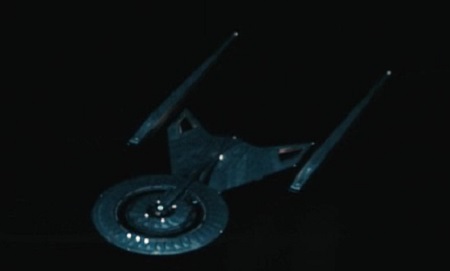
Nurse Ogawa learns of Sito’s death.

In Ten-Forward, Worf sits alone and doesn’t even acknowledge Ben, who has brought him a drink. Lavelle joins Taurik and Ogawa and reveals he’s been promoted to lieutenant, though he feels absolutely no joy in getting what he wanted at the beginning of the story. He’d trade it in a heartbeat to have Sito back.

Taurik, Ogawa, and Ben comfort him, telling him Sito would have been happy for him, and to honour her by performing his new role to the best of his ability. Ben talks to Worf, inviting him to join the others in mourning and remembering Sito, telling him that she considered him a friend, not just a superior officer. He joins Lavelle, Ogawa, Taurik, and Ben silently, and the episode ends as they prepare to remember their friend.

Worf joins the junior officers.

So that was it. The first Lower Decks. What started out as a story with an interesting premise turned into one of the emotional high points of the whole season. It’s a story which still has me tearing up a quarter of a century on, and despite the fact that we didn’t know Sito or her friends terribly well, the episode did a phenomenal job getting across their relationships, which were at the core of what made the story so emotional.

The new series may have its emotional moments too – we don’t know for sure yet, but many comedy shows have a balance between funny and emotional moments. I’m looking forward to seeing what Star Trek’s latest show, and first animated series in four decades, will have to offer, and it provided a great excuse to step back in time and re-watch the first Lower Decks.

If I were thinking of characters to bring back for a future iteration of Star Trek, the junior officers we met in Lower Decks would absolutely be contenders. I wonder if the new series will make any reference to them, or to the events of this episode. If it did, it would be a neat little tie-in between The Next Generation and the new Lower Decks.
It’s only a couple of days now, so I hope you’re ready! Check back here regularly while Lower Decks is on the air for episode reviews, theories, speculation, deep dives, and more.

Star Trek: Lower Decks begins on the 6th of August for viewers in the US and Canada. The Star Trek brand – including Lower Decks and The Next Generation – is the copyright of ViacomCBS. This article contains the thoughts and opinions of one person only and is not intended to cause any offence.